Other endocrine organs
1Why this matters
Ms. Okoro, 58, has had kidney disease for ten years. She is pale and gets breathless climbing one flight of stairs. Her red blood cell count is low, yet her bone marrow is healthy and she has plenty of iron. The missing piece is a hormone her kidneys used to make. Her kidneys, her heart, her fat and a gland deep in her brain all release hormones, even though most people never think of them as endocrine organs.
2What this builds on
3Quick check before you start
1. Where do long bones grow in length?
- At the epiphyseal plates, where cartilage cells divide and are replaced by bone
- At the periosteum, by adding bone to the outer surface
- In the medullary cavity, by filling it with new bone
Show the answer
Chondrocytes in the epiphyseal plate divide and are replaced by bone on the side toward the shaft, lengthening the bone. Adding bone at the surface makes it wider, not longer.
- Correct: At the epiphyseal plates, where cartilage cells divide and are replaced by bone:
- At the periosteum, by adding bone to the outer surface:
- In the medullary cavity, by filling it with new bone:
2. What does growth hormone do to bone growth, and through which other hormone does it mainly act?
- It slows growth, through calcitonin
- It drives growth at the epiphyseal plates, mainly through IGF-1
- It closes the epiphyseal plates, through thyroid hormones
Show the answer
Growth hormone makes the liver and other tissues release insulin-like growth factor 1 (IGF-1), which drives chondrocyte division at the plates.
- It slows growth, through calcitonin:
- Correct: It drives growth at the epiphyseal plates, mainly through IGF-1:
- It closes the epiphyseal plates, through thyroid hormones:
3. Where do the axons of the retina's ganglion cells cross over, partly, on their way to the brain?
- At the optic chiasm
- At the lateral geniculate nucleus
- In the primary visual cortex
Show the answer
The optic nerves meet at the optic chiasm, where fibers from the inner half of each retina cross to the other side.
- Correct: At the optic chiasm:
- At the lateral geniculate nucleus:
- In the primary visual cortex:
4Anatomy
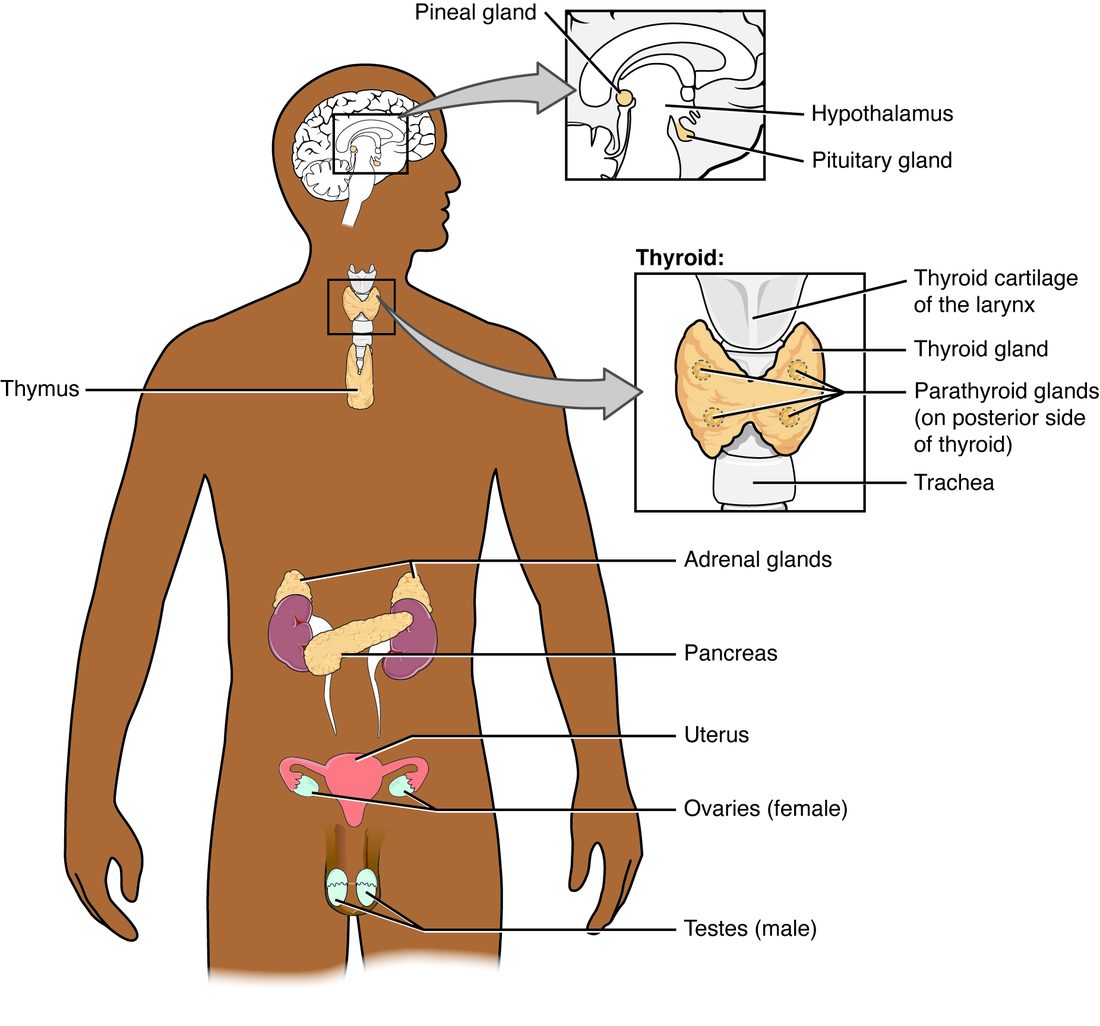
With labels hidden, select a box to reveal its label.
5How it works, step by step
- Blood loss or high altitude lowers the oxygen delivered to the kidney's tissue (hypoxia).Oxygen-sensing cells in the kidney switch on the erythropoietin gene and release EPO into the blood.
- EPO reaches the red bone marrow.More of the cells that make red blood cells survive and divide.
- More red blood cells enter the blood over days to weeks.Each liter of blood carries more oxygen, so oxygen delivery to the tissues rises.
- Oxygen delivery to the kidney rises back toward normal.EPO release falls back: negative feedback.
6Core concepts
7A common mistake
The wrong idea: Melatonin is a sleeping pill the brain makes; taking more of it at any time will make you sleep.
What actually happens: Melatonin is mainly a timing signal. The pineal gland releases it in darkness, under control of the suprachiasmatic nucleus, and it tells the body's clocks that it is night. Its direct sleep-promoting effect is modest. Taken at the right time, a small dose shifts the body clock, which helps jet lag and shift work; taken at the wrong time, it can shift the clock the wrong way.
8Check yourself
Anything you miss goes into your review queue.
1. A student scrolls on a bright phone in bed until 1 a.m. What happens to his melatonin while the screen is on?
- It rises with the eyes' effort
- It is suppressed
- It is unaffected by artificial light
- It rises as light passes through the skull
Show the answer
Light, especially blue-rich light, excites melanopsin-containing retinal ganglion cells, which signal the suprachiasmatic nucleus. The sympathetic drive to the pineal gland is shut off, so melatonin release falls. Evening light also shifts the body clock later.
- It rises with the eyes' effort: Visual effort does not drive the pineal gland. Light suppresses melatonin, whatever the eyes are looking at.
- Correct: It is suppressed: Correct. Light at the retina switches off melatonin release.
- It is unaffected by artificial light: Artificial light works through the same retinal cells as sunlight, though bright light has more effect than dim light.
- It rises as light passes through the skull: In humans, the pineal gland does not sense light itself. The signal comes from the retina through the SCN and a sympathetic pathway, and light lowers melatonin rather than raising it.
2. A patient receives two liters of saline by drip over an hour. His blood volume rises and his heart's upper chambers are stretched. Which response follows?
- More aldosterone, so his kidneys keep more of the sodium they filter
- Less ANP, so his vessels constrict
- More ANP, so his kidneys excrete more sodium and water
- More renin, so angiotensin II rises
Show the answer
Stretched muscle cells in the heart's upper chambers release atrial natriuretic peptide. ANP makes the kidneys filter more and reabsorb less sodium, lowers renin, aldosterone and ADH, and dilates vessels, so the extra volume is excreted: negative feedback.
- More aldosterone, so his kidneys keep more of the sodium they filter: ANP lowers aldosterone. Aldosterone would keep more sodium, raising volume further.
- Less ANP, so his vessels constrict: Stretch raises ANP release, not lowers it.
- Correct: More ANP, so his kidneys excrete more sodium and water: Correct. Stretch releases ANP, which lowers blood volume.
- More renin, so angiotensin II rises: Higher volume and ANP both lower renin release.
3. A runner from a coastal city moves to a training camp at 3,000 meters. Predict each variable first in the first day at altitude and then after six weeks there, compared with the day before.
| Variable | Change |
|---|---|
| Oxygen in her arterial blood, first day | — |
| EPO release from her kidneys, first day | — |
| Red blood cell count, first day | — |
| Red blood cell count, after six weeks | — |
| Oxygen carried per liter of her blood, after six weeks | — |
| EPO release, after six weeks compared with the first day | — |
Show the answer
At altitude the arterial blood carries less oxygen, and the kidneys respond within hours by releasing EPO. Red blood cells rise only over weeks. Once they have, the blood carries more oxygen, the kidney's oxygen supply improves, and EPO falls back.
- Oxygen in her arterial blood, first day: down. Each breath carries less oxygen at lower air pressure, so she is hypoxemic.
- EPO release from her kidneys, first day: up. Kidney cells sense less oxygen, and the oxygen-sensing protein survives and switches on the EPO gene within hours.
- Red blood cell count, first day: no change. EPO acts on the bone marrow, and new red blood cells take days to weeks to appear in large numbers.
- Red blood cell count, after six weeks: up. Weeks of raised EPO have increased red blood cell production.
- Oxygen carried per liter of her blood, after six weeks: up. More red blood cells in each liter carry more oxygen, partly offsetting the thin air.
- EPO release, after six weeks compared with the first day: down. The extra red blood cells deliver more oxygen to the kidney, so EPO release eases back toward normal: negative feedback.
4. Which person has hypoxia without hypoxemia?
- A climber at 5,000 meters
- A person with severe lung disease on room air
- A person breathing too slowly after an opioid overdose
- A person who has just lost a lot of blood
Show the answer
After a large bleed, the blood that remains is normally loaded with oxygen, so there is no hypoxemia. But there are too few red blood cells and too little flow, so the tissues receive too little oxygen: hypoxia.
- A climber at 5,000 meters: At altitude, each breath brings in less oxygen, so the arterial blood itself is low in oxygen: hypoxemia, with hypoxia.
- A person with severe lung disease on room air: Lung disease impairs loading oxygen into the blood, so the arterial blood is low in oxygen: hypoxemia.
- A person breathing too slowly after an opioid overdose: Breathing too slowly brings too little fresh air into the lungs, so arterial oxygen falls: hypoxemia.
- Correct: A person who has just lost a lot of blood: Correct. The blood is fully loaded but there is not enough of it reaching the tissues.
5. Most people with obesity have high blood leptin, yet they do not eat less. What best explains this?
- Their brains respond weakly to leptin
- Their fat cells release an inactive form of leptin
- Leptin stops acting on the brain after childhood
- High leptin increases hunger instead of lowering it
Show the answer
Leptin rises in proportion to fat stores, but in most obesity the hypothalamus responds weakly to it: leptin resistance. That is why giving more leptin helps only the rare people born unable to make it.
- Correct: Their brains respond weakly to leptin: Correct. This is leptin resistance.
- Their fat cells release an inactive form of leptin: The leptin is normal and active; the weak link is the brain's response to it.
- Leptin stops acting on the brain after childhood: Leptin acts in adults too: adults born without it stay severely hungry until they are treated with it.
- High leptin increases hunger instead of lowering it: High leptin signals that energy stores are full and normally lowers food intake. It does not reverse its own effect.
6. A 24-year-old man injects high doses of an anabolic steroid for six months. Predict the change in each variable compared with before he started.
| Variable | Change |
|---|---|
| LH and FSH from his anterior pituitary | — |
| Testosterone made by his own testes | — |
| Size of his testes | — |
| Sperm production | — |
| Skeletal muscle mass | — |
Show the answer
The drug builds muscle, but it also switches off his own reproductive axis by negative feedback. LH and FSH fall, so his testes shrink and make less testosterone and fewer sperm. After he stops, recovery can take months.
- LH and FSH from his anterior pituitary: down. High androgen feeds back on the hypothalamus and pituitary, cutting GnRH, LH and FSH.
- Testosterone made by his own testes: down. Without LH, his testes make little testosterone of their own.
- Size of his testes: down. Without LH and FSH, the testes are no longer driven and shrink.
- Sperm production: down. Sperm production needs FSH and a high testosterone level inside the testes, both of which fall.
- Skeletal muscle mass: up. The drug binds androgen receptor proteins in muscle and increases protein synthesis, causing hypertrophy.
7. A 28-year-old man is still growing taller, and X-rays show his epiphyseal plates are open. His testosterone is normal. Tests find he was born without aromatase, the enzyme that turns testosterone into estrogen. What does his case show?
- Testosterone by itself closes the epiphyseal plates in men
- Growth hormone, not sex hormones, closes the plates
- The plates close in women but stay open in men
- Estrogen, not testosterone, closes the epiphyseal plates
Show the answer
His testosterone is normal, yet his plates stay open. Without aromatase he makes almost no estrogen. So estrogen is the hormone that matures the plate cartilage and ends growth in length, in men as well as women.
- Testosterone by itself closes the epiphyseal plates in men: If testosterone closed the plates, his normal testosterone would have closed them by his late teens.
- Growth hormone, not sex hormones, closes the plates: Growth hormone drives growth at the plates; it does not close them.
- The plates close in women but stay open in men: Men's plates close too, normally by their early twenties, through estrogen made from testosterone. His stay open because he lacks that estrogen.
- Correct: Estrogen, not testosterone, closes the epiphyseal plates: Correct. Estrogen closes the plates in both sexes.
8. A student described how the body responds to a fall in oxygen delivery. One step is wrong. Which one?
- Less oxygen reaches the kidney's tissue
- Oxygen-sensing cells in the kidney switch on the EPO gene
- EPO travels in the blood to the liver, where red blood cells are made
- More red blood cells are produced and enter the blood
- Oxygen delivery rises, and EPO release falls back
Show the answer
In adults, red blood cells are made in the red bone marrow, and that is where EPO acts. The liver makes red blood cells only before birth.
- Less oxygen reaches the kidney's tissue: This step is right. The kidney's tissue oxygen tracks what the blood can deliver.
- Oxygen-sensing cells in the kidney switch on the EPO gene: This step is right. An oxygen-sensing protein that survives when oxygen is low switches on the EPO gene.
- Correct: EPO travels in the blood to the liver, where red blood cells are made: This is the error. EPO acts on the red bone marrow.
- More red blood cells are produced and enter the blood: This step is right. More red cells enter the blood over days to weeks.
- Oxygen delivery rises, and EPO release falls back: This step is right. Better oxygen delivery turns EPO back down: negative feedback.
9Summary
The pineal gland's pinealocytes release melatonin in darkness; light, detected by special retinal ganglion cells and relayed through the suprachiasmatic nucleus and a sympathetic pathway, switches it off. The suprachiasmatic nucleus is the master clock of your circadian rhythms, reset daily by light. The thymus, largest in childhood, releases thymosins that help white blood cells mature there. The testes make testosterone and the ovaries make estrogens and progesterone, the sex hormones. Stretch of the heart's upper chambers releases atrial natriuretic peptide, which makes the kidneys excrete sodium and water. Hypoxia, too little oxygen reaching tissues, makes the kidneys release erythropoietin, which raises red blood cell production; hypoxemia is low oxygen in the arterial blood. Fat releases leptin in proportion to its stores. Growth hormone, thyroid hormones and sex hormones control bone growth, and estrogen closes the epiphyseal plates in both sexes. Anabolic steroids, EPO and growth hormone are misused as performance-enhancing substances, and their harms follow from what each hormone does.