Why anatomy needs fixed directions
A paramedic radios ahead: "Deep cut on the left forearm, on the thumb side, just above the wrist." Is "above" toward the elbow or toward the fingers? That depends on whether the patient's arm is hanging down or raised overhead. Everyday words for direction shift with posture. Anatomical directional terms do not, because they are all defined from one agreed body posture: the anatomical position. This page teaches that position and the eight pairs of anatomical directional terms built on it.
The anatomical position
The anatomical position is the reference posture used to describe every location in the body. In it, a person:
- stands upright, facing forward, with the head level and the eyes looking straight ahead;
- has the feet flat on the floor, close together and pointing forward;
- has the arms hanging at the sides, with the palms turned forward and the thumbs pointing away from the body.
The palms are the detail students miss. Stand with your arms relaxed and your palms face your thighs. Turn them to face forward and the two bones of your forearm lie side by side, parallel, and your thumbs point outward. That is the reference.
The rule: every directional term describes the body as if it were in the anatomical position, whatever position it is really in. A patient lying on a stretcher, curled on one side or hanging upside down is still described as though standing in the anatomical position.
Figure 1 shows the anatomical position with the main directional terms marked on it.
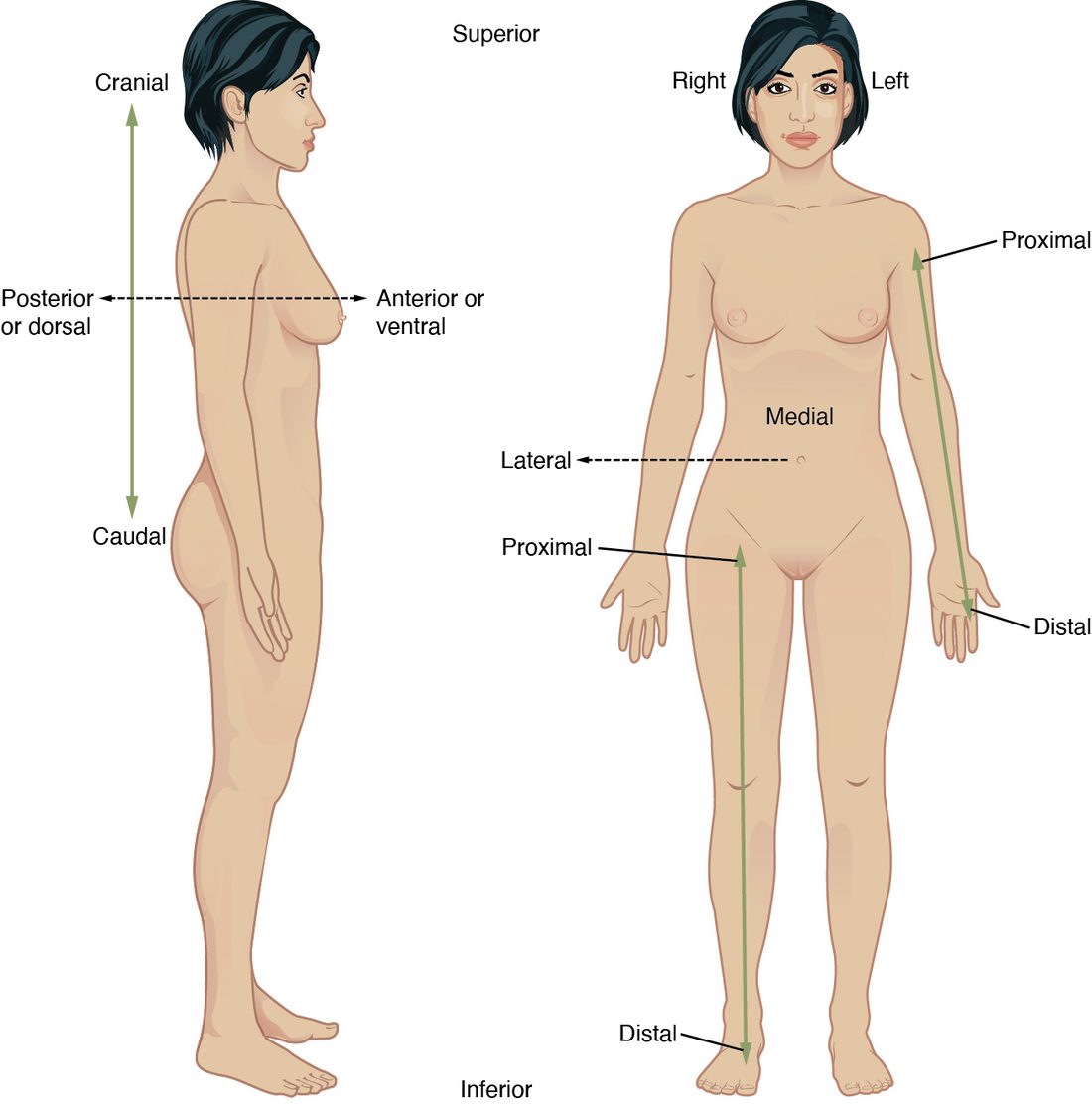
Right and left are the patient's
"Right" and "left" always mean the patient's own right and left, never yours. When you face a patient, their right hand is on your left. The front-view image in Figure 1 labels the woman's right side on the left of the page for this reason.
Lying down: supine and prone
Two terms describe a person lying flat:
- Supine (Latin supinus = lying on the back): lying face up. A trick for remembering it: supine, on your spine.
- Prone (Latin pronus = leaning forward): lying face down.
Supine and prone describe how the body is lying. They do not change what any directional term means. A supine patient's nose is still anterior to their ears, even though it points at the ceiling.
Directional terms always compare two things
Directional terms are relative. "The wrist is distal" means nothing on its own. "The wrist is distal to the elbow" gives an exact relationship. Each term below comes in a pair of opposites.
Superior and inferior (cranial and caudal)
Superior (Latin = higher) means toward the head, or above. Inferior (Latin = lower) means toward the feet, or below. Your nose is superior to your mouth. Your knees are inferior to your hips.
Cranial (crani/o = skull) means toward the head end of the body, and caudal (Latin cauda = tail) means toward the tail end, the lowest part of the trunk. In a standing human, cranial matches superior and caudal matches inferior, so the pairs are often used interchangeably for the trunk.
Anterior and posterior (ventral and dorsal)
Anterior (ante- = before) means toward the front of the body. Posterior (post- = after, behind) means toward the back. Your breastbone is anterior to your heart; your backbone is posterior to it.
Ventral (Latin venter = belly) means toward the belly side, and dorsal (Latin dorsum = back) means toward the back. In an upright human, ventral matches anterior and dorsal matches posterior.
Medial and lateral, and intermediate
Picture a vertical line running down the middle of the body from the top of the head, splitting it into equal right and left halves: the midline. Medial (Latin medius = middle) means closer to the midline. Lateral (Latin latus = side) means farther from the midline, toward the side. Your nose is medial to your eyes. Your ears are lateral to your eyes.
Intermediate means between a more medial structure and a more lateral one. Your eye is intermediate between your nose and your ear.
Here is where the palms matter. In the anatomical position the thumb points away from the body, so the thumb is lateral and the little finger is medial. On the forearm, the thumb side is the lateral side. Many students get this wrong because they picture their hands resting palms-in.
Proximal and distal
Proximal (Latin proximus = nearest) means closer to the point where a limb attaches to the trunk. Distal (Latin distare = to stand apart) means farther from that point. Your elbow is proximal to your wrist. Your toes are distal to your ankle.
Use proximal and distal on the limbs, not superior and inferior. Raise your arm overhead and your hand is now above your elbow, but it is still distal to it. Proximal and distal hold steady because they follow the limb itself.
The same pair also works along a tube, measured from where the tube starts. The part of the urethra nearest the urinary bladder is its proximal part; the end that opens to the outside is its distal part.
Superficial and deep
Superficial (Latin superficies = surface) means toward the body surface. Deep means away from the surface, farther inside. Your skin is superficial to your muscles; your bones are deep to your muscles. Figure 2 shows the layers of the thigh from outside in.
A stab wound that is "deep to the muscle" has passed through the skin, the fat and the muscle. The terms tell a clinician how many layers are involved.
Ipsilateral and contralateral
Ipsilateral (Latin ipse = same, latus = side) means on the same side of the body. Contralateral (contra- = opposite) means on the opposite side. Your right arm and right leg are ipsilateral. Your right arm and left leg are contralateral.
The pair matters in the nervous system. Most of the pathways between the brain and the body cross the midline. So damage to the right side of the brain, as in a stroke, weakens the contralateral side of the body: the left arm and leg.
All eight pairs side by side
| Pair | First term means | Opposite term means | Example |
|---|---|---|---|
| Superior / inferior | toward the head | toward the feet | The nose is superior to the mouth. |
| Cranial / caudal | toward the head end | toward the tail end | The chest is cranial to the abdomen. |
| Anterior / posterior | toward the front | toward the back | The breastbone is anterior to the heart. |
| Ventral / dorsal | toward the belly side | toward the back side | The navel is on the ventral surface. |
| Medial / lateral | toward the midline | away from the midline | The little finger is medial to the thumb. |
| Proximal / distal | nearer the limb's attachment | farther from it | The knee is proximal to the ankle. |
| Superficial / deep | toward the surface | away from the surface | Skin is superficial to muscle. |
| Ipsilateral / contralateral | on the same side | on the opposite side | The right hand and right foot are ipsilateral. |
Putting the terms together
Back to the paramedic. In anatomical terms: "a laceration on the lateral surface of the left forearm, just proximal to the wrist". Lateral fixes the thumb side, left is the patient's left, and proximal fixes the elbow direction. That description means the same thing to everyone who reads it, whether the patient is sitting, lying supine or waving an arm overhead. That shared meaning is the whole point of the anatomical position.