Anatomical position and directional terms
1Why this matters
A paramedic radios the hospital: "Deep cut on the left forearm, just above the wrist." The patient is lying on a stretcher with his arm across his chest. Is "above" toward the elbow or toward the fingers? The emergency team needs one answer. Anatomical directional terms give it, because they are all defined from one fixed reference posture.
2What this builds on
This is where the course starts. Nothing comes before it.
3Quick check before you start
1. In the term anatomy (ana- = apart, -tomy = cutting), what kind of word part is -tomy?
- A prefix
- A suffix
- A combining vowel
Show the answer
-tomy sits at the end of the term, so it is a suffix. A prefix sits at the front, as ana- does here.
- A prefix:
- Correct: A suffix:
- A combining vowel:
2. Which part of a medical term usually names the body part?
- The suffix
- The prefix
- The word root
Show the answer
The word root carries the core meaning, usually a body part, such as cardi (heart).
- The suffix:
- The prefix:
- Correct: The word root:
4Anatomy
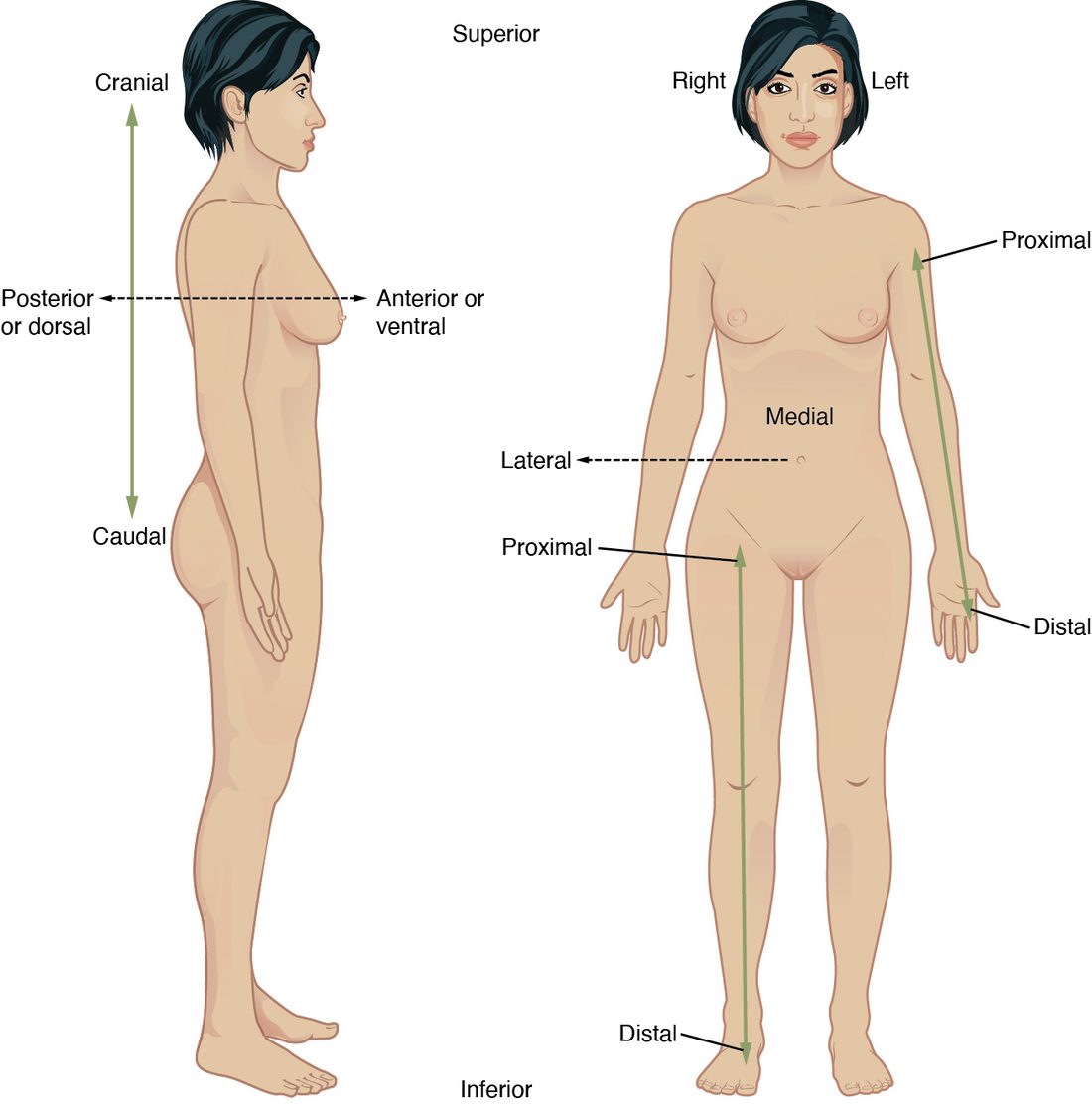
With labels hidden, select a box to reveal its label.
5How it works, step by step
- Everyone agrees to describe the body in one reference posture, the anatomical position.Each directional term gets one fixed meaning.
- Each term has a fixed meaning tied to that posture.A term describes where one structure lies relative to another, no matter how the person is actually lying or moving.
- A location is reported with those fixed terms, such as "lateral left forearm, proximal to the wrist".Every reader finds the same spot on the patient.
- Everyone finds the same spot.Wrong-side and wrong-site mistakes become less likely.
6Core concepts
7A common mistake
The wrong idea: When a patient lies down, the directional terms change: the front of a supine patient becomes superior.
What actually happens: Directional terms always describe the body as if it were standing in the anatomical position. A supine patient's chest is still anterior, and their feet are still inferior to their knees, whichever way they face. Supine and prone only describe how the body is lying.
8Check yourself
Anything you miss goes into your review queue.
1. In the anatomical position, which way do the palms face?
- Toward the thighs
- Forward
- Backward
- Toward the midline, thumbs forward
Show the answer
In the anatomical position the arms hang at the sides with the palms facing forward and the thumbs pointing away from the body.
- Toward the thighs: Palms toward the thighs is how most people stand when relaxed, but it is not the anatomical position.
- Correct: Forward: Correct. Palms forward, thumbs pointing away from the body.
- Backward: Palms backward turns the thumbs toward the body, the opposite of the reference posture.
- Toward the midline, thumbs forward: Palms toward the midline is the relaxed resting posture. The anatomical position turns the palms fully forward.
2. In the anatomical position, how is the thumb described relative to the little finger?
- Medial
- Proximal
- Deep
- Lateral
Show the answer
With the palms forward, the thumb points away from the body, so it lies farther from the midline than the little finger. The thumb is lateral.
- Medial: The thumb is medial only if you picture the palms turned backward or in. In the anatomical position the palms face forward, so the little finger is the medial one.
- Proximal: Proximal and distal compare distance from the limb's attachment. The thumb and little finger are at about the same distance from the shoulder.
- Deep: Deep compares distance from the surface. Both fingers are at the surface of the hand.
- Correct: Lateral: Correct. Palms forward puts the thumb on the lateral side.
3. Where does the breastbone lie relative to the heart?
- Anterior
- Posterior
- Lateral
- Inferior
Show the answer
The breastbone sits at the front of the chest, in front of the heart. Toward the front is anterior.
- Correct: Anterior: Correct. The breastbone is anterior to the heart.
- Posterior: Posterior means behind. The backbone, not the breastbone, is posterior to the heart.
- Lateral: The breastbone lies on the midline, directly in front of the heart. Neither is to the side of the other.
- Inferior: The breastbone runs along the front of the chest at the level of the heart, not below it.
4. A 71-year-old man has a stroke that damages the right side of his brain. Most pathways between the brain and the body cross the midline. Where would you expect weakness?
- In the right arm and leg
- In the left arm and leg
- In both legs only
- In the face only, on the right
Show the answer
Because most brain-body pathways cross the midline, damage on one side of the brain affects the opposite side of the body. The weakness is contralateral: the left arm and leg.
- In the right arm and leg: Weakness on the same side would be ipsilateral. That would happen only if the pathways stayed on one side, and most cross.
- Correct: In the left arm and leg: Correct. Right-sided brain damage, left-sided (contralateral) weakness.
- In both legs only: Damage to one side of the brain affects one side of the body, not both legs.
- In the face only, on the right: The face on the same side would be ipsilateral, and the arm and leg would be spared. That does not fit crossing pathways.
5. A patient lies supine on a stretcher. Which statement about her is correct?
- Her chest is now superior because it faces the ceiling
- Her face is still anterior to her ears
- Her feet are now posterior to her knees
- Her back is now inferior to her chest
Show the answer
Directional terms always describe the body as if it stood in the anatomical position. Lying down changes nothing: the face is still anterior to the ears.
- Her chest is now superior because it faces the ceiling: Superior means toward the head, not toward the ceiling. Her chest is still anterior.
- Correct: Her face is still anterior to her ears: Correct. Directional terms do not change when the body lies down.
- Her feet are now posterior to her knees: Her feet are still inferior (and distal) to her knees. Lying down does not make them posterior.
- Her back is now inferior to her chest: Her back is still posterior to her chest. Inferior means toward the feet, not toward the mattress.
6. A student raises an arm straight overhead and says, "Now my hand is superior to my elbow, so it is proximal." What is the error?
- The hand is still distal to the elbow in every posture
- The hand becomes proximal only when the elbow is bent
- Proximal and distal are used only on the trunk
- The hand is lateral, not proximal
Show the answer
Proximal and distal measure distance along the limb from where it attaches to the trunk. The hand is farther from the shoulder than the elbow in every posture, so it is always distal to the elbow. Terms are also read from the anatomical position, not from a raised arm.
- Correct: The hand is still distal to the elbow in every posture: Correct. The hand is always distal to the elbow.
- The hand becomes proximal only when the elbow is bent: Bending the elbow does not change the order along the limb. The hand stays farther from the shoulder than the elbow, so it stays distal.
- Proximal and distal are used only on the trunk: Proximal and distal are used mainly on the limbs, the opposite of this claim.
- The hand is lateral, not proximal: Lateral compares distance from the midline, which is not the student's mistake. The mistake is about proximal and distal.
7. An EMT reports "a laceration on the lateral left forearm, just proximal to the wrist." Where is the wound?
- On the thumb side of the left forearm, a little toward the elbow from the wrist
- On the little-finger side of the left forearm, just below the elbow
- On the thumb side of the right forearm, on the back of the hand
- On the little-finger side of the left forearm, toward the fingers from the wrist
Show the answer
Lateral on the forearm is the thumb side (palms forward). Left is the patient's left. Just proximal to the wrist means slightly toward the elbow from the wrist.
- Correct: On the thumb side of the left forearm, a little toward the elbow from the wrist: Correct. Thumb side, left arm, slightly toward the elbow from the wrist.
- On the little-finger side of the left forearm, just below the elbow: The little-finger side is medial, not lateral, and "just proximal to the wrist" is near the wrist, not the elbow.
- On the thumb side of the right forearm, on the back of the hand: The report says the left forearm, and the patient's left is meant. The back of the hand is distal to the wrist.
- On the little-finger side of the left forearm, toward the fingers from the wrist: The little-finger side is medial, and toward the fingers from the wrist is distal, not proximal.
9Summary
The anatomical position is standing upright, facing forward, feet flat and forward, arms at the sides with palms forward. Every directional term describes the body as if it were in this posture, and right and left are the patient's own. Supine is face up and prone is face down. The paired terms compare two structures: superior and inferior (cranial and caudal), anterior and posterior (ventral and dorsal), medial and lateral (with intermediate between), proximal and distal on the limbs, superficial and deep, and ipsilateral and contralateral. In the anatomical position the thumb is lateral.