Body regions and abdominal quadrants
1Why this matters
Jordan, 19, woke up with a dull ache around his navel. By evening the pain has moved low on his right side, and it is sharp when he coughs or walks. The triage nurse writes "periumbilical pain moving to the right lower quadrant". That one line points the whole team toward his appendix.
2What this builds on
3Quick check before you start
1. Which plane divides the body into right and left parts?
- Transverse plane
- Sagittal plane
- Frontal plane
Show the answer
The sagittal plane divides right from left. The midsagittal plane makes equal halves. The transverse plane divides upper from lower, and the frontal plane divides front from back.
- Transverse plane:
- Correct: Sagittal plane:
- Frontal plane:
2. Which cavity holds the stomach, liver and intestines?
- Thoracic cavity
- Dorsal body cavity
- Abdominopelvic cavity
Show the answer
The abdominopelvic cavity lies below the diaphragm and holds the abdominal organs. The thoracic cavity is above the diaphragm, and the dorsal body cavity holds the brain and spinal cord.
- Thoracic cavity:
- Dorsal body cavity:
- Correct: Abdominopelvic cavity:
3. When you face a patient, where is the patient's right side?
- On your left
- On your right
- It depends on whether the patient is supine
Show the answer
Right and left always mean the patient's own sides. Facing the patient, their right is on your left, whether they are standing or lying down.
- Correct: On your left:
- On your right:
- It depends on whether the patient is supine:
4Anatomy
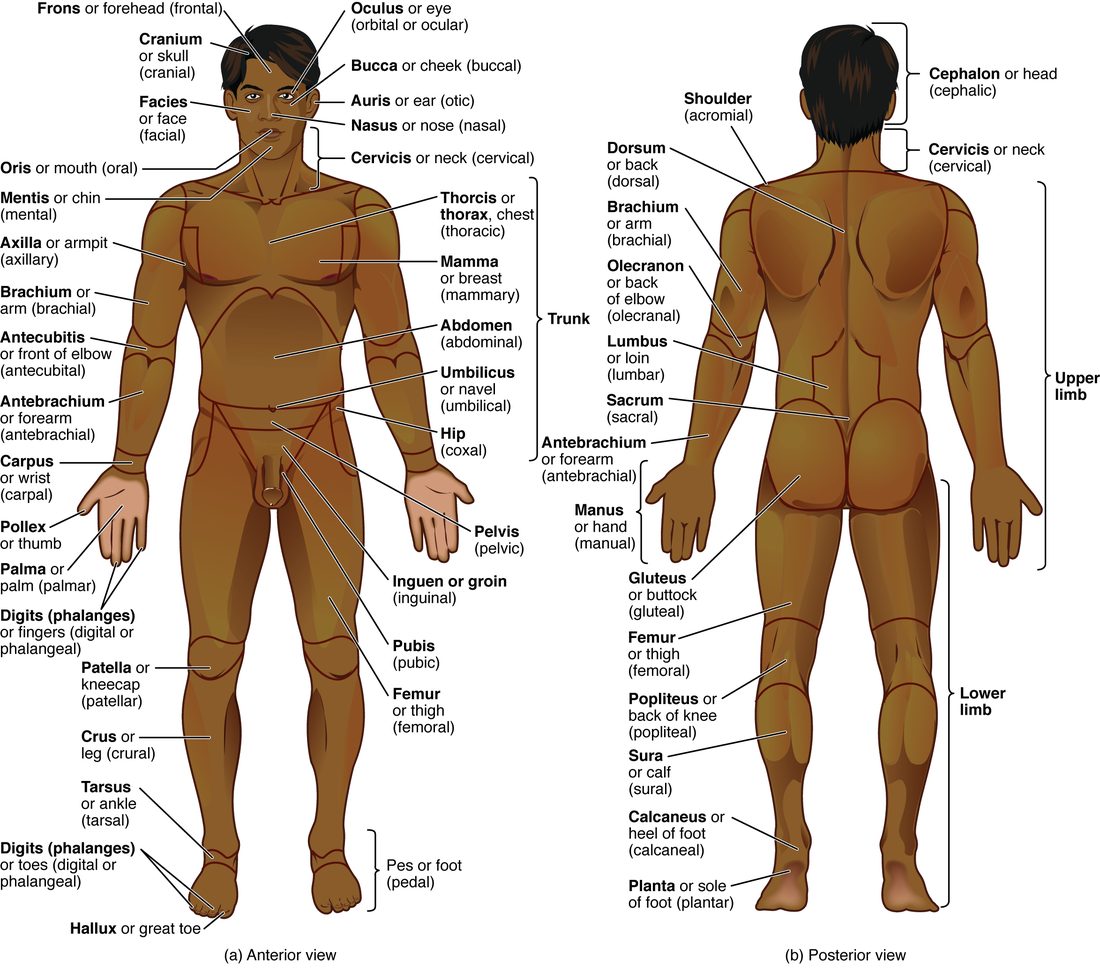
With labels hidden, select a box to reveal its label.
5How it works, step by step
- A clinician draws a midsagittal line and a transverse line through the navel.The abdomen is split into four quadrants, named by the patient's own right and left.
- Each quadrant lies over a predictable set of organs.The site of pain, swelling or a wound narrows the list of organs that could be involved.
- A problem inflames the parietal layer of the peritoneum on the abdominal wall.Pain becomes sharp and fixed at that spot, so the patient can point to one quadrant.
- The team records that quadrant in shared terms.Everyone examines, images and operates on the same place.
6Core concepts
7A common mistake
The wrong idea: In anatomy, the arm is the whole upper limb and the leg is the whole lower limb.
What actually happens: Anatomically, the arm is only the part from the shoulder to the elbow (the brachial region), and the forearm is from the elbow to the wrist (the antebrachial region). The leg is only the part from the knee to the ankle (the crural region); the thigh, from hip to knee, is the femoral region. A report of a fractured leg means a break below the knee.
8Check yourself
Anything you miss goes into your review queue.
1. In anatomical terms, what does the leg (the crural region) include?
- The whole lower limb, from hip to toes
- Only the part from the hip to the knee
- Only the part from the knee to the ankle
- Only the foot and ankle
Show the answer
Anatomically, the leg is only the segment between the knee and the ankle, the crural region (crus = leg). The thigh, from hip to knee, is the femoral region.
- The whole lower limb, from hip to toes: That is the everyday meaning. In anatomy the whole limb is the lower limb, and the leg is one segment of it.
- Only the part from the hip to the knee: The part from the hip to the knee is the thigh, the femoral region.
- Correct: Only the part from the knee to the ankle: Correct. Leg means knee to ankle.
- Only the foot and ankle: The ankle is the tarsal region and the foot is the pedal region. Neither is the leg.
2. A phlebotomist draws blood from a vein at the front of the elbow, in the crease where the elbow bends. Which region is this?
- Antebrachial
- Popliteal
- Axillary
- Antecubital
Show the answer
The antecubital region (ante- = in front of, cubitus = elbow) is the front of the elbow. Large veins lie just under the skin there, which is why it is the usual site for drawing blood.
- Antebrachial: Antebrachial is the forearm, from elbow to wrist, not the crease of the elbow itself.
- Popliteal: Popliteal is the hollow behind the knee, in the lower limb, not the elbow.
- Axillary: Axillary is the armpit.
- Correct: Antecubital: Correct. Front of the elbow is antecubital.
3. Jordan, 19, has pain that began around his navel and has moved low on his right side. It is sharp when he coughs. Which quadrant should the nurse record?
- Left lower quadrant
- Right upper quadrant
- Left upper quadrant
- Right lower quadrant
Show the answer
Low on the patient's right side, below the transverse line through the navel and to the right of the midline, is the right lower quadrant. It holds the appendix.
- Left lower quadrant: The left lower quadrant is on the patient's left. The pain is on his right.
- Right upper quadrant: The right upper quadrant is above the navel, over most of the liver and the gallbladder. His pain is low.
- Left upper quadrant: The left upper quadrant is on the left and above the navel, over the stomach and spleen.
- Correct: Right lower quadrant: Correct. Low and right: right lower quadrant.
4. Which abdominopelvic region lies over the stomach, in the upper middle of the abdomen?
- Hypogastric
- Epigastric
- Umbilical
- Left lumbar
Show the answer
Epigastric (epi- = upon, over; gastr/o = stomach) means over the stomach. It is the upper middle square of the nine-region grid.
- Hypogastric: Hypogastric (hypo- = below) means below the stomach, the lower middle square.
- Correct: Epigastric: Correct. Epi- over, gastr stomach.
- Umbilical: Umbilical is the center square, around the navel.
- Left lumbar: The left lumbar region is on the left side of the middle row.
5. Early in appendicitis, pain is often felt around the navel even though the appendix lies low on the right. What explains this?
- The appendix lies in the umbilical region at first
- Organ-wall pain is vague and felt near the midline
- The navel is where the four quadrant lines cross
- The appendix moves from the left to the right side
Show the answer
Early on, the swollen appendix stretches, and pain signals from an organ's wall are poorly placed by the brain. They are felt near the midline, around the navel. Later, when the inflamed appendix irritates the parietal layer of the peritoneum on the abdominal wall, the pain becomes sharp and fixed in the right lower quadrant.
- The appendix lies in the umbilical region at first: The appendix stays in the right lower quadrant (right iliac region). Its position does not change; where the pain is felt does.
- Correct: Organ-wall pain is vague and felt near the midline: Correct. Organ-wall pain is vague and felt centrally; pain from the lining of the wall is precise.
- The navel is where the four quadrant lines cross: The crossing point of the lines is a drawing convention. It has no effect on where pain is felt.
- The appendix moves from the left to the right side: The appendix does not move from side to side. It is attached on the right.
6. A clinician wants to place a patient's pain more exactly than a quadrant allows. Which system should she use?
- The four abdominal quadrants
- The dorsal and ventral body cavities
- The nine abdominopelvic regions
- The three main body planes
Show the answer
The nine abdominopelvic regions divide the abdomen into smaller areas than the four quadrants, so they place a finding more exactly.
- The four abdominal quadrants: The quadrants are what she wants to improve on. Each covers a quarter of the abdomen.
- The dorsal and ventral body cavities: The body cavities name internal spaces, not areas of the abdominal surface.
- Correct: The nine abdominopelvic regions: Correct. Nine smaller areas give finer location.
- The three main body planes: The planes are used to draw the grid lines, but they do not name areas on their own.
9Summary
Regional terms name areas of the body surface in the anatomical position, most from Latin or Greek roots: cephalic (head), cervical (neck), thoracic (chest), lumbar (lower back), brachial (arm, shoulder to elbow), antebrachial (forearm), femoral (thigh) and crural (leg, knee to ankle). Two lines through the navel, one midsagittal and one transverse, divide the abdomen into four quadrants: right upper, left upper, right lower and left lower, named for the patient's own sides. Two vertical and two horizontal lines divide it more finely into nine abdominopelvic regions: right and left hypochondriac with the epigastric between them, right and left lumbar with the umbilical between them, and right and left iliac with the hypogastric between them. Clinicians use quadrants for quick description and the nine regions for more exact location.