How muscles move bones
1Why this matters
Jordan, 34, feels a pop at the front of his elbow while lifting a heavy box. A bulge appears high on his upper arm. He can still bend his elbow, but it is weak, and turning a screwdriver palm-up is hard. The tendon that attaches the main elbow-bending muscle to his forearm has torn away from the bone, and his other elbow flexors are now doing all the work.
2What this builds on
3Quick check before you start
1. Bending your elbow so your hand moves toward your shoulder is which movement?
- Extension
- Flexion
- Abduction
Show the answer
Flexion decreases the angle between two bones at a joint. Bending the elbow brings the forearm toward the upper arm, which is flexion. Extension straightens the joint, and abduction moves a part away from the midline.
- Extension:
- Correct: Flexion:
- Abduction:
2. What attaches a skeletal muscle to a bone?
- A ligament
- A tendon
- A bursa
Show the answer
Tendons are cords of dense regular connective tissue that attach muscle to bone. Ligaments join bone to bone, and a bursa is a fluid-filled sac that cushions where parts rub.
- A ligament:
- Correct: A tendon:
- A bursa:
3. What is a fascicle in a skeletal muscle?
- A single muscle fiber
- A bundle of muscle fibers wrapped in perimysium
- The whole muscle wrapped in epimysium
Show the answer
A fascicle is a bundle of muscle fibers surrounded by perimysium. Each fiber inside has its own endomysium, and the epimysium wraps the whole muscle.
- A single muscle fiber:
- Correct: A bundle of muscle fibers wrapped in perimysium:
- The whole muscle wrapped in epimysium:
4Anatomy
With labels hidden, select a box to reveal its label.
5How it works, step by step
- Motor neurons signal the fibers of the prime mover.The fibers shorten and pull on their endomysium, perimysium and epimysium.
- The connective tissue wrappings merge into the tendon.The tendon pulls on the bones at both ends of the muscle.
- Fixators and the body's own weight hold the origin's bone still.Only the insertion's bone moves, pulled toward the origin.
- The moving bone turns about the joint, a lever with the joint as its fulcrum.With the insertion close to the joint (a third-class lever), the far end of the bone moves far and fast, while the muscle pulls several times harder than the load.
- To reverse the movement, the antagonist on the other side of the joint contracts.It pulls the bone back, since the first muscle cannot push.
6Core concepts
7A common mistake
The wrong idea: Muscles can push as well as pull, so one muscle can both bend and straighten a joint.
What actually happens: A muscle fiber can only shorten and pull. When it stops, it simply stops pulling. Straightening a bent elbow takes a different muscle on the other side of the joint (the antagonist), or gravity. That is why muscles are arranged in opposing sets across every joint that moves both ways.
8Check yourself
Anything you miss goes into your review queue.
1. Name the pinned part of this spindle-shaped muscle.
- Origin
- Belly
- Insertion
- Aponeurosis
Show the answer
The belly is the thick, fleshy middle of a muscle, between the tendons that run to its origin and insertion.
- Origin: The origin is the attachment that stays still, at one end of the muscle, not its fleshy middle.
- Correct: Belly: Correct. The fleshy middle part of the muscle is its belly.
- Insertion: The insertion is the attachment on the bone that moves, at the other end of the muscle.
- Aponeurosis: An aponeurosis is a flat sheet of dense connective tissue that attaches some muscles. It is not the fleshy middle.
2. You bend your elbow to lift a cup. The large muscle on the front of your upper arm attaches to the scapula above and to the radius below. Which statement is correct?
- The scapula attachment is the insertion
- The radius attachment is the origin
- Both attachments are origins
- The radius attachment is the insertion
Show the answer
The insertion is the attachment on the bone that moves. When you lift the cup, the forearm (with the radius) swings up while the scapula stays put, so the radius attachment is the insertion and the scapula attachment is the origin.
- The scapula attachment is the insertion: The scapula stays still while the forearm moves, which makes the scapula attachment the origin. Being higher does not decide it.
- The radius attachment is the origin: The origin is the stable attachment. The radius moves when you lift the cup, so its attachment is the insertion.
- Both attachments are origins: A muscle has an origin at the stable end and an insertion at the moving end, not two origins. (Some muscles have several heads at their origin, but they still have an insertion.)
- Correct: The radius attachment is the insertion: Correct. The radius moves, so that attachment is the insertion.
3. Which statements about the roles muscles take in a movement are correct? Select all that apply.
- The prime mover is also called the agonist
- A synergist helps the prime mover or steadies the movement
- A fixator holds a bone still so the prime mover has a stable base
- An antagonist makes the same movement as the prime mover
- A muscle keeps the same role in every movement it takes part in
Show the answer
The prime mover (agonist) does most of the work, synergists help or steady it, fixators hold the base still, and the antagonist makes the opposite movement. Roles belong to movements: the same muscle can be an antagonist in one movement and the prime mover in the next.
- Correct: The prime mover is also called the agonist: Correct. Prime mover and agonist are two names for the muscle most responsible for a movement.
- Correct: A synergist helps the prime mover or steadies the movement: Correct. Synergists add force to the same movement or keep it moving in the right direction.
- Correct: A fixator holds a bone still so the prime mover has a stable base: Correct. A fixator is a kind of synergist that stabilizes the bone the prime mover pulls from.
- An antagonist makes the same movement as the prime mover: Incorrect. An antagonist makes the opposite movement; it relaxes and lengthens, often braking, while the prime mover contracts.
- A muscle keeps the same role in every movement it takes part in: Incorrect. The muscle on the back of the arm is the antagonist when you bend the elbow and the prime mover when you straighten it.
4. You tip your head back to look at the ceiling. The skull pivots on the atlanto-occipital joint, the weight of the face is in front of the joint, and muscles pull down on the back of the skull behind it. Which lever class is this?
- Second class
- Third class
- First class
- It is not a lever
Show the answer
The joint (fulcrum) sits between the effort at the back of the skull and the load of the face in front. A fulcrum in the middle makes a first-class lever, like a seesaw.
- Second class: In a second-class lever the load sits in the middle, between the fulcrum and the effort. Here the joint is in the middle.
- Third class: In a third-class lever the effort sits in the middle. Here the muscles pull behind the joint, not between the joint and the face.
- Correct: First class: Correct. Fulcrum in the middle makes a first-class lever.
- It is not a lever: The skull is a rigid bar turning about a joint under a muscle's pull, which is exactly what a lever is.
5. A muscle inserts 5 cm from a joint and holds a 20-newton load 30 cm from that joint, with the bone still. Ignoring the weight of the bone, how hard must the muscle pull?
- About 3 newtons
- 20 newtons
- 120 newtons
- 600 newtons
Show the answer
At balance, effort × effort arm = load × load arm. Effort × 5 cm = 20 N × 30 cm = 600 N·cm, so effort = 600 ÷ 5 = 120 N. The muscle pulls six times the load, because its effort arm is one sixth as long as the load arm.
- About 3 newtons: About 3 N would come from dividing the load by the six-fold ratio. With the effort arm shorter than the load arm, the muscle must pull more than the load, not less.
- 20 newtons: Pulling with the same force as the load would balance only if both arms were the same length.
- Correct: 120 newtons: Correct. 20 N × 30 cm ÷ 5 cm = 120 N.
- 600 newtons: 600 is the product of the load and its arm (600 N·cm). It still has to be divided by the 5-cm effort arm.
6. Two muscles have the same volume. One is pennate with short, angled fibers; the other is parallel with long fibers. Which comparison is correct?
- The pennate muscle produces more force; the parallel muscle shortens farther
- The parallel muscle produces more force; the pennate muscle shortens farther
- They produce the same force because their volume is the same
- The pennate muscle both produces more force and shortens farther
Show the answer
Short, angled fibers let more fibers pack side by side into the pennate muscle, so more cross-bridges pull at once and it is stronger. Long parallel fibers have more sarcomeres in series, so the parallel muscle shortens a longer distance, faster.
- Correct: The pennate muscle produces more force; the parallel muscle shortens farther: Correct. Pennate means more force; parallel means more range and speed.
- The parallel muscle produces more force; the pennate muscle shortens farther: This reverses both effects. More fibers side by side gives the pennate muscle more force; longer fibers give the parallel muscle more range.
- They produce the same force because their volume is the same: Force depends on how many fibers pull side by side, not on volume alone. The pennate muscle fits more fibers into the same volume.
- The pennate muscle both produces more force and shortens farther: Short fibers cannot shorten as far as long ones. The pennate muscle gives up range to gain force.
7. Decode the name flexor pollicis longus: flexor = bends a joint; pollicis = ____; longus = long.
- Of the thumb
- Of the smallest finger
- Of the chest
- With two heads
Show the answer
Pollex is Latin for thumb, and pollicis means "of the thumb". Flexor pollicis longus is the long muscle that flexes the thumb.
- Correct: Of the thumb: Correct. Pollicis means of the thumb.
- Of the smallest finger: The smallest finger is digiti minimi, as in abductor digiti minimi.
- Of the chest: The chest is pectoral-.
- With two heads: Two heads is biceps (-ceps = heads).
9Summary
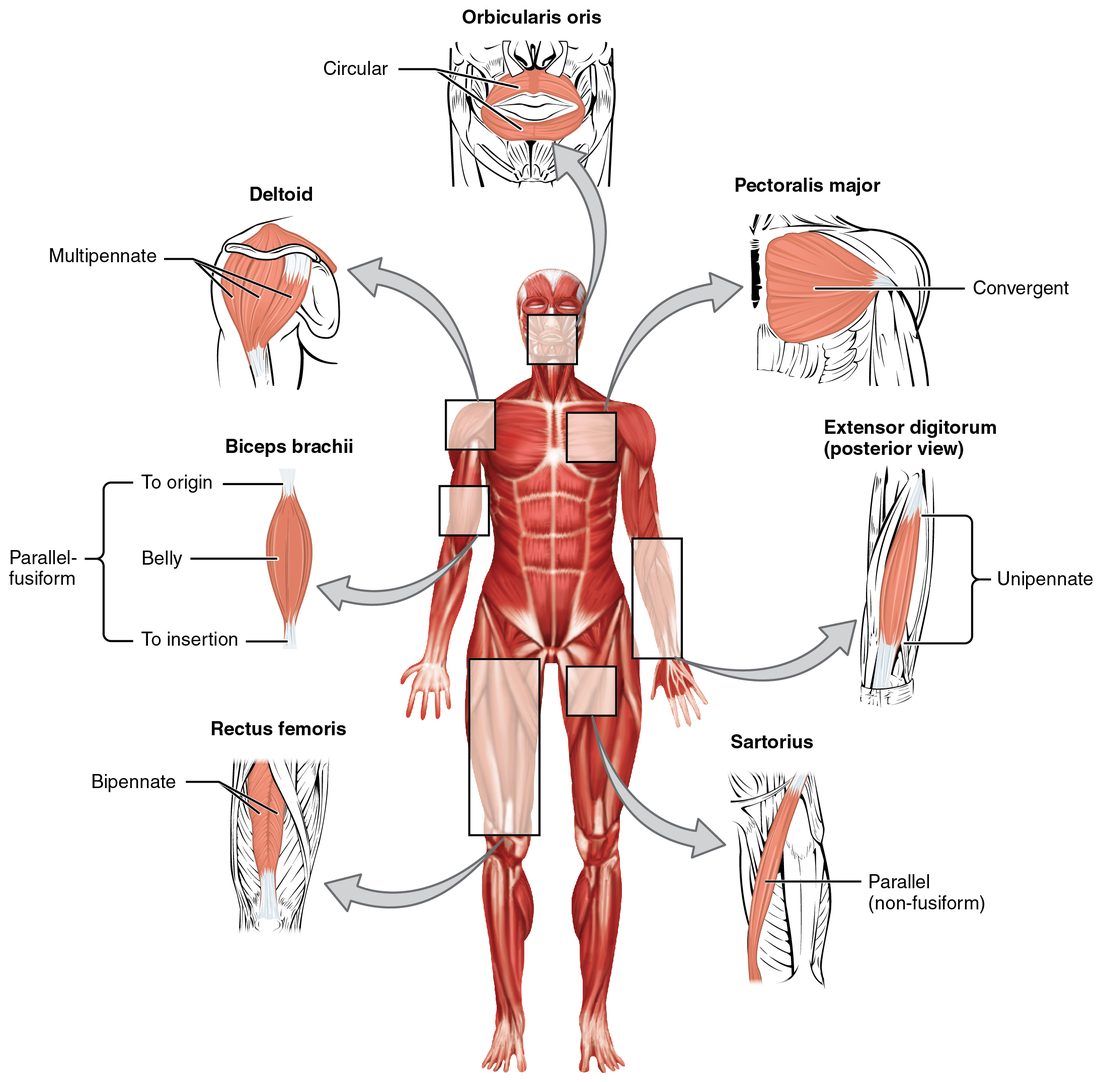
Muscles only pull. Each pulls its insertion, on the bone that moves, toward its origin, on the bone that stays still. In a movement, the prime mover (agonist) does most of the work, synergists help, fixators steady the base and the antagonist makes the opposite movement. Bones are levers turning about joints: the fulcrum is in the middle of a first-class lever, the load in a second-class and the effort in a third-class lever. Most body levers are third-class, trading force for speed and range. Fascicles can be parallel, convergent, pennate or circular: pennate muscles are stronger for their size, parallel muscles shorten farther. Muscle names describe location, shape, size, fascicle direction, number of heads, attachments and action.