Atoms, ions and chemical bonds
1Why this matters
Dana, 34, runs a marathon on a hot day and drinks plain water at every station. At the finish she is confused and vomiting. Her blood test shows sodium far below its normal range. The sodium on that report is not the metal: it is the sodium ion, a sodium atom that has lost one electron. That single missing electron gives it a charge, and the charge is why its level matters.
2What this builds on
3Quick check before you start
1. Which is the smallest level of organization in your body?
- The cellular level
- The tissue level
- The chemical level
Show the answer
The chemical level, atoms and the molecules they form, is the base that cells, tissues and organs are built from.
- The cellular level:
- The tissue level:
- Correct: The chemical level:
2. What is a molecule?
- Two or more atoms joined together
- A single cell
- A group of similar cells
Show the answer
A molecule is two or more atoms joined together. Cells are built from enormous numbers of molecules.
- Correct: Two or more atoms joined together:
- A single cell:
- A group of similar cells:
4Anatomy
With labels hidden, select a box to reveal its label.
5How it works, step by step
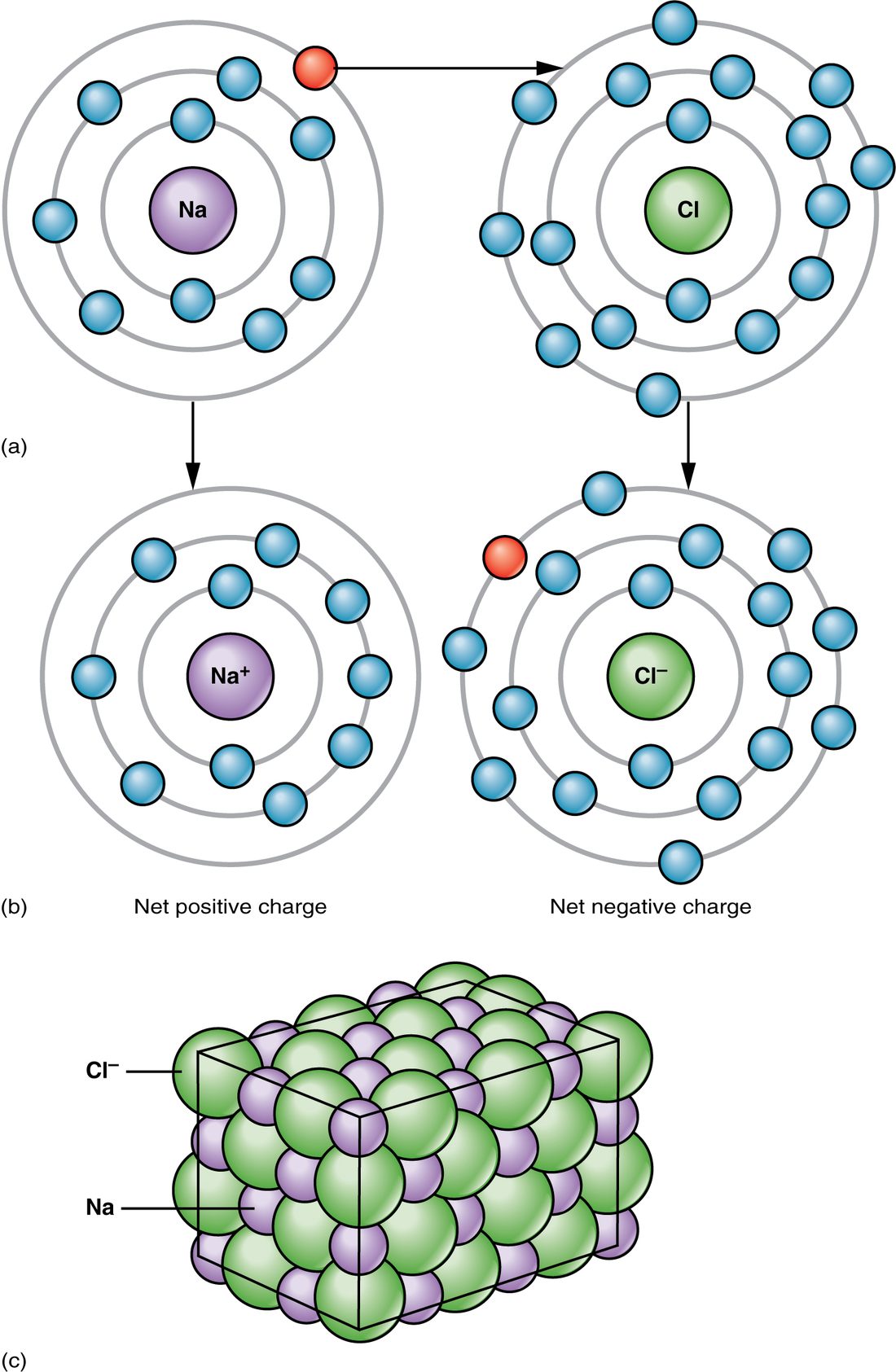
- A sodium atom has one electron in its valence shell, and a chlorine atom has seven.Sodium's lone valence electron moves to chlorine, leaving each atom with a full valence shell.
- Sodium now has 11 protons but 10 electrons, and chlorine has 17 protons but 18 electrons.Sodium becomes the cation Na+ and chlorine becomes the anion Cl−.
- Opposite charges attract.Na+ and Cl− are held together by ionic bonds, and many of them stack into a crystal of sodium chloride.
- The crystal enters water, whose polar molecules carry partial charges that attract each ion.Water pulls the ions apart, so Na+ and Cl− spread through the water as separate, free ions.
- Free ions carry electric charge through the water around and inside your cells.Sodium and chloride act as electrolytes: the charged particles a blood test measures and your nervous system, muscles and heart depend on.
6Core concepts
7A common mistake
The wrong idea: An ion forms when an atom gains or loses protons.
What actually happens: Ions form when an atom gains or loses electrons. The number of protons defines the element, so if protons changed, sodium would stop being sodium. Na+ still has 11 protons, like every sodium atom; it has one fewer electron than a neutral sodium atom, which leaves one proton's worth of charge unbalanced.
8Check yourself
Anything you miss goes into your review queue.
1. A potassium atom has 19 protons and 19 electrons. The potassium found inside your cells has 19 protons and 18 electrons. What is it?
- An anion with a charge of −1
- A cation with a charge of +1
- A neutral atom of a different element
- An isotope of potassium with one fewer neutron
Show the answer
Charge is protons minus electrons: +19 − 18 = +1. A positive ion is a cation, written K+. The proton count still says potassium.
- An anion with a charge of −1: An anion has more electrons than protons. This particle has one fewer electron than protons, so its net charge is positive, not negative.
- Correct: A cation with a charge of +1: Correct. One more proton than electrons gives a +1 charge, and a positively charged ion is a cation: K+.
- A neutral atom of a different element: The element is fixed by the number of protons. It is still 19, so this is still potassium, and with unequal protons and electrons it is not neutral.
- An isotope of potassium with one fewer neutron: Isotopes differ in neutrons, and the question describes a change in electrons. Losing an electron changes charge, not mass number.
2. Carbon-12 and carbon-14 are isotopes of carbon. What is different between an atom of each?
- The number of protons in the nucleus
- The number of electrons in a neutral atom
- The element they belong to
- The number of neutrons in the nucleus
Show the answer
Isotopes have the same number of protons and different numbers of neutrons. Carbon-12 has 6 neutrons; carbon-14 has 8. The mass number changes, the element does not.
- The number of protons in the nucleus: Both have 6 protons. The proton count is the atomic number, and it is what makes both of them carbon.
- The number of electrons in a neutral atom: A neutral atom has as many electrons as protons. Both have 6 protons, so both neutral atoms have 6 electrons.
- The element they belong to: Both are carbon, because both have 6 protons. Isotopes are versions of one element.
- Correct: The number of neutrons in the nucleus: Correct. Mass number is protons plus neutrons: 6 + 6 = 12 and 6 + 8 = 14.
3. Mr. Reyes, 70, has a low blood potassium level. His nurse adds potassium chloride (KCl) to his IV fluid. Once it is in his blood, in what form is the potassium?
- As whole KCl units, each held together by a covalent bond
- As neutral potassium atoms that have picked up an electron from the water
- As small crystals of KCl carried along in the blood
- As K+ ions, separated from the Cl− ions and surrounded by water
Show the answer
KCl is held together by ionic bonds, which are weak in water. Water separates the ions, so the potassium circulates as free K+ ions and the chloride as free Cl− ions.
- As whole KCl units, each held together by a covalent bond: KCl is ionic, not covalent: potassium transferred an electron to chlorine rather than sharing one. In water the ions separate.
- As neutral potassium atoms that have picked up an electron from the water: Potassium stays a cation in body water. Nothing in blood hands it an electron back, and a lab measures it as the K+ ion.
- As small crystals of KCl carried along in the blood: A crystal forms only when there is little water between the ions. In blood, water separates the ions, so no crystals remain.
- Correct: As K+ ions, separated from the Cl− ions and surrounded by water: Correct. Ionic bonds break apart in water, releasing K+ and Cl− as separate electrolytes.
4. Which kind of bond holds each hydrogen atom to the oxygen atom inside a single water molecule?
- A hydrogen bond
- A polar covalent bond
- An ionic bond
- A nonpolar covalent bond
Show the answer
Inside one water molecule, oxygen and hydrogen share a pair of electrons: a covalent bond. Oxygen pulls the pair harder than hydrogen does, so the sharing is unequal and the bond is polar.
- A hydrogen bond: A hydrogen bond is the weak attraction between a hydrogen of one water molecule and the oxygen of another. The bond inside a molecule is a shared electron pair.
- Correct: A polar covalent bond: Correct. A shared pair makes it covalent; oxygen's stronger pull makes it polar.
- An ionic bond: No electron is transferred between oxygen and hydrogen and no ions form. They share electrons.
- A nonpolar covalent bond: Oxygen pulls shared electrons much harder than hydrogen, so the sharing is unequal. Equal sharing, as in H2 or O2, is nonpolar.
5. Which pair of atoms can form a hydrogen bond?
- A hydrogen of one water molecule and the oxygen of its neighbor
- The two hydrogen atoms within the same water molecule
- A carbon atom and one of its hydrogen atoms within a methane molecule
- A sodium ion and a chloride ion in a crystal
Show the answer
A hydrogen bond forms between a partly positive hydrogen, already covalently bonded to oxygen or nitrogen, and a partly negative oxygen or nitrogen nearby. Neighboring water molecules fit that description exactly.
- Correct: A hydrogen of one water molecule and the oxygen of its neighbor: Correct. The δ+ hydrogen of one molecule is attracted to the δ− oxygen of the next.
- The two hydrogen atoms within the same water molecule: The two hydrogens in one water molecule both carry partial positive charges. Like charges repel, so they do not attract each other.
- A carbon atom and one of its hydrogen atoms within a methane molecule: Carbon and hydrogen share electrons almost equally, so a C–H bond gives hydrogen almost no partial positive charge. The carbon–hydrogen link here is a covalent bond, not a hydrogen bond.
- A sodium ion and a chloride ion in a crystal: Na+ and Cl− carry full charges and are held by ionic bonds. A hydrogen bond involves partial charges and a hydrogen atom.
6. Which of these is an organic compound?
- Carbon dioxide (CO2), which you exhale
- Methane (CH4), a gas made by microbes in your gut
- Water (H2O)
- Sodium chloride (NaCl)
Show the answer
An organic compound has carbon covalently bonded to hydrogen. Methane is one carbon bonded to four hydrogens.
- Carbon dioxide (CO2), which you exhale: Carbon dioxide contains carbon but no carbon–hydrogen bond, so it is classed as inorganic. Containing carbon is not enough.
- Correct: Methane (CH4), a gas made by microbes in your gut: Correct. Four carbon–hydrogen bonds make methane organic.
- Water (H2O): Water has no carbon at all, so it is inorganic.
- Sodium chloride (NaCl): Sodium chloride has no carbon and is held by ionic bonds. It is inorganic.
7. A long chain molecule is folded into a compact shape. Gentle heating makes it unfold, but its chain of atoms stays intact. Which attractions most likely broke?
- Hydrogen bonds between different parts of the chain
- Covalent bonds between the atoms of the chain
- The attraction between electrons and protons in each atom
- Every bond in the molecule, which then re-formed as a straight chain
Show the answer
Hydrogen bonds are weak, so modest heat breaks them. Many hydrogen bonds between different parts of a chain hold it folded; breaking them lets the chain unfold while the stronger covalent bonds of the chain survive.
- Correct: Hydrogen bonds between different parts of the chain: Correct. Weak hydrogen bonds hold the fold; they give way to heat first.
- Covalent bonds between the atoms of the chain: The chain stayed intact, so its covalent bonds did not break. Covalent bonds are far stronger than hydrogen bonds and need a chemical reaction to break.
- The attraction between electrons and protons in each atom: Gentle heat does not strip electrons from atoms. The atoms themselves are unchanged.
- Every bond in the molecule, which then re-formed as a straight chain: If every bond broke, the chain would fall apart into separate atoms. The chain survived, so only the weak attractions gave way.
9Summary
An atom is a nucleus of protons (positive) and neutrons (no charge) surrounded by electrons (negative) in shells. The atomic number, the proton count, defines the element; isotopes of an element differ only in neutrons. Atoms gain, lose or share valence electrons until their valence shell is full. Losing or gaining electrons makes ions: cations are positive, anions are negative, and dissolved ions are electrolytes. Opposite ions attract in ionic bonds, which water pulls apart. Shared electron pairs make covalent bonds, the strongest bonds in body molecules; unequal sharing makes them polar. Hydrogen bonds are weak attractions between the partial charges of polar molecules. Chemical reactions rearrange atoms by breaking and forming bonds, and organic compounds are those with carbon–hydrogen bonds.