Adrenal glands
1Why this matters
Mr. Lindqvist, 60, took prednisone for eight months for a lung condition. When the prescription ran out, he simply stopped. Five days later he is in the emergency department, dizzy, vomiting and confused, with a blood pressure of 78/44 and a blood glucose of 52 mg/dL. Nothing is wrong with his heart or his pancreas. His adrenal cortex has forgotten how to make cortisol.
2What this builds on
3Quick check before you start
1. What stimulates the adrenal medulla to release epinephrine?
- ACTH from the anterior pituitary
- Sympathetic preganglionic fibers releasing acetylcholine
- Low blood potassium
Show the answer
The adrenal medulla behaves like a sympathetic ganglion: preganglionic fibers release acetylcholine onto its chromaffin cells, which release epinephrine into the blood.
- ACTH from the anterior pituitary:
- Correct: Sympathetic preganglionic fibers releasing acetylcholine:
- Low blood potassium:
2. How does a steroid hormone change what a target cell does?
- It binds a membrane receptor protein and raises cyclic AMP within seconds
- It crosses the plasma membrane, binds an intracellular receptor protein and changes which genes are transcribed
- It opens ion channels directly
Show the answer
Steroids are lipid-soluble. They diffuse into the cell, bind an intracellular receptor protein, and the complex acts on DNA, so the cell makes different proteins over hours.
- It binds a membrane receptor protein and raises cyclic AMP within seconds:
- Correct: It crosses the plasma membrane, binds an intracellular receptor protein and changes which genes are transcribed:
- It opens ion channels directly:
3. In a hypothalamic–pituitary axis, what usually stops the hypothalamus and pituitary from overdriving the target gland?
- The final hormone from the target gland feeds back and inhibits them
- The target gland runs out of hormone
- Nerves from the target gland signal the pituitary directly
Show the answer
Long-loop negative feedback: the target gland's hormone travels back in the blood and inhibits both the releasing hormone and the tropic hormone.
- Correct: The final hormone from the target gland feeds back and inhibits them:
- The target gland runs out of hormone:
- Nerves from the target gland signal the pituitary directly:
4Anatomy
5How it works, step by step
- Stress, or the early-morning rise of the daily rhythm, acts on the hypothalamus.The hypothalamus releases CRH into the hypophyseal portal system.
- CRH reaches the anterior pituitary.The anterior pituitary releases ACTH into the blood.
- ACTH binds receptor proteins on cells of the zona fasciculata.They make cortisol from cholesterol and release it at once.
- Cortisol enters target cells and binds intracellular receptor proteins.Gluconeogenesis rises, muscle protein is broken down, inflammation is damped and vessels respond fully to sympathetic signals.
- Cortisol rises in the blood.It inhibits CRH and ACTH release (long-loop negative feedback), so cortisol settles back.
6Core concepts
7A common mistake
The wrong idea: Epinephrine and cortisol come from the same part of the adrenal gland, and both act within seconds.
What actually happens: They come from two different tissues. Epinephrine is an amine from the medulla, released within seconds when sympathetic preganglionic fibers fire; it acts through membrane receptor proteins and fades within minutes. Cortisol is a steroid from the zona fasciculata of the cortex, released when ACTH arrives; it acts by changing gene expression, so its effects take hours to build and last much longer.
8Check yourself
Anything you miss goes into your review queue.
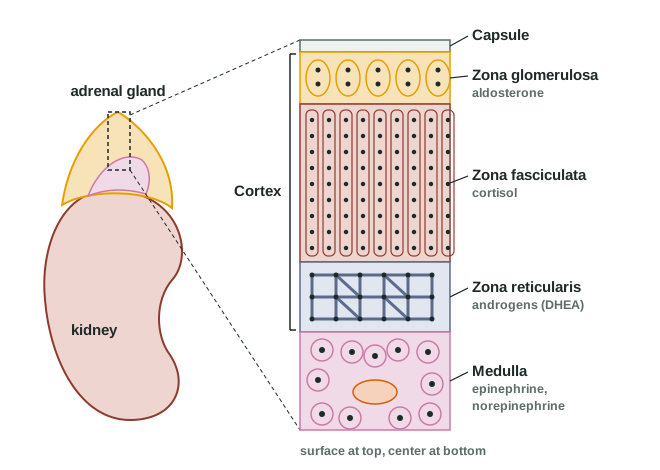
1. In the slice through the adrenal gland, which layer is arranged in straight columns of cells, and what does it make?
- Zona glomerulosa; aldosterone
- Zona reticularis; androgens
- Medulla; epinephrine
- Zona fasciculata; cortisol
Show the answer
The zona fasciculata (fascicul- = little bundle) is the thickest layer of the cortex. Its cells line up in columns, and it makes cortisol, the main glucocorticoid.
- Zona glomerulosa; aldosterone: The zona glomerulosa is the thin outer layer of rounded clusters (glomerul- = little ball). It makes aldosterone.
- Zona reticularis; androgens: The zona reticularis is the inner layer of branching cords (reticul- = little net). It makes androgens such as DHEA.
- Medulla; epinephrine: The medulla is the core, with larger round chromaffin cells, not columns. It makes epinephrine.
- Correct: Zona fasciculata; cortisol: Correct. Columns of cells in the thickest layer: the zona fasciculata, making cortisol.
2. Blood volume falls after a bleed. Put the steps of the renin–angiotensin–aldosterone system in order.
- Pressure falls in the kidney's small arteries
- Kidney cells release renin into the blood
- Renin converts angiotensinogen from the liver into angiotensin I
- ACE, mostly in the lungs, converts angiotensin I into angiotensin II
- Angiotensin II makes the zona glomerulosa release aldosterone
- The kidneys reabsorb more sodium, and water follows
Show the answer
Low pressure in the kidney triggers renin release. Renin makes angiotensin I from angiotensinogen; ACE makes angiotensin II; angiotensin II releases aldosterone; aldosterone makes the kidney keep sodium, and water follows by osmosis, restoring volume.
- Correct order: 1. Pressure falls in the kidney's small arteries 2. Kidney cells release renin into the blood 3. Renin converts angiotensinogen from the liver into angiotensin I 4. ACE, mostly in the lungs, converts angiotensin I into angiotensin II 5. Angiotensin II makes the zona glomerulosa release aldosterone 6. The kidneys reabsorb more sodium, and water follows
3. Mr. Haas has taken high-dose prednisone, a synthetic glucocorticoid, for six months for arthritis. Predict each variable first during the months of treatment, compared with before, and then in the days after he stops the drug suddenly, compared with while he was taking it.
| Variable | Change |
|---|---|
| ACTH, during treatment | — |
| Size of his zona fasciculata, during treatment | — |
| His own cortisol release, during treatment | — |
| Total glucocorticoid activity, in the days after stopping | — |
| Blood glucose, in the days after stopping | — |
| Blood pressure, in the days after stopping | — |
| ACTH, in the days after stopping | — |
Show the answer
During treatment, feedback from the drug suppresses ACTH and the zona fasciculata shrinks. When the drug stops suddenly, glucocorticoid activity crashes: blood glucose and blood pressure fall, the picture of an adrenal crisis. ACTH stays low at first, and it rises only over weeks to months, while the shrunken cortex recovers more slowly still. That is why long courses of glucocorticoids are tapered.
- ACTH, during treatment: down. The drug acts like cortisol on the hypothalamus and pituitary, so long-loop feedback suppresses CRH and ACTH.
- Size of his zona fasciculata, during treatment: down. ACTH keeps the zona fasciculata large; without it, the layer shrinks over weeks.
- His own cortisol release, during treatment: down. With little ACTH, the shrunken zona fasciculata makes little cortisol.
- Total glucocorticoid activity, in the days after stopping: down. The drug is gone, and his shrunken adrenal cortex cannot make up for it quickly.
- Blood glucose, in the days after stopping: down. Without glucocorticoid, the liver makes less glucose by gluconeogenesis.
- Blood pressure, in the days after stopping: down. Cortisol is permissive for the vessels' response to norepinephrine and epinephrine; without it, vessels constrict poorly.
- ACTH, in the days after stopping: no change. The hypothalamus and pituitary were suppressed for months and take weeks to restart, so ACTH stays low at first; that is why the crisis comes on so fast.
4. Ms. Tran, 34, has lost weight, feels exhausted, craves salty food and feels faint when she stands. Her skin creases and gums have darkened. Blood tests show low sodium, high potassium, low glucose and a very high ACTH. Where is the problem?
- Her anterior pituitary is releasing too little ACTH
- Her adrenal cortex has been destroyed
- Her adrenal medulla has stopped releasing epinephrine
- Her hypothalamus is releasing too much CRH
Show the answer
This is Addison disease, primary adrenal insufficiency. Low cortisol explains the weakness, weight loss and low glucose; low aldosterone explains the salt loss, high potassium and faintness. Feedback no longer holds back the pituitary, so ACTH rises very high, and high ACTH darkens the skin.
- Her anterior pituitary is releasing too little ACTH: Her ACTH is very high, not low. Pituitary failure would also spare aldosterone and would not darken her skin.
- Correct: Her adrenal cortex has been destroyed: Correct. Both cortisol and aldosterone are low, and ACTH is high, so the cortex itself has failed.
- Her adrenal medulla has stopped releasing epinephrine: Losing epinephrine alone causes little, because sympathetic nerves cover its effects. It cannot explain the high potassium or dark skin.
- Her hypothalamus is releasing too much CRH: Too much CRH would raise ACTH and so raise cortisol, giving high glucose, not low.
5. A patient with raised blood pressure starts a drug that blocks angiotensin-converting enzyme (ACE). What happens to his plasma potassium?
- It rises
- It falls
- It does not change
Show the answer
Blocking ACE lowers angiotensin II, so the zona glomerulosa releases less aldosterone. With less aldosterone, the kidney secretes less potassium into the urine, and plasma potassium rises. Clinicians check potassium after starting these drugs.
- Correct: It rises: Correct. Blocking ACE lowers angiotensin II, so the zona glomerulosa releases less aldosterone. With less aldosterone, the kidney secretes less potassium into the urine, and plasma potassium rises. Clinicians check potassium after starting these drugs.
- It falls: Potassium excretion falls, not rises, when aldosterone falls, so plasma potassium cannot fall for this reason.
- It does not change: Aldosterone is a main control of potassium excretion, so lowering it changes potassium.
6. Select every effect of cortisol.
- More gluconeogenesis in the liver
- Breakdown of muscle protein
- Stronger inflammatory responses
- Blood vessels that respond normally to norepinephrine
- Faster bone building
- Less response of muscle and fat to insulin
Show the answer
Cortisol raises blood glucose by driving gluconeogenesis, breaking down muscle protein for its amino acids and making tissues resist insulin. It is permissive for the vessels' response to sympathetic signals. It damps inflammation and slows bone building.
- Correct: More gluconeogenesis in the liver: Correct. Cortisol switches on gluconeogenesis.
- Correct: Breakdown of muscle protein: Correct. The amino acids feed gluconeogenesis; in excess, muscles waste.
- Stronger inflammatory responses: Cortisol damps inflammation, which is why glucocorticoid drugs treat inflammatory diseases.
- Correct: Blood vessels that respond normally to norepinephrine: Correct. This permissive effect is why low cortisol causes low blood pressure.
- Faster bone building: Cortisol slows bone building; long-term excess thins bone.
- Correct: Less response of muscle and fat to insulin: Correct. Muscle and fat take up less glucose, which leaves more in the blood; in excess this causes high blood glucose.
7. A pituitary tumor destroys the ACTH-making cells. Unlike a person with Addison disease, this person does not develop darker skin or high potassium. Why?
- The pituitary tumor releases aldosterone in place of ACTH
- ACTH is low, and aldosterone has its own main controls
- The adrenal medulla takes over making cortisol
- The skin and kidneys stop responding to adrenal hormones
Show the answer
In pituitary failure, ACTH is low, so nothing darkens the skin. Cortisol falls, but the zona glomerulosa still answers angiotensin II and potassium, so aldosterone is mostly spared and potassium stays normal. In Addison disease the cortex itself is destroyed, so aldosterone falls too, and very high ACTH darkens the skin.
- The pituitary tumor releases aldosterone in place of ACTH: The pituitary does not make aldosterone; only the zona glomerulosa does.
- Correct: ACTH is low, and aldosterone has its own main controls: Correct. Low ACTH means no darkening, and aldosterone keeps its own controls.
- The adrenal medulla takes over making cortisol: The medulla makes epinephrine and norepinephrine. It cannot make steroids.
- The skin and kidneys stop responding to adrenal hormones: Nothing changes the tissues' responses. The difference lies in which hormones are low.
8. Within seconds of a car swerving toward her, a driver's heart pounds and her blood glucose begins to rise. Which stage of the general adaptation syndrome is this, and which hormone mainly drives it?
- Resistance; cortisol
- Alarm reaction; epinephrine
- Alarm reaction; aldosterone
- Stage of exhaustion; ACTH
Show the answer
The alarm reaction is the fight-or-flight response, acting in seconds through sympathetic nerves and epinephrine from the adrenal medulla. Epinephrine speeds the heart and switches on glycogenolysis in the liver.
- Resistance; cortisol: Cortisol acts over hours through new proteins. It carries the stage of resistance, not the first seconds.
- Correct: Alarm reaction; epinephrine: Correct. The seconds-long response is sympathetic and epinephrine-driven.
- Alarm reaction; aldosterone: Aldosterone takes hours to act and handles sodium and potassium, not heart rate.
- Stage of exhaustion; ACTH: The stage of exhaustion comes after weeks or months of unrelieved stress.
9Summary
Each adrenal gland is two glands. The cortex makes steroids from cholesterol in three zones: the zona glomerulosa makes aldosterone, the zona fasciculata makes cortisol, and the zona reticularis makes adrenal androgens such as DHEA. The medulla releases epinephrine. Aldosterone, released when potassium rises or angiotensin II arrives, makes the kidney keep sodium and water and excrete potassium. In the renin–angiotensin–aldosterone system, renin from the kidney turns angiotensinogen into angiotensin I, and ACE turns that into angiotensin II. Cortisol is controlled by CRH and ACTH with negative feedback; it raises blood glucose, damps inflammation and keeps vessels responsive. Epinephrine carries the alarm reaction of the stress response, and cortisol the stage of resistance. Addison disease (cortex destroyed) brings low cortisol and aldosterone with darker skin; Cushing syndrome (glucocorticoid excess, usually from medication) brings central fat, thin skin and high glucose. Glucocorticoid drugs are tapered, because they shut down the axis.