Regions of the brain
1Why this matters
Ms. Reyes, 58, wakes up dizzy. When she reaches for her glasses her left hand swings past them, and she staggers to the left as she walks. Her strength is normal and she can feel everything. A scan shows a small bleed in the left side of her cerebellum, a structure behind the brainstem that does not start movements but makes them accurate.
2What this builds on
3Quick check before you start
1. In the CNS, what is gray matter mostly made of?
- Myelinated axons
- Neuron cell bodies, dendrites and synapses
- Connective tissue
Show the answer
Gray matter holds neuron cell bodies, dendrites and synapses. White matter is mostly myelinated axons, which look white because of the fatty myelin.
- Myelinated axons:
- Correct: Neuron cell bodies, dendrites and synapses:
- Connective tissue:
2. What is a cluster of neuron cell bodies inside the CNS called?
- A ganglion
- A tract
- A nucleus
Show the answer
Inside the CNS a cluster of cell bodies is a nucleus; outside it, a ganglion. A tract is a bundle of axons inside the CNS.
- A ganglion:
- A tract:
- Correct: A nucleus:
3. In a negative feedback loop for body temperature, what does the control center do?
- Compares the sensed temperature with the set point and signals the effectors
- Produces the heat itself
- Detects the temperature of the skin
Show the answer
The control center compares incoming information with the set point and sends commands to effectors that oppose the change. Sensing is the job of sensory receptors; producing or losing heat is the effectors' job.
- Correct: Compares the sensed temperature with the set point and signals the effectors:
- Produces the heat itself:
- Detects the temperature of the skin:
4Anatomy
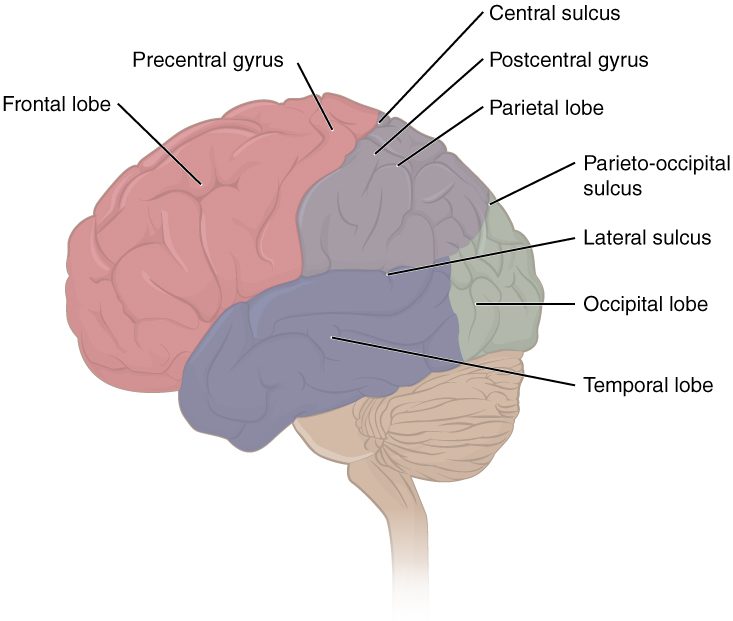
With labels hidden, select a box to reveal its label.
5How it works, step by step
- The motor areas of the frontal lobe send a command to move your hand, and a copy of the command reaches the cerebellum through the pons.The cerebellum now holds the intended movement.
- As the hand moves, sensory signals from its muscles and joints, and from the balance organs of the ear, reach the cerebellum.The cerebellum now also holds the actual movement.
- The cerebellum compares the intended movement with the actual one.It detects any error in force, timing or direction.
- The cerebellum sends corrections through the thalamus to the motor areas of the cortex.The cortex adjusts its command while the movement is under way, and the hand stops on target.
- If the cerebellum is damaged, the error is never corrected.The hand overshoots and the walk staggers, even though strength is normal: ataxia, on the same side as the damage.
6Core concepts
7A common mistake
The wrong idea: The cerebellum is where movements are started, so damage to it paralyzes you.
What actually happens: Movements start in the motor areas of the frontal lobe, with the basal nuclei helping select which one goes ahead. The cerebellum compares the command with what the body actually does and corrects it. Damage to the cerebellum leaves strength intact but makes movement clumsy and poorly timed (ataxia) on the same side of the body, while damage to the motor areas or internal capsule causes weakness on the opposite side.
8Check yourself
Anything you miss goes into your review queue.
1. Name the pinned lobe.
- Parietal lobe
- Temporal lobe
- Occipital lobe
- Frontal lobe
Show the answer
The occipital lobe is the back of each hemisphere, behind the parieto-occipital sulcus and above the cerebellum. It handles vision.
- Parietal lobe: The parietal lobe lies on top, between the central sulcus and the parieto-occipital sulcus, in front of the pinned lobe.
- Temporal lobe: The temporal lobe lies along the side below the lateral sulcus, not at the back of the hemisphere.
- Correct: Occipital lobe: Correct. The rearmost lobe, sitting above the cerebellum, is the occipital lobe.
- Frontal lobe: The frontal lobe is at the front of the hemisphere, in front of the central sulcus.
2. Which secondary brain vesicle becomes both the pons and the cerebellum?
- Myelencephalon
- Mesencephalon
- Metencephalon
- Telencephalon
Show the answer
The hindbrain (rhombencephalon) splits into the metencephalon, which becomes the pons and cerebellum, and the myelencephalon, which becomes the medulla oblongata.
- Myelencephalon: The myelencephalon is the lower half of the hindbrain; it becomes the medulla oblongata.
- Mesencephalon: The mesencephalon does not split and becomes the midbrain.
- Correct: Metencephalon: Correct. The metencephalon forms the pons and the cerebellum.
- Telencephalon: The telencephalon becomes the cerebrum.
3. Mr. Brandt, 52, overshoots when he reaches for a cup with his left hand, and he walks with a wide, staggering walk. The strength in all four limbs is normal. Where is the damage most likely to be?
- The left side of the cerebellum
- The right side of the cerebellum
- The left frontal lobe
- The left occipital lobe
Show the answer
Clumsy, poorly timed movement with normal strength is ataxia, the sign of cerebellar damage. Each side of the cerebellum coordinates the same side of the body, so a clumsy left hand points to the left cerebellum.
- Correct: The left side of the cerebellum: Correct. Ataxia of the left arm comes from the left side of the cerebellum.
- The right side of the cerebellum: The cerebellum coordinates the same side, not the opposite side, so right-sided damage would make the right hand clumsy.
- The left frontal lobe: Damage to the frontal lobe's movement areas causes weakness on the opposite side. Mr. Brandt's strength is normal, and his left side is affected.
- The left occipital lobe: The occipital lobe handles vision; damage there causes loss of vision in part of what you see, not clumsy reaching with normal sight.
4. A patient cannot be woken by loud noise or pain after an injury to the core of the upper brainstem on both sides. His cerebral cortex is undamaged. What best explains this?
- The injury destroyed the basal nuclei, which start all movement
- The injury cut the corpus callosum, so the hemispheres cannot communicate
- The injury destroyed the hypothalamus, which controls body temperature
- The injury destroyed the reticular activating system, which keeps the cortex awake
Show the answer
The reticular activating system, in the core of the brainstem, sends a steady stream of signals through the thalamus that keeps the cortex awake. Destroy it on both sides and even an undamaged cortex cannot be roused, which is coma.
- The injury destroyed the basal nuclei, which start all movement: The basal nuclei lie deep in the cerebrum, not in the brainstem, and their loss affects the selection of movement, not wakefulness.
- The injury cut the corpus callosum, so the hemispheres cannot communicate: The corpus callosum lies in the cerebrum. Cutting it leaves a person fully awake; the hemispheres just share less information.
- The injury destroyed the hypothalamus, which controls body temperature: The hypothalamus is in the diencephalon, not the brainstem core, and loss of temperature control does not by itself prevent waking.
- Correct: The injury destroyed the reticular activating system, which keeps the cortex awake: Correct. Loss of the reticular activating system on both sides causes coma.
5. Which does the hypothalamus regulate? Select all that apply.
- Body temperature
- Thirst and water balance
- Release of hormones by the pituitary gland
- The timing and force of a movement while it is under way
- Heart rate, through the autonomic nervous system
- The relay of touch signals to the cerebral cortex
Show the answer
The hypothalamus is the control center for temperature, water balance and thirst, hunger, autonomic output and the pituitary gland. Correcting movement is the cerebellum's job, and relaying touch to the cortex is the thalamus's.
- Correct: Body temperature: Yes. Hypothalamic neurons sense blood temperature and drive sweating, skin blood flow and shivering.
- Correct: Thirst and water balance: Yes. The hypothalamus creates thirst and controls a hormone that makes the kidneys keep water.
- Correct: Release of hormones by the pituitary gland: Yes. The hypothalamus controls the pituitary gland just below it.
- The timing and force of a movement while it is under way: No. Correcting the force and timing of movement is the cerebellum's job.
- Correct: Heart rate, through the autonomic nervous system: Yes. The hypothalamus sends axons to the brainstem and spinal cord neurons of the sympathetic and parasympathetic divisions.
- The relay of touch signals to the cerebral cortex: No. Relaying touch and other body sensations to the cortex is the thalamus's job.
6. After a severe head injury, Mr. Osei's brain swells and is pushed down through the foramen magnum, compressing the lowest part of his brainstem. Which change is most immediately life-threatening?
- Loss of the sense of smell
- Loss of the rhythm of breathing and control of the heart
- Loss of the ability to form new memories of events
- Loss of coordination on one side of the body
Show the answer
The lowest part of the brainstem is the medulla oblongata, which passes through the foramen magnum. Its nuclei set the basic rhythm of breathing, the heartbeat and blood vessel diameter, so crushing it stops breathing and circulation.
- Loss of the sense of smell: Smell does not depend on the medulla, and losing it is not life-threatening.
- Correct: Loss of the rhythm of breathing and control of the heart: Correct. Compressing the medulla stops breathing and circulation.
- Loss of the ability to form new memories of events: Forming new memories depends on the hippocampus in the temporal lobe, not the medulla.
- Loss of coordination on one side of the body: Coordination depends on the cerebellum. It may be affected too, but losing it is not what kills first.
7. A small bleed destroys part of the right internal capsule. Which result is most likely?
- Clumsy, staggering movement of the right arm and leg
- Loss of the sense of smell on the right
- Weakness of the left arm and leg
- Loss of hearing in both ears
Show the answer
The internal capsule is the compact band that carries the axons running between the cortex and the brainstem and spinal cord. Movement commands for the left side of the body come from the right hemisphere, so damage to the right internal capsule weakens the left side.
- Clumsy, staggering movement of the right arm and leg: Clumsy staggering movement with normal strength is cerebellar ataxia, and the right side of the body is controlled by the left hemisphere.
- Loss of the sense of smell on the right: Smell does not travel through the internal capsule.
- Correct: Weakness of the left arm and leg: Correct. Motor axons from the right hemisphere pass through the right internal capsule and control the left side.
- Loss of hearing in both ears: Each ear sends signals to both sides of the brain, and hearing does not depend on this band.
9Summary
The brain grows from the front of the neural tube: three primary vesicles (forebrain, midbrain, hindbrain) become five secondary vesicles and then the cerebrum, diencephalon, midbrain, pons and cerebellum, and medulla oblongata. The cerebrum's two hemispheres are separated by the longitudinal fissure and joined by the corpus callosum; its folded cortex is split by the central, lateral and parieto-occipital sulci into frontal, parietal, temporal and occipital lobes, with the insula buried in the lateral sulcus. The thalamus relays and filters input to the cortex, and the hypothalamus controls temperature, water, hunger, autonomic output, daily rhythms and the pituitary gland. The brainstem links brain and spinal cord and runs breathing and circulation; the reticular formation in its core keeps the cortex awake. The cerebellum corrects movement, the basal nuclei select it, and the limbic system links emotion and memory.