Cleavage, implantation and the embryo
1Why this matters
Lena's period is due today, and a home pregnancy test shows a faint second line. The hormone the test detects was not made by her ovaries or her pituitary gland. It was made by a hollow ball of cells, smaller than the dot on this i, that burrowed into the wall of her uterus about a week ago. That hormone is the reason her period will not come. Over the next six weeks, the same ball of cells will fold itself into an embryo with a beating heart, a spinal cord and the buds of arms and legs.
2What this builds on
3Quick check before you start
1. During mitosis, what happens to the chromosome number of the daughter cells?
- It halves
- It stays the same as the parent cell's
- It doubles
Show the answer
Mitosis gives two daughter cells with the same chromosome number as the parent. Only meiosis halves it.
- It halves:
- Correct: It stays the same as the parent cell's:
- It doubles:
2. Without a pregnancy, how long does the corpus luteum keep making progesterone?
- About 12 to 14 days
- About 3 days
- About 3 months
Show the answer
The corpus luteum lasts about 12 to 14 days, then dies. The fall in progesterone sets off the next menstrual period.
- Correct: About 12 to 14 days:
- About 3 days:
- About 3 months:
3. In endochondral ossification, what model is replaced by bone?
- A sheet of fibrous membrane
- A hyaline cartilage model
- A mass of fat
Show the answer
Endochondral ossification replaces a hyaline cartilage model with bone. Intramembranous ossification forms bone directly in a fibrous membrane.
- A sheet of fibrous membrane:
- Correct: A hyaline cartilage model:
- A mass of fat:
4Anatomy
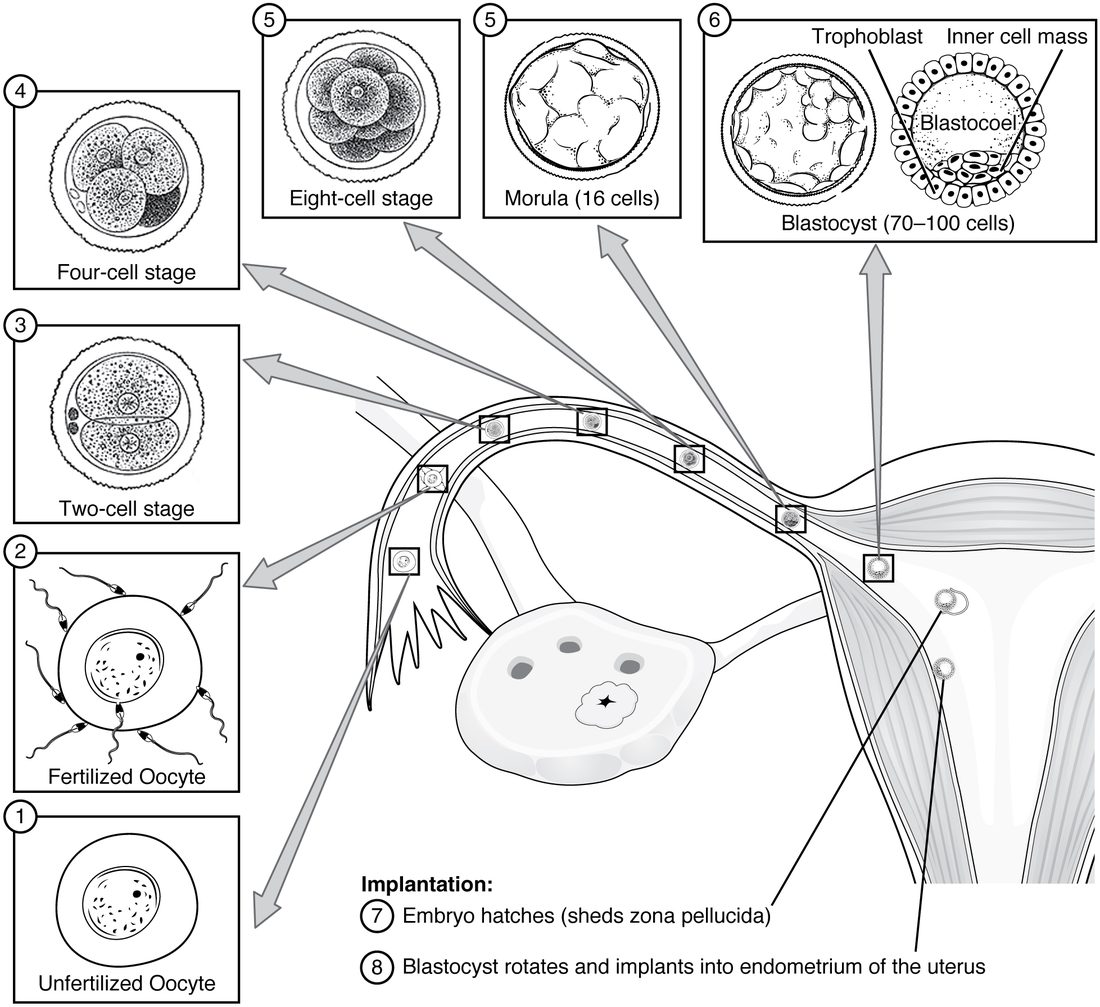
With labels hidden, select a box to reveal its label.
5How it works, step by step
- The zygote divides by mitosis again and again inside the zona pellucida without growing.Cleavage produces smaller and smaller blastomeres, and by day 3 to 4 a solid morula reaches the uterus.
- The morula's outer cells pump sodium into its center, and water follows.A fluid-filled blastocoel forms, and the embryo becomes a blastocyst with an outer trophoblast and an inner cell mass.
- The blastocyst hatches from the zona pellucida and sticks to the secretory-phase endometrium around day 6 to 7.The trophoblast forms an invading syncytiotrophoblast, which buries the blastocyst in the endometrium: implantation.
- The syncytiotrophoblast secretes human chorionic gonadotropin, which binds LH receptor proteins on the corpus luteum.The corpus luteum survives and keeps secreting progesterone, so the endometrium is not shed and no period comes.
- With the embryo secure, the epiblast's cells move through the primitive streak in week 3.Gastrulation forms ectoderm, mesoderm and endoderm, from which every organ is built during the rest of the embryonic period.
6Core concepts
7A common mistake
The wrong idea: A pregnancy test detects a hormone made by the mother's body.
What actually happens: Pregnancy tests detect human chorionic gonadotropin, which is made by the embryo's own syncytiotrophoblast as it implants. The mother's corpus luteum responds to it by staying alive and making progesterone. That is why the test turns positive only after implantation, about a week or more after fertilization, and not at fertilization itself.
8Check yourself
Anything you miss goes into your review queue.
1. A woman who is trying to conceive has a sensitive blood test for hCG five days after she ovulated. It is negative, but a repeat test a week later is positive. Assuming she conceived on the day of ovulation, why was the first test negative?
- Her corpus luteum had not yet started to make hCG in amounts a test can detect
- The embryo had not yet implanted
- hCG is made only once the embryo's heart begins to beat
- The zygote's hCG was still trapped inside the zona pellucida
Show the answer
hCG is secreted by the syncytiotrophoblast, which forms only as the blastocyst invades the endometrium from about day 6 to 7. hCG reaches the mother's blood in measurable amounts about 8 to 10 days after fertilization, so a test on day 5 is too early.
- Her corpus luteum had not yet started to make hCG in amounts a test can detect: The corpus luteum does not make hCG; it responds to it. hCG comes from the embryo's trophoblast.
- Correct: The embryo had not yet implanted: Correct. No implantation means no syncytiotrophoblast and no hCG in her blood.
- hCG is made only once the embryo's heart begins to beat: The heart starts beating around day 22, long after hCG first appears. hCG depends on implantation, not on the heart.
- The zygote's hCG was still trapped inside the zona pellucida: A day-5 embryo is not secreting hCG at all. Secretion begins with the syncytiotrophoblast during implantation.
2. Put the stages from zygote to implantation in order.
- The zygote divides into two blastomeres
- A solid morula of about 16 to 32 cells forms
- A fluid-filled blastocoel forms, making a blastocyst
- The blastocyst hatches from the zona pellucida
- The blastocyst attaches to the endometrium, inner cell mass side first
- The syncytiotrophoblast invades the endometrium and secretes hCG
Show the answer
Cleavage divides the zygote into blastomeres and then a solid morula. Fluid pumped into the morula forms the blastocoel of the blastocyst, which must hatch from the zona pellucida before it can attach. Once attached, the trophoblast forms the invading syncytiotrophoblast, which begins secreting hCG.
- Correct order: 1. The zygote divides into two blastomeres 2. A solid morula of about 16 to 32 cells forms 3. A fluid-filled blastocoel forms, making a blastocyst 4. The blastocyst hatches from the zona pellucida 5. The blastocyst attaches to the endometrium, inner cell mass side first 6. The syncytiotrophoblast invades the endometrium and secretes hCG
3. An implanting embryo's syncytiotrophoblast secretes far too little hCG. Predict the change in each variable over the following week, compared with a normal early pregnancy.
| Variable | Change |
|---|---|
| Survival of the corpus luteum past its usual two weeks | — |
| Progesterone in the mother's blood | — |
| Chance that the endometrium is shed | — |
| Intensity of a home pregnancy test line | — |
Show the answer
hCG keeps the corpus luteum alive. With too little of it, the corpus luteum dies, progesterone falls and the endometrium is shed, ending the pregnancy. This is one way a very early pregnancy is lost, often before it is recognized.
- Survival of the corpus luteum past its usual two weeks: down. Without enough hCG acting on its LH receptor proteins, the corpus luteum dies on its usual schedule.
- Progesterone in the mother's blood: down. The dying corpus luteum stops making progesterone, and the embryo's own tissues cannot yet make enough.
- Chance that the endometrium is shed: up. Falling progesterone sets off menstruation, and the functional layer, with the embryo in it, is shed.
- Intensity of a home pregnancy test line: down. The test detects hCG in urine, so less hCG gives a fainter line or a negative result.
4. A tumor arises from the epithelial cells lining the pancreatic ducts. From which germ layer did those cells originally develop?
- Ectoderm
- Mesoderm
- Endoderm
- Neural crest
Show the answer
The pancreas buds from the foregut, a tube of endoderm, so its ducts and the cells lining them come from endoderm. Its connective tissue and blood vessels come from mesoderm.
- Ectoderm: Ectoderm forms the epidermis, the nervous system and a few other structures, not the lining of gut glands.
- Mesoderm: Mesoderm forms the pancreas's connective tissue and vessels, not the epithelium lining its ducts.
- Correct: Endoderm: Correct. Epithelium of the gut and the glands that bud from it comes from endoderm.
- Neural crest: Neural crest forms peripheral ganglia and Schwann cells, among other things, but not pancreatic duct epithelium.
5. A drug that blocks sodium–potassium pumps is added to a morula growing in a dish on day 4. Predict the change in each variable over the next day, compared with an untreated morula.
| Variable | Change |
|---|---|
| Sodium pumped into the center of the morula | — |
| Water moving into the center | — |
| Size of the blastocoel | — |
| Number of chromosomes in each blastomere | — |
Show the answer
The blastocoel forms because the outer cells pump sodium into the center and water follows by osmosis. Blocking the pumps blocks that fluid collection, so the morula cannot become a proper blastocyst, even though its cells keep their normal chromosomes.
- Sodium pumped into the center of the morula: down. The outer cells use sodium–potassium pumps to move sodium inward. Blocked pumps move less.
- Water moving into the center: down. Water follows the solute. With less sodium collecting in the center, less water enters.
- Size of the blastocoel: down. The blastocoel is the fluid that collects in the center. Less water in means a smaller cavity or none.
- Number of chromosomes in each blastomere: no change. The drug blocks ion pumping, not DNA copying or mitosis. Each cell stays diploid.
6. A pathologist tests cells from each embryonic membrane of an early pregnancy for human chorionic gonadotropin. In which membrane will she find the cells that make it?
- Amnion
- Chorion
- Yolk sac
- Allantois
Show the answer
hCG is made by the syncytiotrophoblast, and the trophoblast forms the chorion. The hormone's name records this: chorionic gonadotropin.
- Amnion: The amnion forms from epiblast, not trophoblast, and does not make hCG.
- Correct: Chorion: Correct. The chorion's syncytiotrophoblast secretes hCG.
- Yolk sac: The yolk sac forms from hypoblast. Its wall makes the first blood cells, not hCG.
- Allantois: The allantois is a small outpouching whose vessels become the cord's vessels. It does not make hCG.
7. In a developing knee, the cells in the middle of the joint interzone fail to die. What would most likely result?
- No joint cavity; the bones stay joined
- A normal synovial joint whose capsule is unusually thick
- Extra toes on the foot of the same leg
- An unusually long femur
Show the answer
A synovial joint cavity opens when the cells in the middle of the interzone die. If they survive, no cavity forms, and the two bones stay joined by tissue instead of moving freely against each other.
- Correct: No joint cavity; the bones stay joined: Correct. Without the cells dying, no cavity opens.
- A normal synovial joint whose capsule is unusually thick: A synovial joint needs a cavity. The cells that should die are the ones that make room for it.
- Extra toes on the foot of the same leg: Extra digits come from extra ridges in the limb's hand or foot plate, not from the knee's interzone.
- An unusually long femur: The length of a bone depends on its growth, not on whether a joint cavity forms beside it.
9Summary
Cleavage divides the zygote into blastomeres without growth, giving a morula by day 3 to 4. By day 5 it is a blastocyst: a trophoblast, an inner cell mass that forms the embryo, and a fluid-filled blastocoel. It hatches and implants in the secretory endometrium from day 6 to 7, as the syncytiotrophoblast invades. The syncytiotrophoblast secretes hCG, which acts like LH to keep the corpus luteum making progesterone; pregnancy tests detect it. The inner cell mass forms a disc of epiblast and hypoblast, and in week 3 gastrulation through the primitive streak makes ectoderm, mesoderm and endoderm. The notochord induces the neural tube; somites form sclerotomes (vertebrae and ribs), myotomes (skeletal muscle) and dermatomes (dermis). Folding in week 4 makes a body with a gut tube (foregut, midgut, hindgut). The amnion, yolk sac, allantois and chorion surround the embryo. Organogenesis runs to the end of week 8, the end of the embryonic period. Limbs grow from buds under the apical ectodermal ridge; cartilage models become bone and joint interzones become joints.