Organization of the nervous system
1Why this matters
Jamal, 24, put his hand through a window. The cut at his wrist is small but deep. Now he cannot feel his little finger, he cannot spread his fingers apart, and the skin on the little-finger side of his palm stays dry while the rest of his hand sweats. One cut caused three different losses, because the one nerve it severed carried three different kinds of axons. Sorting out which is which is what this topic is about.
2What this builds on
3Quick check before you start
1. What is a nerve?
- A single, very long neuron
- A bundle of many axons wrapped in connective tissue
- A cluster of neuron cell bodies
Show the answer
A nerve is an organ-level cable: many axons from many different neurons, bundled together with connective tissue and blood vessels. It is not one cell, and the cell bodies of its axons lie elsewhere.
- A single, very long neuron:
- Correct: A bundle of many axons wrapped in connective tissue:
- A cluster of neuron cell bodies:
2. In a feedback loop, what does the efferent pathway do?
- Carries signals from the control center to the effector
- Carries signals from the sensory receptor to the control center
- Detects a change in the regulated variable
Show the answer
Efferent means carrying away. The efferent pathway carries the control center's command out to the effector. The afferent pathway carries signals in from the sensory receptor, and the sensory receptor does the detecting.
- Correct: Carries signals from the control center to the effector:
- Carries signals from the sensory receptor to the control center:
- Detects a change in the regulated variable:
3. Which kind of muscle tissue makes up the walls of your stomach and blood vessels?
- Skeletal muscle
- Cardiac muscle
- Smooth muscle
Show the answer
Smooth muscle lines hollow organs and blood vessels. Skeletal muscle moves the skeleton, and cardiac muscle is found only in the heart.
- Skeletal muscle:
- Cardiac muscle:
- Correct: Smooth muscle:
4Anatomy
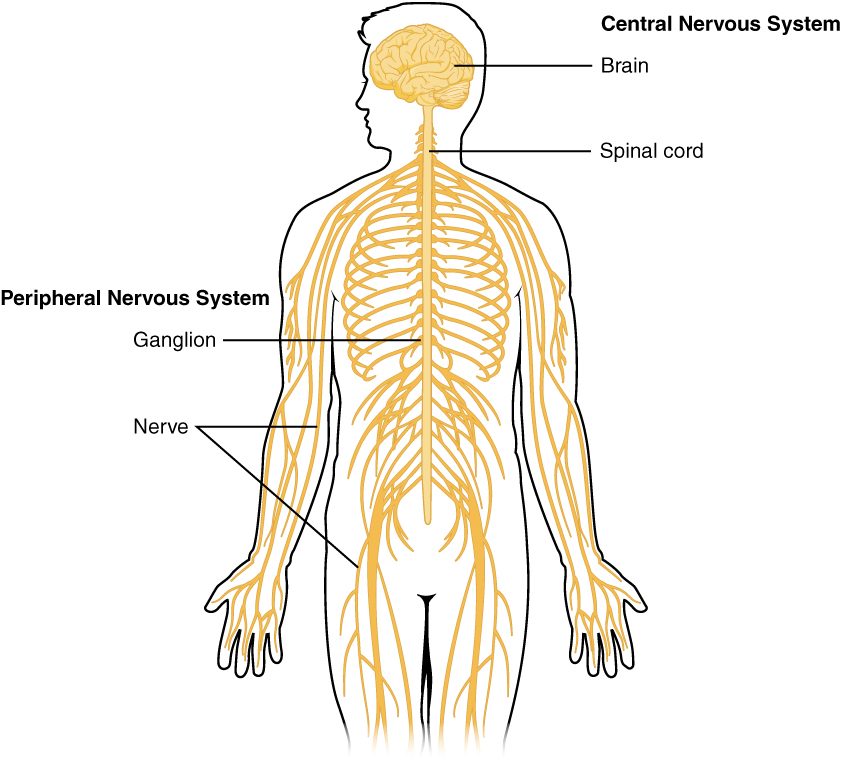
With labels hidden, select a box to reveal its label.
5How it works, step by step
- You step on a tack, and it presses into the skin of your heel.Sensory receptors in the skin respond and start signals: this is sensory input.
- The signals travel along axons of the sensory (afferent) division, inside a nerve in your leg, which is part of the PNS.They reach the spinal cord, part of the CNS.
- In the gray matter of the spinal cord and brain, neurons combine the incoming signals with other information.Integration settles on a response: lift the foot, and prepare the body for trouble.
- Commands leave the CNS along axons of the motor (efferent) division, through nerves of the PNS.Somatic motor axons reach skeletal muscles of the leg, and autonomic axons reach the heart and sweat glands.
- The effectors receive the commands: this is motor output.Your leg muscles contract and lift your foot, while sympathetic signals speed your heart and make your palms sweat.
6Core concepts
7A common mistake
The wrong idea: The central nervous system handles conscious actions, and the peripheral nervous system handles automatic ones.
What actually happens: CNS versus PNS is a division by location; somatic versus autonomic is a division by function, and each system has parts in both locations. The neurons that decide to speed your heart sit in the brain (CNS), and the neurons that decide to move your leg do too. Both commands then travel out through nerves of the PNS. The somatic system is defined by its effector, skeletal muscle, and the autonomic system by its effectors, cardiac muscle, smooth muscle and glands.
8Check yourself
Anything you miss goes into your review queue.
1. Name the pinned structure.
- Spinal cord
- Nerve
- Ganglion
- Tract
Show the answer
The spinal cord runs down from the brain inside the vertebral column. With the brain, it forms the central nervous system.
- Correct: Spinal cord: Correct. The long central column running down from the brain is the spinal cord, part of the CNS.
- Nerve: Nerves branch off the spinal cord and run out into the body. The pinned structure is the central column they branch from.
- Ganglion: A ganglion is a small swelling on a nerve, not the long central column.
- Tract: Tracts are bundles of axons inside the CNS, too small to see on a whole-body drawing. The pinned structure is the whole spinal cord.
2. As your stomach fills after a large meal, stretch-sensitive sensory receptors in its wall start sending signals to your brain. Which division carries those signals?
- The somatic nervous system
- The motor division
- The sensory division
- The sympathetic division
Show the answer
The signals start at sensory receptors and travel toward the CNS, so they are carried by the sensory (afferent) division. Sensory input comes from internal organs as well as from the skin.
- The somatic nervous system: The somatic nervous system is motor output to skeletal muscle. These signals are traveling in, not out.
- The motor division: The motor division carries signals away from the CNS. These travel toward the brain.
- Correct: The sensory division: Correct. Input from sensory receptors, heading to the CNS, travels in the sensory division.
- The sympathetic division: The sympathetic division carries commands out from the CNS. It does not carry sensory input in.
3. You step out of a warm house into freezing wind and start to shiver without deciding to. Which part of the nervous system carries the commands that make you shiver?
- The autonomic nervous system
- The somatic nervous system
- The sensory division
- The parasympathetic division
Show the answer
Shivering is rapid contraction of skeletal muscles, and skeletal muscle is controlled only by the somatic nervous system. "Voluntary" is a useful rule of thumb for somatic output, but the effector is what defines the division.
- The autonomic nervous system: Shivering is involuntary, but the autonomic nervous system does not reach skeletal muscle. Its effectors are cardiac muscle, smooth muscle and glands.
- Correct: The somatic nervous system: Correct. The effector is skeletal muscle, so the commands travel in somatic motor neurons.
- The sensory division: The skin's sensory receptors detect the cold, and the sensory division carries that input in. The commands that produce shivering travel out, in the motor division.
- The parasympathetic division: The parasympathetic division is autonomic and has no axons to skeletal muscle, so it cannot produce shivering.
4. An hour after a large dinner you are lying on the couch, and the balance of your autonomic output shifts toward the parasympathetic division. Predict each change compared with an hour of brisk walking.
| Variable | Change |
|---|---|
| Heart rate | — |
| Movement and secretion in the gut | — |
| Commands to skeletal muscles of the legs | — |
Show the answer
At rest after a meal, parasympathetic activity dominates: the heart slows and digestion speeds up. Somatic output to the legs drops because you are not moving, a separate change in a separate system.
- Heart rate: down. Parasympathetic signals to the heart slow its beat, and sympathetic drive to the heart falls, so the rate drops.
- Movement and secretion in the gut: up. Parasympathetic signals stimulate the gut's smooth muscle and digestive glands: rest-and-digest.
- Commands to skeletal muscles of the legs: down. You are lying still, so somatic motor output to the leg muscles falls. This change is somatic, not autonomic: the autonomic nervous system does not control skeletal muscle.
5. This pathway, from stepping on a tack to lifting your foot, has one wrong step. Find it.
- Sensory receptors in the heel start signals
- Afferent axons in a leg nerve carry the signals to the spinal cord
- Neurons in the spinal cord's gray matter integrate the input
- Afferent axons carry commands from the spinal cord to the leg muscles
- Skeletal muscles of the leg contract and lift the foot
Show the answer
Commands going out from the CNS to muscles travel in efferent (motor) axons, not afferent ones. Afferent axons only carry signals toward the CNS.
- Sensory receptors in the heel start signals: Correct step. Sensory receptors in the skin start the signals.
- Afferent axons in a leg nerve carry the signals to the spinal cord: Correct step. Afferent axons carry input toward the CNS.
- Neurons in the spinal cord's gray matter integrate the input: Correct step. Integration happens where neurons connect, in gray matter.
- Correct: Afferent axons carry commands from the spinal cord to the leg muscles: This is the wrong step. Signals leaving the CNS travel in efferent axons of the motor division.
- Skeletal muscles of the leg contract and lift the foot: Correct step. Skeletal muscles are the effectors that respond.
6. Why does white matter look white?
- It holds few blood vessels, so less blood tints the tissue a darker color
- It is packed with neuron cell bodies, which are pale
- It is mostly connective tissue with collagen fibers
- Many of its axons are wrapped in fatty layers made by glial cells
Show the answer
White matter is mostly bundles of axons, and many are wrapped in layers of fatty glial membrane. That fat reflects light and looks white.
- It holds few blood vessels, so less blood tints the tissue a darker color: White matter does have fewer capillaries than gray matter, but blood supply is not what sets its color. The fat around its axons is.
- It is packed with neuron cell bodies, which are pale: Cell bodies are concentrated in gray matter, not white matter.
- It is mostly connective tissue with collagen fibers: The CNS has very little collagen-rich connective tissue inside it. White matter is axons and glial cells.
- Correct: Many of its axons are wrapped in fatty layers made by glial cells: Correct. The fatty wrapping around the axons gives white matter its color.
7. Which statement about the divisions of the nervous system is correct?
- The autonomic nervous system lies entirely in the PNS
- The CNS controls voluntary actions and the PNS controls involuntary ones
- The somatic and autonomic nervous systems both have parts in the CNS and the PNS
- Somatic and autonomic axons travel in separate nerves
Show the answer
CNS and PNS divide the system by location; somatic and autonomic divide it by function. Both the somatic and the autonomic systems start with neurons in the CNS and send their commands out through PNS nerves.
- The autonomic nervous system lies entirely in the PNS: The neurons that control autonomic output, for example those that decide to speed the heart, sit in the brain and spinal cord. Only part of the autonomic system lies in the PNS.
- The CNS controls voluntary actions and the PNS controls involuntary ones: This mixes two separate ways of dividing the system. Both voluntary and involuntary commands start in the CNS and travel out through the PNS.
- Correct: The somatic and autonomic nervous systems both have parts in the CNS and the PNS: Correct. Each functional system has CNS neurons that issue commands and PNS axons that carry them.
- Somatic and autonomic axons travel in separate nerves: Many nerves carry somatic motor, autonomic and sensory axons together. That is why a cut at the wrist can cause numbness, weakness and loss of sweating at once.
9Summary
Your nervous system does three jobs: sensory input, integration and motor output. By location it has two parts: the central nervous system (brain and spinal cord), which integrates, and the peripheral nervous system (nerves, ganglia and sensory receptors), which carries signals in and out. By direction, the sensory (afferent) division carries signals toward the CNS and the motor (efferent) division carries them out to effectors. The motor division splits by effector: the somatic nervous system controls skeletal muscle, mostly consciously; the autonomic nervous system controls cardiac muscle, smooth muscle and glands, mostly unconsciously, through its sympathetic (fight-or-flight) and parasympathetic (rest-and-digest) divisions. In the CNS, gray matter holds cell bodies and white matter holds bundles of insulated axons. A cluster of cell bodies is a nucleus in the CNS and a ganglion in the PNS; a bundle of axons is a tract in the CNS and a nerve in the PNS.