Sensory receptors and ascending pathways
1Why this matters
Daniel, 29, shows his doctor painless burn blisters on both hands. He has picked up hot pans without noticing. Yet with his eyes closed he can name a coin placed in his palm and feel a buzzing tuning fork on his knuckles. Touch works; pain and temperature do not, across both shoulders and arms. A scan finds a fluid-filled cavity in the center of his neck's spinal cord. The reason only some sensations vanished lies in where each sensory pathway crosses the midline.
2What this builds on
3Quick check before you start
1. How does a graded potential differ from an action potential?
- It is all-or-none and travels without fading
- Its size varies with the stimulus and it fades with distance
- It occurs only in muscle cells
Show the answer
A graded potential is a local change whose size depends on the stimulus strength, and it fades as it spreads. An action potential is all-or-none and is regenerated along the axon without fading.
- It is all-or-none and travels without fading:
- Correct: Its size varies with the stimulus and it fades with distance:
- It occurs only in muscle cells:
2. Which structure relays almost all sensory signals on their way to the cerebral cortex?
- Thalamus
- Cerebellum
- Hypothalamus
Show the answer
The thalamus is the relay and filter for sensory input to the cortex. The cerebellum coordinates movement, and the hypothalamus controls autonomic and endocrine functions.
- Correct: Thalamus:
- Cerebellum:
- Hypothalamus:
3. Where is the primary somatosensory cortex?
- In the precentral gyrus of the frontal lobe
- In the occipital lobe
- In the postcentral gyrus of the parietal lobe
Show the answer
The primary somatosensory cortex lies in the postcentral gyrus, just behind the central sulcus. The precentral gyrus holds the primary motor cortex, and the occipital lobe holds the primary visual cortex.
- In the precentral gyrus of the frontal lobe:
- In the occipital lobe:
- Correct: In the postcentral gyrus of the parietal lobe:
4Anatomy
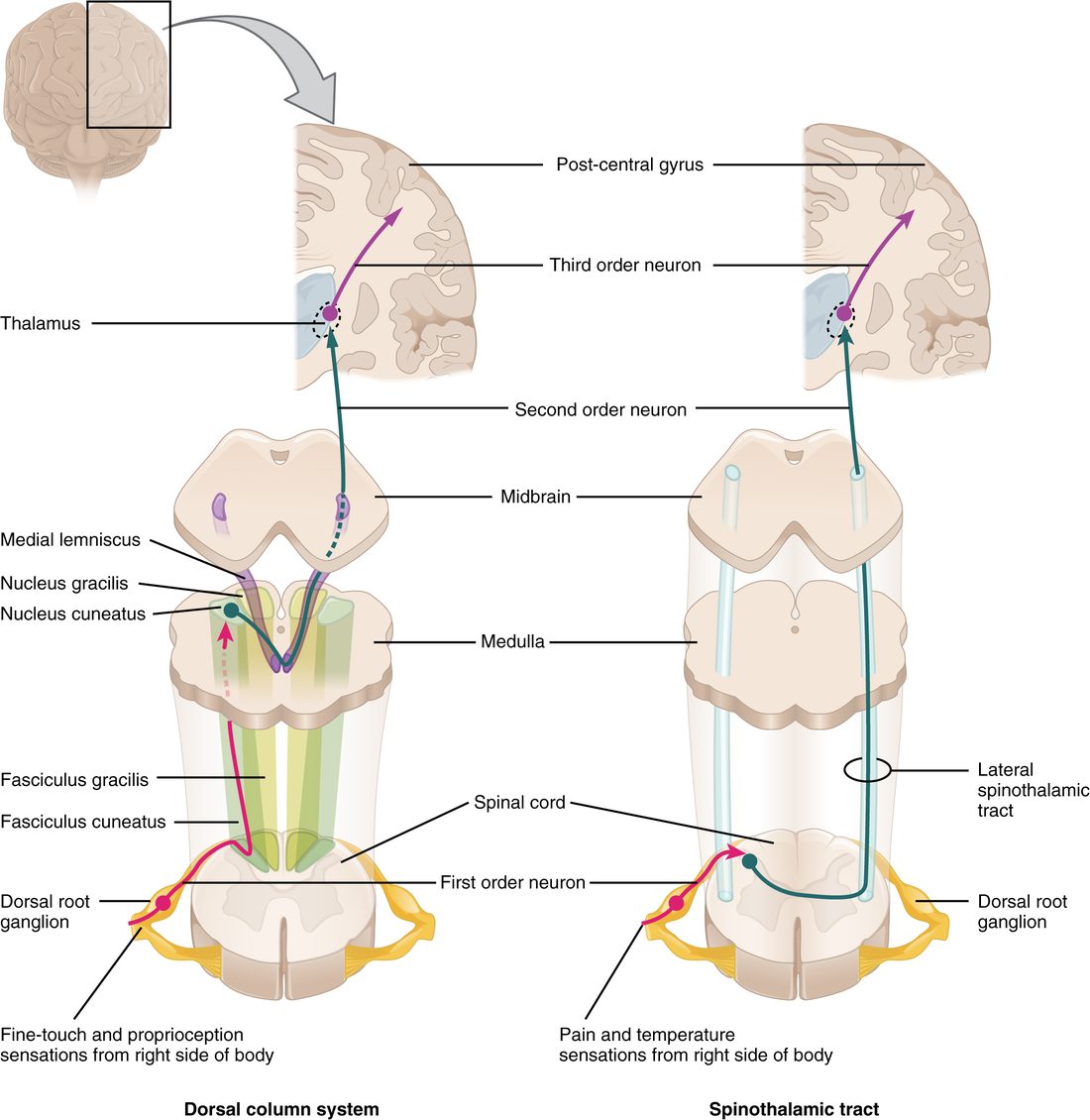
With labels hidden, select a box to reveal its label.
5How it works, step by step
- You step on a tack with your right foot.Nociceptors in the skin open ion channels, and a graded receptor potential depolarizes their endings to threshold.
- Action potentials fire in the first-order neurons, whose cell bodies sit in a lumbar or sacral dorsal root ganglion.The signal enters the right dorsal horn, where the first-order axon synapses on a second-order neuron.
- The second-order axon crosses the midline within a segment or two.It climbs in the left spinothalamic tract, through the brainstem, to the left thalamus.
- A third-order neuron in the left thalamus fires.Its axon reaches the foot area of the left primary somatosensory cortex, near the top of the postcentral gyrus.
- The left cortex receives the signal on a line that always reports the right foot.You perceive a sharp pain in your right foot, even though every neuron above the cord's crossing point lies on the left.
6Core concepts
7A common mistake
The wrong idea: All sensory signals from one side of the body cross to the other side at the same place, so damage to one side of the spinal cord removes all feeling on one side.
What actually happens: The two main pathways cross at different levels. Pain and temperature axons (spinothalamic tract) cross in the spinal cord, within a segment or two of where they enter. Fine touch, vibration and position axons (dorsal column–medial lemniscus) climb on the same side and cross in the medulla. So damage to the left half of the cord removes fine touch and position on the left but pain and temperature on the right.
8Check yourself
Anything you miss goes into your review queue.
1. Put the steps of the dorsal column–medial lemniscus pathway in order, for vibration felt on the left index finger.
- A lamellated corpuscle in the fingertip depolarizes, firing action potentials
- The first-order axon passes its cell body in a cervical dorsal root ganglion and enters the cord
- The axon climbs, without synapsing, in the left fasciculus cuneatus
- It synapses in the nucleus cuneatus of the medulla oblongata
- The second-order axon crosses the midline and rises in the right medial lemniscus
- A third-order neuron in the right thalamus projects to the right postcentral gyrus
Show the answer
The first-order neuron runs from the fingertip up the same side of the cord to the medulla. The second-order neuron crosses there and rises in the medial lemniscus to the thalamus. The third-order neuron reaches the somatosensory cortex of the opposite hemisphere.
- Correct order: 1. A lamellated corpuscle in the fingertip depolarizes, firing action potentials 2. The first-order axon passes its cell body in a cervical dorsal root ganglion and enters the cord 3. The axon climbs, without synapsing, in the left fasciculus cuneatus 4. It synapses in the nucleus cuneatus of the medulla oblongata 5. The second-order axon crosses the midline and rises in the right medial lemniscus 6. A third-order neuron in the right thalamus projects to the right postcentral gyrus
2. A stab wound cuts the left half of the spinal cord at T10. Below the injury, which pattern of sensory loss do you expect?
- All sensation lost on the left side only
- All sensation lost on the right side only
- Pain and temperature lost on the left; vibration and position lost on the right side
- Vibration and position lost on the left; pain and temperature lost on the right
Show the answer
The dorsal column pathway climbs on the same side and crosses only in the medulla, so the cut removes vibration and position from the left. Pain and temperature axons cross within a segment or two of entering, so the left spinothalamic tract carries signals from the right, and those are lost on the right.
- All sensation lost on the left side only: This would need both pathways to run on the left, but the spinothalamic axons in the left cord serve the right side of the body.
- All sensation lost on the right side only: This would need both pathways to have crossed below T10, but dorsal column axons do not cross until the medulla.
- Pain and temperature lost on the left; vibration and position lost on the right side: This reverses the two pathways. Pain and temperature cross early, so the left tract serves the right side.
- Correct: Vibration and position lost on the left; pain and temperature lost on the right: Correct. Dorsal column loss is on the same side; spinothalamic loss is on the opposite side.
3. A dentist injects a local anesthetic that blocks voltage-gated sodium channels in the nerve to a lower tooth, partway along its length. The tooth is then drilled. Predict the change in each variable, compared with no anesthetic.
| Variable | Change |
|---|---|
| Receptor potentials in the nociceptor endings in the tooth | — |
| Action potentials reaching the brainstem from the tooth | — |
| Pain perceived from the tooth | — |
Show the answer
The anesthetic leaves transduction intact but stops conduction along the axon, so nociception at the ending never becomes a perception.
- Receptor potentials in the nociceptor endings in the tooth: no change. The drilling still opens channels in the endings, which lie beyond the blocked stretch of nerve, so receptor potentials still form.
- Action potentials reaching the brainstem from the tooth: down. Action potentials need voltage-gated sodium channels to regenerate along the axon. Where the channels are blocked, conduction fails.
- Pain perceived from the tooth: down. Without signals reaching the brainstem, thalamus and cortex, no pain is perceived, even though the tissue is being stimulated.
4. A 60-year-old man has crushing pain that spreads down the inner side of his left arm during a heart attack. His arm is healthy. What best explains why he feels pain in his arm?
- Nerves from the heart run down the arm
- Blood backs up into the arm and stretches its vessels
- Heart and arm pain axons converge on the same dorsal horn neurons
- The phrenic nerve carries heart pain up to the C3 to C5 dermatomes of the shoulder
Show the answer
Visceral pain axons from the heart enter the cord at about T1 to T4, the same segments that receive skin axons from the chest and inner arm. They converge on shared second-order neurons, and the brain assigns the pain to the skin that line usually reports.
- Nerves from the heart run down the arm: No nerves run from the heart into the arm; the arm pain is referred, not local.
- Blood backs up into the arm and stretches its vessels: A heart attack does not stretch the arm’s vessels, and his arm is healthy.
- Correct: Heart and arm pain axons converge on the same dorsal horn neurons: Correct. This is referred pain, explained by convergence in the dorsal horn.
- The phrenic nerve carries heart pain up to the C3 to C5 dermatomes of the shoulder: The phrenic nerve carries sensation from the diaphragm and causes shoulder-tip pain, not inner arm pain from the heart.
5. Daniel has lost pain and temperature sensation across both shoulders and arms, but fine touch and vibration there are normal. A cavity has formed in the center of his cervical spinal cord. Why is only pain and temperature affected?
- The cavity has destroyed both dorsal columns along the back of the cord
- The cavity presses on the dorsal root ganglia
- Nociceptors in the arms have died
- Crossing spinothalamic axons pass just in front of the central canal
Show the answer
Second-order pain and temperature axons cross the midline in front of the central canal, within a segment or two of entry. A central cavity cuts these crossing axons from both sides at the levels it spans, while the dorsal columns, off to the back, are spared.
- The cavity has destroyed both dorsal columns along the back of the cord: If the dorsal columns were destroyed, fine touch and vibration would be lost, but they are normal.
- The cavity presses on the dorsal root ganglia: The dorsal root ganglia lie outside the cord in the intervertebral foramina; a cavity inside the cord cannot reach them.
- Nociceptors in the arms have died: Nociceptors in the skin are not affected by damage inside the spinal cord.
- Correct: Crossing spinothalamic axons pass just in front of the central canal: Correct. A central cord cavity cuts the crossing spinothalamic axons.
6. In the spinothalamic tract, where does the second-order axon cross the midline?
- In the medulla oblongata, at the same level where the dorsal column axons cross
- In the thalamus
- In the spinal cord, within a segment or two of where the signal entered
- In the internal capsule
Show the answer
The first-order neuron synapses in the dorsal horn, and the second-order axon crosses in front of the central canal within a segment or two, then climbs on the opposite side.
- In the medulla oblongata, at the same level where the dorsal column axons cross: The dorsal column pathway crosses in the medulla; the spinothalamic tract has already crossed by then.
- In the thalamus: The thalamus is where the second-order neuron ends, not where it crosses.
- Correct: In the spinal cord, within a segment or two of where the signal entered: Correct. Spinothalamic axons cross in the spinal cord close to their level of entry.
- In the internal capsule: The internal capsule carries third-order axons from the thalamus to the cortex; no crossing happens there.
7. Sensory endings in the wall of the urinary bladder fire as it fills and stretches. How are they classified?
- Exteroceptors and chemoreceptors
- Proprioceptors and thermoreceptors
- Interoceptors and nociceptors
- Interoceptors and mechanoreceptors
Show the answer
They sit in an internal organ, so they are interoceptors, and they respond to stretch, a physical deformation, so they are mechanoreceptors.
- Exteroceptors and chemoreceptors: Exteroceptors respond to stimuli from outside the body, and stretch is not a chemical stimulus.
- Proprioceptors and thermoreceptors: Proprioceptors are in muscles, tendons and joints, and stretch is not temperature.
- Interoceptors and nociceptors: They are interoceptors, but ordinary filling is not a damaging stimulus, so they are not nociceptors.
- Correct: Interoceptors and mechanoreceptors: Correct. Internal location, stretch stimulus: interoceptor and mechanoreceptor.
8. A small bleed damages the right thalamus. Which pattern of sensory loss is expected?
- Right side of the body only, all sensations
- Left face only
- Fine touch on the right, pain on the left
- Left side of the body and face, all sensations
Show the answer
By the time sensory pathways reach the thalamus, every one of them, from the body and from the face, has crossed. The right thalamus therefore relays all sensation from the left side of the body and face.
- Right side of the body only, all sensations: The right thalamus serves the left side, because all pathways have crossed below it.
- Left face only: The face pathway and the body pathways both pass through the thalamus, so the body would be affected too.
- Fine touch on the right, pain on the left: A split pattern like this arises in the spinal cord, where the two pathways cross at different levels, not in the thalamus.
- Correct: Left side of the body and face, all sensations: Correct. Above the medulla all pathways have crossed, so the loss is on the whole opposite side.
9Summary
Sensation is the detection of a stimulus and the delivery of its signal into the CNS; perception is the conscious interpretation of it in the cortex. Sensory receptors are classed by stimulus (mechanoreceptor, thermoreceptor, nociceptor, chemoreceptor, photoreceptor, osmoreceptor), by location (exteroceptors, interoceptors, proprioceptors) and by structure. Transduction opens ion channels and produces a graded receptor potential; stronger stimuli raise the firing frequency and recruit more neurons. Tonic sensory receptors keep firing during a steady stimulus; phasic ones adapt quickly and signal change. Conscious pathways use three neurons: first-order (ganglion to CNS), second-order (crosses the midline, up to the thalamus) and third-order (thalamus to the postcentral gyrus). The dorsal column–medial lemniscus pathway (fine touch, vibration, proprioception) crosses in the medulla; the spinothalamic tract (pain, temperature, crude touch) crosses in the spinal cord. The face uses the trigeminal pathway. Nociception is the signal; pain is the perception, and visceral pain can be referred to skin that shares its spinal segments.