Taste and smell
1Why this matters
Mr. Okafor, 58, tells his doctor that since a bad bout of flu two months ago, food "has no taste" and coffee is just hot and bitter. On testing, he names sugar, salt, lemon juice and quinine solutions on his tongue without a mistake. He cannot name a single scent from a set of sniff sticks. His taste buds are fine. What he has lost is smell, and most of what he called taste was smell all along.
2What this builds on
3Quick check before you start
1. What kind of sensory receptor responds to particular chemicals?
- Mechanoreceptor
- Chemoreceptor
- Thermoreceptor
Show the answer
Chemoreceptors respond to particular chemicals. Mechanoreceptors respond to physical force such as touch and stretch, and thermoreceptors to temperature.
- Mechanoreceptor:
- Correct: Chemoreceptor:
- Thermoreceptor:
2. Which cranial nerve carries sensation from the olfactory epithelium to the brain?
- Olfactory nerve (I)
- Trigeminal nerve (V)
- Facial nerve (VII)
Show the answer
Cranial nerve I, the olfactory nerve, carries smell. The trigeminal nerve carries touch, pain and temperature from the face, and the facial nerve carries taste from the front of the tongue and moves the face.
- Correct: Olfactory nerve (I):
- Trigeminal nerve (V):
- Facial nerve (VII):
3. A messenger binds a G protein–coupled receptor protein on the outside of a cell. What usually happens next?
- The messenger enters the nucleus and switches on a gene
- The receptor protein opens as a channel and lets the messenger through
- A G protein switches on an enzyme that makes a second messenger inside the cell
Show the answer
A G protein–coupled receptor protein passes the signal to a G protein, which switches on an enzyme that makes a second messenger such as cAMP. The second messenger then acts inside the cell.
- The messenger enters the nucleus and switches on a gene:
- The receptor protein opens as a channel and lets the messenger through:
- Correct: A G protein switches on an enzyme that makes a second messenger inside the cell:
4Anatomy
5How it works, step by step
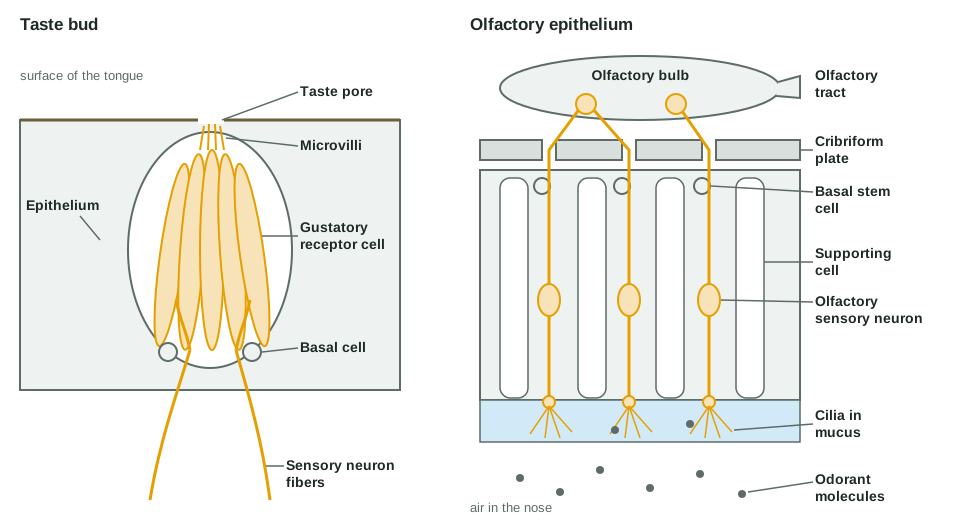
- Odorant molecules from food rise up the back of your throat into your nose.They dissolve in the mucus over the olfactory epithelium and bind odorant receptor proteins on the cilia of olfactory sensory neurons.
- An activated odorant receptor protein switches on a G protein.The G protein switches on an enzyme that makes cAMP, and cAMP opens cation channels in the cilia.
- Na+ and Ca2+ flow in, and the Ca2+ opens chloride channels so that Cl− flows out.The neuron depolarizes. Receptor potentials like this spread to the axon and fire action potentials.
- Action potentials travel along the axons through the cribriform plate.The axons synapse in the olfactory bulb, where all neurons with the same receptor protein converge on a few small clusters of synapses.
- The olfactory tract carries the sorted signals to the olfactory cortex and the limbic system, with no first stop in the thalamus.Your brain combines the smell with the taste signals arriving through cranial nerves VII, IX and X, and you perceive one flavor.
6Core concepts
7A common mistake
The wrong idea: Different parts of the tongue sense different tastes: sweet at the tip, salty and sour on the sides, bitter at the back (the "tongue map").
What actually happens: Every part of the tongue that has taste buds senses all five qualities, and one taste bud usually holds cells for several of them. The map came from a misread 1901 study that found only small differences in sensitivity. Put salt on the tip of your tongue and you taste salt at once.
8Check yourself
Anything you miss goes into your review queue.
1. A student places a few grains of salt on the very tip of her tongue. What does she taste?
- A sweet taste
- No taste until the salt reaches the sides of the tongue
- A salty taste
- A weak bitter taste
Show the answer
Every region of the tongue that has taste buds detects all five taste qualities. The tip has taste buds with salt-sensing cells, so she tastes salt at once. The tongue map, which puts only sweet at the tip, is a myth.
- A sweet taste: Salt triggers the salty quality wherever it lands. Taste buds at the tip are not limited to sweet; that idea comes from the tongue map, which is wrong.
- No taste until the salt reaches the sides of the tongue: The sides of the tongue are not the only place salt is sensed. Taste buds at the tip detect it directly.
- Correct: A salty taste: Correct. Na+ enters salt-sensing cells at the tip, and she tastes salt immediately.
- A weak bitter taste: Sodium ions trigger the salty quality, not bitter. Bitter compounds act on their own receptor proteins.
2. Daniel, 34, fell off his bike and struck the back of his head. Two weeks later he says food "has no taste". On testing, he correctly identifies sweet, salty, sour and bitter solutions placed on his tongue, but he cannot identify coffee or vanilla by sniffing. Which structures were most likely damaged?
- The gustatory receptor cells in the taste buds of his tongue
- Olfactory axons passing through the cribriform plate
- The facial nerve on one side
- The gustatory cortex in the insula
Show the answer
A blow to the head can jolt the brain against the skull and tear the thin olfactory axons where they pass through the cribriform plate. His taste qualities are intact, so what he has lost is smell, which provides most of what people call flavor.
- The gustatory receptor cells in the taste buds of his tongue: His gustatory receptor cells work: he identifies all four solutions correctly.
- Correct: Olfactory axons passing through the cribriform plate: Correct. Anosmia after a head injury usually comes from torn olfactory axons at the cribriform plate.
- The facial nerve on one side: Damage to one facial nerve would reduce taste on the front two thirds of that side of the tongue, but it would not stop him identifying odors by sniffing.
- The gustatory cortex in the insula: Damage to the gustatory cortex would impair his perception of taste qualities, which is normal. His problem is with odors.
3. Put these steps in order, from an odorant entering the nose to the signal leaving the olfactory bulb.
- The odorant dissolves in the mucus over the olfactory epithelium
- It binds an odorant receptor protein on a cilium of an olfactory sensory neuron
- A G protein switches on an enzyme that makes cAMP
- cAMP opens cation channels, and chloride leaving the cell adds to the depolarization
- Action potentials travel along the axon through the cribriform plate
- The axon synapses in the olfactory bulb, and the olfactory tract carries the signal backward
Show the answer
An odorant must dissolve in mucus before it can bind a receptor protein. Binding activates a G protein, which switches on the enzyme that makes the second messenger cAMP. cAMP opens cation channels; the calcium that enters opens chloride channels, and Cl− leaving depolarizes the cell further. Once the axon reaches threshold, action potentials pass through the cribriform plate to the olfactory bulb, and the olfactory tract carries the signal on.
- Correct order: 1. The odorant dissolves in the mucus over the olfactory epithelium 2. It binds an odorant receptor protein on a cilium of an olfactory sensory neuron 3. A G protein switches on an enzyme that makes cAMP 4. cAMP opens cation channels, and chloride leaving the cell adds to the depolarization 5. Action potentials travel along the axon through the cribriform plate 6. The axon synapses in the olfactory bulb, and the olfactory tract carries the signal backward
4. Which taste qualities are detected through G protein–coupled receptor proteins and a second messenger? Select all that apply.
- Salty
- Sweet
- Sour
- Umami
- Bitter
Show the answer
Sweet, umami and bitter tastants bind G protein–coupled receptor proteins, which set off a second messenger cascade. Salty and sour work through ion channels: Na+ and H+ flow straight into the cell.
- Salty: Not this one. Na+ enters directly through sodium channels.
- Correct: Sweet: Yes. Sugars bind a G protein–coupled receptor protein.
- Sour: Not this one. H+ enters directly through a proton channel.
- Correct: Umami: Yes. Glutamate binds a G protein–coupled receptor protein.
- Correct: Bitter: Yes. Bitter compounds bind one of about 25 G protein–coupled receptor proteins.
5. After throat surgery, a patient has reduced taste on the back third of his tongue only. Which nerve was most likely injured?
- Facial nerve
- Trigeminal nerve
- Hypoglossal nerve
- Glossopharyngeal nerve
Show the answer
The glossopharyngeal nerve (IX) carries taste from the back third of the tongue. The facial nerve carries the front two thirds, and the vagus carries the throat and epiglottis.
- Facial nerve: The facial nerve carries taste from the front two thirds of the tongue, not the back third.
- Trigeminal nerve: The trigeminal nerve carries touch, temperature and pain from the tongue, not taste.
- Hypoglossal nerve: The hypoglossal nerve is a motor nerve that moves the tongue. It carries no taste.
- Correct: Glossopharyngeal nerve: Correct. Cranial nerve IX serves taste on the back third of the tongue.
6. Humans have only about 400 kinds of odorant receptor protein, yet can tell apart far more odors than that. How?
- Each olfactory sensory neuron makes all 400 kinds, so every neuron responds to every odor
- Each odor has its own dedicated receptor protein, and new kinds are made as new odors are met
- Each odorant binds several kinds of receptor protein, and the brain reads the pattern
- The olfactory bulb makes up for the small number by adding extra kinds of synapse
Show the answer
Each odorant activates several kinds of receptor protein, some strongly and some weakly, and each receptor protein responds to several odorants. The pattern across all the kinds identifies the odor, the way a chord is identified by its combination of notes.
- Each olfactory sensory neuron makes all 400 kinds, so every neuron responds to every odor: Each olfactory sensory neuron makes just one kind of receptor protein. That is what lets the bulb sort signals by receptor type.
- Each odor has its own dedicated receptor protein, and new kinds are made as new odors are met: There are far fewer receptor protein kinds than odors, and the set is fixed by your genes. Odors share receptor proteins.
- Correct: Each odorant binds several kinds of receptor protein, and the brain reads the pattern: Correct. Odor identity is a pattern across many kinds of receptor protein, not a single kind.
- The olfactory bulb makes up for the small number by adding extra kinds of synapse: The bulb sorts and pools signals by receptor type; it does not create new ways of detecting odorants.
7. In most neurons, opening chloride channels makes the inside more negative. In an olfactory sensory neuron, opening chloride channels depolarizes the cell. Why?
- Chloride in olfactory neurons carries a positive charge
- These neurons hold so much chloride inside that Cl− flows out
- Chloride channels in olfactory neurons let Na+ through as well
- cAMP reverses the direction of every ion gradient in the cilia
Show the answer
Olfactory sensory neurons keep chloride unusually high inside. When the channels open, Cl− moves down its gradient out of the cell. Negative charge leaving makes the inside less negative, so the cell depolarizes.
- Chloride in olfactory neurons carries a positive charge: Chloride is always a negative ion. What differs is the direction it moves.
- Correct: These neurons hold so much chloride inside that Cl− flows out: Correct. Negative ions leaving make the inside less negative.
- Chloride channels in olfactory neurons let Na+ through as well: These channels pass chloride. Na+ enters through the separate cAMP-gated cation channels.
- cAMP reverses the direction of every ion gradient in the cilia: cAMP opens cation channels; it does not change ion gradients. The chloride gradient is set by how much chloride these neurons accumulate.
9Summary
Gustation (taste) and olfaction (smell) are chemical senses: a molecule dissolves, binds, and changes the voltage of a sensory cell. Taste buds hold gustatory receptor cells, epithelial cells with no axon whose microvilli reach into the taste pore; basal cells replace them. Salty and sour work through ion channels (Na+ and H+ flow in); sweet, umami and bitter work through G protein–coupled receptor proteins. All five qualities are sensed wherever there are taste buds, so the tongue map is a myth. Taste travels in the facial, glossopharyngeal and vagus nerves to the medulla, then through the thalamus to the insula. Olfactory sensory neurons are bipolar neurons in the olfactory epithelium that are replaced throughout life. Each makes one of about 400 odorant receptor proteins; binding raises cAMP, cation channels open and chloride leaving adds to the depolarization. Axons cross the cribriform plate to the olfactory bulb, and signals reach the olfactory cortex and limbic system without a first stop in the thalamus. Flavor is mostly smell, so anosmia is usually felt as a loss of taste.