Every cell is a tiny battery
Push a very fine glass electrode through the membrane of one of your neurons and connect it to a meter, with a second electrode in the fluid outside. The meter reads about −70 millivolts. The inside of the cell is negative compared with the outside, and it stays that way for as long as the cell is healthy (Figure 1). This page gives you the resting membrane potential explained step by step: what that voltage is, which ions build it, why it sits near −70 mV, and why a change in your blood potassium can shift it.
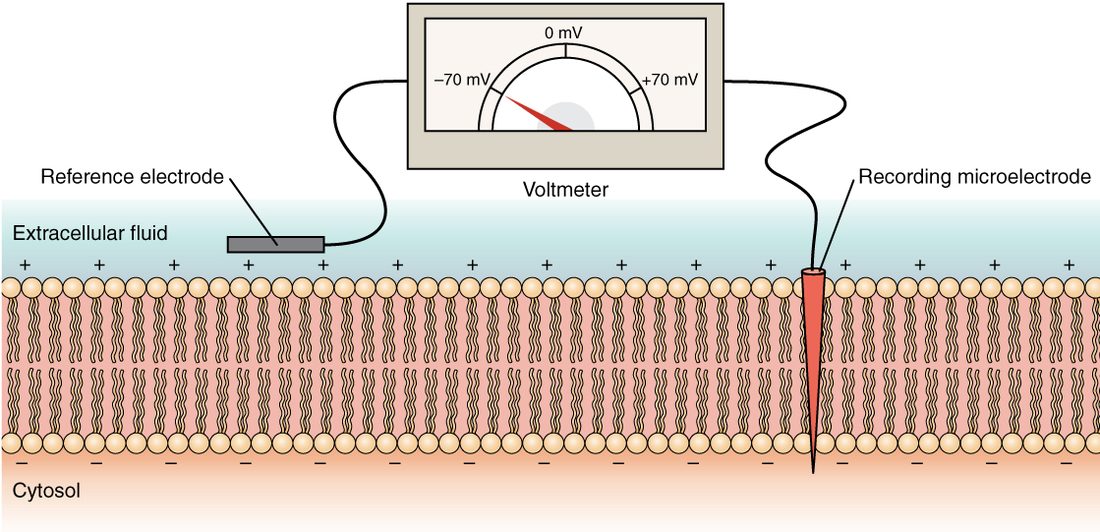
This topic is a short, general version. You will use it again in the next topic, when cells change this voltage on purpose. It returns in full in the muscle chapter, the nervous chapter and the heart chapter.
What a membrane potential is
A membrane potential is the voltage across a cell's plasma membrane: the electrical potential difference between the inside and the outside. Potential comes from the Latin potentia (power): a stored ability to push charge. By convention, you always read it as inside compared with outside. A value of −70 mV means the inside is 70 millivolts more negative than the outside.
The resting membrane potential (RMP, or resting potential) is the membrane potential of a cell that is not being disturbed. Every living cell has one, not just neurons. Typical values:
- Neurons: about −70 mV (roughly −60 to −80 mV, depending on the neuron).
- Skeletal muscle fibers and the working muscle cells of the heart: about −85 to −90 mV.
- Smooth muscle fibers: often −50 to −60 mV.
The voltage exists only right at the membrane. A thin layer of extra positive ions lines the outer face, and a matching thin layer of extra negative charge lines the inner face. The bulk fluid inside and the bulk fluid outside are each electrically neutral. This is the charge separation you met in the chemistry primer, spread across a membrane only about 5 nanometers thick.
The ingredients: two gradients and a leaky membrane
Three things set up the resting potential. The first two you already know.
| Ion | Outside the cell | Inside the cell |
|---|---|---|
| Potassium (K+) | about 4 (blood range 3.5–5.0) | about 140 |
| Sodium (Na+) | about 145 | about 15 |
| Chloride (Cl−) | about 110 | about 5–10 |
| Large negatively charged molecules (proteins, phosphates) | very few | many; too big to cross the membrane |
- Opposite gradients. Potassium is concentrated inside; sodium is concentrated outside.
- Trapped negative charge. Proteins and phosphate-carrying molecules inside the cell carry negative charge and cannot leave.
- A membrane that leaks mostly potassium. At rest, many potassium leak channels are open, and only a few channels let sodium through. In a typical neuron at rest, the membrane lets potassium through tens of times more easily than sodium.
Potassium leak builds the voltage
Follow the potassium ions and the voltage builds itself (Figure 2).
- Potassium diffuses out through the open leak channels, down its concentration gradient (140 inside, 4 outside).
- Each K+ that leaves carries one positive charge out. The negatively charged proteins it was balancing cannot follow. So every K+ that leaves makes the inside a little more negative.
- The negative inside pulls on positive ions. It starts to draw K+ back in.
- Outflow slows as the inside grows more negative. Soon the electrical pull inward nearly equals the chemical push outward, and net movement almost stops.
That is the potassium leak and the resting potential: potassium diffusing out through leak channels, leaving negative charge behind, is the main source of the resting potential. The combined chemical and electrical push on an ion is its electrochemical gradient, which you met in the chemistry primer.
The equilibrium potential: where the two pushes balance
Imagine a membrane with only potassium channels. Potassium would leave until the inside reached about −90 mV. At that voltage, the electrical pull inward exactly balances the concentration push outward, and net potassium movement stops. That voltage is potassium's equilibrium potential.
An ion's equilibrium potential is the membrane voltage at which that ion has no net movement across the membrane, because its electrical gradient exactly cancels its concentration gradient. Equi- means equal and libra means balance. Each ion has its own, set by its concentrations on the two sides:
- Potassium: about −90 mV. Potassium is concentrated inside, so the inside must be negative to hold it in.
- Sodium: about +60 mV. Sodium is concentrated outside, so the inside would have to be positive to keep it out.
Why rest sits near −70 mV, not −90 mV
The real membrane is not a pure potassium membrane. A few channels let sodium leak in, down its steep electrochemical gradient. Each Na+ that enters brings a positive charge, pulling the voltage a little way toward sodium's +60 mV. The result is a compromise: about −70 mV in a typical neuron.
Here is the rule you will use in every electrical topic that follows:
The membrane potential moves toward the equilibrium potential of whichever ion the membrane lets through most easily.
At rest, potassium channels dominate, so rest sits close to potassium's −90 mV. Skeletal muscle fibers leak even less sodium relative to potassium, so they rest nearer −90 mV. If a membrane suddenly let sodium through far more easily than potassium, its voltage would swing toward +60 mV. That is exactly what the next topic is about.
Only a tiny number of ions move
It takes very few ions to build −70 mV. Far fewer than one potassium ion in a thousand leaves the cell to charge the membrane. The concentrations inside and outside barely change. So "the cell is negative inside" does not mean the cytosol is full of spare negative charge. It means a thin film of charge sits on each face of the membrane, and everywhere else the fluid is neutral.
The pump maintains the gradients
The leak never stops. Potassium keeps trickling out and sodium keeps trickling in. Left alone, the gradients would slowly run down. The sodium–potassium pump, which you met in active transport, uses the energy of one ATP to move 3 Na+ out and 2 K+ in. Running continuously, it puts back the ions that leak and holds the concentration gradients steady. This is what "the pump maintains the gradients" means. It is expensive: by common estimates the pump uses a fifth or more of your resting ATP, and a larger share in your brain.
Because it moves 3 positive charges out for every 2 it brings in, the pump also makes the inside slightly more negative on its own. That direct contribution is small, only a few millivolts. Most of the −70 mV comes from potassium leaking out.
| Potassium leak channels | Sodium–potassium pump | |
|---|---|---|
| What moves | K+ out, down its gradient | 3 Na+ out and 2 K+ in, against their gradients |
| Energy source | The concentration gradient itself (passive) | ATP (primary active transport) |
| Direct share of the −70 mV | Most of it | A few millivolts |
| Main role at rest | Creates the voltage | Keeps the gradients from running down |
| If it stopped | The inside would lose most of its negativity at once | The voltage shifts only a few millivolts at once, then fades slowly over minutes to hours as the gradients run down |
That last row explains what happens when blood flow to part of the brain stops. Without oxygen, the neurons make little ATP. The pumps slow, the gradients run down, and over minutes the cells lose their resting potential.
Depolarization, repolarization and hyperpolarization
Cells change their membrane potential all the time. Three words describe the direction of the change, measured against rest (Figure 3). All three build on polarized: a resting membrane is polarized because its two faces carry opposite charges.
- Depolarization (de- = away from, removing): the membrane potential becomes less negative than rest, moving toward zero or past it. From −70 mV to −60 mV is a depolarization, even though the inside is still negative. So is −70 mV to +20 mV.
- Repolarization (re- = again): after a depolarization, the potential returns toward the resting value. From +20 mV back to −70 mV is repolarization.
- Hyperpolarization (hyper- = above, beyond): the potential becomes more negative than rest. From −70 mV to −80 mV is a hyperpolarization.
The mechanism follows from the rule above. Letting positive ions in (such as opening sodium channels) depolarizes. Letting more potassium out, or letting negative chloride in, hyperpolarizes.
Blood potassium changes the resting potential
Because potassium leak sets most of the resting potential, the potassium level in your blood (and so in the fluid around your cells) matters a great deal.
- Hyperkalemia (hyper- = above, kal- = potassium, from its Latin name kalium, -emia = blood condition): blood potassium above about 5.0 mmol/L. More potassium outside makes the potassium gradient smaller. Less potassium leaves before the electrical pull balances it, so potassium's equilibrium potential becomes less negative. The resting potential depolarizes.
- Hypokalemia (hypo- = below): blood potassium below about 3.5 mmol/L. The potassium gradient is larger, potassium's equilibrium potential becomes more negative, and in most cells the resting potential hyperpolarizes.
The heart and skeletal muscles are the most sensitive. Both extremes can cause muscle weakness and dangerous heart rhythms, which is why a blood potassium result far outside 3.5–5.0 mmol/L is treated as urgent. Notice what changed: not the potassium inside the cells, but the small concentration outside. A shift of a few mmol/L outside is a large fraction of 4, so it changes the gradient a lot. The same shift inside is a tiny fraction of 140.
This is a short version. The fluid and electrolyte chapter covers how your kidneys set blood potassium and how hyperkalemia and hypokalemia are treated. In the next topic you will also see why a cell held partly depolarized for a long time can become harder, not easier, to fire.
Where this returns
- Next topic: cells that change their membrane potential quickly by opening voltage-gated channels.
- Muscle chapter: the resting potential of skeletal muscle fibers, and how a nerve disturbs it to start a contraction.
- Nervous chapter: the full treatment of how neurons use changes in membrane potential.
- Heart chapter: why heart muscle cells rest near −90 mV and why the heart is so sensitive to blood potassium.
- Fluid and electrolyte chapter: how blood potassium is kept in its normal range.