Every fluid in your body is water with things dissolved or spread through it. This page explains water, solutions and concentration from the ground up: why water's structure gives it its unusual properties, how substances dissolve, how to read a concentration on a lab report or an IV bag, and what osmolarity counts. The numbers here come back every time the course talks about body fluids, blood tests or IV therapy.
Water in your body
About 50 to 60% of an adult's body mass is water. A 70 kg adult carries roughly 40 liters of it. The share is higher in lean tissue than in fat tissue, so it varies with body build, and it is highest in infants, at about 75%.
Almost everything water does in your body follows from two facts you learned in the atoms topic. A water molecule is polar: its oxygen end is partly negative and its hydrogen ends are partly positive. And neighboring water molecules cling to each other with hydrogen bonds. Keep those two facts in view as you read the properties below.
Properties of water
It absorbs heat with little change in temperature
When you exercise hard, your working muscles produce a lot of heat. Your blood carries that heat to your skin, yet its own temperature barely rises on the way. Water can take in a large amount of heat per degree of warming, because much of the energy goes into breaking hydrogen bonds between water molecules rather than into making the molecules move faster. A body that is mostly water therefore warms and cools slowly.
It takes a lot of heat to evaporate
For a water molecule to escape from liquid into the air as vapor, it must break every hydrogen bond holding it to its neighbors. That takes a large amount of heat. When sweat evaporates from your skin, the heat that frees each molecule comes from your skin, so your skin cools.
Its molecules cling together: cohesion and surface tension
A drop of water on a table beads up instead of spreading flat. Hydrogen bonds pull the molecules toward each other, a property called cohesion (co- = together, haerere = to stick). At the surface, molecules have water neighbors only below and beside them, so they are pulled inward. That inward pull makes the surface behave like a stretched skin: surface tension. A thin film of water lines the tiny air sacs of your lungs, and its surface tension pulls inward on each sac, tending to collapse it. A later topic shows how your lungs counter that pull.
It lubricates and cushions
Watery fluids reduce friction between moving parts. The serous fluid you met in the body cavities topic lets your heart and lungs slide against their surroundings with every beat and breath. Water also barely compresses, so a layer of fluid around your brain and spinal cord spreads out the force of a blow.
It takes part in reactions
Water is not only the setting for your chemistry; it is often a reactant or product. In the next topic you will see water molecules added when large molecules are split and released when they are built.
It dissolves more substances than any other common liquid
This is the property the rest of this page is about.
Solutions: solute and solvent
Stir a pinch of sodium chloride into a glass of water. The crystals vanish, and every sip tastes the same. You have made a solution: a mixture in which one substance is spread evenly, particle by particle, through another. The substance that dissolves is the solute (solutus = loosened). The substance it dissolves in is the solvent (solvere = to loosen). In your body the solvent is almost always water, and a solution in water is called an aqueous solution (aqua = water).
How does water pull a crystal apart? Look at Figure 1. Water molecules crowd the crystal's surface. Their partly negative oxygen ends are attracted to sodium ions, and their partly positive hydrogen ends are attracted to chloride ions. Many small attractions together outweigh the ionic bond holding each ion in the crystal, so ions are pulled out one by one. Each ion then travels wrapped in a shell of water molecules, which keeps it from rejoining the crystal.
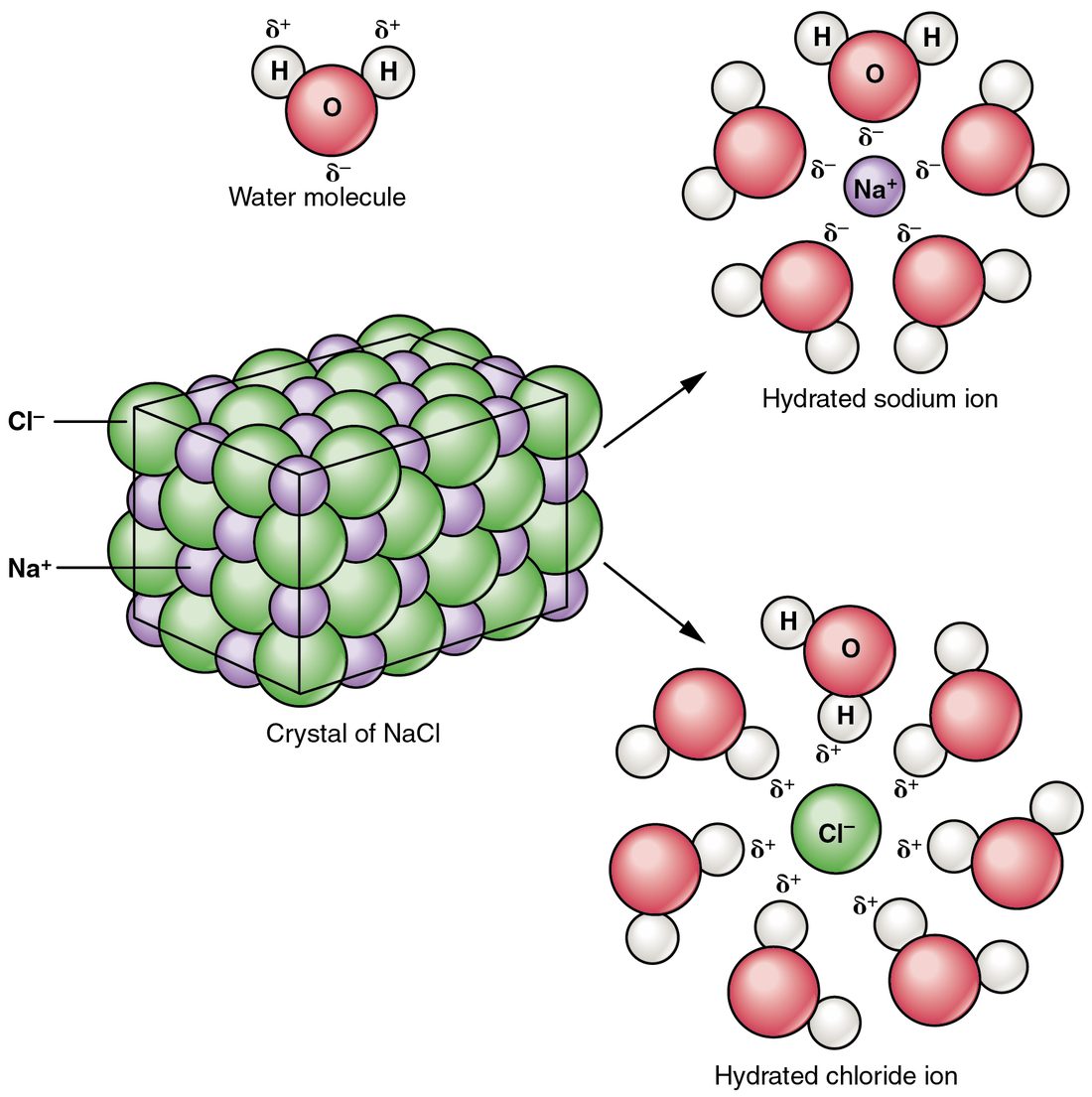
Polar molecules dissolve the same way, minus the full charges: their partial charges form hydrogen bonds or other attractions with water. That is why water dissolves ions, polar molecules and many gases, and why your blood can carry so many different substances at once.
Hydrophilic and hydrophobic
Shake oil and water in a jar and they separate within seconds, with the oil floating in a layer on top. Some substances mix with water and some do not, and polarity decides which.
- Hydrophilic (hydro- = water, -philic = loving) substances are ions and polar molecules. They attract water molecules and dissolve easily. Another word for hydrophilic is water soluble. Sodium chloride and molecules studded with –OH groups are hydrophilic.
- Hydrophobic (-phobic = fearing) substances are nonpolar. Oils, waxes and long chains of carbon and hydrogen are hydrophobic. They do not dissolve in water; they clump together.
The names suggest feelings, but the mechanism is about water. Water molecules attract each other through hydrogen bonds much more strongly than they attract a nonpolar molecule. As water molecules bond with each other, they squeeze nonpolar molecules out of their way and into clusters. Nothing is repelling the oil; water is simply holding on to itself.
This matters throughout physiology. Oxygen gas is nonpolar, so very little of it dissolves in the watery part of your blood; almost all of the oxygen you carry rides on a carrier molecule inside red blood cells. Hydrophobic substances in general travel through your blood attached to hydrophilic carriers, and the boundary around each of your cells has a hydrophobic core that ions cannot cross on their own. Later topics build on each of these.
Solutions, colloids and suspensions
Draw blood into a tube treated so the blood stays liquid, and let the tube stand in a rack. Over an hour or more, the blood cells sink toward the bottom and a straw-colored liquid collects above them. Blood is a mixture: several substances combined physically, without chemical bonds between them, so they can be separated again. Mixtures come in three kinds, and blood contains all three.
| Solutions | Colloids | Suspensions | |
|---|---|---|---|
| Size of the spread-out particles | Smallest: single ions and small molecules | Medium: very large molecules or tiny clusters | Largest: big enough to see under a light microscope |
| Do the particles settle when left standing? | No | No | Yes |
| How it looks | Clear | Often cloudy or thick | Cloudy; separates on standing |
| Example in your blood | Sodium, potassium and chloride ions in the liquid part | Very large molecules spread through the liquid part | Blood cells, which sink in a tube left standing |
Colloids (kollā = glue, -oid = like) hold particles too large to count as truly dissolved but small enough that the random jostling of water molecules keeps them from settling. Milk is a familiar example. The thick, gel-like fluid inside your cells is another. A suspension (suspendere = to hang) holds particles large enough to settle out once stirring stops. In your blood vessels, flow keeps blood cells spread through the liquid; stop the flow and they settle.
Concentration
Two cups of coffee can hold the same amount of coffee powder and still taste different, if one cup holds twice as much water. What your tongue senses is not the amount of solute but the amount in each sip. That is concentration: the amount of solute in a given volume of solution.
Concentration = amount of solute ÷ volume of solution
That relationship runs both ways, as Figure 2 shows. Add solute or remove water and concentration rises. Remove solute or add water and it falls. A blood value on its own never tells you which of those happened.
Units you will meet
- Percent for IV fluids means grams of solute per 100 mL of solution. "0.9% sodium chloride" is 0.9 g in every 100 mL.
- Milligrams per deciliter (mg/dL), used for some blood values in the United States. A deciliter is 100 mL.
- Millimoles per liter (mmol/L), used for electrolytes. This unit counts particles rather than weighing them.
A mole is a counting unit, like a dozen, but enormous: 6.02 × 10²³ particles. Its usefulness is that one mole of any substance weighs its molar mass in grams, found by adding up the atomic masses of its atoms. Sodium's is about 23 and chlorine's about 35.5, so one mole of sodium chloride weighs 58.5 g. A millimole (mmol) is one thousandth of a mole. Counting particles matters because many effects in your body, including the one in the osmolarity section below, depend on how many particles are present, not on how much they weigh.
Worked example 1: what is in a bag of 0.9% sodium chloride?
- 0.9% means 0.9 g per 100 mL.
- A liter is 1,000 mL, ten times 100 mL, so one liter holds 0.9 × 10 = 9 g of sodium chloride.
- Convert grams to moles by dividing by the molar mass: 9 g ÷ 58.5 g per mole = 0.154 moles.
- Convert to millimoles: 0.154 × 1,000 = 154 mmol. The concentration is 154 mmol/L of sodium chloride.
- Each unit of sodium chloride releases one Na+ and one Cl−, so the bag holds 154 mmol/L of sodium ions and 154 mmol/L of chloride ions.
Compare the sodium with your blood: a normal blood sodium is about 135 to 145 mmol/L. The bag's sodium is in the same neighborhood.
Worked example 2: losing water raises concentration. Picture 3.0 liters of body fluid with a sodium concentration of 140 mmol/L. The person loses 0.3 liters of pure water and drinks nothing.
- Find the amount of sodium first. Amount = concentration × volume = 140 mmol/L × 3.0 L = 420 mmol.
- Find the new volume: 3.0 L − 0.3 L = 2.7 L. No sodium left, so the amount is still 420 mmol.
- New concentration = amount ÷ volume = 420 mmol ÷ 2.7 L ≈ 156 mmol/L.
The sodium concentration rose from 140 to about 156 mmol/L without a single ion being added. A high blood sodium can mean too little water just as easily as too much sodium.
Osmolarity: counting every dissolved particle
Dissolve 1 mmol of sodium chloride and you do not get 1 mmol of particles. You get 2: one sodium ion and one chloride ion. Dissolve 1 mmol of calcium chloride (CaCl2) and you get 3: one calcium ion and two chloride ions. Dissolve 1 mmol of a molecule that stays whole in water and you get 1.
Osmolarity (osmos = a push) is the total concentration of all dissolved particles in a solution, whatever they are. Every ion counts separately. Its unit is the osmole per liter; for body fluids the handy size is milliosmoles per liter (mOsm/L).
Osmolarity = concentration × number of particles each unit releases, added up over every solute
Worked example 3: finding osmolarity.
- 0.9% sodium chloride is 154 mmol/L (worked example 1). Each unit releases 2 particles: 154 × 2 = 308 mOsm/L.
- A solution of 100 mmol/L calcium chloride: each unit releases 3 particles, so 100 × 3 = 300 mOsm/L.
- A solution holding both 50 mmol/L sodium chloride and 20 mmol/L of a molecule that stays whole: (50 × 2) + (20 × 1) = 100 + 20 = 120 mOsm/L. Solutes add together.
A close cousin, osmolality, counts particles per kilogram of water (mOsm/kg) instead of per liter of solution. In dilute fluids like yours the two numbers are nearly identical. Laboratories measure osmolality, and the normal value for blood is about 275 to 295 mOsm/kg.
You can estimate it from a single lab value. In the liquid part of your blood, sodium is by far the most plentiful cation, and each sodium ion is matched by an anion, mostly chloride. So doubling the sodium concentration counts most of the particles: with sodium at 140 mmol/L, 2 × 140 = 280 mOsm/kg, close to the measured value. The small remainder comes from other dissolved substances.
Why count particles at all? Because water moves between your cells and the fluid around them in response to differences in dissolved particle count. A later topic in this chapter turns osmolarity into the rule that decides which way water moves, which particles count, and why a cell swells or shrinks.
Putting it together
Water's polarity and hydrogen bonds give it a high capacity for heat, cooling as it evaporates, surface tension and the power to dissolve ions and polar molecules. Substances that attract water dissolve; nonpolar ones are pushed into clusters. Concentration is amount divided by volume, so it changes when either one changes. Osmolarity counts every dissolved particle and sets up the next big idea in this chapter: how water moves.