The stomach
1Why this matters
Mr. Brennan, 52, has taken ibuprofen every day for a year for back pain. This morning he felt faint getting out of bed, and his stools have been black and sticky for two days. A camera passed through his mouth finds a bleeding ulcer in his stomach lining, and a biopsy shows spiral bacteria in the mucus. His stomach makes no more acid than yours. What failed is the barrier that normally keeps that acid off his stomach wall, and both the drug and the bacteria helped break it down.
2What this builds on
3Quick check before you start
1. What makes a transporter an example of primary active transport?
- It uses ATP directly to move a substance against its gradient
- It lets a substance move down its gradient through a channel
- It uses the sodium gradient built by another pump
Show the answer
Primary active transport spends ATP directly, as the sodium–potassium pump does. Using a gradient built by another pump is secondary active transport; moving down a gradient is passive.
- Correct: It uses ATP directly to move a substance against its gradient:
- It lets a substance move down its gradient through a channel:
- It uses the sodium gradient built by another pump:
2. What does carbonic anhydrase speed up?
- The splitting of ATP
- The reaction of carbon dioxide with water to form carbonic acid
- The binding of oxygen to hemoglobin
Show the answer
Carbonic anhydrase speeds CO2 + H2O ⇌ H2CO3, which splits into H+ and bicarbonate.
- The splitting of ATP:
- Correct: The reaction of carbon dioxide with water to form carbonic acid:
- The binding of oxygen to hemoglobin:
3. What is the main effect of gastrin?
- It slows emptying of the stomach
- It makes the gallbladder contract
- It increases acid secretion by the stomach
Show the answer
Gastrin, released from the lower stomach by protein, stretch and vagal signals, raises stomach acid secretion.
- It slows emptying of the stomach:
- It makes the gallbladder contract:
- Correct: It increases acid secretion by the stomach:
4Anatomy
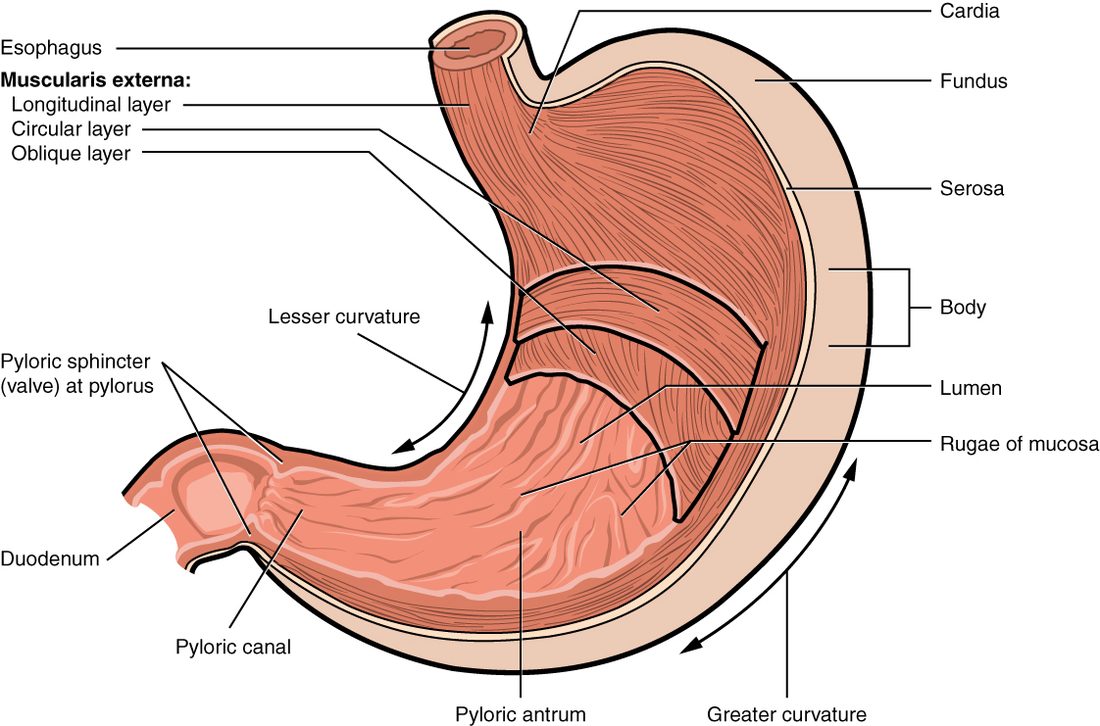
With labels hidden, select a box to reveal its label.
5How it works, step by step
- Protein fragments in the stomach and vagal signals stimulate the G cells.G cells release gastrin into the blood.
- Gastrin acts mostly by releasing histamine from ECL cells beside the parietal cells; histamine and acetylcholine then act on the parietal cells.Carbonic anhydrase makes H+ and bicarbonate, and the H+/K+ proton pump spends ATP to push H+ into the gland's lumen, where it pairs with Cl− as hydrochloric acid.
- Acid reaches the pepsinogen released by the chief cells.Pepsinogen cuts itself into active pepsin, and pepsin activates more, so protein digestion begins.
- Acid keeps accumulating and the pH in the antrum falls below about 3.D cells release somatostatin, which shuts off gastrin release.
- With less gastrin, the parietal cells receive a weaker stimulus.Acid secretion falls: negative feedback keeps the stomach from over-acidifying.
6Core concepts
7A common mistake
The wrong idea: The stomach is where most food is digested and absorbed, and its acid does the digesting.
What actually happens: Acid denatures proteins, kills microbes and activates pepsin, but splits few bonds itself. Pepsin does only a minority of protein digestion, and the stomach absorbs almost no nutrients. The small intestine does most digestion and nearly all absorption. People whose stomach has been removed digest food well on small meals; what they cannot do without is intrinsic factor, so they need vitamin B12 injections.
8Check yourself
Anything you miss goes into your review queue.
1. Put the steps of acid secretion by a parietal cell in order.
- Carbon dioxide and water combine inside the cell, sped up by carbonic anhydrase
- Carbonic acid splits into H+ and bicarbonate
- The H+/K+ ATPase spends ATP to pump H+ into the lumen in exchange for K+
- Cl− leaves the cell into the lumen through channels
- H+ and Cl− form hydrochloric acid in the lumen of the gland
Show the answer
Carbonic anhydrase makes carbonic acid, which splits into H+ and bicarbonate. The proton pump moves H+ into the lumen against a huge gradient, Cl− follows through channels, and the two make hydrochloric acid outside the cell. Meanwhile the bicarbonate goes to the blood.
- Correct order: 1. Carbon dioxide and water combine inside the cell, sped up by carbonic anhydrase 2. Carbonic acid splits into H+ and bicarbonate 3. The H+/K+ ATPase spends ATP to pump H+ into the lumen in exchange for K+ 4. Cl− leaves the cell into the lumen through channels 5. H+ and Cl− form hydrochloric acid in the lumen of the gland
2. A patient with a peptic ulcer takes a proton pump inhibitor, which blocks the H+/K+ ATPase of parietal cells. Predict the change in each variable after a meal, compared with before treatment.
| Variable | Change |
|---|---|
| pH of the stomach contents | — |
| Conversion of pepsinogen to pepsin | — |
| Gastrin in the blood | — |
| Bicarbonate added to the blood by the stomach (alkaline tide) | — |
Show the answer
Blocking the final step of acid secretion raises the stomach's pH, so less pepsin is activated and less bicarbonate goes to the blood. The rise in pH also removes the negative feedback on gastrin, which rises.
- pH of the stomach contents: up. With the pump blocked, far less H+ is moved into the lumen, so the contents are less acidic.
- Conversion of pepsinogen to pepsin: down. Pepsinogen needs acid, below about pH 5, to cut itself into pepsin.
- Gastrin in the blood: up. Low pH normally releases somatostatin, which shuts gastrin off. Without the acid, that brake is removed and G cells keep releasing gastrin.
- Bicarbonate added to the blood by the stomach (alkaline tide): down. One bicarbonate enters the blood for each H+ secreted, so less acid means less alkaline tide.
3. Fill the gap: Chief cells release pepsinogen into the gland → ______ → pepsin activates more pepsinogen → proteins are split into polypeptides
- Bicarbonate in the mucus layer converts pepsinogen into pepsin
- Intrinsic factor binds pepsinogen and switches on its active site
- Gastrin reaches the gland lumen and cuts a piece off pepsinogen
- Acid makes pepsinogen cut itself into pepsin
Show the answer
In acid, pepsinogen changes shape and removes a short piece of itself, uncovering its active site. The pepsin formed then activates more pepsinogen, a positive feedback loop.
- Bicarbonate in the mucus layer converts pepsinogen into pepsin: Bicarbonate raises the pH, which would keep pepsinogen inactive; that is part of how the mucus layer protects the lining.
- Intrinsic factor binds pepsinogen and switches on its active site: Intrinsic factor binds vitamin B12, not pepsinogen.
- Gastrin reaches the gland lumen and cuts a piece off pepsinogen: Gastrin is a hormone released into the blood; it stimulates acid secretion but does not cut pepsinogen.
- Correct: Acid makes pepsinogen cut itself into pepsin: Correct. Acid starts the activation, and pepsin then speeds it up.
4. A 60-year-old woman has anemia with unusually large red blood cells. Tests show antibodies against her parietal cells. Her doctor prescribes vitamin B12 injections. Why not simply advise her to eat more foods rich in B12?
- Her stomach acid destroys the B12 in her food before it can be absorbed
- B12 in food is digested by pepsin into inactive fragments in her stomach
- Her liver can no longer store B12, so she needs a steady supply by injection
- She lacks intrinsic factor, so she cannot absorb B12 from food
Show the answer
Parietal cells secrete intrinsic factor, which binds B12 in the small intestine so the lining of its last part can absorb it. Autoimmune destruction of parietal cells removes intrinsic factor, so dietary B12 passes through unabsorbed. Injections bypass the gut. This is pernicious anemia.
- Her stomach acid destroys the B12 in her food before it can be absorbed: Acid helps free B12 from food proteins; it does not destroy it. Her problem is the opposite: she has lost her parietal cells and has little acid.
- B12 in food is digested by pepsin into inactive fragments in her stomach: Pepsin frees B12 from the proteins it is bound to in food; it does not inactivate the vitamin.
- Her liver can no longer store B12, so she needs a steady supply by injection: Her liver can store B12. The problem is getting B12 across the intestinal lining.
- Correct: She lacks intrinsic factor, so she cannot absorb B12 from food: Correct. The problem is absorption, not intake, so more dietary B12 would not help.
5. This pathway describes control of acid secretion during the gastric phase. Which step is wrong?
- Protein fragments in the stomach stimulate G cells
- G cells release gastrin into the blood
- Gastrin increases acid secretion, partly by releasing histamine
- The stomach contents become strongly acidic
- The falling pH makes the G cells release even more gastrin
Show the answer
A falling pH inhibits gastrin release: below about pH 3, D cells release somatostatin, which shuts the G cells off. This negative feedback limits acid secretion.
- Protein fragments in the stomach stimulate G cells: This step is right. Peptides and amino acids stimulate G cells directly.
- G cells release gastrin into the blood: This step is right. Gastrin is a hormone carried by the blood.
- Gastrin increases acid secretion, partly by releasing histamine: This step is right. Gastrin acts mainly through histamine-releasing cells and partly on parietal cells.
- The stomach contents become strongly acidic: This step is right. Increased acid secretion lowers the pH of the contents.
- Correct: The falling pH makes the G cells release even more gastrin: This is the error. Low pH inhibits gastrin release through somatostatin.
6. Two friends eat meals with the same calories. One eats plain rice and the other a fatty cheeseburger. An hour later, the cheeseburger eater's stomach is much fuller. What mainly explains the difference?
- Fat stretches the stomach more, and stretch weakens its mixing waves
- Fat raises gastrin release, and gastrin tightens the pyloric sphincter
- Fat in the small intestine releases CCK and triggers the enterogastric reflex
- Rice is absorbed through the stomach wall, so less of it remains to empty
Show the answer
The small intestine sets the pace of gastric emptying. Fat arriving there is the strongest stimulus for CCK release and the enterogastric reflex, which weaken the antrum's contractions and tighten the pylorus. Carbohydrate empties fastest.
- Fat stretches the stomach more, and stretch weakens its mixing waves: Stretch of the stomach speeds emptying rather than slowing it, and equal meals stretch it similarly.
- Fat raises gastrin release, and gastrin tightens the pyloric sphincter: Gastrin is released by protein and stretch, not mainly by fat, and its effect is on acid secretion.
- Correct: Fat in the small intestine releases CCK and triggers the enterogastric reflex: Correct. Signals from the intestine, not from the stomach, hold a fatty meal back.
- Rice is absorbed through the stomach wall, so less of it remains to empty: The stomach absorbs almost no nutrients; rice leaves faster because carbohydrate triggers weaker braking signals from the intestine.
7. A 3-year-old has vomited repeatedly for two days. Which change in her blood is most likely?
- Acidosis, with low bicarbonate
- A rise in blood potassium
- No lasting change in blood pH
- Alkalosis, with high bicarbonate
Show the answer
Vomit carries H+ and Cl− from the stomach. For each H+ the parietal cells secrete, a bicarbonate ion enters the blood, and when that acid is lost instead of reaching the intestine, the bicarbonate stays. The blood becomes alkaline. Potassium is lost too, so hypokalemia is common.
- Acidosis, with low bicarbonate: Bicarbonate-rich fluid is secreted further down the intestine. Vomiting mainly loses acid from the stomach.
- A rise in blood potassium: Potassium falls with repeated vomiting: it is lost in the vomit and, even more, in the urine.
- No lasting change in blood pH: The kidneys respond over hours to days and cannot fully correct the change while acid keeps being lost, especially with water loss.
- Correct: Alkalosis, with high bicarbonate: Correct. Losing stomach acid leaves extra bicarbonate in the blood.
8. An H2 blocker blocks only the histamine signal to parietal cells, yet it reduces acid secretion stimulated by food by well over half. Why is the effect so large?
- Histamine is the only signal that parietal cells respond to
- The drug also blocks the proton pump on the parietal cell membrane
- Blocking histamine raises somatostatin release, which then blocks the pump
- The three stimuli amplify each other, and gastrin acts largely via histamine
Show the answer
The three stimuli amplify each other, so removing one cuts the combined effect by much more than a third. And much of gastrin's effect passes through the histamine-releasing cells, so blocking histamine also blunts gastrin.
- Histamine is the only signal that parietal cells respond to: Parietal cells respond to acetylcholine and gastrin as well; that is why a proton pump inhibitor, which blocks the final step, is even stronger.
- The drug also blocks the proton pump on the parietal cell membrane: H2 blockers act on H2 receptor proteins. The pump is blocked by a different drug class, proton pump inhibitors.
- Blocking histamine raises somatostatin release, which then blocks the pump: Somatostatin is released by low pH. An H2 blocker raises the pH, if anything reducing somatostatin.
- Correct: The three stimuli amplify each other, and gastrin acts largely via histamine: Correct. Mutual amplification, and gastrin's reliance on histamine, make histamine a strong lever.
9Summary
The stomach's regions are the cardia, fundus, body and pyloric part (antrum, canal and pylorus, guarded by the pyloric sphincter). Rugae and relaxation let it fill; an extra oblique muscle layer lets it churn. Gastric pits lead into gastric glands with mucous neck cells, parietal cells (hydrochloric acid and intrinsic factor), chief cells (pepsinogen and gastric lipase) and enteroendocrine cells such as G cells (gastrin). Parietal cells make acid with carbonic anhydrase and the H+/K+ proton pump, releasing bicarbonate into the blood as the alkaline tide. Acid turns the zymogen pepsinogen into pepsin. Intrinsic factor is needed to absorb vitamin B12. Secretion runs in cephalic, gastric and intestinal phases, and low pH shuts off gastrin. Mixing waves make chyme; the enterogastric reflex, CCK and secretin set the pace of gastric emptying. Mucus, bicarbonate, tight junctions, renewal, blood flow and prostaglandins form the mucosal barrier, which Helicobacter pylori and NSAIDs break down to cause peptic ulcers. Vomiting is a reflex coordinated in the medulla oblongata and powered by the diaphragm and abdominal muscles.