Chemical digestion and absorption
1Why this matters
Ms. Okoye, 29, moved from Lagos to Chicago and started having a latte every morning. Within an hour or two she is bloated, crampy and running to the bathroom. She eats cheese and yogurt without trouble. Her small intestine is healthy; it simply makes little of one enzyme, lactase, like the small intestines of most adults worldwide. To see why one missing enzyme causes all of this, you need to know how each nutrient is split and carried across the gut lining.
2What this builds on
3Quick check before you start
1. In secondary active transport, what directly powers the movement of the transported molecule?
- ATP bound to the carrier
- The gradient of another ion, usually sodium
- Osmosis
Show the answer
A secondary active carrier uses the energy of an ion, usually sodium, flowing down its gradient. The sodium–potassium pump spends the ATP that keeps that gradient steep.
- ATP bound to the carrier:
- Correct: The gradient of another ion, usually sodium:
- Osmosis:
2. Where do the enzymes of the brush border sit?
- In pancreatic juice
- On the microvilli of the absorptive cells
- In the gastric glands
Show the answer
Brush border enzymes such as lactase, sucrase and maltase are fixed to the membrane of the microvilli, so they finish digestion right where absorption happens.
- In pancreatic juice:
- Correct: On the microvilli of the absorptive cells:
- In the gastric glands:
3. What do bile salts do to fat?
- Emulsify it into tiny droplets
- Split it into fatty acids
- Carry it into the blood
Show the answer
Bile salts coat fat droplets and keep them small, which multiplies the surface lipase can work on. Lipase does the splitting.
- Correct: Emulsify it into tiny droplets:
- Split it into fatty acids:
- Carry it into the blood:
4Anatomy
With labels hidden, select a box to reveal its label.
5How it works, step by step
- Sodium–potassium pumps on the basolateral membrane of each absorptive cell spend ATP pushing sodium out.Sodium inside the cell stays low, so sodium in the lumen has a steep gradient into the cell.
- Sodium flows into the cell through SGLT1, which carries glucose or galactose with it.Glucose and galactose enter the cell even when they are more concentrated inside than in the lumen.
- Glucose builds up inside the cell.It leaves across the basolateral membrane by facilitated diffusion and enters the villus capillaries, then the hepatic portal vein.
- Sodium and glucose have moved from the lumen to the blood side of the epithelium.Water follows by osmosis, through and between the cells.
- Every absorbed sugar, amino acid and salt pulls water with it.About 98% of the 9 L of water entering the gut each day is absorbed, and only about 150 mL leaves in the feces.
6Core concepts
7A common mistake
The wrong idea: All digested nutrients go straight from the intestine to the liver in the hepatic portal vein.
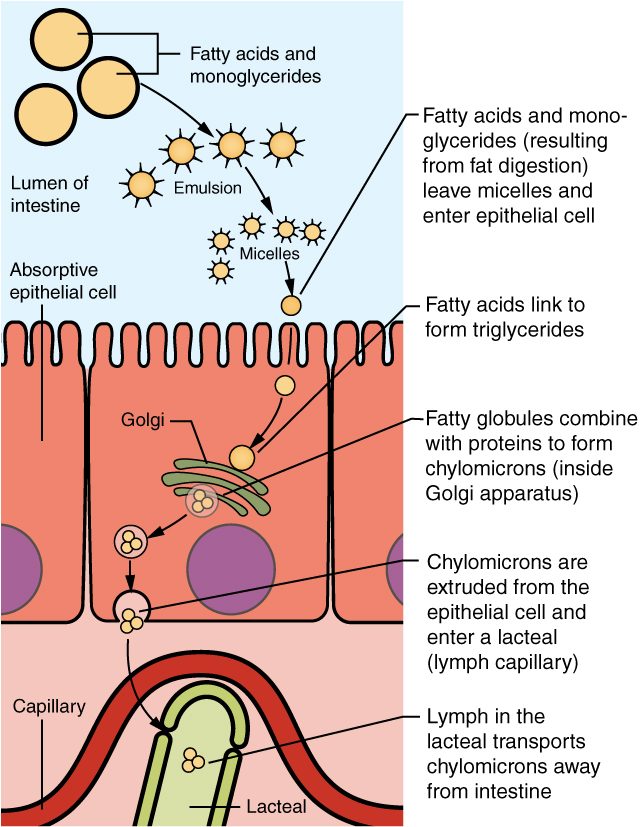
What actually happens: Sugars, amino acids, short-chain fatty acids and most vitamins that dissolve in water do: they enter the villus capillaries, which drain into the hepatic portal vein. But long-chain fats are rebuilt into triglycerides and packaged into chylomicrons, which are too large for blood capillaries. They enter the lacteals, travel in lymph through the thoracic duct, and join the blood where the left internal jugular and subclavian veins meet, reaching the rest of the body before the liver. Vitamins that dissolve in fat travel with them.
8Check yourself
Anything you miss goes into your review queue.
1. Put the steps of fat digestion and absorption in order.
- Bile salts emulsify fat into tiny droplets
- Pancreatic lipase splits triglycerides into fatty acids and monoglycerides
- Micelles carry fatty acids and monoglycerides to the brush border
- Fatty acids and monoglycerides enter the absorptive cell and are rebuilt into triglycerides
- Triglycerides are packaged into chylomicrons and leave the cell by exocytosis
- Chylomicrons enter a lacteal and travel in lymph to the thoracic duct
Show the answer
Emulsification gives lipase more surface; lipase makes fatty acids and monoglycerides; micelles ferry them through the water next to the brush border; inside the cell they are rebuilt and packaged into chylomicrons, which are too large for blood capillaries and enter the lacteal instead.
- Correct order: 1. Bile salts emulsify fat into tiny droplets 2. Pancreatic lipase splits triglycerides into fatty acids and monoglycerides 3. Micelles carry fatty acids and monoglycerides to the brush border 4. Fatty acids and monoglycerides enter the absorptive cell and are rebuilt into triglycerides 5. Triglycerides are packaged into chylomicrons and leave the cell by exocytosis 6. Chylomicrons enter a lacteal and travel in lymph to the thoracic duct
2. An adult with low lactase drinks two large glasses of milk on an empty stomach. Predict the change in each variable over the next few hours, compared with a person with high lactase drinking the same milk.
| Variable | Change |
|---|---|
| Lactose reaching the colon | — |
| Water in the lumen of the small intestine | — |
| Hydrogen in the exhaled breath | — |
| Water content of the stool | — |
| Rise in blood glucose after drinking | — |
Show the answer
Without enough lactase, lactose cannot be split or absorbed. It holds water in the small intestine by osmosis and is fermented by colon bacteria into gas and acids, giving bloating, hydrogen on the breath and osmotic diarrhea, while little of its sugar reaches the blood.
- Lactose reaching the colon: up. Too little lactase is left at the brush border to split the lactose, so much of it passes through the small intestine intact.
- Water in the lumen of the small intestine: up. Unabsorbed lactose is a solute that stays in the lumen and holds water there by osmosis.
- Hydrogen in the exhaled breath: up. Colon bacteria ferment the lactose and make hydrogen; some is absorbed into the blood and breathed out.
- Water content of the stool: up. The extra water, plus the solutes fermentation adds, is more than the colon can absorb, so the stool becomes loose.
- Rise in blood glucose after drinking: down. Undigested lactose yields no glucose or galactose for SGLT1 to absorb, so blood glucose rises less than it would after the milk in a person with high lactase.
3. In an experiment on intestinal tissue, a drug blocks the sodium–potassium pumps on the basolateral membrane of the absorptive cells. SGLT1 itself is untouched. What happens to glucose absorption?
- It stops once sodium inside the cell rises and the gradient collapses
- It continues unchanged
- It speeds up
- It continues at the same rate by facilitated diffusion
Show the answer
SGLT1 uses the energy of sodium moving down its gradient into the cell. The pumps keep sodium inside the cell low. Once they stop, sodium inside rises, the gradient collapses, and SGLT1 can no longer pull glucose in against its own gradient.
- Correct: It stops once sodium inside the cell rises and the gradient collapses: Correct. With the pumps stopped, sodium leaks in and is not removed, the gradient collapses, and SGLT1 loses its energy source.
- It continues unchanged: SGLT1 uses no ATP directly, but it depends on the sodium gradient that the ATP-using pumps maintain.
- It speeds up: Sodium building up inside the cell shrinks the gradient, which slows SGLT1 rather than speeding it.
- It continues at the same rate by facilitated diffusion: Facilitated diffusion moves glucose only down its own gradient, so it cannot keep absorption going at the same rate once lumen glucose falls.
4. A child with cholera is losing liters of watery stool. The toxin makes the intestinal lining secrete chloride, and sodium and water follow. Nurses give a drink of water, salt and glucose. Why does the glucose help?
- Glucose kills the cholera bacteria in the lumen
- Glucose blocks the chloride secretion caused by the toxin
- Glucose pulls sodium in through SGLT1, and water follows
- Glucose is the main fuel the child's colon needs to absorb water
Show the answer
The toxin drives secretion but leaves SGLT1 working. Each glucose that enters through SGLT1 brings two sodium ions with it. The absorbed sodium and glucose raise the solute on the blood side, and water follows by osmosis, rehydrating the child even while secretion goes on.
- Glucose kills the cholera bacteria in the lumen: Glucose does not kill bacteria; it feeds most of them.
- Glucose blocks the chloride secretion caused by the toxin: The chloride secretion continues. The solution works by adding absorption, not by blocking secretion.
- Correct: Glucose pulls sodium in through SGLT1, and water follows: Correct. Sodium-glucose cotransport is the basis of oral rehydration.
- Glucose is the main fuel the child's colon needs to absorb water: The colon's epithelial cells burn mainly butyrate from bacteria, and fuel is not what limits absorption here.
5. A stone completely blocks the common bile duct for several weeks. Select every substance whose absorption falls sharply.
- Long-chain fatty acids
- Vitamin K
- Glucose
- Cholesterol
- Amino acids
- Vitamin D
Show the answer
Without bile salts, fat is poorly emulsified and no micelles form, so long-chain fatty acids, cholesterol and the vitamins that dissolve in fat, such as D and K, are poorly absorbed. Glucose and amino acids are water-soluble and absorbed by carriers that do not need bile.
- Correct: Long-chain fatty acids: Correct. Long-chain fatty acids need micelles to reach the brush border.
- Correct: Vitamin K: Correct. Vitamin K travels with fat in micelles; its loss is why obstructive jaundice can cause bleeding.
- Glucose: Glucose is absorbed through SGLT1, which does not need bile.
- Correct: Cholesterol: Correct. Cholesterol is absorbed from micelles.
- Amino acids: Amino acids use carriers powered by sodium, not micelles.
- Correct: Vitamin D: Correct. Vitamin D dissolves in fat and is absorbed with it.
6. A 45-year-old man had the last meter of his ileum removed eight years ago. He eats a normal diet and his stomach is healthy. He now has a large-cell anemia and numb feet. What is the most likely cause?
- Loss of the site where B12 bound to intrinsic factor is absorbed
- Loss of intrinsic factor production
- Loss of pancreatic proteases that free B12 from haptocorrin
- Loss of the lactase needed to absorb B12
Show the answer
Vitamin B12 bound to intrinsic factor is absorbed only in the terminal ileum, by receptor-mediated endocytosis. Removing it stops B12 absorption. The liver's store lasts three to five years, so the deficiency appears years after surgery.
- Correct: Loss of the site where B12 bound to intrinsic factor is absorbed: Correct. The terminal ileum is the only site where B12 bound to intrinsic factor is absorbed.
- Loss of intrinsic factor production: His stomach is healthy, so parietal cells still make intrinsic factor.
- Loss of pancreatic proteases that free B12 from haptocorrin: His pancreas is not affected by removing the ileum.
- Loss of the lactase needed to absorb B12: Lactase splits lactose; it has no role in B12 absorption.
7. A student described what happens to fat after lipase has digested it. One step is wrong. Which one?
- Fatty acids and monoglycerides join bile salts in micelles
- At the brush border they leave the micelles and enter the absorptive cell
- The smooth endoplasmic reticulum rebuilds them into triglycerides
- Triglycerides are packaged with cholesterol and protein into chylomicrons
- Chylomicrons enter the villus blood capillaries and go to the liver in the hepatic portal vein
Show the answer
Chylomicrons are too large for the villus blood capillaries. They enter the lacteals and travel in lymph through the thoracic duct into the veins where the left internal jugular and subclavian veins meet, bypassing the liver at first.
- Fatty acids and monoglycerides join bile salts in micelles: This step is right. Micelles carry the digested lipids through the water next to the brush border.
- At the brush border they leave the micelles and enter the absorptive cell: This step is right. The lipids cross the apical membrane; the bile salts stay in the lumen.
- The smooth endoplasmic reticulum rebuilds them into triglycerides: This step is right. Rebuilding keeps free fatty acids inside the cell low.
- Triglycerides are packaged with cholesterol and protein into chylomicrons: This step is right. Chylomicrons are triglyceride and cholesterol wrapped in phospholipid and protein.
- Correct: Chylomicrons enter the villus blood capillaries and go to the liver in the hepatic portal vein: This is the error. Chylomicrons enter the lacteals, not the blood capillaries.
8. Celiac disease flattens the villi and damages the brush border. After a starchy meal, which products would you expect to build up in the lumen?
- Whole starch
- Glucose
- Maltose and α-dextrins
- Galactose
Show the answer
Pancreatic amylase works in the lumen and still cuts starch into maltose, maltotriose and α-dextrins. The last step, by maltase and α-dextrinase, happens on the brush border, which is damaged. So the partly digested pieces build up, unabsorbed.
- Whole starch: Pancreatic amylase works in the lumen, not on the brush border, so starch is still cut into pieces.
- Glucose: Glucose is released by maltase and α-dextrinase on the brush border, which is damaged, so little is made.
- Correct: Maltose and α-dextrins: Correct. The brush border step fails, so its substrates accumulate.
- Galactose: Starch is made only of glucose; galactose comes from lactose.
9Summary
Digestion splits food by hydrolysis; absorption carries the products across the epithelium. Amylase cuts starch into maltose, maltotriose and α-dextrins, and brush border enzymes finish them into glucose, galactose and fructose; glucose and galactose enter with sodium through SGLT1, fructose by facilitated diffusion. Proteolysis runs from pepsin to the pancreatic enzymes (trypsin, chymotrypsin, elastase, carboxypeptidase) to brush border aminopeptidase and dipeptidase; amino acids and small peptides enter on carriers and reach the blood as amino acids. Fat is emulsified, split by lipase into fatty acids and monoglycerides, carried in micelles, rebuilt inside the cell and sent out in chylomicrons to the lacteals as chyle. Nucleases and brush border enzymes split nucleic acids into sugars, bases and phosphate. Vitamins that dissolve in fat need fat absorption; B12 needs intrinsic factor and the terminal ileum. Water follows absorbed sodium. Low lactase leaves lactose to hold water and feed colon bacteria: lactose intolerance.