Diffusion and osmosis
1Why this matters
Ms. Chen, 29, finishes a hot marathon after drinking plain water at every station, far more than she sweated out. An hour later she is confused and vomiting, and then she has a seizure. Her blood sodium is very low: her blood is too dilute. Nothing is wrong with her heart or lungs. Water has moved into her brain cells by osmosis, and the swelling brain has no room inside her skull.
2What this builds on
3Quick check before you start
1. A solution contains 100 mmol/L of sodium chloride, which splits into two ions in water. What is its osmolarity?
- 100 mOsm/L
- 200 mOsm/L
- 50 mOsm/L
Show the answer
Osmolarity counts every dissolved particle. Each sodium chloride unit releases a sodium ion and a chloride ion, so 100 mmol/L gives 200 mOsm/L. Osmosis depends on exactly this particle count.
- 100 mOsm/L:
- Correct: 200 mOsm/L:
- 50 mOsm/L:
2. Without any energy input, which way does heat move between a hot mug and your cold hands?
- From your hands to the mug
- From the mug to your hands
- It does not move until the temperatures are equal
Show the answer
Heat moves down its temperature gradient, from warmer to cooler, with no energy input. Dissolved particles do the same thing with their concentration gradients, and that is diffusion.
- From your hands to the mug:
- Correct: From the mug to your hands:
- It does not move until the temperatures are equal:
3. What makes blood move from your heart through your arteries?
- A pressure gradient: higher pressure near the heart than farther along
- A concentration gradient of oxygen
- The random motion of the blood's particles
Show the answer
Blood moves by bulk flow, from higher to lower pressure. This page contrasts bulk flow with diffusion, which is driven by random motion down a concentration gradient.
- Correct: A pressure gradient: higher pressure near the heart than farther along:
- A concentration gradient of oxygen:
- The random motion of the blood's particles:
4Anatomy
With labels hidden, select a box to reveal its label.
5How it works, step by step
- A runner drinks far more plain water than she loses in sweat.The water dilutes her blood, and the osmolarity of the fluid around her cells falls.
- Her cells keep the same dissolved particles, which their membranes hold back, while the fluid around them has become more dilute.The inside of each cell now has more dissolved particles than the fluid outside.
- Water crosses a semipermeable membrane toward the side with more dissolved particles.Water moves into her cells by osmosis, and the cells swell.
- Her brain cells swell inside the rigid skull.Pressure inside the skull rises, and she becomes confused and has a seizure.
- A small volume of concentrated salt solution raises the osmolarity of her blood.Water moves back out of her brain cells by osmosis, and they shrink toward their normal size.
6Core concepts
7A common mistake
The wrong idea: When diffusion reaches equilibrium, the particles stop moving.
What actually happens: The particles never stop moving: their random motion comes from heat, and it continues at equilibrium. What stops is net diffusion. Once the particles are evenly spread, just as many cross one way each second as cross the other way, so there is no overall change. The same is true of water at the end of osmosis: water keeps crossing the membrane in both directions, in equal amounts.
8Check yourself
Anything you miss goes into your review queue.
1. A drop of dye has spread evenly through a glass of still water. What are the dye particles doing now?
- They have stopped moving because the gradient is gone
- They are all drifting slowly toward the bottom of the glass
- They keep moving at random, crossing any line each way in equal numbers
- They move only when the water is stirred or warmed
Show the answer
The particles' random motion comes from heat and never stops. At equilibrium, as many particles cross any line one way as cross it the other way each second, so net diffusion is zero even though the particles keep moving.
- They have stopped moving because the gradient is gone: The gradient is what disappears, not the motion. Without a gradient there is no net movement, but each particle still zigzags at random.
- They are all drifting slowly toward the bottom of the glass: Dissolved dye particles do not settle out of solution. Their random motion keeps them spread through the water.
- Correct: They keep moving at random, crossing any line each way in equal numbers: Correct. Net diffusion has stopped, but individual particles keep moving and crossing in both directions in equal numbers.
- They move only when the water is stirred or warmed: Stirring or warming speeds the motion, but particles move at random all the time because of heat, even in still water at room temperature.
2. A substance takes 3 seconds to diffuse across a layer of tissue. The layer becomes three times as thick. Roughly how long does the same trip take now?
- About 9 seconds
- About 27 seconds
- About 1 second
- About 18 seconds
Show the answer
Diffusion time grows with the square of the distance. Three times the distance gives 3 × 3 = 9 times the time: 3 seconds × 9 = 27 seconds.
- About 9 seconds: This triples the time, treating diffusion time as proportional to distance. Time grows with the square of the distance, so it rises ninefold.
- Correct: About 27 seconds: Correct. Three times the distance squared is nine times the time, and 3 × 9 = 27 seconds.
- About 1 second: A thicker layer makes diffusion slower, not faster. This answer divides instead of multiplying.
- About 18 seconds: This multiplies the time by 6 (twice the thickness factor). Squaring the factor of 3 gives 9, not 6.
3. A membrane that lets water cross, but not sodium chloride or glucose, separates two solutions. Side A holds 100 mmol/L sodium chloride. Side B holds 150 mmol/L glucose. Which way does water move?
- From side A to side B, toward the higher number of millimoles
- In neither direction, because the solutes are different substances
- From side B to side A, toward the higher particle count
- In neither direction, because neither solute can cross
Show the answer
Count particles. Sodium chloride gives 2 per unit: 100 × 2 = 200 mOsm/L on side A. Glucose gives 1: 150 mOsm/L on side B. Water follows solute, so it moves from B into A.
- From side A to side B, toward the higher number of millimoles: Millimoles of solute are not the measure that counts. Side A releases 200 mOsm/L of particles against 150 on side B, so water moves the other way.
- In neither direction, because the solutes are different substances: Osmosis depends on the number of dissolved particles, not on what they are. The particle counts differ, so water moves.
- Correct: From side B to side A, toward the higher particle count: Correct. Side A has 200 mOsm/L and side B 150 mOsm/L, so water moves from B toward A.
- In neither direction, because neither solute can cross: Solutes that cannot cross are exactly the ones that drive osmosis. Because neither crosses, the difference in particle count stays, and water moves.
4. A marathon runner drinks far more plain water than she sweats out. Her blood becomes more dilute. What happens to her brain cells?
- Water moves out of them, and they shrink
- Water moves into them, and they swell
- Salt diffuses out of them into her blood, and their size is unchanged
- Nothing happens, because brain cells are protected by the skull
Show the answer
Diluted blood means the fluid around her cells has fewer dissolved particles than the inside of the cells. Water follows solute, so it moves into the cells by osmosis and they swell. In the rigid skull, that raises pressure on the brain.
- Water moves out of them, and they shrink: This is the direction for blood that has become more concentrated. Here the outside has become more dilute, so water moves in.
- Correct: Water moves into them, and they swell: Correct. The inside of each cell now has more dissolved particles than the fluid around it, so water moves in.
- Salt diffuses out of them into her blood, and their size is unchanged: The membranes around her cells hold most ions back, so the main change is water moving, not salt. And any change in particles would not leave the cells unchanged.
- Nothing happens, because brain cells are protected by the skull: The skull protects the brain from knocks, but it does not stop osmosis across each cell's membrane. The rigid skull actually makes swelling more dangerous.
5. Two solutions are separated by a membrane that lets only water through. One is 285 mOsm/L and the other 290 mOsm/L. Using about 19 mm Hg per mOsm/L, roughly how large is the difference in osmotic pressure?
- About 5 mm Hg
- About 19 mm Hg
- About 95 mm Hg
- About 5,500 mm Hg
Show the answer
The difference in osmolarity is 290 − 285 = 5 mOsm/L. Multiply by about 19 mm Hg per mOsm/L: 5 × 19 = 95 mm Hg. A tiny difference in particle count creates a large pressure.
- About 5 mm Hg: This is the difference in osmolarity, in mOsm/L. It still has to be converted to mm Hg.
- About 19 mm Hg: This is the pressure for a difference of 1 mOsm/L. The difference here is 5 mOsm/L.
- Correct: About 95 mm Hg: Correct. 5 mOsm/L × 19 mm Hg per mOsm/L ≈ 95 mm Hg.
- About 5,500 mm Hg: This is roughly the osmotic pressure of one whole solution against pure water (290 × 19). The question asks about the difference between the two solutions.
6. A student explains why salted cucumber slices go limp. One step is wrong. Find it.
- Salt dissolves in the thin film of water on the slices, making a very concentrated solution
- The membranes around the cucumber's cells let water cross but hold back most of the salt
- Water moves from the salty film into the cells, toward fewer dissolved particles
- The cells lose volume and the slices go limp
Show the answer
Water moves toward the side with more dissolved particles, not fewer. The salty film outside has more particles than the inside of the cells, so water moves out of the cells, which is why they lose volume.
- Salt dissolves in the thin film of water on the slices, making a very concentrated solution: This step is right: the salt dissolves in the surface water and makes a concentrated solution.
- The membranes around the cucumber's cells let water cross but hold back most of the salt: This step is right: the membranes are semipermeable, open to water but not to most of the salt.
- Correct: Water moves from the salty film into the cells, toward fewer dissolved particles: This is the error. Water follows solute, so it moves out of the cells into the salty film, not into the cells.
- The cells lose volume and the slices go limp: This step is right: losing water shrinks the cells, and the slices go limp.
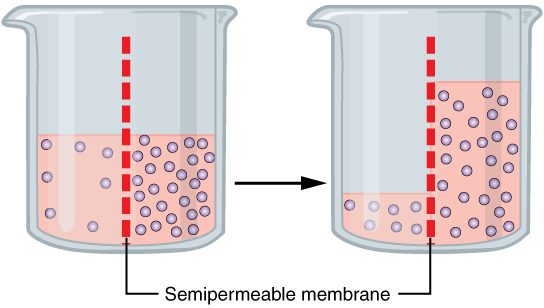
7. The figure shows a beaker divided by a membrane that lets water cross but not the solute, before and after some time passes. Which statement describes what happened?
- Solute crossed the membrane until the concentrations matched
- Water crossed into the side with more solute, raising the fluid level on that side
- Water crossed into the side with less solute, raising its fluid level
- Nothing crossed; the difference in level comes from the weight of the solute
Show the answer
The membrane holds the solute back, so the solute cannot even out. Water moves instead, toward the side with more dissolved particles, and that side's level rises.
- Solute crossed the membrane until the concentrations matched: The membrane does not let the solute cross, so the solute cannot even out by diffusion.
- Correct: Water crossed into the side with more solute, raising the fluid level on that side: Correct. Water follows solute across the membrane, so the fluid level rises on the side with more dissolved particles.
- Water crossed into the side with less solute, raising its fluid level: This reverses the direction. Water moves toward more dissolved particles, not fewer.
- Nothing crossed; the difference in level comes from the weight of the solute: The fluid level changed because water crossed the membrane. The weight of dissolved particles does not raise a fluid level.
9Summary
Particles move at random all the time, so more of them cross from a crowded region to a sparse one than the reverse: that is diffusion, down a concentration gradient, with no energy input. Net diffusion stops at equilibrium, but the particles keep moving. Diffusion is faster with a steeper gradient, a higher temperature, smaller particles, a larger surface area and a shorter distance, and its time grows with the square of the distance, so it works only over micrometers; bulk flow carries materials the long way. A semipermeable membrane lets some substances cross and not others. Osmosis is the net movement of water across such a membrane toward the side with more dissolved particles that the membrane holds back: water follows solute, and particle number is what counts. Osmotic pressure is the pressure needed to stop that water movement; it is large, about 19 mm Hg for each mOsm/L.