Capillary exchange
1Why this matters
Mrs. Lindqvist, 61, has had liver disease for years. Lately her shoes will not fit by evening, and when her nurse presses a thumb into the skin over her shin, the dent stays for half a minute. Her heart and veins are fine. Her blood test shows the real problem: her albumin, a protein her liver makes, is far below normal.
2What this builds on
3Quick check before you start
1. What is hydrostatic pressure?
- The pressure a fluid exerts on the walls of its container
- The pull of water toward a region with more solute
- The pressure of the air in the lungs
Show the answer
Hydrostatic pressure is the pressure a fluid exerts on the walls around it, such as blood pushing on a vessel wall. The pull of water toward more solute is osmotic pressure.
- Correct: The pressure a fluid exerts on the walls of its container:
- The pull of water toward a region with more solute:
- The pressure of the air in the lungs:
2. A membrane lets water through but blocks a solute. The solute is more concentrated on side 1. Which way does water move by osmosis?
- From side 1 to side 2
- From side 2 to side 1
- It does not move, because the solute cannot cross
Show the answer
Water moves by osmosis toward the side with more solute that cannot cross, which is side 1. The blocked solute is exactly what creates the osmotic pull.
- From side 1 to side 2:
- Correct: From side 2 to side 1:
- It does not move, because the solute cannot cross:
3. Which is the most abundant plasma protein?
- Fibrinogen
- Hemoglobin
- Albumin
Show the answer
Albumin, made by the liver, is the most abundant plasma protein. Fibrinogen is a clotting protein present in smaller amounts, and hemoglobin is inside red blood cells, not dissolved in plasma.
- Fibrinogen:
- Hemoglobin:
- Correct: Albumin:
4Anatomy
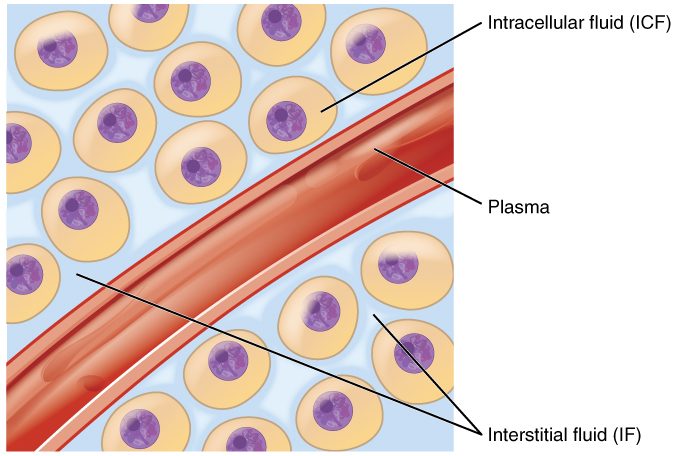
With labels hidden, select a box to reveal its label.
5How it works, step by step
- The heart's pumping keeps blood in the capillaries under pressure.Capillary hydrostatic pressure pushes water and small solutes out through the capillary wall: filtration.
- Plasma proteins, mainly albumin, are too large to pass the glycocalyx that lines the capillary.The proteins stay in the plasma and create blood colloid osmotic pressure, an osmotic pull back into the capillary.
- Capillary hydrostatic pressure is larger than the effective oncotic pull along most of the capillary.Fluid filters out, briskly near the arteriole end and slowly near the venule end.
- The filtered fluid collects in the interstitial spaces.It drains into a separate set of thin-walled vessels that return it to the veins near the heart.
- Plasma albumin falls, for example in liver disease.The oncotic pull shrinks, filtration outpaces drainage, and fluid collects between the cells: edema.
6Core concepts
7A common mistake
The wrong idea: Capillaries filter fluid at their arteriole end and reabsorb almost all of it at their venule end.
What actually happens: That is the classic textbook picture, and exams still expect it. Direct measurements show that in most tissues at steady state, fluid filters out along almost the whole capillary. When pressure falls low enough to start reabsorption, proteins build up in the thin layer of fluid beneath the glycocalyx and stop it within minutes. The filtered fluid returns to the blood through a separate drainage route instead. Reabsorption does happen for a while after a sudden fall in capillary pressure, such as after bleeding, and all the time in a few special beds such as those in the kidneys and intestine.
8Check yourself
Anything you miss goes into your review queue.
1. At one point along a capillary, capillary hydrostatic pressure is 30 mm Hg, interstitial fluid hydrostatic pressure is 2 mm Hg, blood colloid osmotic pressure is 26 mm Hg and interstitial fluid colloid osmotic pressure is 4 mm Hg. What is the net filtration pressure, and which way does fluid move?
- −6 mm Hg, reabsorption into the capillary
- +10 mm Hg, filtration out of the capillary
- +6 mm Hg, filtration out of the capillary
- +2 mm Hg, filtration out of the capillary
Show the answer
Outward forces: CHP + IFCOP = 30 + 4 = 34 mm Hg. Inward forces: BCOP + IFHP = 26 + 2 = 28 mm Hg. NFP = 34 − 28 = +6 mm Hg. A positive value means filtration.
- −6 mm Hg, reabsorption into the capillary: This has the right size but the wrong sign. The outward forces (34 mm Hg) are larger than the inward forces (28 mm Hg), so the result is positive, which means filtration.
- +10 mm Hg, filtration out of the capillary: This comes from adding the interstitial hydrostatic pressure to the outward side instead of the inward side. IFHP pushes fluid into the capillary, so it belongs with BCOP.
- Correct: +6 mm Hg, filtration out of the capillary: Correct. (30 + 4) − (26 + 2) = +6 mm Hg, so fluid filters out.
- +2 mm Hg, filtration out of the capillary: This comes from subtracting IFHP from CHP but leaving out IFCOP: (30 − 2) − 26. IFCOP pulls fluid out of the capillary, so it must be added to the outward side.
2. Mrs. Lindqvist, 61, has long-term liver disease. Her blood albumin is well below normal, and both of her ankles are swollen; pressing the skin leaves a dent. Which change best explains the swelling?
- Her capillary hydrostatic pressure has risen
- Her capillary walls have become leaky to protein
- Her blood colloid osmotic pressure has fallen
- Her interstitial fluid hydrostatic pressure has fallen
Show the answer
The liver makes albumin, the protein that supplies most of blood colloid osmotic pressure. With less albumin, less pull holds fluid in the capillaries, net filtration pressure rises, and fluid collects in the interstitial spaces. Her ankles swell first because they sit lowest when she is upright.
- Her capillary hydrostatic pressure has risen: A rise in capillary pressure causes edema, but nothing in this case raises it. The finding that points to the cause is her low albumin.
- Her capillary walls have become leaky to protein: Leaky capillaries cause the swelling of inflammation. Her problem is too little protein in the blood, not protein escaping through the wall.
- Correct: Her blood colloid osmotic pressure has fallen: Correct. Low albumin lowers the inward pull, so more fluid filters out and stays in the tissue.
- Her interstitial fluid hydrostatic pressure has fallen: Interstitial hydrostatic pressure rises, not falls, as fluid collects in the tissue. That rise is a result of the edema, and it pushes back against more filtration.
3. Which changes would increase net filtration out of the capillaries in a tissue? Select all that apply.
- The arterioles feeding the tissue dilate
- Pressure in the veins draining the tissue rises
- Plasma albumin concentration falls
- The arterioles feeding the tissue constrict
- Plasma albumin concentration rises
- The capillary walls become leaky to protein
Show the answer
Filtration rises when capillary hydrostatic pressure rises (dilated arterioles, higher venous pressure), when blood colloid osmotic pressure falls (less albumin), or when protein leaks out and shrinks the oncotic difference (leaky walls).
- Correct: The arterioles feeding the tissue dilate: Increases filtration. Dilated arterioles lose less pressure, so more pressure reaches the capillaries and CHP rises.
- Correct: Pressure in the veins draining the tissue rises: Increases filtration. With no large resistance between capillaries and veins, a rise in venous pressure passes back into the capillaries and raises CHP.
- Correct: Plasma albumin concentration falls: Increases filtration. Less albumin means a lower blood colloid osmotic pressure, so less inward pull opposes filtration.
- The arterioles feeding the tissue constrict: Decreases filtration. Constricted arterioles lose more pressure, so CHP downstream falls.
- Plasma albumin concentration rises: Decreases filtration. More albumin raises the inward oncotic pull.
- Correct: The capillary walls become leaky to protein: Increases filtration. Protein leaking into the interstitial fluid raises IFCOP and shrinks the oncotic difference that holds fluid in the blood.
4. A person's plasma protein concentration falls steadily over several weeks because of a very protein-poor diet. Predict the change in each variable once the protein level has fallen.
| Variable | Change |
|---|---|
| Blood colloid osmotic pressure | — |
| Capillary hydrostatic pressure | — |
| Net filtration pressure | — |
| Interstitial fluid volume | — |
| Interstitial fluid hydrostatic pressure | — |
Show the answer
Less plasma protein lowers blood colloid osmotic pressure. Filtration then exceeds drainage, interstitial fluid collects, and its pressure rises until a new balance is reached with visible edema.
- Blood colloid osmotic pressure: down. Plasma proteins, mainly albumin, create blood colloid osmotic pressure. Fewer proteins means less osmotic pull.
- Capillary hydrostatic pressure: no change. Capillary hydrostatic pressure depends on arterial pressure, arteriole resistance and venous pressure. None of these is changed directly by the protein level.
- Net filtration pressure: up. With less inward oncotic pull and unchanged outward push, the balance of the four forces shifts toward filtration.
- Interstitial fluid volume: up. More fluid filters out than drains away, so fluid collects between the cells: edema.
- Interstitial fluid hydrostatic pressure: up. As fluid collects in the tissue spaces, the pressure of that fluid rises. This rise partly opposes further filtration.
5. In the revised Starling principle, sustained reabsorption shuts itself off. Complete the sequence: capillary hydrostatic pressure falls below the effective oncotic pull → fluid begins flowing into the capillary through the clefts → ____ → inward flow fades within minutes.
- Interstitial proteins build up in the space beneath the glycocalyx
- Plasma proteins leak out through the clefts into the interstitial fluid
- The arterioles dilate and raise the capillary pressure back up
- The glycocalyx dissolves, making the capillary wall fully permeable
Show the answer
Outward filtration normally washes the thin space beneath the glycocalyx, keeping its protein level near zero. Once flow reverses, the washing stops, interstitial proteins diffuse into that space, and its oncotic pressure rises. The effective oncotic pull into the blood shrinks, and the inward flow dies away.
- Correct: Interstitial proteins build up in the space beneath the glycocalyx: Correct. Protein accumulation beneath the glycocalyx cancels the inward oncotic pull.
- Plasma proteins leak out through the clefts into the interstitial fluid: The glycocalyx holds plasma proteins back whichever way fluid flows. Loss of plasma protein is not what stops reabsorption.
- The arterioles dilate and raise the capillary pressure back up: Arteriole diameter is set by local and nervous signals, not by the direction of flow across the capillary wall. Reabsorption fades even when capillary pressure stays low.
- The glycocalyx dissolves, making the capillary wall fully permeable: The glycocalyx stays in place. It is damaged in some diseases, but that is not part of the normal shutoff.
6. In the classic textbook picture of capillary exchange that most exams expect, what happens at the venule end of a capillary, and which force is larger there?
- Net filtration; capillary hydrostatic pressure is larger
- Net reabsorption; blood colloid osmotic pressure is larger
- No net movement; the two forces are equal
- Net reabsorption; capillary hydrostatic pressure is larger
Show the answer
In the classic picture, capillary hydrostatic pressure falls along the capillary while blood colloid osmotic pressure stays about 25 mm Hg. At the venule end, the oncotic pull is larger, so the model predicts net reabsorption of most of the fluid filtered upstream.
- Net filtration; capillary hydrostatic pressure is larger: That describes the arteriole end, where hydrostatic pressure is highest.
- Correct: Net reabsorption; blood colloid osmotic pressure is larger: Correct for the classic model. The revised Starling principle shows this reabsorption is not sustained in most tissues, but this is the answer exams expect.
- No net movement; the two forces are equal: The classic model places the point of no net movement near the middle of the capillary, where CHP equals BCOP, not at the venule end.
- Net reabsorption; capillary hydrostatic pressure is larger: Capillary hydrostatic pressure is lowest at the venule end, and a larger CHP would favor filtration, not reabsorption.
7. During a sprint, oxygen delivery from blood to the leg muscle cells rises sharply. Apart from the steeper oxygen gradient, which change in the capillary bed speeds diffusion?
- Higher capillary hydrostatic pressure pushes oxygen out faster by bulk flow
- More capillaries open, adding surface area and shortening the distance
- The capillary walls thicken and store extra oxygen
- Plasma proteins carry the oxygen out through the clefts
Show the answer
Diffusion rate rises with surface area and falls with distance. When more capillaries in a working muscle carry blood, the total exchange surface grows and each cell is closer to an open capillary, so oxygen diffuses to the cells faster.
- Higher capillary hydrostatic pressure pushes oxygen out faster by bulk flow: Oxygen leaves capillaries by diffusion down its concentration gradient. Bulk flow carries only a tiny fraction of the oxygen that diffusion moves.
- Correct: More capillaries open, adding surface area and shortening the distance: Correct. More open capillaries means more area and a shorter path.
- The capillary walls thicken and store extra oxygen: A thicker wall would lengthen the diffusion distance and slow oxygen delivery, and capillary walls do not thicken during a sprint.
- Plasma proteins carry the oxygen out through the clefts: Plasma proteins mostly stay in the blood, and oxygen does not need a carrier to cross the wall. It dissolves through the endothelial cells.
9Summary
Capillaries exchange materials in two ways. Diffusion moves each solute down its own gradient: oxygen and carbon dioxide straight through the endothelial cells, and small water-soluble solutes through the clefts between them. Bulk flow moves fluid, and four Starling forces set its direction: capillary hydrostatic pressure pushes fluid out, blood colloid osmotic pressure from plasma proteins pulls it in, and two small interstitial forces act the other way. Net filtration pressure is (CHP + IFCOP) − (BCOP + IFHP). In most tissues fluid filters out along the whole capillary and returns through a separate drainage route; exams still expect reabsorption at the venule end. Edema forms when capillary pressure rises, plasma protein falls, the wall leaks, or drainage is blocked.