Glomerular filtration
1Why this matters
Mr. Osei, 68, has narrowed arteries to both kidneys. His blood pressure is high, so his doctor starts an ACE inhibitor. A week later his blood tests show that his kidneys are clearing wastes at half their old rate, though his blood pressure is now normal. The drug has not damaged his kidneys: it has taken away the angiotensin II that was squeezing his efferent arterioles and keeping enough pressure in his glomeruli to filter.
2What this builds on
3Quick check before you start
1. In a systemic capillary, the capillary hydrostatic pressure is 35 mm Hg, the blood colloid osmotic pressure is 25 mm Hg and the interstitial forces are both 0. What is the net filtration pressure?
- +60 mm Hg
- +10 mm Hg
- −10 mm Hg
Show the answer
NFP = (outward) − (inward) = 35 − 25 = +10 mm Hg. Positive means fluid filters out of the capillary.
- +60 mm Hg:
- Correct: +10 mm Hg:
- −10 mm Hg:
2. In a nephron, which vessel carries blood out of the glomerulus?
- The efferent arteriole
- A venule
- The afferent arteriole
Show the answer
Blood leaves the glomerulus through the efferent arteriole, which then feeds the peritubular capillaries or the vasa recta. The afferent arteriole brings blood in.
- Correct: The efferent arteriole:
- A venule:
- The afferent arteriole:
3. What happens to an arteriole's smooth muscle when a rise in pressure stretches it?
- It relaxes, and the arteriole widens
- It contracts, and the arteriole narrows
- It does not respond without a nerve signal
Show the answer
This is the myogenic response: stretch opens mechanically gated channels, calcium enters, and the smooth muscle contracts, so flow stays nearly steady.
- It relaxes, and the arteriole widens:
- Correct: It contracts, and the arteriole narrows:
- It does not respond without a nerve signal:
4Anatomy
With labels hidden, select a box to reveal its label.
5How it works, step by step
- Mean arterial pressure rises, for example as you climb stairs.More pressure reaches the glomerulus, so glomerular hydrostatic pressure, net filtration pressure and GFR start to rise.
- The higher pressure stretches the wall of the afferent arteriole.Its smooth muscle contracts within seconds (the myogenic mechanism), narrowing the arteriole.
- Fluid flows faster through the tubule, so more sodium chloride reaches the macula densa.The macula densa releases ATP, broken down to adenosine, which constricts the afferent arteriole further (tubuloglomerular feedback).
- The narrower afferent arteriole loses more pressure before blood reaches the glomerulus.Glomerular hydrostatic pressure falls back, so net filtration pressure and GFR return almost to normal.
- GFR stays near 125 mL/min across a mean arterial pressure of about 80 to 180 mm Hg.The tubules receive a nearly steady flow of filtrate, so a change in blood pressure does not flood or starve them; how much salt and water leaves is then set mainly by the tubules.
6Core concepts
7A common mistake
The wrong idea: Higher blood pressure always means more filtration, so GFR simply follows your blood pressure.
What actually happens: Between a mean arterial pressure of about 80 and 180 mm Hg, autoregulation holds GFR almost constant: the myogenic mechanism and tubuloglomerular feedback narrow the afferent arteriole when pressure rises and widen it when pressure falls. GFR follows pressure only outside that range, or when sympathetic nerves and hormones deliberately change it.
8Check yourself
Anything you miss goes into your review queue.
1. An enlarged gland presses on a man's urethra, and urine backs up into both kidneys. His capsular hydrostatic pressure rises to 25 mm Hg. Glomerular hydrostatic pressure is 55 mm Hg and blood colloid osmotic pressure is 30 mm Hg. What happens to filtration?
- It doubles, because more pressure is in the system
- It stops, because net filtration pressure falls to 0
- It is unchanged, because only the glomerular pressure matters
- It rises, because capsular pressure pushes fluid out
Show the answer
NFP = 55 − (25 + 30) = 55 − 55 = 0 mm Hg. With no net outward pressure, filtration stops. A blockage anywhere downstream raises capsular pressure and opposes filtration.
- It doubles, because more pressure is in the system: Capsular pressure opposes filtration, so extra pressure in the capsule lowers filtration rather than raising it.
- Correct: It stops, because net filtration pressure falls to 0: Correct. 55 − 55 = 0, so filtration stops.
- It is unchanged, because only the glomerular pressure matters: Capsular hydrostatic pressure is one of the three pressures in the equation. Raising it lowers NFP.
- It rises, because capsular pressure pushes fluid out: Capsular pressure pushes fluid back into the capillaries, not out of them.
2. The afferent arterioles of both kidneys constrict, and nothing else changes. Predict the change in each variable.
| Variable | Change |
|---|---|
| Renal blood flow | — |
| Glomerular hydrostatic pressure | — |
| Net filtration pressure | — |
| GFR | — |
| Hydrostatic pressure in the peritubular capillaries | — |
Show the answer
Constricting the afferent arteriole cuts off pressure and flow before the glomerulus. Glomerular pressure, NFP and GFR all fall, along with renal blood flow and the pressure in the capillaries downstream.
- Renal blood flow: down. Narrowing a vessel in series with the whole kidney raises resistance, so less blood flows through.
- Glomerular hydrostatic pressure: down. More pressure is lost across the narrowed afferent arteriole before blood reaches the glomerulus.
- Net filtration pressure: down. NFP = GBHP − (CHP + BCOP). GBHP falls while the opposing pressures stay the same.
- GFR: down. GFR = Kf × NFP, and NFP has fallen.
- Hydrostatic pressure in the peritubular capillaries: down. Less pressure passes through the glomerulus and efferent arteriole to the capillaries downstream.
3. After a heavy bleed, a patient's mean arterial pressure is at point A (60 mm Hg). Why is GFR there so far below normal, although it is higher than the dashed line?
- The filtration membrane has become more permeable
- Autoregulation has switched off completely below 80 mm Hg
- The afferent arterioles are already fully widened, and pressure is too low to keep GFR at normal
- Capsular hydrostatic pressure has risen above glomerular pressure
Show the answer
Below about 80 mm Hg the afferent arterioles have widened as far as they can, so autoregulation can no longer make up for the low pressure. The partial widening still keeps GFR above the dashed line, but GFR now falls with pressure. Strong sympathetic activation after a bleed lowers it further.
- The filtration membrane has become more permeable: A more permeable membrane would raise GFR, not lower it. Nothing in a bleed makes the filter leakier.
- Autoregulation has switched off completely below 80 mm Hg: Autoregulation is still helping at point A: the curve sits above the dashed line. It has reached its limit, not switched off.
- Correct: The afferent arterioles are already fully widened, and pressure is too low to keep GFR at normal: Correct. Autoregulation is at its limit, so GFR falls with pressure, though less than it would without it.
- Capsular hydrostatic pressure has risen above glomerular pressure: Nothing in a bleed raises capsular pressure. The problem is the low pressure reaching the glomerulus.
4. Name the pinned pores in the capillary wall.
- Filtration slits
- Tight junctions
- Pedicels
- Fenestrations
Show the answer
Fenestrations (fenestra = window) are round pores through the endothelial cells of the glomerular capillaries. They are large enough to let all dissolved substances through but stop blood cells.
- Filtration slits: Filtration slits are gaps between podocyte pedicels, on the capsule side of the basement membrane.
- Tight junctions: Tight junctions join neighboring endothelial cells at their edges; they are not pores through the cells.
- Pedicels: Pedicels are the podocytes' finger-like branches, not holes in the capillary.
- Correct: Fenestrations: Correct. The pores through the endothelium are fenestrations.
5. A cyclist is hit by a car and loses about 1.5 L of blood. His urine output drops sharply over the next hour. What best explains the fall in GFR?
- Strong sympathetic activation constricts his afferent arterioles
- ANP released by stretched atria dilates his afferent arterioles
- His plasma proteins fall, so colloid osmotic pressure pulls fluid in
- Tubuloglomerular feedback dilates his afferent arterioles
Show the answer
After a large bleed, the baroreceptor reflex drives strong sympathetic activity. Norepinephrine on alpha-1 receptor proteins constricts the afferent arterioles, glomerular pressure falls, and GFR and urine output drop, which saves blood volume.
- Correct: Strong sympathetic activation constricts his afferent arterioles: Correct. Strong sympathetic activation overrides autoregulation and lowers GFR.
- ANP released by stretched atria dilates his afferent arterioles: After blood loss the atria are less stretched, not more, so ANP release falls.
- His plasma proteins fall, so colloid osmotic pressure pulls fluid in: Lower plasma protein would weaken the inward pull and raise GFR, not lower it.
- Tubuloglomerular feedback dilates his afferent arterioles: Tubuloglomerular feedback dilating the afferent arterioles would help GFR, not cause it to fall.
6. Order the steps of tubuloglomerular feedback after a nephron's GFR rises.
- Filtrate flows faster through the tubule
- More sodium chloride reaches the macula densa
- The macula densa releases ATP, broken down to adenosine
- The afferent arteriole constricts
- Glomerular hydrostatic pressure falls
- GFR returns toward normal
Show the answer
Faster flow leaves less time to take back sodium chloride, so more reaches the macula densa. Its cells release ATP, which becomes adenosine and constricts the afferent arteriole. Less pressure reaches the glomerulus, and GFR falls back toward normal: negative feedback.
- Correct order: 1. Filtrate flows faster through the tubule 2. More sodium chloride reaches the macula densa 3. The macula densa releases ATP, broken down to adenosine 4. The afferent arteriole constricts 5. Glomerular hydrostatic pressure falls 6. GFR returns toward normal
7. A man with long-standing diabetes mellitus has foamy urine that tests strongly positive for protein, and his ankles and eyelids have become puffy. What links his urine to his swelling?
- Protein in the urine irritates the bladder and triggers fluid retention
- His glomeruli filter less fluid, so water that should leave in the urine builds up in his tissues
- Lost albumin lowers blood colloid osmotic pressure, so capillaries filter more fluid out
- Protein in the filtrate raises capsular pressure and forces fluid into the veins
Show the answer
Diabetes damages the glomerular basement membrane and podocytes, so albumin leaks into the urine (proteinuria). As plasma albumin falls, blood colloid osmotic pressure falls. In capillaries throughout the body, less protein holds fluid in the blood, filtration outpaces drainage, and edema appears.
- Protein in the urine irritates the bladder and triggers fluid retention: Protein in urine does not act on the bladder to cause fluid retention. The link is through plasma albumin.
- His glomeruli filter less fluid, so water that should leave in the urine builds up in his tissues: His problem is a leaky filter, not less filtration. The swelling comes from low plasma protein.
- Correct: Lost albumin lowers blood colloid osmotic pressure, so capillaries filter more fluid out: Correct. Low albumin weakens the inward pull in every capillary, causing edema.
- Protein in the filtrate raises capsular pressure and forces fluid into the veins: A little extra protein in the filtrate does not force fluid into the veins; the loss of protein from the blood is what matters.
8. Blood colloid osmotic pressure is about 25 mm Hg as blood enters a glomerulus but about 35 mm Hg as it leaves. What causes the rise?
- The liver adds albumin to the blood inside the glomerulus
- Protein-free fluid is filtered out, concentrating the proteins left behind
- Podocytes secrete protein into the capillaries
- Blood cells break down and release their protein as they pass through the capillary loops
Show the answer
About a fifth of the plasma is filtered as it passes through the glomerulus, and the filter holds back the proteins. The same amount of protein ends up in less plasma, so its concentration, and the oncotic pull it produces, rise along the capillary.
- The liver adds albumin to the blood inside the glomerulus: The liver releases albumin into the general circulation, not into the glomerulus specifically. The rise happens within one pass through the glomerulus.
- Correct: Protein-free fluid is filtered out, concentrating the proteins left behind: Correct. Removing protein-free fluid concentrates the proteins that remain.
- Podocytes secrete protein into the capillaries: Podocytes wrap the capillaries from outside and are part of the filter. They do not add protein to the blood.
- Blood cells break down and release their protein as they pass through the capillary loops: Blood cells do not break down as they pass through a healthy glomerulus.
9Summary
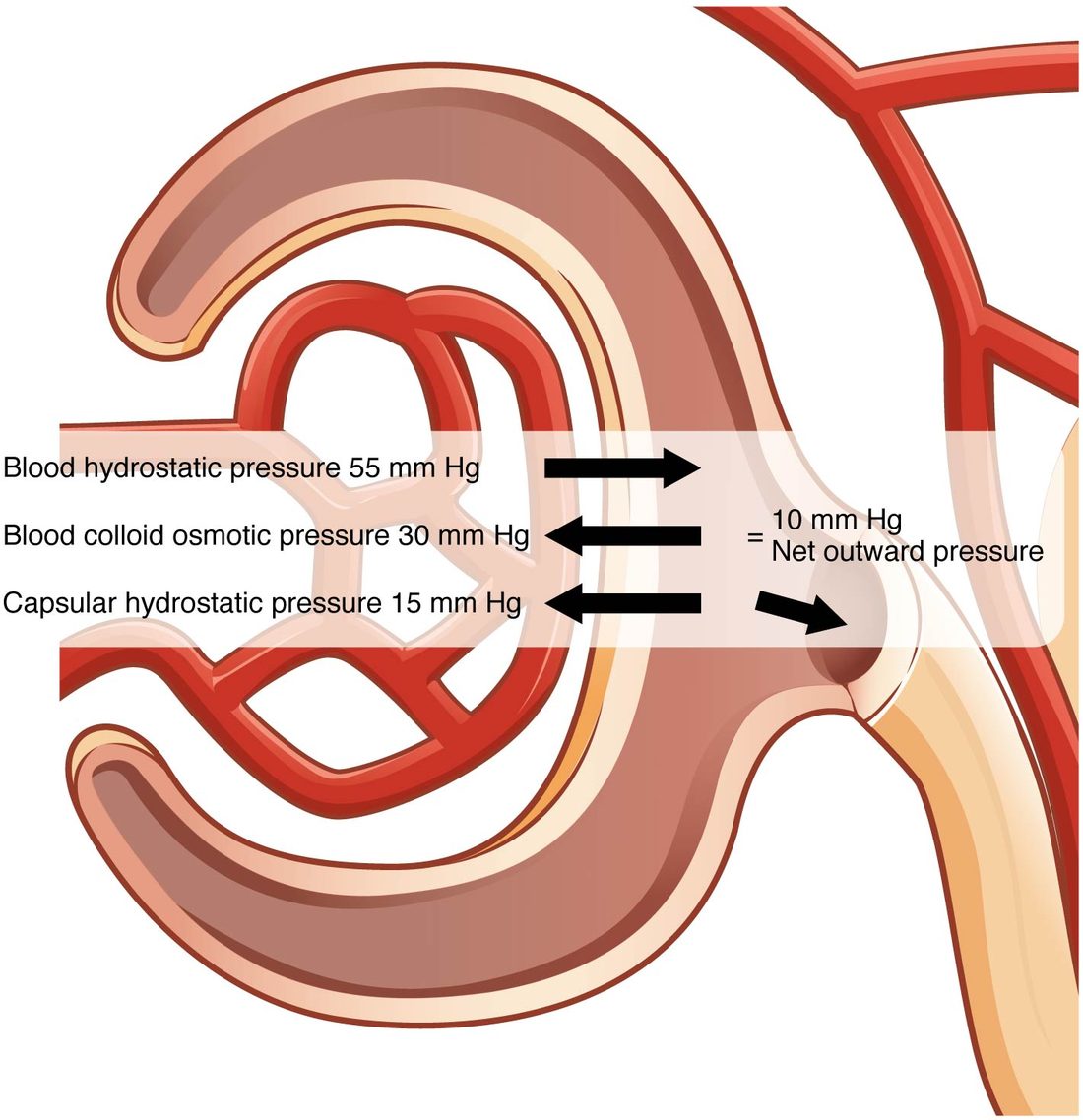
Glomerular filtration pushes plasma fluid through the filtration membrane: a fenestrated endothelium that stops blood cells, a thick, negatively charged basement membrane, and podocyte pedicels with filtration slits; together they hold back almost all protein. Glomerular hydrostatic pressure (about 55 mm Hg) pushes fluid out; capsular hydrostatic pressure (about 15) and blood colloid osmotic pressure (about 30 on average) push back, leaving a net filtration pressure of about 10 mm Hg. GFR = Kf × NFP, about 125 mL/min or 180 L a day, of which more than 99% is taken back. Autoregulation, through the myogenic mechanism and tubuloglomerular feedback at the macula densa, keeps GFR nearly constant between a MAP of about 80 and 180 mm Hg by adjusting the afferent arteriole. Strong sympathetic activation constricts the afferent arterioles and lowers GFR; angiotensin II constricts the efferent arteriole and protects GFR; ANP and local prostaglandins raise it. A damaged filter lets protein (proteinuria) or red cells (hematuria) into the urine.