Maternal changes during pregnancy
1Why this matters
Aisha, 31, is 34 weeks pregnant. Lying flat on her back for an ultrasound, she turns pale and sweaty, feels faint, and her blood pressure drops from 110/70 to 85/50. The sonographer rolls her onto her left side, and within a minute she feels fine and her pressure is back. Nothing was wrong with her heart. The weight of her uterus had pressed on her inferior vena cava, and her circulation, already reshaped by pregnancy, depends heavily on venous return.
2What this builds on
3Quick check before you start
1. A person's heart rate is 80 beats/min and stroke volume 75 mL. What is the cardiac output?
- 6.0 L/min
- 155 mL/min
- 0.94 L/min
Show the answer
CO = HR × SV = 80 × 75 mL = 6,000 mL/min = 6.0 L/min.
- Correct: 6.0 L/min:
- 155 mL/min:
- 0.94 L/min:
2. What is minute ventilation?
- The largest volume that can be exhaled after a deepest breath
- Tidal volume times breathing rate
- The air left in the lungs after a normal exhalation
Show the answer
Minute ventilation is the volume of air moved per minute: tidal volume × breaths per minute.
- The largest volume that can be exhaled after a deepest breath:
- Correct: Tidal volume times breathing rate:
- The air left in the lungs after a normal exhalation:
3. Which hormone do the corpus luteum and then the placenta make that keeps the endometrium in place during pregnancy?
- Progesterone
- Oxytocin
- FSH
Show the answer
Progesterone keeps the endometrium intact and the uterine muscle quiet. The placenta takes over making it from the corpus luteum by about weeks 7 to 9.
- Correct: Progesterone:
- Oxytocin:
- FSH:
4Anatomy
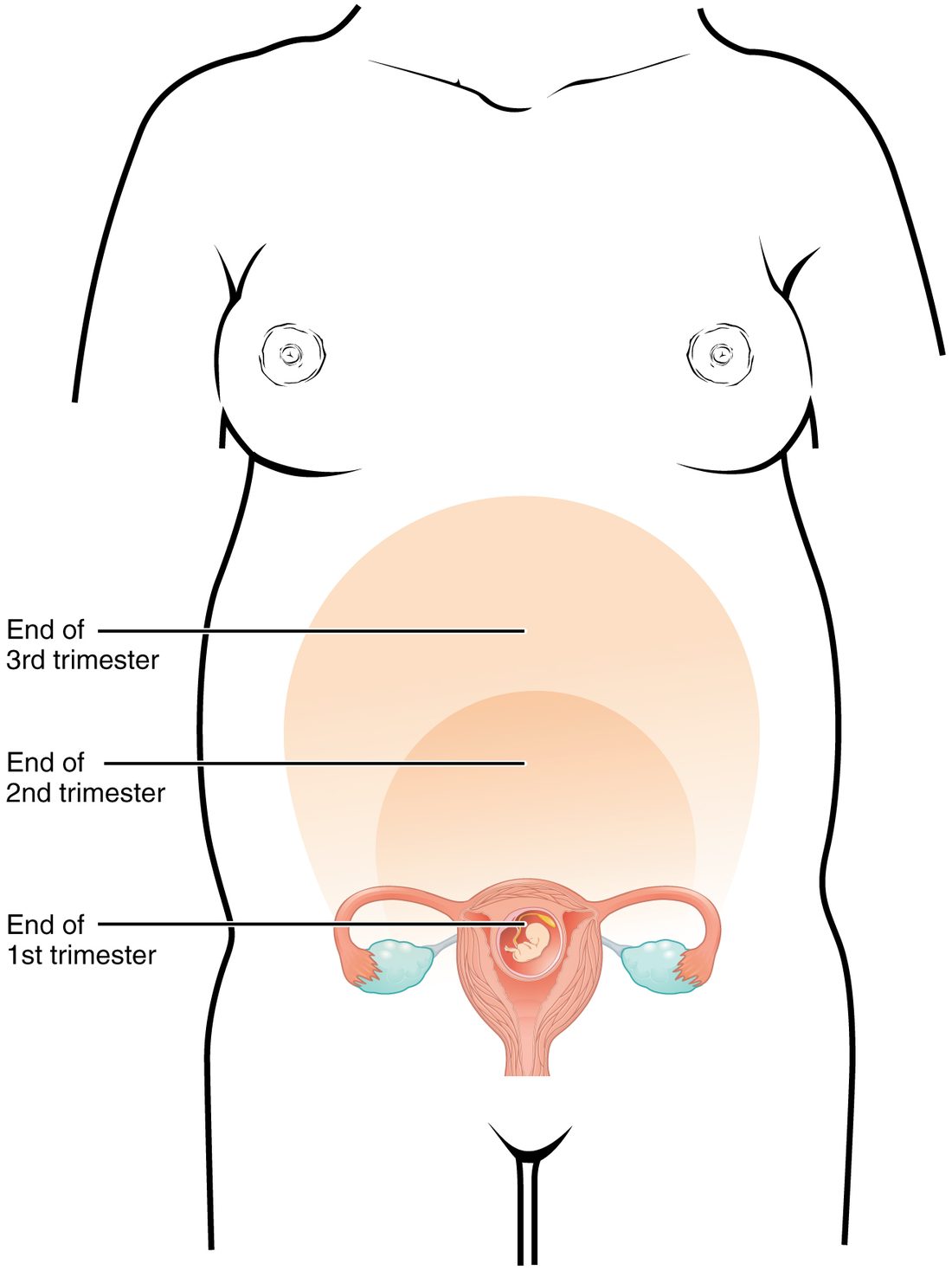
With labels hidden, select a box to reveal its label.
5How it works, step by step
- Progesterone and other signals relax arteriolar smooth muscle, and the placenta adds a low-resistance bed.Total peripheral resistance falls, and the circulation is sensed as underfilled.
- The renin–angiotensin–aldosterone system switches on, and the thresholds for thirst and ADH reset lower.The kidneys keep sodium and water, and plasma volume rises by about 40 to 50%.
- The larger blood volume raises venous return and preload, while heart rate also rises.Stroke volume and heart rate rise, so cardiac output rises by 30 to 50%.
- Cardiac output rises while total peripheral resistance falls.Mean arterial pressure stays about the same, dipping slightly in mid-pregnancy.
- Plasma volume rises more than red cell mass.The hematocrit and hemoglobin concentration fall, giving the normal dilutional anemia of pregnancy.
6Core concepts
7A common mistake
The wrong idea: Blood pressure normally rises during pregnancy, because the heart is pumping so much more blood.
What actually happens: Cardiac output does rise by 30 to 50%, but total peripheral resistance falls by about a quarter to a third at the same time, so blood pressure normally stays the same or dips a little in mid-pregnancy. A new rise in blood pressure after week 20 is not normal; it is the hallmark of preeclampsia and needs to be checked.
8Check yourself
Anything you miss goes into your review queue.
1. At 34 weeks, a woman lying on her back for an ultrasound becomes pale and faint, and her blood pressure falls. Rolling her onto her left side fixes it within a minute. What caused the drop?
- The uterus compressed the inferior vena cava
- The uterus pressed on the aorta and raised afterload
- Lying down triggered a vagal reflex that stopped the heart
- Blood pooled in her lungs when she lay flat on the table
Show the answer
The heavy uterus can flatten the inferior vena cava against the spine. Less blood returns to the heart, so preload, stroke volume and cardiac output fall, and blood pressure drops. Turning to the left lifts the uterus off the vein.
- Correct: The uterus compressed the inferior vena cava: Correct. Less venous return means less preload and less cardiac output.
- The uterus pressed on the aorta and raised afterload: Pressure on the aorta could lower flow to the legs, but it would not drop her arm blood pressure this way. The key effect is on venous return.
- Lying down triggered a vagal reflex that stopped the heart: Her heart kept beating; she felt faint because her cardiac output fell. The fast recovery on turning shows a mechanical cause.
- Blood pooled in her lungs when she lay flat on the table: Lying flat does not pool blood in the lungs. The problem is blood held back in the lower body.
2. Compare a healthy woman at 30 weeks of pregnancy with herself before pregnancy. Predict each variable.
| Variable | Change |
|---|---|
| Plasma volume | — |
| Hematocrit | — |
| Cardiac output | — |
| Total peripheral resistance | — |
| Glomerular filtration rate | — |
| Serum creatinine | — |
| Arterial PCO2 | — |
Show the answer
Pregnancy lowers vascular resistance, which switches on sodium and water retention. The larger plasma volume raises cardiac output and dilutes the red cells. More blood reaches the kidneys, so GFR rises and creatinine falls. Separately, progesterone drives extra breathing, which lowers PCO2.
- Plasma volume: up. The renin–angiotensin–aldosterone system is switched on, so the kidneys keep sodium and water.
- Hematocrit: down. Plasma rises by 40 to 50% but red cell mass by only 20 to 30%, so red cells are diluted.
- Cardiac output: up. Stroke volume rises with the larger blood volume, and heart rate rises too.
- Total peripheral resistance: down. Progesterone and other signals relax arterioles, and the placenta adds a low-resistance bed.
- Glomerular filtration rate: up. Renal plasma flow rises by 50 to 80%, so more is filtered.
- Serum creatinine: down. A higher GFR clears creatinine faster, so its blood level falls.
- Arterial PCO2: down. Progesterone makes the brainstem more sensitive to carbon dioxide, so minute ventilation rises more than metabolism and more carbon dioxide is breathed off.
3. In mid-pregnancy, a woman's cardiac output has risen by 40% and her total peripheral resistance has fallen by 30%. Her mean arterial pressure before pregnancy was 90 mm Hg. About what is it now?
- About 126 mm Hg
- About 108 mm Hg
- About 88 mm Hg
- About 63 mm Hg
Show the answer
MAP = CO × TPR. New MAP = 90 × 1.40 × 0.70 = 90 × 0.98 ≈ 88 mm Hg. The fall in resistance slightly outweighs the rise in output.
- About 126 mm Hg: 126 mm Hg counts the 40% rise in cardiac output but ignores the fall in resistance.
- About 108 mm Hg: 108 mm Hg would need a much smaller fall in resistance. With 1.40 × 0.70, the product is just under 1.
- Correct: About 88 mm Hg: Correct. 90 × 0.98 ≈ 88 mm Hg.
- About 63 mm Hg: 63 mm Hg counts the 30% fall in resistance but ignores the rise in cardiac output.
4. A 29-year-old with a past chlamydia infection has a positive pregnancy test about 7 weeks after her last period, sharp right lower abdominal pain and light vaginal bleeding. Ultrasound shows no pregnancy in the uterus, and her hCG has risen only slowly over two days. What is the most likely explanation?
- A normal early pregnancy too small to see
- A placenta previa causing early bleeding
- A corpus luteum that has stopped making hCG
- An ectopic pregnancy in a scarred tube
Show the answer
Scarring from an earlier infection can slow the embryo's trip down the tube, so the blastocyst implants in the tube wall. A positive test with one-sided pain, bleeding, no pregnancy in the uterus and slowly rising hCG points to an ectopic pregnancy, which can rupture as it grows.
- A normal early pregnancy too small to see: By 7 weeks with hCG rising, a normal pregnancy inside the uterus is usually visible on ultrasound, and hCG normally doubles every two to three days.
- A placenta previa causing early bleeding: Placenta previa is a placenta over the cervix, a problem of the second half of pregnancy, not of week 7.
- A corpus luteum that has stopped making hCG: The corpus luteum does not make hCG; the trophoblast does. And her hCG is rising.
- Correct: An ectopic pregnancy in a scarred tube: Correct. This picture fits a tubal ectopic pregnancy.
5. A baby born to a mother with gestational diabetes is large, and two hours after birth his blood glucose is dangerously low. Why is it low?
- His extra insulin outlasts the glucose supply
- He inherited type 1 diabetes and makes no insulin
- Her insulin crossed the placenta and is still acting on him
- His liver cannot yet store any glycogen for use after birth
Show the answer
Before birth, high maternal glucose crossed the placenta, and his pancreas adapted by secreting extra insulin, which also made him grow large. Cutting the cord stopped the glucose supply at once, but his pancreas kept secreting extra insulin for a while, so his glucose fell.
- Correct: His extra insulin outlasts the glucose supply: Correct. Extra fetal insulin continues after the glucose supply stops.
- He inherited type 1 diabetes and makes no insulin: Type 1 diabetes causes high glucose, not low, and it does not present at birth.
- Her insulin crossed the placenta and is still acting on him: Maternal insulin is a protein too large to cross the placenta.
- His liver cannot yet store any glycogen for use after birth: A newborn's liver does store glycogen late in pregnancy. The problem is the extra insulin.
6. At 28 weeks, a woman's serum creatinine is 1.0 mg/dL. The lab marks it normal, because the adult range goes up to 1.1. Why should her clinician be concerned?
- Creatinine rises in pregnancy, so this value is too low
- Her GFR should be higher, so creatinine should be lower
- Creatinine cannot be measured accurately in pregnancy
- The fetus adds creatinine to her blood, so 1.0 means fetal kidney disease
Show the answer
Pregnancy raises GFR by about 50%, so creatinine is cleared faster and a normal pregnant value is lower, often about 0.4 to 0.8 mg/dL. A value of 1.0 suggests her filtration has fallen, for example from preeclampsia.
- Creatinine rises in pregnancy, so this value is too low: It is the reverse: creatinine falls in pregnancy.
- Correct: Her GFR should be higher, so creatinine should be lower: Correct. A higher GFR should bring her creatinine down, so a normal-range value hides reduced filtration.
- Creatinine cannot be measured accurately in pregnancy: Creatinine is measured as usual in pregnancy. The issue is reading it against the right range.
- The fetus adds creatinine to her blood, so 1.0 means fetal kidney disease: The fetus's creatinine is small in amount, and a raised maternal value points to the mother's kidneys.
7. At a checkup, a woman's fundal height, measured from the pubic symphysis, is 22 cm. Her dates put her at 30 weeks. What does the mismatch suggest?
- The fetus is larger than expected
- The measurement is normal for 30 weeks
- Slow fetal growth or too little amniotic fluid
- She is carrying twins, which crowd each other
Show the answer
Between weeks 20 and 36, fundal height in centimeters roughly equals the weeks of pregnancy, so about 30 cm is expected. A measurement 8 cm short suggests a small fetus, too little amniotic fluid, or wrong dates, and an ultrasound is needed.
- The fetus is larger than expected: A larger fetus would make the fundal height greater than the weeks, not smaller.
- The measurement is normal for 30 weeks: At 30 weeks, about 30 cm is expected. 22 cm is well short.
- Correct: Slow fetal growth or too little amniotic fluid: Correct. A low fundal height points to slow growth or low fluid.
- She is carrying twins, which crowd each other: Twins would make the uterus larger than expected, not smaller.
9Summary
Placental hormones, the growing uterus and the demands of the fetus drive the mother's changes. Blood volume rises 40 to 50%, plasma more than red cells, so the hematocrit falls (dilutional anemia), and the blood clots more readily. Cardiac output rises 30 to 50% while total peripheral resistance falls, so blood pressure dips slightly in mid-pregnancy; lying flat can compress the inferior vena cava. Progesterone raises minute ventilation more than metabolism needs, lowering PaCO2 to about 30 mm Hg. GFR rises about 50% and serum creatinine falls. Progesterone slows the gut, and insulin resistance in the second half spares glucose for the fetus. An ectopic pregnancy implants outside the uterus, usually in a tube, and can rupture. Placenta previa covers the cervix and bleeds painlessly. Preeclampsia is new hypertension after week 20 with organ damage, starting with poor spiral artery remodeling. Gestational diabetes arises when beta cells cannot overcome placental insulin resistance.