Renal clearance, urine composition and urinalysis are how you check what the kidneys are doing from the outside. This page starts with what normal urine contains and what a urinalysis looks for, then works through renal clearance, the calculation that measures how fast the kidneys clean a substance from the plasma, and how clinicians use creatinine to estimate your glomerular filtration rate. It then explains pressure natriuresis, gathers the hormones that act on the kidney into one comparison, and ends with what happens when the kidneys fail and with the most common urinary disorders.
What urine contains
A healthy adult passes about 1 to 2 L of urine a day. It is about 95% water. The rest is what the tubule chose not to reabsorb, plus what it secreted:
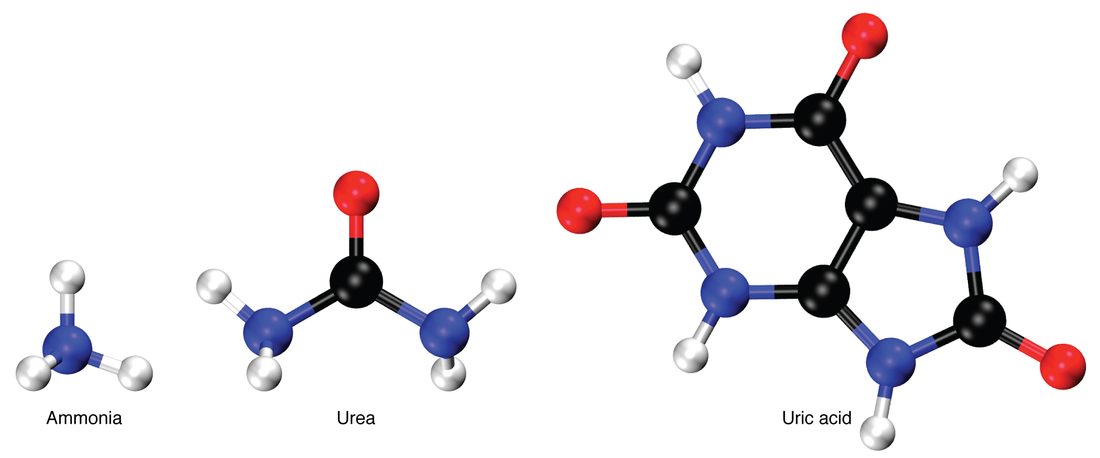
- Nitrogen wastes. Urea, from the liver's urea cycle, is the largest single solute, about 20 to 30 g a day. Creatinine comes from muscle: a small share of the creatine phosphate in your muscle fibers breaks down each day into creatinine, at a steady rate set mostly by how much muscle you have. Uric acid comes from breaking down the purine bases of nucleic acids (Figure 1).
- Ions, mainly sodium, chloride and potassium, in amounts that roughly match what you ate that day.
- Urochrome (uro- = urine, chrom- = color), the yellow pigment, made from the breakdown of the heme in old red blood cells. The more water you excrete, the paler your urine, because the same pigment is spread through more water.
Normal urine contains no glucose, almost no protein, no blood and no bacteria. The normal pH of urine ranges widely, from about 4.5 to 8, and is usually near 6, depending mainly on diet. Its osmolarity ranges from about 50 to 1,200 mOsm/L, as you saw in the last topic.
Specific gravity
The specific gravity of urine is its density compared with pure water, which is set at 1.000. Every solute adds a little weight, so specific gravity is a quick bedside index of how concentrated urine is. It usually runs from about 1.005 to 1.030. Very dilute urine, as after drinking a lot of water, sits near 1.001 to 1.005; concentrated urine after a day without water sits near 1.030. Specific gravity also rises with large, heavy solutes such as glucose or X-ray contrast dye, which osmolarity counts only by number.
Urinalysis
A urinalysis (urine + analysis) is the standard set of urine tests. It has three parts:
- Looking at it. Color, clarity and smell. Cloudy urine can mean white blood cells or bacteria; red or brown urine can mean blood, muscle breakdown or certain foods and drugs.
- A dipstick. A strip of reagent pads dipped in the sample changes color for specific gravity, pH, protein, glucose, ketones, blood, bilirubin, nitrite and leukocyte esterase, an enzyme released by white blood cells.
- A microscope. A spun-down sample is checked for red and white blood cells, bacteria, crystals and casts, which are cylinders of protein molded in the tubules.
| Finding | What it usually means | Why it gets into urine |
|---|---|---|
| Glucose | Blood glucose above about 180 mg/dL, as in uncontrolled diabetes mellitus | The filtered load exceeds what the proximal tubule's carriers can reabsorb |
| Ketones | Fat being burned fast: fasting, or uncontrolled type 1 diabetes | Ketone bodies are filtered at high plasma levels |
| Protein (proteinuria) | A damaged filtration membrane | Proteins that are normally held back pass the filter |
| Blood (hematuria) | Stones, infection, injury, or disease anywhere from glomerulus to urethra | Red cells leak through damaged tissue |
| Nitrite and leukocyte esterase | A urinary tract infection | Many gut bacteria convert nitrate to nitrite; white cells gather to fight them |
| High specific gravity | Concentrated urine: water loss, or high ADH | Water was reabsorbed in the collecting duct |
How much urine
Doctors track urine output closely in sick patients, because it is one of the first things to fall when the kidneys are poorly perfused.
- Polyuria: more than about 3 L a day, as in untreated diabetes mellitus or diabetes insipidus.
- Oliguria (olig- = few, little): less than about 400 mL a day in an adult, or below 0.5 mL per kg of body weight per hour. At 400 mL a day, even maximally concentrated urine (about 1,200 mOsm/L) carries only about 480 mOsm, less than the usual 600 mOsm of daily waste solute, so wastes start to build up.
- Anuria (an- = without): almost no urine, usually defined as less than 50 to 100 mL a day. It suggests a blocked outflow or severe kidney failure.
Renal clearance
Suppose a drug is in your plasma at 2 mg per liter, and your kidneys excrete 0.25 mg of it every minute. How efficient are they? One way to say it: 0.25 mg is the amount of drug in 125 mL of your plasma. So every minute, your kidneys remove the drug from the equivalent of 125 mL of plasma. That volume is its renal clearance.
Renal clearance is the volume of plasma from which the kidneys completely remove a substance per minute. It is found from three measurements:
C = (U × V) ÷ P
- U is the substance's concentration in urine.
- V is the urine flow rate, in mL/min.
- P is its concentration in plasma, in the same units as U.
U × V is the amount excreted each minute. Dividing by P turns that amount into the volume of plasma that held it.
Worked example 1: inulin clearance measures GFR
Problem. Inulin is a plant sugar polymer that can be given by infusion. It is filtered freely and is neither reabsorbed nor secreted. During an infusion, a patient's plasma inulin is 0.5 mg/mL, her urine inulin is 30 mg/mL and her urine flow is 2 mL/min. What is her inulin clearance, and what does it tell you?
- Write the formula. C = (U × V) ÷ P.
- Amount excreted. U × V = 30 mg/mL × 2 mL/min = 60 mg/min.
- Divide by plasma concentration. 60 mg/min ÷ 0.5 mg/mL = 120 mL/min. The mg cancel, leaving mL/min.
- Interpret. Every milligram of inulin in the urine got there by filtration alone, so the plasma cleared of inulin each minute is exactly the plasma filtered each minute.
Answer. Inulin clearance is 120 mL/min, and so is her GFR.
Inulin gives an accurate GFR, but it has to be infused, so it is used in research. In practice, clinicians use a substance the body already makes.
Worked example 2: creatinine clearance from a 24-hour urine
Problem. A man collects all his urine for 24 hours: 1,440 mL. His urine creatinine is 150 mg/dL, and his plasma creatinine is 1.2 mg/dL. What is his creatinine clearance?
- Convert the urine volume to a flow rate. 24 hours = 1,440 minutes, so V = 1,440 mL ÷ 1,440 min = 1.0 mL/min.
- Check units. U and P are both in mg/dL, so they cancel. No conversion is needed.
- Substitute. C = (150 × 1.0) ÷ 1.2.
- Calculate. 150 ÷ 1.2 = 125 mL/min.
Answer. His creatinine clearance is 125 mL/min, a normal value.
Creatinine clearance is used as an estimate of GFR, because creatinine is filtered freely and not reabsorbed. It runs about 10 to 20% higher than the true GFR, because the proximal tubule secretes a little creatinine too.
What a clearance tells you
Compare any substance's clearance with the GFR and you know what the tubule does with it:
- Clearance equals GFR: filtered only, like inulin.
- Clearance below GFR: net reabsorption. Urea clearance is about 60 to 70 mL/min, because about half the filtered urea is reabsorbed. Glucose clearance is normally zero, because all of it is reabsorbed.
- Clearance above GFR: net secretion. The tubule removes the substance from plasma that was never filtered.
Worked example 3: a secreted drug
Problem. A patient's GFR is 120 mL/min. For a new antibiotic, her plasma level is 0.025 mg/mL, her urine level is 10 mg/mL and her urine flow is 1.5 mL/min. Find the drug's clearance and say what the tubule does with it.
- Amount excreted. U × V = 10 × 1.5 = 15 mg/min.
- Clearance. 15 ÷ 0.025 = 600 mL/min.
- Compare with GFR. 600 is five times 120, so filtration alone can't account for it.
Answer. Clearance is 600 mL/min. The drug is heavily secreted by the tubule, like penicillin, so doses must be given often to keep blood levels up.
Plasma creatinine and GFR
You make creatinine at a steady rate, and at steady state you excrete it at the same rate. Because excretion is roughly GFR × plasma creatinine, the two move in opposite directions: if GFR halves, plasma creatinine rises until twice the concentration is filtered through half the GFR.
Worked example 4: when GFR falls
Problem. A man makes 1.2 mg of creatinine a minute. His GFR is 120 mL/min. Illness lowers his GFR to 60 mL/min and it stays there. What is his plasma creatinine before and after, once it is steady?
- At steady state, excretion = production, and excretion ≈ GFR × P. So P = production ÷ GFR.
- Before. P = 1.2 mg/min ÷ 120 mL/min = 0.01 mg/mL = 1.0 mg/dL.
- After. P = 1.2 ÷ 60 = 0.02 mg/mL = 2.0 mg/dL.
Answer. 1.0 mg/dL before, 2.0 mg/dL after. Half the GFR means double the plasma creatinine.
This inverse link has a trap. Going from a GFR of 120 to 60, half the filtering capacity, moves plasma creatinine only from about 1.0 to 2.0, still a small number. Early kidney disease can hide behind a creatinine that looks near normal. Labs therefore report an estimated GFR (eGFR), calculated from plasma creatinine together with age and sex, because muscle mass affects how much creatinine a person makes.
Pressure natriuresis
In the blood pressure chapter you met the idea that the kidneys set long-term blood pressure. Here is the mechanism that links them most directly. Raise the arterial pressure reaching an isolated kidney, holding every hormone and nerve constant, and it excretes more sodium and more water. This is pressure natriuresis (natri- = sodium, -uresis = passing in urine), and the extra water that leaves with the sodium is pressure diuresis.
- Arterial pressure rises. Autoregulation holds GFR nearly steady, but the higher pressure still reaches the peritubular capillaries and vasa recta, and the pressure in the kidney's interstitial fluid rises.
- The proximal tubule reabsorbs less sodium. Its sodium–hydrogen exchangers are pulled out of the apical membrane, and some reabsorbed fluid leaks back into the tubule through the leaky tight junctions.
- More sodium, and the water it holds, flow on and leave in the urine. Renin release also falls, so there is less angiotensin II and aldosterone.
- Blood volume falls, and so does pressure.
The response is strong: a small, lasting rise in pressure raises sodium excretion steeply. So as long as the kidneys work normally, a rise in pressure brings its own correction, by removing volume. Most researchers hold that in long-standing high blood pressure this relationship has been reset, so the kidneys need a higher pressure than normal to excrete the day's salt. How much the sympathetic nervous system contributes over the long term is still debated.
Hormones that act on the kidney
Four hormones from other organs direct most of the kidney's day-to-day adjustments. You have met each one; the table below puts them side by side.
| ADH | Aldosterone | ANP | PTH | |
|---|---|---|---|---|
| Made by | Hypothalamus, released from the posterior pituitary | Zona glomerulosa of the adrenal cortex | Atrial muscle cells | Parathyroid glands |
| Main trigger | Rise in plasma osmolarity; large fall in blood volume | Angiotensin II; rise in plasma potassium | Stretch of the atria by a large blood volume | Fall in blood calcium |
| Main target in the kidney | Principal cells of the collecting duct | Principal cells of the late distal tubule and collecting duct | Collecting duct and glomerulus; also lowers renin | Proximal tubule (phosphate) and distal tubule (calcium); kidney cells that make calcitriol |
| What it does there | Inserts aquaporins, so water is reabsorbed | Adds sodium channels, potassium channels and pumps | Raises GFR and reduces sodium reabsorption | Keeps calcium, loses phosphate, activates vitamin D |
| Effect on urine | Smaller volume, more concentrated | Less sodium, more potassium | More sodium and water | Less calcium at first, more phosphate |
| Net effect on blood | More water; plasma diluted | More sodium and volume; less potassium | Less volume and pressure | More calcium; less phosphate |
Other signals act mainly on the kidney's blood vessels, and through them on GFR:
- Angiotensin II constricts the efferent arteriole more than the afferent, which helps hold GFR up when pressure falls, and it increases sodium reabsorption in the proximal tubule.
- Sympathetic nerves constrict the afferent arterioles when pressure falls sharply, lowering GFR and urine output, and they release renin.
- Endothelin (endo- = within, thel- = lining) is a peptide made by endothelial cells, one of the strongest vasoconstrictors known. In the kidney it constricts both arterioles, lowering renal blood flow and GFR, and it rises in many kinds of kidney injury. In the collecting duct it has the opposite, sodium-losing effect, which shows that one signal can act differently in different places.
- Prostaglandins made in the kidney widen the afferent arterioles when perfusion falls, protecting GFR. Drugs such as ibuprofen block prostaglandin synthesis, which is why they can injure the kidneys of people who are already short of volume.
Hormones the kidney makes
The kidney is also an endocrine organ:
- Renin, from the juxtaglomerular cells, starts the RAAS.
- Erythropoietin (EPO), from cells between the tubules, rises when oxygen delivery to the kidney falls; EPO in the blood peaks within one to two days and drives red cell production.
- Calcitriol, active vitamin D, is made when kidney tubule cells add the final chemical group to vitamin D, a step PTH switches on.
Kidney failure and dialysis
Kidney failure means the kidneys can no longer keep the blood's composition steady. It comes in two forms that differ mainly in speed.
Acute kidney injury
Acute kidney injury (AKI) is a fall in kidney function over hours to days. It is diagnosed by a rise in plasma creatinine (by at least 0.3 mg/dL within 48 hours, or to 1.5 times the person's baseline within a week) or by urine output below 0.5 mL/kg per hour for 6 hours. Its causes are sorted by where the problem is:
- Before the kidney (prerenal): too little blood reaches it, as after a hemorrhage, severe vomiting and diarrhea, or circulatory shock. The kidney itself is healthy at first, and restoring perfusion reverses it.
- In the kidney (intrinsic): the tubule cells or glomeruli are damaged, by prolonged low perfusion, toxins, some drugs and X-ray dyes, or inflammation.
- After the kidney (postrenal): urine can't drain, from a stone blocking a ureter, a tumor, or a blocked bladder outlet.
AKI often recovers if the cause is fixed quickly.
Chronic kidney disease
Chronic kidney disease (CKD) is kidney damage, or a GFR below 60 mL/min per 1.73 m² of body surface, lasting more than 3 months. Damage is often first seen as albumin in the urine. The two leading causes are diabetes mellitus and high blood pressure. CKD is graded by GFR from stage 1 to 5; stage 5, a GFR below 15, is kidney failure. Nephrons lost in CKD do not regrow, and the survivors enlarge and work harder, which can speed their own damage.
| Acute kidney injury | Chronic kidney disease | |
|---|---|---|
| Speed | Hours to days | Months to years (defined as more than 3 months) |
| Common causes | Low perfusion, toxins and drugs, blocked outflow | Diabetes mellitus, high blood pressure |
| How it is recognized | Rising plasma creatinine, falling urine output | Low eGFR or albumin in the urine for over 3 months |
| Can it reverse | Often, if the cause is treated quickly | Usually not; treatment slows it |
| Anemia and bone disease | Uncommon | Common in later stages |
What goes wrong when the kidneys fail
Every job the kidneys do fails together:
- Water and salt are kept: fluid overload, edema and high blood pressure.
- Potassium is kept: hyperkalemia, which can cause dangerous arrhythmias. This is often what makes kidney failure an emergency.
- Acid is kept: acidosis.
- EPO falls: anemia.
- Calcitriol falls and phosphate is kept: blood calcium tends to fall, PTH rises, and bone is weakened.
- Nitrogen wastes build up. Uremia (ur- = urine, -emia = blood condition) is the illness this causes: loss of appetite, nausea, itching, fatigue, confusion and, in severe cases, inflammation of the pericardium. Urea itself is only one of many retained wastes that cause it.
Dialysis
Dialysis (dia- = through, lysis = loosening) takes over the kidneys' filtering. Blood and a cleansing fluid, the dialysate, are separated by a semipermeable membrane. Small solutes diffuse down their concentration gradients: urea, potassium and creatinine move from the blood into the dialysate, which contains none or little of them, while bicarbonate can move into the blood. Excess water is removed by pressure.
- Hemodialysis pumps blood through an external filter, usually for about 4 hours, three times a week.
- Peritoneal dialysis uses the person's own peritoneum as the membrane: dialysate is run into the peritoneal cavity through a tube, left to equilibrate, then drained, several times a day or overnight.
Dialysis replaces filtration, not the kidney's hormones, so people on dialysis also need EPO injections and active vitamin D. A kidney transplant replaces both.
Common urinary disorders
Urinary tract infection
A urinary tract infection (UTI) is usually caused by gut bacteria, most often Escherichia coli, that climb the urethra. Women get them far more often, because the female urethra is short, 3 to 4 cm, and opens near the anus.
- Infection of the bladder (cystitis; cyst- = bladder, -itis = inflammation) causes burning on urination, frequent small voids, a sudden urge, and sometimes blood in the urine.
- Infection that climbs to the kidney (pyelonephritis; pyel- = pelvis, nephr- = kidney) adds fever, flank pain and vomiting, and needs prompt treatment.
The dipstick shows nitrite and leukocyte esterase, and a urine culture names the bacterium. Emptying the bladder regularly flushes bacteria out, which is why incomplete emptying raises the risk.
Kidney stones
Kidney stones (renal calculi; calculus = pebble) form when a solute in urine becomes so concentrated that it crystallizes. About three quarters are calcium stones, mostly calcium oxalate; others are uric acid or form after certain infections. The biggest risk is simply a small volume of concentrated urine. A stone that moves into a ureter blocks it: the ureter's smooth muscle contracts hard against it, causing severe, wave-like pain in the flank that spreads toward the groin, often with blood in the urine. Most small stones pass on their own. Drinking enough to pass more than about 2.5 L of urine a day is the main prevention, and a thiazide diuretic lowers urine calcium.
Incontinence
Incontinence (in- = not, contin- = hold together) is involuntary leakage of urine. It is common, especially in older adults and after childbirth, and it has different mechanisms:
| Stress incontinence | Urge incontinence | |
|---|---|---|
| When it happens | Coughing, sneezing, laughing, lifting | A sudden, strong urge that can't be held |
| What fails | The pelvic floor and external urethral sphincter can't resist a jump in abdominal pressure | The detrusor contracts when it should not (an overactive bladder) |
| Amount leaked | Usually small spurts | Often larger volumes |
| Common causes | Childbirth, the fall in estrogen in later life, surgery | Aging, nerve damage from stroke or spinal cord injury, bladder irritation |
| First-line treatment | Pelvic floor muscle training | Bladder training; drugs that relax the detrusor |
In overflow incontinence, the bladder can't empty, because its outlet is blocked or the detrusor is too weak, so it overfills and dribbles. Functional incontinence is leakage from a person who can't reach a toilet in time, for example because of limited mobility or dementia, even though the urinary tract works.