Your kidneys can make urine four times as concentrated as your plasma, or six times as dilute. The countercurrent multiplier, explained step by step on this page, is how: the hairpin loops of your nephrons build a gradient of salt and urea through the renal medulla, and antidiuretic hormone (ADH) decides how much water the collecting ducts let out into it. You will see how the gradient is built, how the vasa recta keep blood flow from washing it away, how urea recycling adds to it, how ADH switches the collecting duct's aquaporins on and off, and how diuretic drugs interfere with each step.
Why concentrated urine needs a salty medulla
Every day you have to excrete about 600 mOsm of waste solute: urea, salts and other ions. The volume of water you excrete it in is up to you. After a long hot day without a drink, you might pass 0.5 L of dark urine. After a liter of iced tea, you might pass a liter in an hour, almost as pale as water.
No part of the tubule pumps water. Water leaves the tubule only by osmosis, so tubular fluid can never become more concentrated than the fluid around it. For urine to reach 1,200 mOsm/L, the collecting duct has to pass through tissue that is itself about 1,200 mOsm/L. That tissue is the inner renal medulla.
Worked example 1: the range of urine volumes
Problem. A man must excrete 600 mOsm of solute a day. His kidneys can make urine anywhere from 50 to 1,200 mOsm/L. What are the smallest and largest daily urine volumes that carry that solute?
- Write the relationship. Volume = amount of solute ÷ concentration.
- Most concentrated urine. 600 mOsm ÷ 1,200 mOsm/L = 0.5 L.
- Most dilute urine. 600 mOsm ÷ 50 mOsm/L = 12 L.
Answer. From 0.5 L to 12 L a day. The 0.5 L is the least urine he can make: pass less and waste solute builds up in his blood, however high his ADH.
The medullary osmotic gradient
Push a probe from the renal cortex down toward a renal papilla and measure the osmolarity of the interstitial fluid as you go. At the cortex it is about 300 mOsm/L, the same as plasma. (Labs report the solute concentration of plasma as about 275 to 295 mOsm per kilogram of water; for the kidney it is rounded to 300, and per liter and per kilogram are nearly the same for body fluids.) It climbs steadily through the medulla and reaches about 1,200 mOsm/L at the tip of the papilla. This rise is the medullary osmotic gradient.
Two solutes build it:
- NaCl, pumped out of the ascending limbs, makes up most of it in the outer medulla.
- Urea makes up about half of it in the inner medulla.
The long nephron loops of juxtamedullary nephrons, which dip deep into the medulla, build most of the gradient. The collecting ducts of all nephrons run down through it on their way to the papillae, so all of them can use it.
The countercurrent multiplier
The nephron loop is a hairpin. Fluid flows down the descending limb and back up the ascending limb, in the opposite direction, only a few micrometers away. Flow in opposite directions in neighboring tubes is called countercurrent flow (counter- = against). The loop uses it to multiply a small difference in concentration into a large one, so it is called the countercurrent multiplier.
It rests on two facts from the last topic:
- The thick ascending limb pumps NaCl out into the interstitial fluid on NKCC2, but lets no water follow. At any level it can make the fluid around it about 200 mOsm/L more concentrated than the fluid inside it.
- The descending limb is permeable to water but not much to salt. Its fluid comes to the same osmolarity as the interstitial fluid around it by losing water.
Building the gradient, step by step
Imagine a loop that starts with 300 mOsm/L fluid everywhere, then follow it through repeated rounds of pumping and flowing.
- Pump. The ascending limb pumps salt out until, at every level, its fluid is 200 mOsm/L, and the interstitial fluid next to it is 400.
- Equilibrate. The descending limb loses water to the 400 mOsm/L interstitial fluid until its fluid is 400 too.
- Flow. New 300 mOsm/L fluid enters the top of the descending limb and pushes the 400 fluid around the bend into the bottom of the ascending limb.
- Pump again. At the bottom, the ascending limb now holds 400 fluid. Pumping lowers it to 300 and raises the interstitial fluid there to 500, keeping the same 200 mOsm/L difference. At the top, it still pumps only from 300-level fluid.
- Repeat. Each round, the fluid arriving at the bend is a little more concentrated than the round before, and the pumping adds another step on top of it. The bottom of the loop climbs toward 1,200 mOsm/L while the top stays near 300.
A 200 mOsm/L difference that the pump can make at any single level is multiplied by the flow into a 900 mOsm/L difference from top to bottom. The longer the loop, the higher the multiplication: desert rodents with very long loops make urine above 5,000 mOsm/L. Figure 1 shows the result in a working loop.
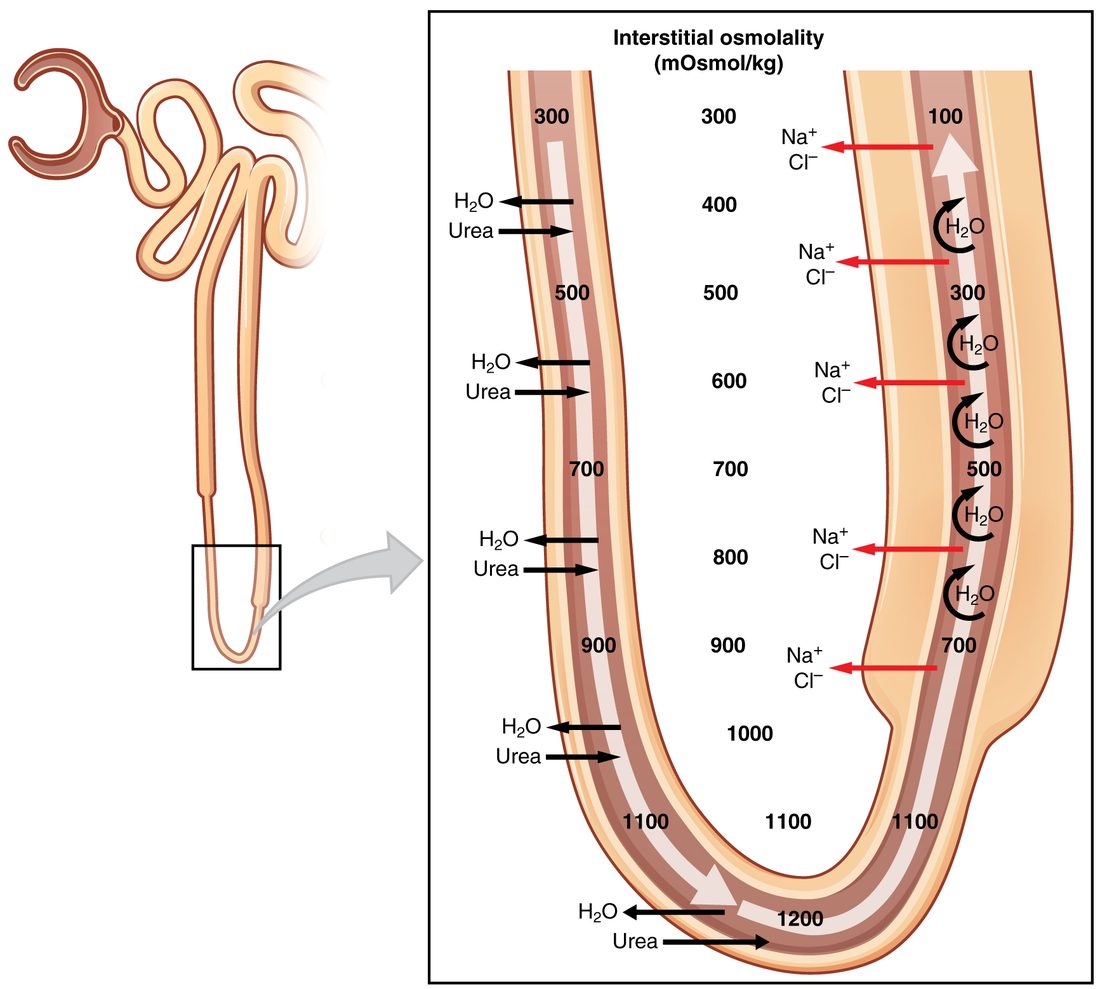
The energy comes from the sodium–potassium pumps that power NKCC2. Everything else, water leaving the descending limb and the fluid flowing around the bend, is passive.
Countercurrent exchange in the vasa recta
The medulla needs a blood supply. But ordinary capillaries running straight through it would do what a stream does to a sand castle. Blood entering at 300 mOsm/L would soak up salt and urea and carry them away, and the gradient would be gone within minutes.
The vasa recta (vasa = vessels, recta = straight) avoid this because they are hairpins too, running beside the loops. This is countercurrent exchange in the vasa recta:
- Blood flowing down the descending vasa recta meets saltier and saltier interstitial fluid. Salt and urea diffuse in, and water moves out. By the bottom, the blood is about 1,200 mOsm/L.
- Blood flowing up the ascending vasa recta meets less and less salty interstitial fluid. Salt and urea diffuse back out, and water moves in.
- Blood leaves the medulla only slightly more concentrated than it entered, carrying away the water and the small amount of solute that the loops and collecting ducts have reabsorbed, and leaving the gradient in place.
Blood flow through the vasa recta is also slow, only a small share of the kidney's blood flow, which gives the blood time to equilibrate at each level. Nothing is pumped: the exchanger is passive. It doesn't create the gradient; it keeps blood flow from destroying it.
| Countercurrent multiplier | Countercurrent exchanger | |
|---|---|---|
| Structure | Nephron loop | Vasa recta |
| What flows through it | Tubular fluid | Blood |
| Uses energy directly | Yes: NKCC2 and the sodium–potassium pump in the thick ascending limb | No: all movement is diffusion and osmosis |
| Job | Builds the medullary gradient | Keeps blood flow from washing the gradient out |
| Fluid leaving it | About 100 mOsm/L, dilute | Slightly above 300 mOsm/L |
| Carries away reabsorbed water | No | Yes |
Urea recycling
You met urea in metabolism: your liver makes it in the urea cycle, from the ammonia released when amino acids are broken down. It is your main nitrogen waste, and it is what the kidneys excrete most of by weight. It is also a building block of the medullary gradient. Follow it along the nephron:
- Urea is filtered freely. About half is reabsorbed passively in the proximal tubule.
- The rest flows on. The distal tubule and the collecting duct in the cortex and outer medulla are nearly impermeable to urea, so as ADH lets water out of the collecting duct, the urea left inside becomes more and more concentrated.
- The inner medullary collecting duct has urea carriers, and ADH adds more. Concentrated urea diffuses out of the duct into the interstitial fluid of the inner medulla.
- That urea supplies about half the inner medulla's osmolarity. Some diffuses into the thin limbs of the loop and travels round again, and some is carried off by the vasa recta.
This is urea recycling. It lets your kidneys make concentrated urine without having to pump urea anywhere, and it lets you excrete urea at a high concentration without a large volume of water. People on very low-protein diets make less urea, and they cannot concentrate their urine as fully.
ADH and aquaporins in the collecting duct
The gradient is always there. Whether you use it is decided by one hormone. You met antidiuretic hormone (ADH, also called vasopressin) with the pituitary gland: hypothalamic neurons release it from the posterior pituitary when the osmolarity of your plasma rises by as little as 1 to 2%, or when your blood volume falls by roughly 5 to 10%.
How ADH opens the collecting duct
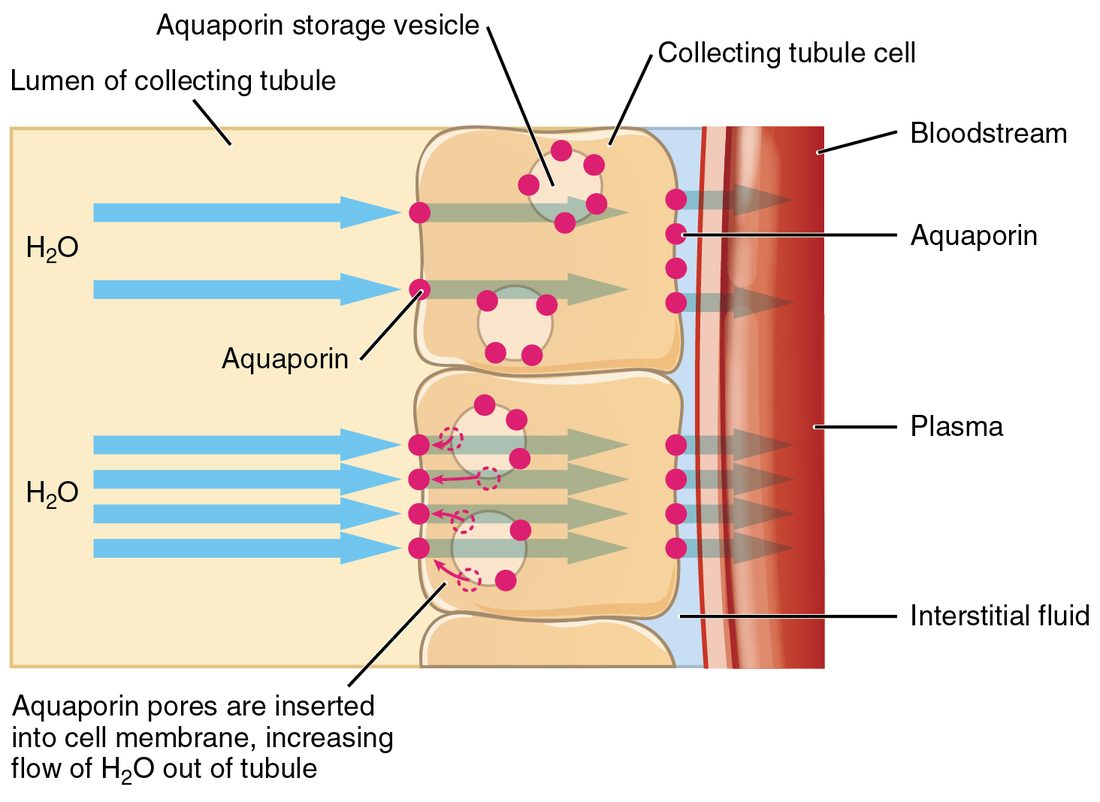
- ADH reaches the collecting duct in the blood and binds its receptor protein on the basolateral membrane of principal cells.
- That receptor protein is coupled to a G protein, which raises cAMP inside the cell. cAMP activates protein kinase A.
- Protein kinase A causes vesicles stored just under the apical membrane, carrying aquaporin water channels, to fuse with the apical membrane. Water channels appear in it within minutes.
- Water moves from the tubular fluid into the cell through them, and leaves the cell into the interstitial fluid through basolateral aquaporins, which are always present.
- The salty medulla draws the water out, and the vasa recta carry it away. The urine that reaches the papilla nears the medulla's own concentration.
When ADH falls, the cell pulls the aquaporins back into vesicles by endocytosis, and the apical membrane becomes nearly waterproof again. Over days of high ADH, principal cells also make more aquaporins. This is ADH and aquaporins in the collecting duct, shown in Figure 2.
High ADH and no ADH
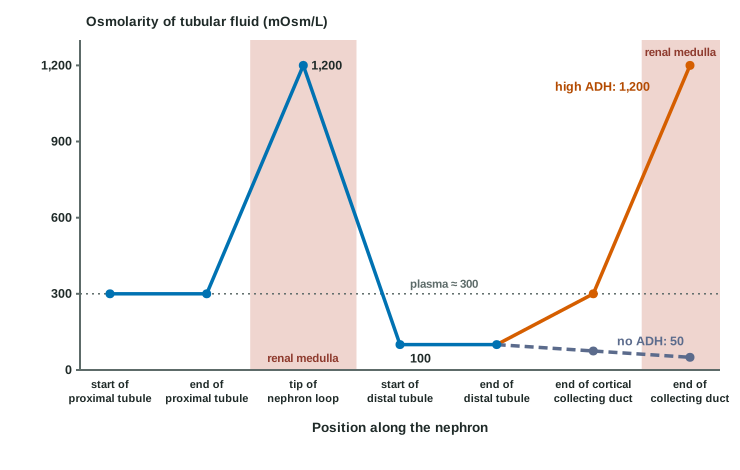
Figure 3 follows the osmolarity of the tubular fluid along the nephron. Everything up to the end of the distal tubule is the same whatever ADH does: 300 in the proximal tubule, 1,200 at the tip of the loop, about 100 leaving the thick ascending limb. The paths only split in the collecting duct.
| High ADH | No ADH | |
|---|---|---|
| Aquaporins in principal cells' apical membranes | Many | Almost none |
| Collecting duct's permeability to water | High | Very low |
| Urea carriers in the inner medullary collecting duct | More | Fewer |
| Urine osmolarity | Up to about 1,200 mOsm/L | Down to about 50 mOsm/L |
| Urine volume | As little as 0.5 L a day | Many liters a day |
| Everyday example | A hot day without drinking | After drinking a lot of water, or after a strong alcoholic drink, which lowers ADH |
When the system fails, the table's right-hand column becomes permanent. In diabetes insipidus, which you met with the pituitary gland, either the posterior pituitary releases too little ADH, or the principal cells cannot respond to it, for example because their ADH receptor protein or their aquaporin is faulty. Either way, the gradient is intact but unused, and the person passes large volumes of dilute urine.
Diuretics
A diuretic (dia- = through, ur- = urine) is anything that increases urine output. Most diuretic drugs work by blocking sodium reabsorption at one segment. The sodium left in the tubule holds water with it, and both leave in the urine. That lowers blood volume, which is why diuretics treat fluid overload, edema and high blood pressure.
- A loop diuretic, such as furosemide, blocks NKCC2 in the thick ascending limb. That segment reabsorbs about a quarter of filtered sodium, so these are the most powerful diuretics. They also stop the countercurrent multiplier, so the medullary gradient fades and the kidney can no longer make concentrated urine. And because the positive lumen of the thick ascending limb disappears, more calcium and magnesium are lost in the urine.
- A thiazide diuretic, such as hydrochlorothiazide, blocks the sodium–chloride symporter in the distal convoluted tubule. It acts on only about 5% of filtered sodium, so its effect is moderate and steady, which suits long-term treatment of high blood pressure. Unlike loop diuretics, thiazides make the distal tubule reabsorb more calcium, so less calcium is lost in the urine.
- An osmotic diuretic, such as mannitol, is a solute that is filtered but not reabsorbed. It stays in the tubule and holds water there, mainly in the proximal tubule and descending limb, the segments that are always permeable to water. It is used to draw fluid out of a swollen brain. Glucose above the renal threshold acts the same way, which is why untreated diabetes mellitus causes polyuria.
Loop and thiazide diuretics both cause potassium loss. They send more sodium and more fluid on to the principal cells of the collecting duct. More sodium enters those cells, and faster flow carries secreted potassium away, so potassium secretion rises, and some people develop hypokalemia. A potassium-sparing diuretic blocks aldosterone's receptor protein or the principal cells' sodium channels instead. Less sodium is reabsorbed there, and potassium secretion falls with it, so these weak diuretics keep potassium and can cause hyperkalemia.
| Loop diuretic | Thiazide diuretic | Osmotic diuretic | |
|---|---|---|---|
| Example | Furosemide | Hydrochlorothiazide | Mannitol |
| Where it acts | Thick ascending limb | Distal convoluted tubule | Mainly proximal tubule and descending limb |
| How it acts | Blocks NKCC2 | Blocks the sodium–chloride symporter | Stays in the tubule and holds water by osmosis |
| Strength | Strongest: acts on about 25% of filtered sodium | Moderate: about 5% | Depends on the dose |
| Ability to concentrate urine | Lost: the medullary gradient fades | Kept | Reduced: the fast flow carries water through |
| Potassium in urine | Up | Up | Up |
| Calcium in urine | Up | Down | Up |
| Typical use | Fluid overload in heart failure; edema | Long-term treatment of high blood pressure | Swelling of the brain |
Putting it together: a day without water
Jonah, 24, works a 10-hour shift outdoors in the heat, sweats about 3 L, and drinks little. Follow what his kidneys do:
- He loses more water than salt, so the osmolarity of his plasma rises, and his blood volume falls.
- Hypothalamic osmoreceptors, and later the fall in volume, increase ADH release. He feels thirsty.
- ADH puts aquaporins into his principal cells, and more urea carriers into his inner medullary collecting ducts.
- Water leaves his collecting ducts into the salty medulla, and his vasa recta carry it into the blood.
- He passes a small volume of dark urine at close to 1,200 mOsm/L.
- The fall in volume also raises renin and aldosterone, so he keeps sodium as well as water.
His kidneys slow the loss, but they can't make up for it: urine volume can't go below about 0.5 L a day. Only drinking restores the water he has lost.