Concentrating the urine
1Why this matters
Mr. Ruiz, 78, has heart failure and swollen ankles. His doctor starts furosemide, and within an hour he is passing large volumes of pale urine; by the next week his ankles are thinner, but his blood potassium has dropped. A single drug that blocks one carrier in one segment of the nephron has changed how much urine he makes, how concentrated it can be and how much potassium he loses. To see why, you need to know how your kidneys concentrate urine.
2What this builds on
3Quick check before you start
1. What carrier moves salt out of the thick ascending limb?
- The sodium–glucose symporter
- The Na–K–2Cl cotransporter (NKCC2)
- Aquaporins
Show the answer
NKCC2 on the apical membrane carries 1 Na+, 1 K+ and 2 Cl− into the cell, and the salt leaves on the basolateral side. The segment lets almost no water follow.
- The sodium–glucose symporter:
- Correct: The Na–K–2Cl cotransporter (NKCC2):
- Aquaporins:
2. Which nephrons have long loops that dip deep into the renal medulla?
- Cortical nephrons
- Juxtamedullary nephrons
- Both equally
Show the answer
Juxtamedullary nephrons sit near the corticomedullary border and send long loops deep into the medulla, with vasa recta beside them.
- Cortical nephrons:
- Correct: Juxtamedullary nephrons:
- Both equally:
3. What does ADH do to the cells at the end of the renal tubule?
- Makes them reabsorb more sodium
- Makes them insert aquaporins, so more water returns to the blood
- Makes them secrete more potassium
Show the answer
ADH works through cAMP to move aquaporins into the membranes of those cells, so water can leave the tubule by osmosis. That is aldosterone's job for sodium and potassium.
- Makes them reabsorb more sodium:
- Correct: Makes them insert aquaporins, so more water returns to the blood:
- Makes them secrete more potassium:
4Anatomy
5How it works, step by step
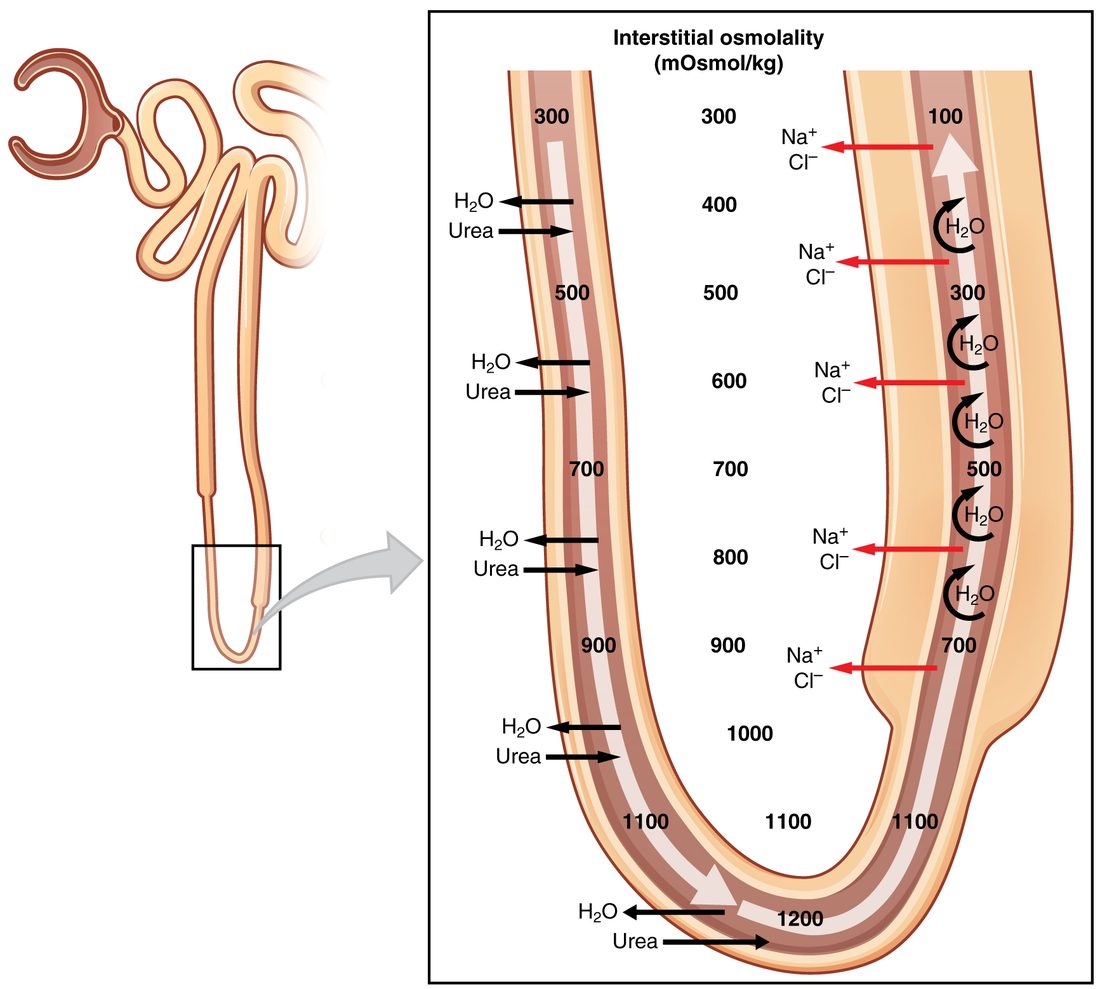
- The thick ascending limb pumps NaCl into the medulla on NKCC2 but keeps its water.The interstitial fluid next to it becomes saltier than the fluid inside it, by about 200 mOsm/L at each level.
- The saltier interstitial fluid surrounds the descending limb, which is permeable to water.Water leaves the descending limb by osmosis, and its fluid becomes more concentrated.
- Flow carries that more concentrated fluid around the bend into the ascending limb, where it is pumped again.The effect is multiplied, and the medulla climbs from 300 mOsm/L at the cortex to about 1,200 at the papilla; urea from the inner medullary collecting duct supplies about half the inner part.
- The hairpin vasa recta gain solute on the way down and give it back on the way up.Blood flow carries off reabsorbed water without washing the gradient away.
- When ADH is high, principal cells insert aquaporins into their apical membranes.Water leaves the collecting duct into the salty medulla, and the urine becomes as concentrated as the medulla, up to about 1,200 mOsm/L.
6Core concepts
7A common mistake
The wrong idea: The kidneys concentrate urine by pumping water out of it.
What actually happens: No part of the kidney pumps water. Water only ever moves by osmosis. What the kidney pumps is salt: the thick ascending limb builds a salty medulla, and ADH then opens the collecting duct so water can flow out into it passively. That is why urine can never be more concentrated than the deepest medulla, and why a loop diuretic, which stops the salt pumping, leaves the kidney unable to concentrate urine at all.
8Check yourself
Anything you miss goes into your review queue.
1. Disease has damaged a woman's renal medulla, so the interstitial fluid at the papilla now reaches only 600 mOsm/L. Her ADH is very high. About what is the most concentrated urine she can make?
- 1,200 mOsm/L
- About 600 mOsm/L
- 300 mOsm/L
- 50 mOsm/L
Show the answer
Water leaves the collecting duct only by osmosis, so urine can at most reach the osmolarity of the medulla around the duct. With the papilla at 600, her urine tops out near 600 mOsm/L, however much ADH she has.
- 1,200 mOsm/L: 1,200 mOsm/L needs a medulla at 1,200. No pump moves water, so the urine can't outrun its surroundings.
- Correct: About 600 mOsm/L: Correct. Her maximum urine concentration equals her medulla's.
- 300 mOsm/L: 300 mOsm/L is what the fluid would reach with a medulla no saltier than plasma. Her medulla still reaches 600.
- 50 mOsm/L: 50 mOsm/L is the most dilute urine, made when ADH is absent. Her ADH is high.
2. A drug blocks ADH's receptor protein on principal cells. Predict the change in each variable in the hours after the first dose, before thirst makes the person drink more.
| Variable | Change |
|---|---|
| Aquaporins in the apical membranes of principal cells | — |
| Water reabsorbed from the collecting duct | — |
| Urine volume | — |
| Urine osmolarity | — |
| Osmolarity of the plasma | — |
Show the answer
Blocking ADH's receptor protein removes the collecting duct's aquaporins. The medullary gradient is still there, but water can't use it. A large volume of dilute urine follows, and the plasma becomes more concentrated until thirst makes the person drink.
- Aquaporins in the apical membranes of principal cells: down. Without the ADH signal, cAMP falls and the cells pull their apical aquaporins back into vesicles.
- Water reabsorbed from the collecting duct: down. With few apical aquaporins, the duct is nearly waterproof, so little water leaves it for the salty medulla.
- Urine volume: up. Water that is not reabsorbed stays in the duct and leaves as urine.
- Urine osmolarity: down. Dilute fluid from the thick ascending limb passes through the collecting duct without losing water, and gets more dilute still as sodium is reabsorbed.
- Osmolarity of the plasma: up. The body loses more water than solute, so the solute left in the plasma is more concentrated.
3. A patient with fluid overload is given a loop diuretic. Predict the change in each variable over the next few hours.
| Variable | Change |
|---|---|
| NaCl reabsorbed by the thick ascending limb | — |
| Osmolarity of the inner medulla | — |
| Urine volume | — |
| Potassium in the urine | — |
| Blood volume | — |
Show the answer
Blocking NKCC2 cuts reabsorption of about a quarter of filtered sodium and stops the multiplier, so the kidney can't concentrate urine. Urine volume rises, blood volume falls, and potassium is lost because more sodium reaches the principal cells.
- NaCl reabsorbed by the thick ascending limb: down. The drug blocks NKCC2, the main carrier that moves salt out of that segment.
- Osmolarity of the inner medulla: down. Salt is no longer pumped into the medulla, so the countercurrent multiplier stops and the vasa recta slowly carry the gradient away.
- Urine volume: up. Sodium left in the tubule holds water with it, and a weaker gradient draws less water out of the collecting duct.
- Potassium in the urine: up. More sodium and faster flow reach the principal cells, which reabsorb more sodium and secrete more potassium.
- Blood volume: down. The extra salt and water lost in urine come out of the extracellular fluid, including the plasma.
4. Imagine the vasa recta were replaced by capillaries that ran straight from the cortex to the papilla and drained there, with the same blood flow. What would happen to the medullary osmotic gradient?
- It would steepen, since fresh blood would bring in more salt
- It would stay the same, since the loops, not the vessels, build it
- It would reverse, making the cortex saltier than the papilla
- It would be washed out, as blood carried salt and urea away
Show the answer
In the hairpin vasa recta, blood gains solute on the way down and gives it back on the way up, so it leaves with little extra. Blood flowing down and away would keep picking up salt and urea and never give them back, and the gradient would wash out.
- It would steepen, since fresh blood would bring in more salt: Blood enters at 300 mOsm/L, less salty than the medulla, so it would remove salt, not add it.
- It would stay the same, since the loops, not the vessels, build it: The loops build the gradient, but it only lasts if blood flow does not carry it away. That is the exchanger's job.
- It would reverse, making the cortex saltier than the papilla: Nothing would pump salt into the cortex. The gradient would flatten, not reverse.
- Correct: It would be washed out, as blood carried salt and urea away: Correct. The hairpin shape is what stops blood flow from carrying the gradient away.
5. A student described the countercurrent multiplier. One step is wrong. Which one?
- The thick ascending limb pumps NaCl into the interstitial fluid
- The descending limb loses water to the saltier interstitial fluid
- The descending limb pumps salt in from the interstitial fluid
- Flow carries the more concentrated fluid around the bend into the ascending limb
- Repeated pumping and flow make the bottom of the loop reach about 1,200 mOsm/L
Show the answer
The descending limb has few salt carriers and pumps nothing. Its fluid becomes concentrated because it loses water by osmosis.
- The thick ascending limb pumps NaCl into the interstitial fluid: This step is right. It is the multiplier's single active step.
- The descending limb loses water to the saltier interstitial fluid: This step is right. That is how the descending fluid comes to match the interstitial fluid.
- Correct: The descending limb pumps salt in from the interstitial fluid: This is the error. The descending limb concentrates its fluid by losing water, not by gaining salt through pumps.
- Flow carries the more concentrated fluid around the bend into the ascending limb: This step is right. Countercurrent flow brings ever more concentrated fluid to the bend.
- Repeated pumping and flow make the bottom of the loop reach about 1,200 mOsm/L: This step is right. The small difference at each level is multiplied along the loop.
6. Leo, 6, passes about 5 L of pale urine a day and is always thirsty. His blood glucose is normal. His ADH level is high, and an injection of synthetic ADH does not reduce his urine volume. Where is the fault most likely to be?
- His posterior pituitary releases too little ADH
- His collecting duct cells can't respond to ADH
- His glomeruli filter too much fluid
- His thick ascending limbs pump too much salt
Show the answer
High ADH with no response to extra ADH points to the kidney: nephrogenic diabetes insipidus. A faulty ADH receptor protein or aquaporin on principal cells leaves the collecting duct waterproof, so dilute urine flows out despite the hormone.
- His posterior pituitary releases too little ADH: Too little ADH would show a low ADH level, and synthetic ADH would fix it. His level is high and the injection fails.
- Correct: His collecting duct cells can't respond to ADH: Correct. The principal cells don't respond, so the collecting duct stays closed to water.
- His glomeruli filter too much fluid: Filtering more would not explain a high ADH level that fails to act; the tubule would still reabsorb most of the extra.
- His thick ascending limbs pump too much salt: More salt pumping would build a steeper gradient, helping concentrate urine, not diluting it.
7. Mr. Adeyemi, 71, has heart failure and takes furosemide, a loop diuretic. His plasma potassium has fallen to 3.1 mmol/L. How does the drug cause this?
- It blocks potassium reabsorption in the proximal tubule
- It lowers aldosterone, which normally keeps potassium
- It pumps potassium directly into the urine
- It sends more sodium and fluid to the principal cells
Show the answer
Blocking NKCC2 leaves more sodium in the tubule. More sodium enters the principal cells of the collecting duct, leaving the lumen more negative, and the faster flow carries secreted potassium away, so more is secreted. A lower blood volume also raises aldosterone, adding to the loss.
- It blocks potassium reabsorption in the proximal tubule: Loop diuretics act on the thick ascending limb, not the proximal tubule.
- It lowers aldosterone, which normally keeps potassium: Aldosterone increases potassium secretion, and a loop diuretic raises aldosterone by lowering blood volume. Less aldosterone would keep potassium, not lose it.
- It pumps potassium directly into the urine: The drug is a blocker, not a pump. It acts by stopping NKCC2.
- Correct: It sends more sodium and fluid to the principal cells: Correct. The potassium loss happens downstream, in the collecting duct.
9Summary
Urine can range from about 50 to 1,200 mOsm/L, so the same daily solute leaves in anywhere from 0.5 L to many liters. Because water moves only by osmosis, concentrated urine needs the medullary osmotic gradient: interstitial fluid rising from 300 mOsm/L at the cortex to about 1,200 at the papilla. The countercurrent multiplier builds it. The thick ascending limb pumps salt out and keeps its water, the descending limb loses water to the salty medulla, and flow in opposite directions multiplies the small difference at each level. The vasa recta preserve the gradient by countercurrent exchange, passively. Urea recycling from the inner medullary collecting duct supplies about half the inner medulla's osmolarity. ADH binds its receptor protein on principal cells, raises cAMP and inserts aquaporins, so water leaves the collecting duct and urine becomes concentrated; without ADH the duct stays waterproof and urine is dilute. Diuretics increase urine output: loop diuretics block NKCC2 and are strongest, thiazides block the distal tubule's sodium–chloride symporter and keep calcium, and osmotic diuretics hold water in the tubule. Loop and thiazide diuretics cause potassium loss.