Labor and birth
1Why this matters
Ms. Adeyemi, 31, is at 40 weeks with her first baby. For six hours her contractions have come every 4 minutes, and her cervix has opened from 4 to 6 cm. Then progress stops: two hours later she is still at 6 cm, and her contractions have grown weaker. The midwife starts a drip of synthetic oxytocin, and within an hour the contractions are strong again. To see why a hormone drip can restart a stalled labor, and why labor could begin without it, you need the positive feedback loop at the heart of birth.
2What this builds on
3Quick check before you start
1. In a positive feedback loop, what does the response do to the stimulus that caused it?
- Strengthens it
- Opposes it
- Holds it at a set point
Show the answer
Positive feedback amplifies its own stimulus, so the change grows until an outside event stops it. Negative feedback opposes the stimulus and holds a variable near a set point.
- Correct: Strengthens it:
- Opposes it:
- Holds it at a set point:
2. Where is oxytocin released into the blood?
- The anterior pituitary
- The posterior pituitary
- The adrenal medulla
Show the answer
Oxytocin is made by hypothalamic neurons whose axons end in the posterior pituitary, where it is released into the blood.
- The anterior pituitary:
- Correct: The posterior pituitary:
- The adrenal medulla:
3. Which layer of the uterine wall contracts during labor?
- Endometrium
- Perimetrium
- Myometrium
Show the answer
The myometrium is the thick smooth muscle layer of the uterus. The endometrium is the inner lining, and the perimetrium is the outer covering.
- Endometrium:
- Perimetrium:
- Correct: Myometrium:
4Anatomy
With labels hidden, select a box to reveal its label.
5How it works, step by step
- In the last weeks of pregnancy, placental CRH and estrogens rise and the uterus stops responding to progesterone.The myometrium gains gap junctions and oxytocin receptor proteins, prostaglandins rise and the cervix ripens, so the uterus can contract strongly as one unit.
- Coordinated contractions, strongest at the fundus, push the fetal head down onto the soft cervix.The cervix is stretched, and its stretch-sensitive sensory receptors send afferent signals to the hypothalamus.
- The afferent signals reach the hypothalamus (the Ferguson reflex).Hypothalamic neurons release pulses of oxytocin from the posterior pituitary into the blood.
- Oxytocin binds its receptor proteins on myometrial cells and releases prostaglandins from the uterine lining.Contractions become stronger, which pushes the head down harder and stretches the cervix further, so the loop repeats, each time harder.
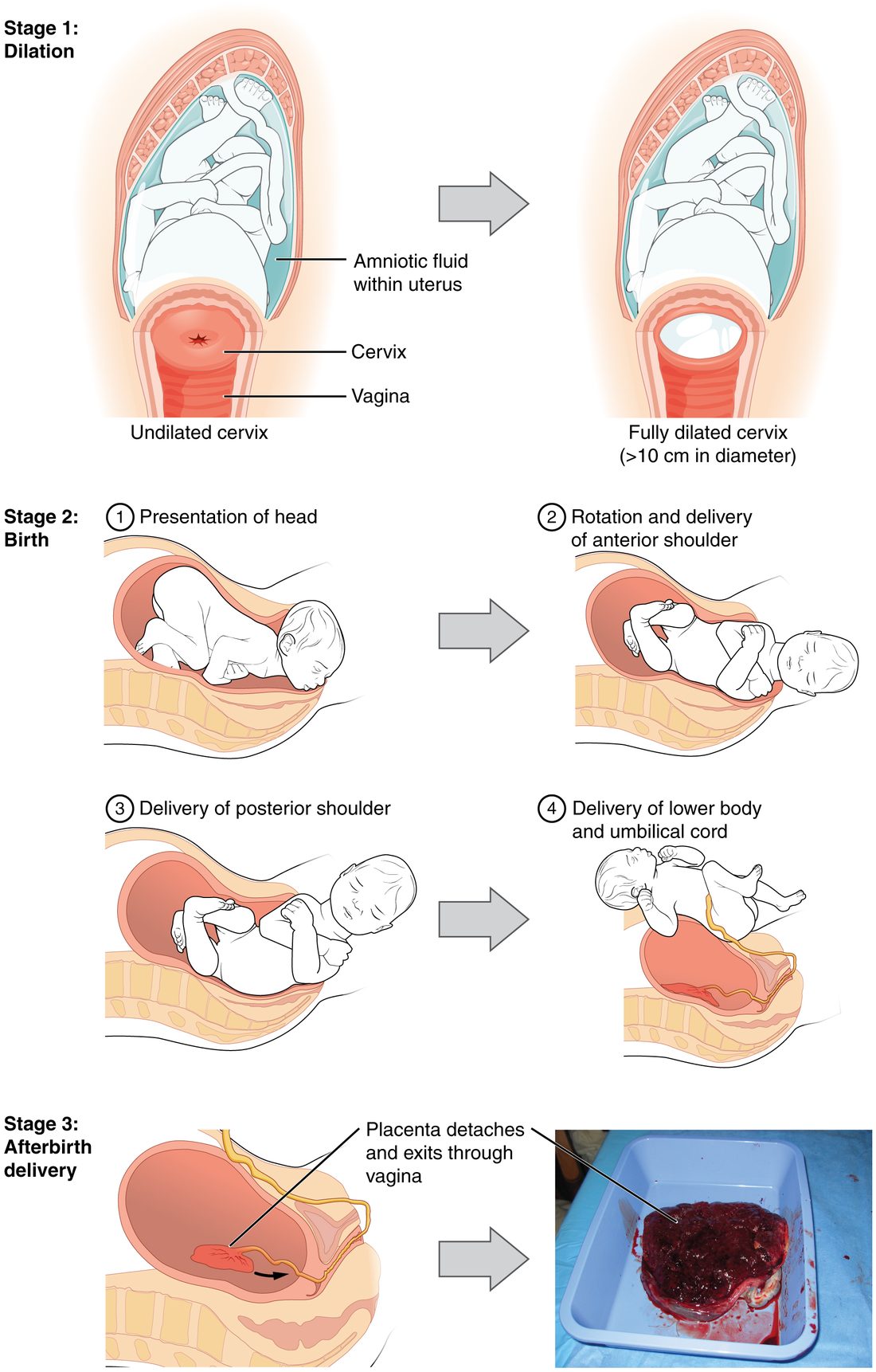
- The cervix reaches full dilation and the baby is pushed out.The stretch stops, which ends the loop; the uterus keeps contracting, shears off the placenta and clamps the vessels of the placental bed.
6Core concepts
7A common mistake
The wrong idea: Oxytocin is what starts labor, and without it labor cannot happen or will stall.
What actually happens: Labor starts from changes in the uterus and placenta: gap junctions, oxytocin receptor proteins, prostaglandins, a ripening cervix and a uterus that stops responding to progesterone. Blood oxytocin barely rises before labor. Oxytocin's positive feedback loop makes contractions stronger once labor is under way, but mice lacking oxytocin give birth normally and women with very little oxytocin have had normal labors. Hospitals give oxytocin when contractions are weak, to strengthen them.
8Check yourself
Anything you miss goes into your review queue.
1. At 37 weeks, Ms. Obi has had painful tightenings every 8 to 20 minutes for three hours. They ease when she walks, and her cervix is closed and unchanged two hours apart. What is she having?
- Braxton Hicks contractions (false labor)
- Early labor, in the latent phase of the dilation stage
- Lightening
- The expulsion stage
Show the answer
Irregular contractions that ease with walking and do not change the cervix are false labor. True labor is defined by progressive thinning and opening of the cervix, not by pain.
- Correct: Braxton Hicks contractions (false labor): Correct. Irregular timing, easing with activity and no change in the cervix mark Braxton Hicks contractions.
- Early labor, in the latent phase of the dilation stage: The latent phase is slow, but the cervix does soften, thin and open over time. Hers has not changed at all.
- Lightening: Lightening is the fetal head dropping into the pelvis. It changes breathing and urination, not contractions.
- The expulsion stage: The expulsion stage starts only once the cervix is fully dilated at 10 cm.
2. A student wrote out the labor positive feedback loop. One step is wrong. Which one?
- The fetal head presses on and stretches the cervix
- Stretch-sensitive sensory receptors send afferent signals to the hypothalamus
- The anterior pituitary releases oxytocin into the blood
- Oxytocin makes the myometrium contract harder
- The harder contraction stretches the cervix further
Show the answer
Oxytocin is made by hypothalamic neurons and released from their axon endings in the posterior pituitary, not the anterior pituitary.
- The fetal head presses on and stretches the cervix: This step is right. The head acts as the wedge that stretches the cervix.
- Stretch-sensitive sensory receptors send afferent signals to the hypothalamus: This step is right. The afferent limb of the Ferguson reflex runs from the cervix to the hypothalamus.
- Correct: The anterior pituitary releases oxytocin into the blood: This is the error. Oxytocin comes from the posterior pituitary, which is made of hypothalamic axon endings.
- Oxytocin makes the myometrium contract harder: This step is right. Oxytocin acts on its receptor proteins in the myometrium.
- The harder contraction stretches the cervix further: This step is right. It closes the loop, which is what makes it positive feedback.
3. A woman whose posterior pituitary was damaged years ago, and who now releases almost no oxytocin, goes into spontaneous labor at 39 weeks. Based on current evidence, what is the best prediction?
- No contractions occur until an oxytocin drip is given
- Contractions begin, but the cervix stops opening at about 3 to 4 cm
- Labor can start and progress, though contractions may be weaker
- Labor runs faster than usual, with a shorter first stage
Show the answer
Labor starts from changes in the uterus itself: gap junctions, oxytocin receptor proteins, prostaglandins, cervical ripening and loss of progesterone's effect. Mice lacking oxytocin or its receptor protein give birth normally, and women with little oxytocin have had normal labors. Oxytocin's loop strengthens contractions; if they are weak, a drip can be given.
- No contractions occur until an oxytocin drip is given: Oxytocin barely rises before labor. Contractions start from changes in the uterus and placenta, not from oxytocin.
- Contractions begin, but the cervix stops opening at about 3 to 4 cm: Some textbooks predict a stall, but the evidence shows labor can progress without oxytocin. The loop makes contractions stronger; it is not required.
- Correct: Labor can start and progress, though contractions may be weaker: Correct. Without oxytocin the loop that strengthens contractions is missing, but labor can begin and progress.
- Labor runs faster than usual, with a shorter first stage: Oxytocin makes contractions stronger. Its absence would not speed labor.
4. Twenty minutes after delivering her placenta, Mrs. Novak is bleeding heavily. Her uterus feels soft and large through the abdomen. Why is she bleeding?
- Her clotting factors were used up during labor
- Her relaxed myometrium is not pinching the placental-bed arteries shut
- Oxytocin given at delivery has widened her uterine arteries
- The placenta separated before the baby was born
Show the answer
This is uterine atony. The crisscrossing muscle fibers of the upper uterus are the main brake on bleeding from the placental site; when they relax, the vessels stay open. Rubbing the fundus and giving oxytocin make the uterus contract and clamp them.
- Her clotting factors were used up during labor: Clotting seals the vessels only after muscle has closed them. A soft, enlarged uterus points to the muscle, not the clotting system.
- Correct: Her relaxed myometrium is not pinching the placental-bed arteries shut: Correct. Atony leaves the vessels open; firm contraction is what closes them.
- Oxytocin given at delivery has widened her uterine arteries: Oxytocin makes the myometrium contract, which compresses the vessels. It is the treatment for this bleeding, not the cause.
- The placenta separated before the baby was born: Early separation would cause bleeding before the birth. Hers began after the placenta was out, with a soft uterus.
5. A woman's cervix is 10 cm dilated and she is pushing with each contraction. The baby has not yet been born. Which stage of labor is she in?
- The dilation stage
- The placental stage
- The postpartum period
- The expulsion stage
Show the answer
Each stage is defined by the event that ends it. The expulsion stage runs from full dilation to the birth of the baby, so a fully dilated woman who has not yet delivered is in it.
- The dilation stage: The dilation stage ends when the cervix reaches 10 cm, which hers has.
- The placental stage: The placental stage begins only after the baby is born.
- The postpartum period: The postpartum period follows delivery of the placenta.
- Correct: The expulsion stage: Correct. Full dilation to birth is the expulsion stage.
6. What makes the placenta separate from the uterine wall after the baby is born?
- The uterus shrinks while the placenta cannot, so it shears away
- Oxytocin digests the tissue anchoring the placenta
- Falling progesterone makes the placenta dissolve
- Traction on the cord pulls the placenta off the wall
Show the answer
Separation is mechanical. The emptied uterus keeps contracting and shrinks, and the patch of wall under the placenta shrinks with it. The placenta cannot shrink, so it shears off, and blood collecting behind it helps peel it away.
- Correct: The uterus shrinks while the placenta cannot, so it shears away: Correct. A shrinking wall under a placenta that cannot shrink shears it off.
- Oxytocin digests the tissue anchoring the placenta: Oxytocin makes muscle contract. It does not digest tissue.
- Falling progesterone makes the placenta dissolve: Progesterone falls after the placenta is delivered, because the placenta makes it. The fall follows separation rather than causing it.
- Traction on the cord pulls the placenta off the wall: The cord is only a guide once the placenta has separated. Pulling hard on an attached placenta can turn the uterus inside out, which is why clinicians wait for separation.
7. Predict the change in each variable over the first week after the placenta is delivered, compared with the day before birth.
| Variable | Change |
|---|---|
| Blood progesterone | — |
| Mass of the uterus | — |
| Urine output | — |
| Number of myometrial cells | — |
Show the answer
Delivering the placenta removes the hormone source that sustained pregnancy. Hormones fall, the uterus involutes by shrinking its cells, and the kidneys clear the extra fluid of pregnancy.
- Blood progesterone: down. The placenta was the main source of progesterone in late pregnancy. Once it is delivered, the level falls within days.
- Mass of the uterus: down. With estrogen and progesterone falling and the uterus contracting, the muscle cells break down their own proteins and shrink: uterine involution.
- Urine output: up. The extra fluid of pregnancy moves back into the blood and is cleared by the kidneys, so she passes large volumes of urine in the first days.
- Number of myometrial cells: no change. Involution shrinks the existing muscle cells rather than removing them, so their number stays about the same.
8. Over a first labor, the wall of the upper uterus becomes thicker while the lower part and cervix become thinner. What explains this?
- Upper myometrial cells divide rapidly during labor
- Fluid collects in the upper wall
- Upper muscle cells stay shorter after each contraction
- The lower uterus loses its oxytocin receptor proteins
Show the answer
This is retraction. The upper muscle ends each contraction slightly shorter and thicker, so it draws the thin lower segment and the softened cervix upward around the head: effacement and dilation.
- Upper myometrial cells divide rapidly during labor: Cell division is far too slow to thicken a wall over hours. The cells change length, not number.
- Fluid collects in the upper wall: Fluid would not explain why the upper wall thickens while the lower wall thins at the same time.
- Correct: Upper muscle cells stay shorter after each contraction: Correct. Retraction: each shortening thickens the upper segment and pulls the lower segment and cervix up and open.
- The lower uterus loses its oxytocin receptor proteins: Receptor protein numbers set how strongly the muscle responds to oxytocin. They would not thin the lower wall while thickening the upper one.
9Summary
Parturition is giving birth. True labor opens the cervix; the Braxton Hicks contractions of false labor do not. Near term, placental CRH and estrogens rise, the uterus stops responding to progesterone, and the myometrium gains gap junctions and oxytocin receptor proteins while prostaglandins ripen the cervix. Cervical stretch triggers oxytocin release (the Ferguson reflex), and oxytocin strengthens contractions, which stretch the cervix more: the labor positive feedback loop, which birth ends. It strengthens labor but is not required for labor to start or progress. The dilation stage opens the cervix to 10 cm, the expulsion stage delivers the baby, and the placental stage delivers the afterbirth; a firmly contracted uterus then pinches its own vessels shut, and a relaxed one bleeds. In the six-week postpartum period the uterus involutes and lochia clears.