Tubular reabsorption and secretion
1Why this matters
Mrs. Kowalski, 58, has type 2 diabetes. Her doctor starts a tablet that makes her urine test strongly positive for glucose, and tells her this is the drug working. Her blood glucose falls over the next weeks. To see how a drug can lower blood glucose by making the kidneys let sugar go, you need to know how the renal tubule reabsorbs glucose, and what limits how much it can take back.
2What this builds on
3Quick check before you start
1. What does secondary active transport use to move a solute against its gradient?
- ATP bound directly to the carrier
- The downhill flow of another ion, usually sodium
- Osmotic pressure
Show the answer
A secondary active carrier couples the solute to sodium moving down the gradient that the sodium–potassium pump maintains. The pump spends the ATP; the carrier spends the gradient.
- ATP bound directly to the carrier:
- Correct: The downhill flow of another ion, usually sodium:
- Osmotic pressure:
2. When every carrier protein for a solute is busy, what happens if the solute's concentration rises further?
- The transport rate stays at its maximum
- The transport rate keeps rising in proportion
- The carriers reverse direction
Show the answer
This is carrier saturation. Once all carriers are occupied, the rate can't rise, however much solute is present.
- Correct: The transport rate stays at its maximum:
- The transport rate keeps rising in proportion:
- The carriers reverse direction:
3. Which part of the nephron receives fluid directly from the glomerular capsule?
- The nephron loop
- The collecting duct
- The proximal convoluted tubule
Show the answer
Filtrate flows from the capsule into the proximal convoluted tubule, then the nephron loop, the distal convoluted tubule and the collecting duct.
- The nephron loop:
- The collecting duct:
- Correct: The proximal convoluted tubule:
4Anatomy
With labels hidden, select a box to reveal its label.
5How it works, step by step
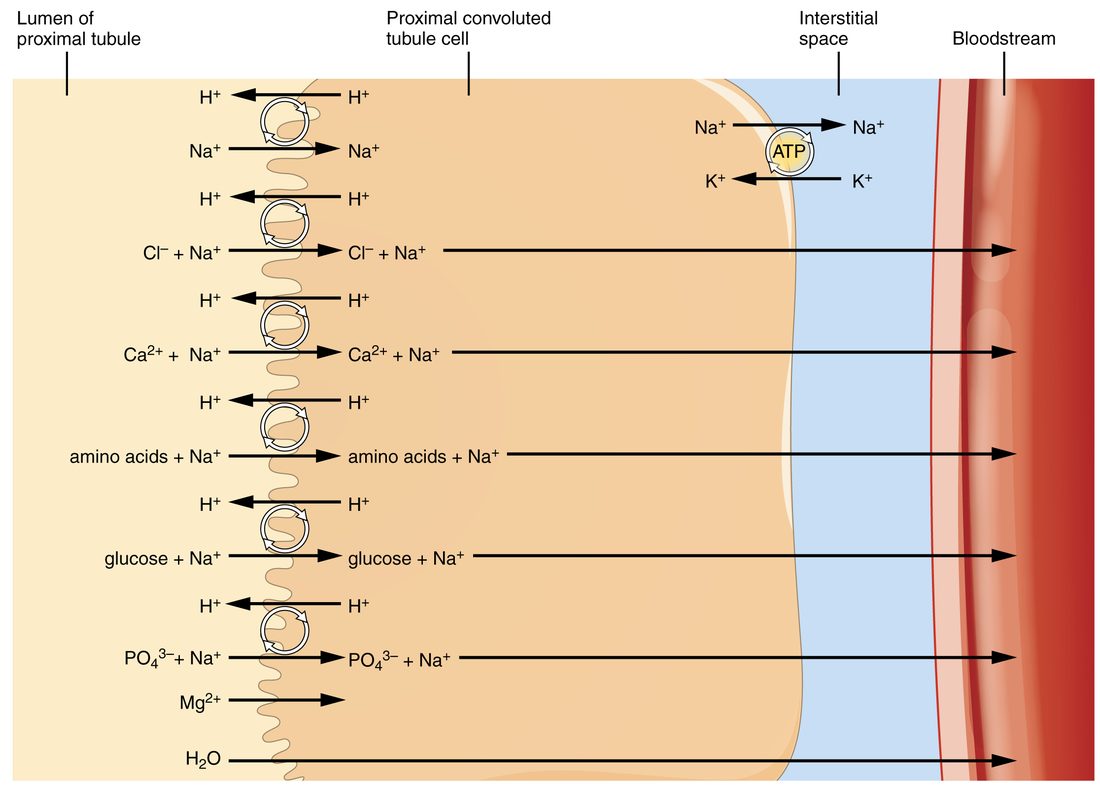
- The sodium–potassium pump on the basolateral membrane moves sodium out of the tubule cell.Sodium inside the cell stays low and the cell interior stays negative, so sodium in the lumen has a steep gradient into the cell.
- Sodium flows into the cell down that gradient on apical symporters and antiporters.Glucose, amino acids and phosphate are carried in with it, and H+ is pushed out in exchange.
- Solute leaves the lumen, leaving the tubular fluid slightly more dilute than the cells and interstitial fluid.Water follows by osmosis, through aquaporins and the leaky tight junctions.
- As water leaves, chloride, potassium, calcium and urea become more concentrated in the lumen than in the blood.They diffuse out passively, much of it between the cells.
- Reabsorbed solute and water collect in the interstitial fluid next to the peritubular capillaries, whose hydrostatic pressure is low and colloid osmotic pressure high.They enter the blood, and about two thirds of the filtrate has been returned before the fluid reaches the nephron loop.
6Core concepts
7A common mistake
The wrong idea: Glucose in the urine means the kidneys are failing.
What actually happens: Healthy kidneys filter glucose freely and reabsorb it on a limited number of carriers. When plasma glucose rises above the renal threshold, about 180 mg/dL, some nephrons' carriers saturate and glucose spills into the urine even though the kidneys are working normally. Glucose in the urine usually points to high blood glucose, as in diabetes mellitus, or to a drug that blocks the carriers, not to kidney damage.
8Check yourself
Anything you miss goes into your review queue.
1. A toxin blocks the sodium–potassium pumps of proximal tubule cells. None of the apical glucose carriers uses ATP. What happens to glucose reabsorption?
- It stops, as cell sodium rises and the inward sodium gradient disappears
- It continues unchanged, since the glucose carriers need no ATP
- It speeds up, as sodium builds up inside the cell and drives the carriers harder
- It switches to the paracellular route between the cells
Show the answer
Glucose enters by secondary active transport: it rides in with sodium, which flows down the gradient that the basolateral pump makes. With the pump stopped, sodium leaks in and is not removed, the gradient runs down, and the symporters have nothing to drive them.
- Correct: It stops, as cell sodium rises and the inward sodium gradient disappears: Correct. The pump spends the ATP; the symporters spend the sodium gradient it makes.
- It continues unchanged, since the glucose carriers need no ATP: The carriers need no ATP directly, but they need the sodium gradient, and only the pump maintains it.
- It speeds up, as sodium builds up inside the cell and drives the carriers harder: Sodium building up inside the cell lowers the gradient into the cell, which slows the symporters rather than speeding them.
- It switches to the paracellular route between the cells: The paracellular route is passive and carries no glucose against its gradient. Glucose in the lumen falls to near zero, below plasma, so it could not diffuse back that way.
2. Use the graph. At a plasma glucose of 600 mg/dL, about how much glucose is excreted in urine each minute?
- 750 mg/min
- About 375 mg/min
- 0 mg/min
- About 190 mg/min
Show the answer
At 600 mg/dL the filtered line reads 750 mg/min and the reabsorbed line is flat at the transport maximum, 375 mg/min. Excreted = 750 − 375 = 375 mg/min, which is where the excreted line sits.
- 750 mg/min: 750 mg/min is the filtered load. Half of it is still reabsorbed.
- Correct: About 375 mg/min: Correct. Filtered minus the transport maximum: 750 − 375.
- 0 mg/min: Excretion is zero only below the renal threshold, about 180 mg/dL.
- About 190 mg/min: About 190 mg/min is what the excreted line shows near 450 mg/dL, not 600.
3. Mr. Mensah, 52, has undiagnosed diabetes mellitus. His plasma glucose is 280 mg/dL, and his urine dipstick shows glucose. His kidneys are healthy. Why is glucose in his urine?
- His glomeruli have been damaged by diabetes and now let glucose through
- His tubules secrete excess glucose into the urine
- Some nephrons get more glucose than their carriers can reabsorb
- Insulin is needed for the tubule to reabsorb glucose
Show the answer
Glucose is always filtered. At 280 mg/dL, he is above the renal threshold of about 180 mg/dL: nephrons with fewer carriers for their load are saturated, and glucose passes them into the urine.
- His glomeruli have been damaged by diabetes and now let glucose through: Glucose is small and is filtered freely by healthy glomeruli at any blood level. Filtration of glucose is normal; what fails is reabsorbing all of it.
- His tubules secrete excess glucose into the urine: Glucose is not secreted by the tubule. It is filtered, then reabsorbed on sodium–glucose symporters.
- Correct: Some nephrons get more glucose than their carriers can reabsorb: Correct. His filtered load is above the renal threshold, so reabsorption can't keep up everywhere.
- Insulin is needed for the tubule to reabsorb glucose: The tubule reabsorbs glucose with sodium symporters that work without insulin. Insulin controls glucose uptake into muscle and fat.
4. A benign tumor of the zona glomerulosa releases large amounts of aldosterone. Predict the change in each variable, compared with before the tumor.
| Variable | Change |
|---|---|
| Number of open sodium channels in principal cells | — |
| Sodium reabsorbed in the collecting duct | — |
| Potassium secreted into the urine | — |
| Plasma potassium | — |
| Glucose reabsorbed in the proximal tubule | — |
Show the answer
Aldosterone acts on principal cells: more sodium channels, potassium channels and pumps. Sodium reabsorption and potassium secretion both rise, so the body keeps sodium and loses potassium. The proximal tubule's glucose handling is not affected.
- Number of open sodium channels in principal cells: up. Aldosterone makes principal cells build more apical sodium channels, potassium channels and basolateral pumps.
- Sodium reabsorbed in the collecting duct: up. More channels and pumps move more sodium from the lumen into the blood.
- Potassium secreted into the urine: up. Sodium entering the principal cells leaves the lumen more negative, and the extra potassium channels let more potassium leave the cells into the urine.
- Plasma potassium: down. Potassium lost in urine exceeds intake, so plasma potassium falls, sometimes to hypokalemia.
- Glucose reabsorbed in the proximal tubule: no change. Aldosterone acts on principal cells at the end of the tubule. Glucose reabsorption in the proximal tubule is unchanged.
5. A student described how the thick ascending limb works. One step is wrong. Which one?
- NKCC2 carries 1 Na+, 1 K+ and 2 Cl− from the lumen into the cell
- Most of the potassium leaks back into the lumen through potassium channels
- The lumen becomes positively charged, pushing calcium and magnesium out between the cells
- Water follows the salt out of the tubule by osmosis
- The fluid leaving the segment is more dilute than plasma
Show the answer
The thick ascending limb is nearly impermeable to water, so water cannot follow the salt. That is exactly why the fluid leaving it is dilute.
- NKCC2 carries 1 Na+, 1 K+ and 2 Cl− from the lumen into the cell: This step is right. That is the stoichiometry of the Na–K–2Cl cotransporter.
- Most of the potassium leaks back into the lumen through potassium channels: This step is right. Potassium recycling keeps NKCC2 supplied and charges the lumen positive.
- The lumen becomes positively charged, pushing calcium and magnesium out between the cells: This step is right. The positive lumen drives paracellular reabsorption of calcium, magnesium and sodium.
- Correct: Water follows the salt out of the tubule by osmosis: This is the error. Water stays in the lumen, because this segment has almost no aquaporins.
- The fluid leaving the segment is more dilute than plasma: This step is right. Salt out, water in: the fluid falls to about 100 mOsm/L.
6. A researcher measures a new drug: 50 mg/min is filtered, and 120 mg/min appears in the urine. What must the renal tubule be doing with it?
- Reabsorbing 70 mg/min
- Neither reabsorbing nor secreting it
- Filtering it a second time in the collecting duct
- Secreting at least 70 mg/min
Show the answer
Excreted = filtered − reabsorbed + secreted. More is excreted than was filtered, so there must be net secretion: 120 − 50 = 70 mg/min at least, more if some is also reabsorbed.
- Reabsorbing 70 mg/min: Reabsorption would make the urine amount smaller than the filtered amount, not larger.
- Neither reabsorbing nor secreting it: Without either process, excretion would equal filtration: 50 mg/min.
- Filtering it a second time in the collecting duct: Filtration happens only in the glomerulus. The collecting duct cannot filter.
- Correct: Secreting at least 70 mg/min: Correct. Only secretion can make excretion exceed filtration.
7. A person drinks 2 L of water quickly, and ADH release falls. Which water reabsorption falls?
- Obligatory water reabsorption in the proximal convoluted tubule
- Water reabsorption in the descending limb
- Facultative water reabsorption in the collecting duct
- Water reabsorption in the thick ascending limb
Show the answer
Facultative water reabsorption depends on ADH putting aquaporins into principal cells. With less ADH, the collecting duct lets less water out, and a large volume of dilute urine follows.
- Obligatory water reabsorption in the proximal convoluted tubule: The proximal tubule reabsorbs water whatever ADH does, because it is always permeable to water. That is why it is called obligatory.
- Water reabsorption in the descending limb: The descending limb is always permeable to water, so its reabsorption is obligatory too.
- Correct: Facultative water reabsorption in the collecting duct: Correct. Only this part is set by ADH.
- Water reabsorption in the thick ascending limb: The thick ascending limb reabsorbs essentially no water at any ADH level.
9Summary
The renal tubule returns about 99% of the 180 L you filter each day. For any substance, excreted = filtered − reabsorbed + secreted. Substances cross the wall through cells (transcellular) or between them (paracellular, through leaky tight junctions in the proximal tubule). The basolateral sodium–potassium pump drives almost everything: sodium flows in and carries glucose, amino acids and phosphate with it by secondary active transport. The proximal tubule reabsorbs about 65% of sodium and water and nearly all nutrients, leaving fluid at 300 mOsm/L. Carriers saturate at a transport maximum (glucose about 375 mg/min), so glucose appears in urine above a renal threshold of about 180 mg/dL. The descending limb loses water; the thick ascending limb pumps salt out on NKCC2 but keeps water, diluting the fluid to about 100 mOsm/L. The distal tubule reabsorbs sodium with chloride and calcium under PTH. In the collecting duct, principal cells reabsorb sodium and secrete potassium under aldosterone and reabsorb water under ADH, while intercalated cells handle acid–base balance. The tubule also secretes potassium, H+ and drugs. About 80 to 85% of water reabsorption is obligatory; the rest, facultative and set by ADH, decides your urine volume.