Gas exchange
1Why this matters
Jamal, 24, drives from Colorado Springs to the summit of Pikes Peak, 4,300 m up. Within minutes of stepping out, he is short of breath climbing a few stairs. The air around him is still 21% oxygen, exactly as at home. What has changed is the pressure of that oxygen, and pressure is what pushes oxygen from his alveoli into his blood.
2What this builds on
3Quick check before you start
1. In net diffusion, which way do molecules move?
- From lower to higher concentration, using ATP
- From higher to lower concentration, without ATP
- In whichever direction a carrier protein moves them
Show the answer
Diffusion is the net movement of molecules down their concentration gradient, driven by their own random motion. It needs no ATP.
- From lower to higher concentration, using ATP:
- Correct: From higher to lower concentration, without ATP:
- In whichever direction a carrier protein moves them:
2. What makes up the respiratory membrane that gases cross in the lungs?
- The alveolar wall, the capillary wall and their fused basement membranes
- The visceral and parietal pleura
- The wall of a terminal bronchiole and its cartilage
Show the answer
The respiratory membrane is the thin barrier between alveolar air and blood: type I alveolar cells, the capillary endothelium and their fused basement membranes, about half a micrometer thick.
- Correct: The alveolar wall, the capillary wall and their fused basement membranes:
- The visceral and parietal pleura:
- The wall of a terminal bronchiole and its cartilage:
3. A resting adult breathes 12 times a minute with 500 mL breaths, and his dead space is 150 mL. What is his alveolar ventilation?
- 6.0 L/min
- 1.8 L/min
- 4.2 L/min
Show the answer
Alveolar ventilation = (tidal volume − dead space) × rate = (500 − 150) × 12 = 4,200 mL/min. The 6.0 L/min minute ventilation includes the dead space.
- 6.0 L/min:
- 1.8 L/min:
- Correct: 4.2 L/min:
4Anatomy
With labels hidden, select a box to reveal its label.
5How it works, step by step
- Mucus partly blocks a small airway, so the alveoli beyond it get less fresh air.The PO2 in those alveoli falls and their PCO2 rises.
- The low alveolar PO2 reaches smooth muscle in the nearby pulmonary arterioles.The arterioles constrict: hypoxic pulmonary vasoconstriction.
- The narrowed arterioles have a higher resistance.Less blood flows to the poorly ventilated alveoli, and more is sent to well-ventilated ones.
- Most blood now passes alveoli whose PO2 is near 100 mm Hg.Oxygen diffuses in down a normal gradient, so the PO2 of arterial blood stays close to normal despite the blocked airway.
6Core concepts
7A common mistake
The wrong idea: The carbon dioxide gradient in the lungs is only about 6 mm Hg, so the lungs can remove only a little carbon dioxide.
What actually happens: How fast a gas diffuses depends on its solubility as well as its gradient. Carbon dioxide is about 20 times more soluble than oxygen, so a 6 mm Hg gradient moves it about as readily as a much larger gradient moves oxygen. That small gradient clears the roughly 200 mL of carbon dioxide you make each minute.
8Check yourself
Anything you miss goes into your review queue.
1. Air breathed in at sea level (760 mm Hg) is warmed to 37 °C and filled with water vapor in the airways. Water vapor at 37 °C has a partial pressure of 47 mm Hg. What is the PO2 of this air? Oxygen is 20.9% of the dry gas.
- About 159 mm Hg
- About 150 mm Hg
- About 713 mm Hg
- About 169 mm Hg
Show the answer
Water vapor takes 47 mm Hg of the total, leaving 760 − 47 = 713 mm Hg for the dry gases. Oxygen's share is 713 × 0.209 = 149, about 150 mm Hg.
- About 159 mm Hg: 159 mm Hg is the PO2 of dry air. It ignores the water vapor, which takes part of the total pressure.
- Correct: About 150 mm Hg: Correct. (760 − 47) × 0.209 ≈ 150 mm Hg.
- About 713 mm Hg: 713 mm Hg is the pressure left for all the dry gases together, not oxygen's share of it.
- About 169 mm Hg: 169 mm Hg adds the water vapor pressure instead of subtracting it.
2. In Leadville, Colorado, total air pressure is about 523 mm Hg. Once breathed-in air is warmed and moistened (water vapor 47 mm Hg), what is its PO2? Oxygen is 20.9% of the dry gas.
- About 109 mm Hg
- About 150 mm Hg
- About 476 mm Hg
- About 100 mm Hg
Show the answer
Dry gases share 523 − 47 = 476 mm Hg. Oxygen's share is 476 × 0.209 = 99.5, about 100 mm Hg: two-thirds of the sea-level value, although the air is still 20.9% oxygen.
- About 109 mm Hg: 109 mm Hg (523 × 0.209) forgets to subtract the water vapor first.
- About 150 mm Hg: 150 mm Hg is the sea-level value. The oxygen fraction is the same here, but the total pressure is lower.
- About 476 mm Hg: 476 mm Hg is the pressure of all the dry gases together.
- Correct: About 100 mm Hg: Correct. (523 − 47) × 0.209 ≈ 100 mm Hg.
3. Across the respiratory membrane, the oxygen gradient is about 60 mm Hg but the carbon dioxide gradient is only about 6 mm Hg. Why is so much carbon dioxide still exchanged?
- Carbon dioxide is pumped across by active transport
- Carbon dioxide molecules are smaller than oxygen molecules
- The respiratory membrane has channels only for carbon dioxide
- Carbon dioxide is about 20 times more soluble than oxygen
Show the answer
Diffusion rate depends on solubility as well as gradient. Carbon dioxide dissolves about 20 times more readily, so 6 mm Hg × 20 moves it about as readily as 120 mm Hg would move oxygen: more than enough to clear the carbon dioxide you make.
- Carbon dioxide is pumped across by active transport: Both gases cross by simple diffusion. No ATP is spent moving them.
- Carbon dioxide molecules are smaller than oxygen molecules: A carbon dioxide molecule is actually heavier than an oxygen molecule. Its advantage is solubility, not size.
- The respiratory membrane has channels only for carbon dioxide: Both gases dissolve through the membrane's lipid and water; neither needs a special channel.
- Correct: Carbon dioxide is about 20 times more soluble than oxygen: Correct. High solubility makes up for the small gradient.
4. Blood enters a pulmonary capillary with a PO2 of 40 mm Hg and a PCO2 of 46 mm Hg. The alveolar air has a PO2 of 100 and a PCO2 of 40 mm Hg. In a healthy lung at rest, what are the blood's values when it leaves the capillary?
- PO2 about 140, PCO2 about 6 mm Hg
- PO2 about 70, PCO2 about 43 mm Hg
- PO2 about 100, PCO2 about 40 mm Hg
- PO2 about 40, PCO2 about 46 mm Hg
Show the answer
Diffusion continues until the blood's partial pressures match the alveolar air. At rest, this happens within the first third of the capillary, so blood leaves at about 100 and 40 mm Hg.
- PO2 about 140, PCO2 about 6 mm Hg: Diffusion can only bring the blood up to the alveolar value, never past it, because the gradient disappears once they match.
- PO2 about 70, PCO2 about 43 mm Hg: Halfway values would mean diffusion stopped early. In healthy lungs at rest, there is plenty of time to finish.
- Correct: PO2 about 100, PCO2 about 40 mm Hg: Correct. Blood leaves in balance with alveolar air.
- PO2 about 40, PCO2 about 46 mm Hg: These are the values of blood arriving from the tissues. They would stay the same only if no exchange happened, as in an unventilated alveolus.
5. During a sprint, the PO2 in the tissue fluid of a working thigh muscle falls from about 40 to about 20 mm Hg, while arterial PO2 stays near 95. What happens to oxygen delivery to the muscle cells, and why?
- It falls, because there is less oxygen in the tissue
- It rises, because arterial blood carries more dissolved oxygen
- It stays the same, because arterial PO2 has not changed
- It rises, because the blood-to-tissue gradient is steeper
Show the answer
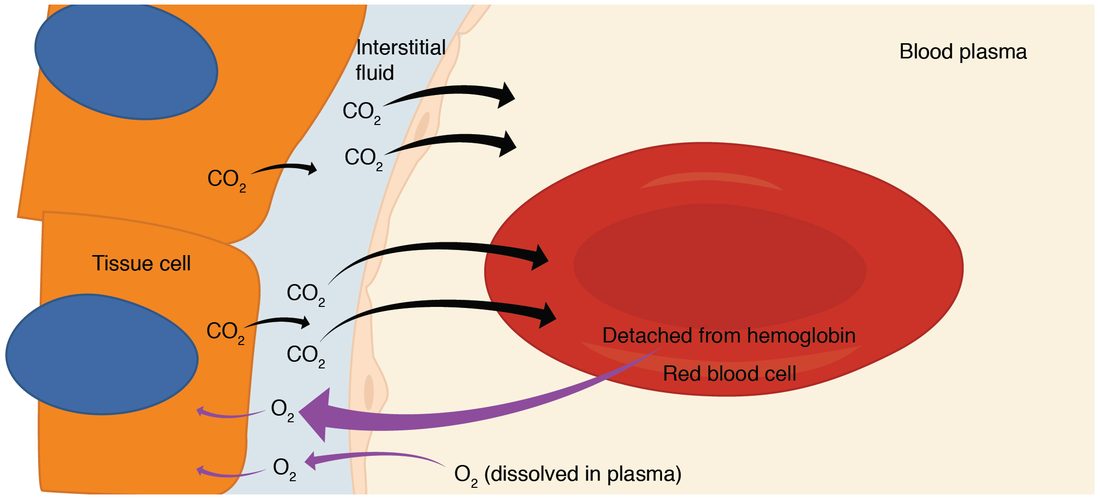
Internal respiration runs down the gradient from blood to tissue. With the tissue at 20 instead of 40 mm Hg, the gradient grows from about 55 to about 75 mm Hg, so more oxygen diffuses out of each pass of blood, with no signal needed.
- It falls, because there is less oxygen in the tissue: The tissue's low PO2 is what steepens the gradient; it pulls more oxygen out of the blood.
- It rises, because arterial blood carries more dissolved oxygen: Arterial PO2 is unchanged, so the dissolved oxygen in arterial blood is unchanged too.
- It stays the same, because arterial PO2 has not changed: Oxygen movement depends on the difference between blood and tissue, and the tissue value has changed.
- Correct: It rises, because the blood-to-tissue gradient is steeper: Correct. A steeper gradient means faster diffusion into the tissue.
6. A plug of mucus partly blocks the bronchiole to one group of Ms. Diaz's alveoli. Within minutes, blood flow to those alveoli falls. What causes the fall in blood flow?
- Nearby pulmonary arterioles dilate and draw blood away from the blocked area
- The mucus plug presses on the pulmonary capillaries
- The alveolar PO2 falls and the nearby pulmonary arterioles constrict
- The heart pumps less blood to the lungs
Show the answer
Poorly ventilated alveoli have a low PO2. Smooth muscle in the nearby pulmonary arterioles responds to the low PO2 by contracting: hypoxic pulmonary vasoconstriction. Blood is sent to better-ventilated alveoli, which keeps the ventilation–perfusion ratio closer to normal.
- Nearby pulmonary arterioles dilate and draw blood away from the blocked area: The response is constriction of the arterioles supplying the poorly ventilated alveoli, not dilation.
- The mucus plug presses on the pulmonary capillaries: The plug sits inside the airway; it does not squeeze the blood vessels.
- Correct: The alveolar PO2 falls and the nearby pulmonary arterioles constrict: Correct. Low alveolar PO2 triggers local vasoconstriction.
- The heart pumps less blood to the lungs: Cardiac output to the lungs as a whole is unchanged; blood is redistributed within the lungs.
7. How does a low PO2 affect arterioles in the lungs compared with arterioles in a working skeletal muscle?
- Lung arterioles dilate; muscle arterioles constrict
- Both constrict
- Lung arterioles constrict; muscle arterioles dilate
- Both dilate
Show the answer
In a systemic tissue such as muscle, low PO2 dilates arterioles, bringing more blood where oxygen is being used up. In the lungs, low alveolar PO2 constricts pulmonary arterioles, sending blood away from alveoli that are getting too little air.
- Lung arterioles dilate; muscle arterioles constrict: This reverses both responses.
- Both constrict: Constriction is the lung response only. Muscle arterioles dilate when oxygen runs low.
- Correct: Lung arterioles constrict; muscle arterioles dilate: Correct. The two circulations respond in opposite directions.
- Both dilate: Dilation is the systemic response only. Lung arterioles constrict.
9Summary
The partial pressure of a gas is the total pressure times that gas's fraction of the mixture, and by Dalton's law the partial pressures add up to the total pressure. Air at sea level has a PO2 of about 159 mm Hg dry and 150 once moistened in the airways; alveolar air has a PO2 of about 100 and a PCO2 of about 40 mm Hg. Henry's law says the amount of gas dissolved in blood is its partial pressure times its solubility; carbon dioxide is about 20 times more soluble than oxygen. In external respiration, oxygen diffuses from alveoli (100) into blood arriving at 40, and carbon dioxide leaves blood arriving at 46. In internal respiration, the gradients reverse: oxygen leaves arterial blood for tissues at about 40 or less, and carbon dioxide enters. Blood flow is matched to airflow locally: low alveolar PO2 constricts pulmonary arterioles, which sends blood to better-ventilated alveoli and keeps the ventilation–perfusion ratio near 0.8.