The large intestine
1Why this matters
Mr. Chen, 78, finished a course of a strong antibiotic for pneumonia last week. Now he has watery diarrhea eight times a day, cramps and a fever. The antibiotic cured his lungs, but it also wiped out much of the bacterial community in his colon, and a resistant species has taken over. To understand what went wrong, you need to know what the large intestine and its bacteria normally do.
2What this builds on
3Quick check before you start
1. A solute that a membrane holds back is more concentrated on one side. Which way does water move?
- Toward the side with more solute
- Toward the side with less solute
- It does not move
Show the answer
Water follows solute: it moves by osmosis toward the side where the held-back solute is more concentrated.
- Correct: Toward the side with more solute:
- Toward the side with less solute:
- It does not move:
2. A reflex whose effectors are smooth muscle, cardiac muscle or glands is called what?
- A somatic reflex
- A visceral reflex
- A stretch reflex of skeletal muscle
Show the answer
Visceral (autonomic) reflexes act on smooth muscle, cardiac muscle and glands. Somatic reflexes act on skeletal muscle.
- A somatic reflex:
- Correct: A visceral reflex:
- A stretch reflex of skeletal muscle:
3. Which of these is an accessory digestive organ rather than part of the alimentary canal?
- The stomach
- The pancreas
- The colon
Show the answer
Food passes through the stomach and colon, which are parts of the alimentary canal. The pancreas makes secretions and delivers them through a duct, so it is an accessory organ.
- The stomach:
- Correct: The pancreas:
- The colon:
4Anatomy
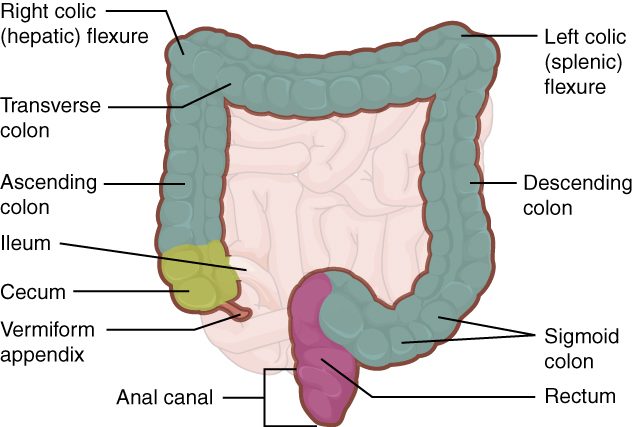
With labels hidden, select a box to reveal its label.
5How it works, step by step
- After a meal, stretch of the stomach triggers the gastrocolic reflex.A mass movement sweeps along the colon and pushes feces into the rectum.
- Feces stretch the rectal wall.Stretch-sensitive sensory receptors fire and signal the sacral spinal cord, and you feel the urge.
- Parasympathetic neurons from the sacral cord fire.The rectum and sigmoid colon contract and the internal anal sphincter relaxes.
- You choose to relax the external anal sphincter and add a Valsalva's maneuver.Pressure in the abdomen rises and feces pass out. If instead you tighten the external sphincter, the rectum relaxes and the urge fades.
- Feces held in the rectum stay in contact with the lining.More water is absorbed, so delaying repeatedly makes stools harder.
6Core concepts
7A common mistake
The wrong idea: The colon absorbs most of the water that passes through the gut.
What actually happens: About 9 L a day enter the gut from food, drink and secretions. The small intestine absorbs about 7 to 8 L of it. Only about 1.5 L reaches the colon, which absorbs about 90% of that. The colon's share is small, but it is the last chance, so any change in it shows up in the stool.
8Check yourself
Anything you miss goes into your review queue.
1. Name the pinned region.
- Ileum
- Sigmoid colon
- Cecum
- Ascending colon
Show the answer
The cecum is the blind pouch at the start of the large intestine, in the lower right, below the ileocecal valve. The appendix hangs from it.
- Ileum: The ileum is the last part of the small intestine, which opens into the large intestine beside the pinned pouch.
- Sigmoid colon: The sigmoid colon is the S-shaped loop in the pelvis, at the other end of the colon.
- Correct: Cecum: Correct. The blind-ended pouch is the cecum.
- Ascending colon: The ascending colon starts above the cecum and rises up the right side.
2. Put the steps of the defecation reflex in order, starting from a mass movement.
- A mass movement pushes feces into the rectum
- The rectal wall stretches and its stretch-sensitive sensory receptors fire
- Sensory neurons carry the signal to the sacral spinal cord
- Parasympathetic neurons make the rectum contract and the internal anal sphincter relax
- You choose to relax the external anal sphincter
- Feces pass out through the anal canal
Show the answer
Filling stretches the rectum. Stretch-sensitive sensory receptors signal the sacral cord, which sends parasympathetic output that contracts the rectum and relaxes the internal sphincter. The last gate, the external sphincter, is voluntary, so defecation happens only when you relax it.
- Correct order: 1. A mass movement pushes feces into the rectum 2. The rectal wall stretches and its stretch-sensitive sensory receptors fire 3. Sensory neurons carry the signal to the sacral spinal cord 4. Parasympathetic neurons make the rectum contract and the internal anal sphincter relax 5. You choose to relax the external anal sphincter 6. Feces pass out through the anal canal
3. About 9 L of fluid enter your gut each day from food, drink and secretions. Where is most of it absorbed?
- In the stomach, before chyme leaves it
- In the colon, where feces take shape
- In the small intestine
- In the rectum
Show the answer
The small intestine absorbs about 7 to 8 L a day. The colon absorbs most of what is left, about 1.3 of the 1.4 to 1.5 L that reaches it. The colon's share is large compared with what arrives, but small compared with the total.
- In the stomach, before chyme leaves it: The stomach absorbs very little water; its lining is built to hold acid in, not to absorb.
- In the colon, where feces take shape: The colon absorbs about 90% of what reaches it, but only about 1.5 L arrives, a small fraction of the 9 L total.
- Correct: In the small intestine: Correct. Most absorption, of water as of nutrients, happens in the small intestine.
- In the rectum: The rectum stores feces briefly and absorbs little.
4. A patient starts taking an opioid pain drug, which slows the movements of the colon. Predict the change in each variable over the following days.
| Variable | Change |
|---|---|
| Time feces spend in the colon | — |
| Water absorbed from each day's contents | — |
| Water content of the stool | — |
| Number of stools per week | — |
Show the answer
Slower movement gives the colon more time to absorb water, so stools become harder, drier and less frequent: opioid constipation. The cause is timing, not a change in the absorbing cells.
- Time feces spend in the colon: up. Opioids depress the enteric neurons that drive haustral contractions and mass movements, so contents move more slowly.
- Water absorbed from each day's contents: up. Contents stay longer in contact with the lining, so more sodium, and water with it, is absorbed.
- Water content of the stool: down. More water absorbed leaves less in the feces.
- Number of stools per week: down. Fewer mass movements deliver feces to the rectum less often, so the defecation reflex is triggered less often.
5. A 74-year-old woman finishes a two-week course of a broad-spectrum antibiotic for pneumonia. A week later she has frequent watery diarrhea, cramps and fever. Stool tests find toxins from Clostridioides difficile. Which explanation fits best?
- The antibiotic thinned her normal colon bacteria, and a resistant species overgrew and made toxins
- The antibiotic damaged her teniae coli and sped up her colon
- The antibiotic blocked her colon's sodium channels and stopped water absorption
- The antibiotic made her pancreas stop secreting enzymes
Show the answer
A settled gut microbiota crowds out invaders by taking up space and nutrients. Broad-spectrum antibiotics kill many of these bacteria. A resistant species can then overgrow, and its toxins inflame the colon, causing diarrhea.
- Correct: The antibiotic thinned her normal colon bacteria, and a resistant species overgrew and made toxins: Correct. Loss of the normal flora's crowding-out effect lets the resistant species take over.
- The antibiotic damaged her teniae coli and sped up her colon: Antibiotics act on bacteria, not on the smooth muscle of the teniae coli.
- The antibiotic blocked her colon's sodium channels and stopped water absorption: Antibiotics do not block the colon's sodium channels. The toxins cause the diarrhea.
- The antibiotic made her pancreas stop secreting enzymes: Pancreatic secretion is unaffected; missing enzymes would cause fatty stools, not a toxin-driven inflammatory diarrhea.
6. A 30-year-old man has a spinal cord injury at T6. His sacral cord is intact. After a mass movement fills his rectum, what happens?
- Nothing happens until signals arrive from the brain
- The rectum contracts by reflex, but he feels no urge and has no voluntary control
- He feels the urge normally, but his rectum cannot contract to push the feces out
- His internal sphincter stays closed, but he can relax his external sphincter at will
Show the answer
The defecation reflex runs through the sacral cord, which is intact, so stretch still makes the rectum contract and the internal sphincter relax. The injury cuts the pathways to and from the brain, so he loses the sensation of urge and voluntary control of the external sphincter.
- Nothing happens until signals arrive from the brain: The reflex arc runs through the sacral cord, not the brain, so it works without signals from the brain.
- Correct: The rectum contracts by reflex, but he feels no urge and has no voluntary control: Correct. The reflex survives; sensation and voluntary control are lost.
- He feels the urge normally, but his rectum cannot contract to push the feces out: Sensation travels up through the injured cord, so he does not feel the urge normally, while the reflex contraction of the rectum still works.
- His internal sphincter stays closed, but he can relax his external sphincter at will: The internal sphincter still relaxes by reflex, and voluntary control of the external sphincter needs signals from the brain, which the injury blocks.
7. A traveler with cholera passes more than 10 L of watery stool a day. The toxin makes his intestinal lining secrete chloride into the lumen. Why does the colon fail to prevent the diarrhea?
- The toxin destroys the colon's lining cells, so the colon can no longer absorb water
- The colon stops moving and fluid pools in it and leaks out
- Chloride blocks the colon's sodium channels
- The fluid arriving far exceeds the colon's maximum absorption of about 4 to 5 L a day
Show the answer
Secreted chloride draws sodium and water into the lumen, so far more fluid than usual leaves the small intestine. The colon keeps absorbing, but it can take up only about 4 to 5 L a day. Everything above that leaves as diarrhea.
- The toxin destroys the colon's lining cells, so the colon can no longer absorb water: The colon is not destroyed. Cholera works mainly on the small intestine, and the colon keeps absorbing near its limit.
- The colon stops moving and fluid pools in it and leaks out: Cholera does not stop colon movement; the diarrhea comes from the volume of fluid.
- Chloride blocks the colon's sodium channels: Chloride does not block sodium channels; the colon's sodium absorption continues.
- Correct: The fluid arriving far exceeds the colon's maximum absorption of about 4 to 5 L a day: Correct. Secretory diarrhea overwhelms the colon's capacity.
8. Why does a high-fiber diet usually relieve constipation?
- Fiber is digested into glucose, which speeds colon movements
- Fiber holds water in the stool and adds bulk that stretches the colon wall
- Fiber blocks the sodium pumps of the colon's epithelial cells and stops water absorption
- Fiber kills the gut bacteria that slow transit
Show the answer
Fiber is not digested by your enzymes. It holds water in the stool, feeds bacteria whose bodies add bulk, and makes a larger, softer mass. The stretch of a bigger mass triggers stronger contractions, so transit speeds up.
- Fiber is digested into glucose, which speeds colon movements: Your enzymes cannot digest most fiber; bacteria ferment some of it into short-chain fatty acids, not glucose for you.
- Correct: Fiber holds water in the stool and adds bulk that stretches the colon wall: Correct. Water held in bulky stool and stretch-driven contractions both help.
- Fiber blocks the sodium pumps of the colon's epithelial cells and stops water absorption: Fiber does not block sodium pumps; absorption continues normally.
- Fiber kills the gut bacteria that slow transit: Fiber feeds gut bacteria rather than killing them.
9Summary
The large intestine runs from the cecum through the ascending, transverse, descending and sigmoid colon to the rectum and anal canal. Its longitudinal muscle is gathered into three teniae coli, which bunch the wall into haustra; its flat lining has no villi and many goblet cells. Trillions of gut bacteria ferment fiber into short-chain fatty acids and gas, turn bilirubin into stercobilin, make some vitamins and crowd out invaders. The colon absorbs about 90% of the fluid that reaches it by absorbing sodium, which water follows by osmosis. Slow haustral contractions mix; a few mass movements a day, often after meals, fill the rectum. Rectal stretch triggers the defecation reflex through the sacral cord, which relaxes the internal anal sphincter; the external anal sphincter is voluntary. Diarrhea follows when too much fluid arrives or it moves too fast; constipation when contents move too slowly and too much water is absorbed.