The pancreas and blood glucose
1Why this matters
Aisha, 14, has been getting up four times a night to urinate, drinking bottle after bottle of water, and losing weight even though she is always hungry. Today she is drowsy and breathing deeply, and her breath smells oddly fruity. Her blood glucose is 510 mg/dL, five times normal. The cause is a loss of cells that make up about 1 percent of her pancreas.
2What this builds on
3Quick check before you start
1. How do endocrine glands differ from exocrine glands?
- Endocrine glands release their products into ducts that open onto a surface
- Endocrine glands release hormones into the blood, with no ducts
- Endocrine glands are found only in the brain
Show the answer
Endocrine glands are ductless: their hormones enter the interstitial fluid and then the blood. Exocrine glands, such as sweat glands, release their products through ducts.
- Endocrine glands release their products into ducts that open onto a surface:
- Correct: Endocrine glands release hormones into the blood, with no ducts:
- Endocrine glands are found only in the brain:
2. Glucose crosses most cell membranes through a carrier protein, moving from higher to lower concentration without using ATP. What is this called?
- Facilitated diffusion
- Primary active transport
- Osmosis
Show the answer
A carrier protein that moves a molecule down its concentration gradient without spending ATP carries out facilitated diffusion.
- Correct: Facilitated diffusion:
- Primary active transport:
- Osmosis:
3. A water-soluble hormone such as a peptide cannot cross the plasma membrane. How does it change what a target cell does?
- It binds a receptor protein inside the nucleus and switches on genes directly
- It binds a receptor protein on the cell surface, which sets off a second-messenger or enzyme cascade inside
- It dissolves in the membrane and changes its shape
Show the answer
Water-soluble hormones bind receptor proteins in the plasma membrane. The receptor protein then starts a chain of signals inside the cell, such as cyclic AMP and protein kinases, which change existing proteins within seconds to minutes.
- It binds a receptor protein inside the nucleus and switches on genes directly:
- Correct: It binds a receptor protein on the cell surface, which sets off a second-messenger or enzyme cascade inside:
- It dissolves in the membrane and changes its shape:
4Anatomy
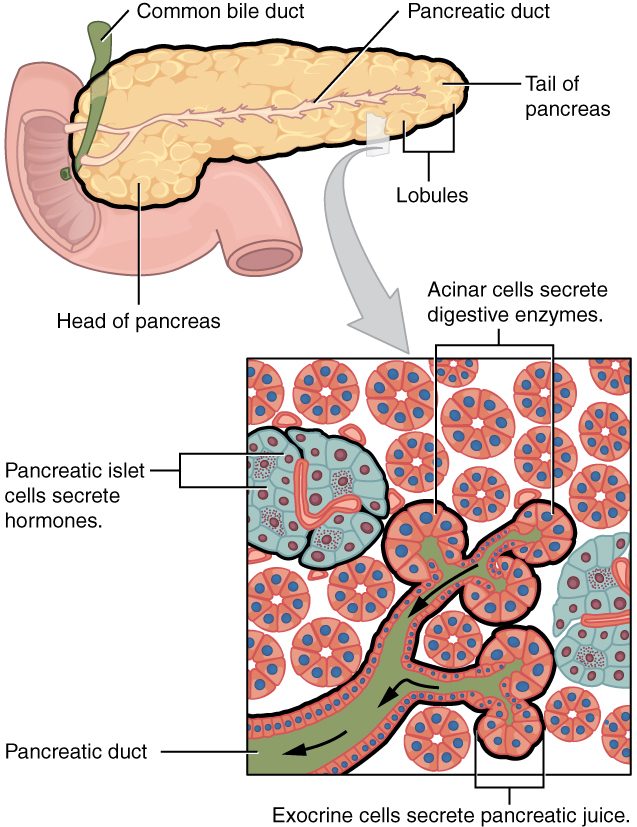
With labels hidden, select a box to reveal its label.
5How it works, step by step
- After a meal, glucose absorbed from the gut raises blood glucose.More glucose enters the beta cells of the pancreatic islets, and their ATP level rises.
- Rising ATP closes ATP-sensitive potassium channels in the beta cell membrane.The membrane depolarizes, voltage-gated calcium channels open, and calcium triggers the release of insulin into the blood.
- Insulin binds receptor proteins on skeletal muscle, fat and liver cells.Muscle and fat cells move GLUT4 carriers into their membranes and take up glucose; the liver switches on glycogenesis and switches off glycogenolysis and gluconeogenesis.
- Glucose moves out of the blood into cells and storage.Blood glucose falls back toward 70 to 99 mg/dL.
- Blood glucose falls, so less glucose enters the beta cells.Insulin release drops (negative feedback), and as glucose keeps drifting down between meals, alpha cells release glucagon, which makes the liver release glucose.
6Core concepts
7A common mistake
The wrong idea: Insulin puts glucose into every cell, so without insulin no cell can use glucose.
What actually happens: Insulin moves GLUT4 carriers into the membranes of skeletal muscle and fat cells, which is where most glucose goes after a meal. But brain cells, liver cells and red blood cells take up glucose through carriers that are always in their membranes. That is why, in untreated diabetes, the brain still gets glucose while muscle and fat go short, and why the brain is the organ that fails first when glucose falls too low.
8Check yourself
Anything you miss goes into your review queue.
1. Diazoxide, a drug given to people whose beta cells release too much insulin, holds ATP-sensitive potassium channels open. What happens in the beta cell when glucose rises?
- The membrane stays polarized and insulin release falls
- Potassium flows into the cell and insulin release rises
- Glucose entry stops and insulin release falls
- The membrane depolarizes more easily and insulin release rises
Show the answer
Insulin release depends on ATP closing these channels. With them held open, potassium keeps leaking out, the membrane cannot depolarize, voltage-gated calcium channels stay closed, and without calcium entry the insulin vesicles are not released.
- Correct: The membrane stays polarized and insulin release falls: Correct. With the channels held open, potassium keeps leaking out, the membrane cannot depolarize, voltage-gated calcium channels stay closed, and without calcium entry the insulin vesicles are not released.
- Potassium flows into the cell and insulin release rises: Open potassium channels let potassium flow out, down its gradient, not in. Outward flow keeps the inside negative, which works against depolarization.
- Glucose entry stops and insulin release falls: The drug acts on the potassium channel, not on glucose entry. Glucose still enters and raises ATP; the step after ATP is blocked.
- The membrane depolarizes more easily and insulin release rises: Depolarization needs the potassium channels to close. Holding them open does the opposite.
2. Look at the healthy person's curves. What best explains why blood glucose falls back into range by about two hours?
- Glucagon rising after the meal
- Insulin driving glucose into cells
- The kidneys excreting the extra glucose in urine
- The brain burning the meal's glucose
Show the answer
Insulin rises within minutes of the meal and peaks with glucose. It moves GLUT4 into muscle and fat membranes and makes the liver store glucose as glycogen, so glucose leaves the blood. As glucose falls, insulin falls too: negative feedback.
- Glucagon rising after the meal: Glucagon falls after a carbohydrate meal, and it would raise blood glucose, not lower it.
- Correct: Insulin driving glucose into cells: Correct. The insulin curve rises and falls with the glucose curve.
- The kidneys excreting the extra glucose in urine: Glucose appears in the urine only above about 180 mg/dL. This person peaks near 135, so the kidneys return all of it.
- The brain burning the meal's glucose: The brain uses glucose at a steady rate of about 5 grams an hour. That alone cannot clear a meal's 50 grams or more in two hours.
3. A 12-year-old's beta cells have been destroyed, and her type 1 diabetes has not yet been diagnosed or treated. Predict the change in each variable across her endocrine, urinary, circulatory and respiratory systems, compared with a healthy child.
| Variable | Change |
|---|---|
| Blood glucose | — |
| Plasma glucagon | — |
| Glucose in the urine | — |
| Urine volume | — |
| Blood volume | — |
| Body weight | — |
| Blood pH | — |
| Depth and rate of breathing | — |
Show the answer
Losing insulin raises glucose; losing the beta cells' brake raises glucagon too. Glucose spills into the urine and drags water with it, shrinking blood volume and driving thirst. Fat breakdown runs unchecked, the liver turns the fatty acids into acids that build up in the blood, and breathing deepens to blow off carbon dioxide. Untreated, this becomes a life-threatening emergency.
- Blood glucose: up. With no insulin, muscle and fat take up little glucose and the liver keeps releasing it.
- Plasma glucagon: up. Insulin from neighboring beta cells normally damps the alpha cells. With the beta cells gone, that brake is lost.
- Glucose in the urine: up. Blood glucose is above the roughly 180 mg/dL the kidney's carriers can fully reabsorb, so the excess stays in the urine.
- Urine volume: up. Glucose left in the kidney's fluid holds water there by osmosis: polyuria.
- Blood volume: down. Water lost in the extra urine comes from the plasma.
- Body weight: down. Calories leave as urine glucose, and with no insulin, fat and muscle are broken down.
- Blood pH: down. Unchecked fat breakdown and high glucagon make the liver turn fatty acids into acids faster than tissues can burn them.
- Depth and rate of breathing: up. Acid in the blood drives faster, deeper breathing, which blows off carbon dioxide and partly offsets the acid.
4. Why are confusion and seizures early signs of severe hypoglycemia, while skeletal muscle keeps working normally at the same glucose level?
- Neurons need insulin to take up glucose, and insulin is low
- Low glucose triggers a sympathetic discharge that shuts down the brain
- Muscle makes glucose by gluconeogenesis and shares it with the brain
- Neurons have almost no glycogen and burn almost no fatty acids
Show the answer
The brain runs almost entirely on glucose from the blood, minute by minute. Muscle can burn fatty acids and its own glycogen, so it keeps working when blood glucose falls.
- Neurons need insulin to take up glucose, and insulin is low: Neurons take up glucose through carriers that are always in their membranes, with no need for insulin.
- Low glucose triggers a sympathetic discharge that shuts down the brain: The sympathetic response causes shakiness, sweating and a fast heart. It does not shut down the brain; the lack of glucose does.
- Muscle makes glucose by gluconeogenesis and shares it with the brain: Gluconeogenesis happens in the liver and, in a long fast, the kidneys. Muscle cannot release glucose into the blood.
- Correct: Neurons have almost no glycogen and burn almost no fatty acids: Correct. The brain has no fuel reserve and no fallback fuel for sudden lows, so it depends on glucose from the blood minute by minute.
5. In untreated diabetes, urine volume rises before the person starts drinking more. What causes the extra urine?
- Glucose in the kidney's fluid holds water there by osmosis
- High blood glucose blocks the release of ADH from the posterior pituitary
- Insulin normally tells the kidneys to keep water
- Drinking more, which the kidneys then excrete
Show the answer
Above about 180 mg/dL, the kidney's carriers cannot take back all the filtered glucose. The glucose left behind holds water by osmosis, so more water leaves as urine. The thirst comes after, from the water lost.
- Correct: Glucose in the kidney's fluid holds water there by osmosis: Correct. The glucose drags water with it: polyuria.
- High blood glucose blocks the release of ADH from the posterior pituitary: High glucose raises plasma concentration, which increases ADH release, not decreases it.
- Insulin normally tells the kidneys to keep water: Insulin does not control water handling by the kidneys. Its absence acts through the high glucose.
- Drinking more, which the kidneys then excrete: That gets the order backwards. The water loss comes first and causes the thirst.
6. Ms. Reyes, 52, has excess abdominal fat. Her fasting glucose is 138 mg/dL, and her fasting insulin is higher than normal. Which best describes her condition?
- Type 1 diabetes
- Hypoglycemia from excess insulin
- Type 2 diabetes with insulin resistance
- Normal glucose control
Show the answer
High glucose together with high insulin means her tissues respond too little to insulin: insulin resistance. Her beta cells are releasing extra insulin but can no longer keep glucose normal. That is type 2 diabetes. A fasting glucose of 126 or above, confirmed on a second test, meets the diagnostic cutoff.
- Type 1 diabetes: In type 1 diabetes the beta cells are destroyed and insulin is very low or absent, not high.
- Hypoglycemia from excess insulin: Her glucose is high, not low. The high insulin is failing to lower it.
- Correct: Type 2 diabetes with insulin resistance: Correct. High glucose despite high insulin is the signature of insulin resistance.
- Normal glucose control: A fasting glucose of 138 mg/dL is well above the normal range of 70 to 99.
7. A student described what happens during a long gap between meals. One step is wrong. Which one?
- Blood glucose falls toward the low end of its range
- Alpha cells release more glucagon, and beta cells release less insulin
- Glucagon binds receptor proteins on liver cells, and cyclic AMP rises
- The liver switches on glycogenolysis and gluconeogenesis
- Glucagon makes skeletal muscle release glucose from its glycogen into the blood
Show the answer
Skeletal muscle has almost no glucagon receptor proteins and lacks the enzyme that lets glucose leave the cell. Between meals, blood glucose comes from the liver.
- Blood glucose falls toward the low end of its range: This step is right. Tissues keep using glucose between meals, so it drifts down.
- Alpha cells release more glucagon, and beta cells release less insulin: This step is right. Low glucose stimulates alpha cells and quiets beta cells.
- Glucagon binds receptor proteins on liver cells, and cyclic AMP rises: This step is right. Glucagon acts through a G protein–coupled receptor protein and cyclic AMP.
- The liver switches on glycogenolysis and gluconeogenesis: This step is right. The liver releases stored glucose and makes new glucose.
- Correct: Glucagon makes skeletal muscle release glucose from its glycogen into the blood: This is the error. Muscle glycogen stays in the muscle; only the liver releases glucose into the blood.
8. Fill the gap. Building glycogen from glucose is glycogenesis; breaking glycogen down into glucose is glycogenolysis; making new glucose from amino acids, lactate or glycerol is ____.
- Glycolysis
- Gluconeogenesis
- Glycogenesis
- Cellular respiration
Show the answer
Gluconeogenesis: gluc/o = glucose, neo- = new, -genesis = making. The liver does most of it.
- Glycolysis: Glycolysis is the breakdown of glucose in cellular respiration, the opposite direction.
- Correct: Gluconeogenesis: Correct. New glucose from molecules that are not carbohydrates.
- Glycogenesis: Glycogenesis is building glycogen, the first term in the list.
- Cellular respiration: Cellular respiration breaks fuel down to make ATP. It uses glucose rather than making it.
9Summary
The pancreatic islets are the endocrine part of the pancreas: beta cells make insulin, alpha cells make glucagon, and delta cells make somatostatin, which damps both. Beta cells sense glucose directly: more glucose raises ATP, closes potassium channels, depolarizes the cell and lets calcium trigger insulin release. Insulin lowers blood glucose by moving GLUT4 into muscle and fat membranes, driving glycogenesis and shutting off glycogenolysis and gluconeogenesis. Glucagon raises blood glucose by switching on glycogenolysis and gluconeogenesis in the liver. The two form a negative feedback loop that holds fasting glucose at about 70 to 99 mg/dL. In diabetes mellitus, the loss of insulin (type 1) or insulin resistance with failing beta cells (type 2) leaves glucose high, which causes polyuria and polydipsia and, with no insulin at all, acid blood from unchecked fat breakdown. Hypoglycemia, below 70 mg/dL, starves the brain; glucagon and epinephrine are the first defenses.