The small intestine
1Why this matters
Priya, 24, has lost 6 kg in a year without trying. She feels bloated after meals, her stools are loose, pale and hard to flush, and her blood tests show iron deficiency. She eats well. A biopsy from the first part of her small intestine shows that the finger-like projections of its lining have flattened almost completely. She has celiac disease, an immune reaction to gluten in wheat, and it has taken away most of her absorptive surface. On a gluten-free diet the projections grow back within months.
2What this builds on
3Quick check before you start
1. Which change would speed diffusion of a nutrient across a membrane barrier?
- A thicker barrier
- A larger surface area
- A smaller concentration gradient
Show the answer
Diffusion rate rises with surface area and concentration gradient and falls with the thickness of the barrier.
- A thicker barrier:
- Correct: A larger surface area:
- A smaller concentration gradient:
2. What are microvilli?
- Hair-like projections that beat to move mucus
- Tiny finger-like folds of the plasma membrane, supported by actin, that increase surface area
- Channels that join neighboring cells
Show the answer
Microvilli are membrane projections with a core of actin filaments. They do not move; cilia beat, and gap junctions join cells.
- Hair-like projections that beat to move mucus:
- Correct: Tiny finger-like folds of the plasma membrane, supported by actin, that increase surface area:
- Channels that join neighboring cells:
3. What does segmentation do to the contents of the gut?
- Mixes them with little forward movement
- Pushes them rapidly toward the anus
- Absorbs them into the blood
Show the answer
Segmentation is alternating rings of contraction that chop and remix the contents; peristalsis is what moves them along.
- Correct: Mixes them with little forward movement:
- Pushes them rapidly toward the anus:
- Absorbs them into the blood:
4Anatomy
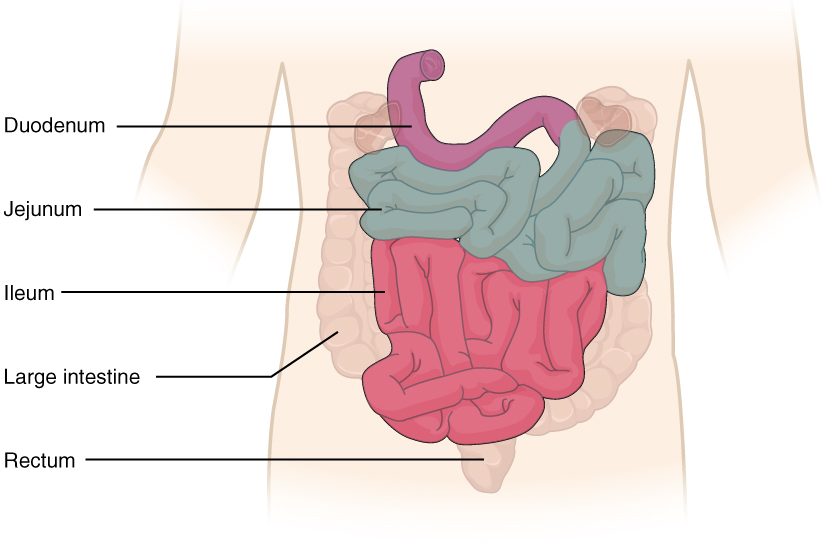
With labels hidden, select a box to reveal its label.
5How it works, step by step
- Chyme enters the duodenum and stretches its wall.Segmentation mixes it with bile and pancreatic secretions and presses it against the lining again and again.
- Enzymes from the pancreas split starch and proteins in the lumen.Short pieces, such as maltose and small peptides, reach the brush border of the absorptive cells.
- Brush border enzymes in the microvillus membrane, such as maltase and the peptidases, cut these pieces.Single sugars and amino acids are released right beside the transporters that carry them into the cell.
- The monomers cross the absorptive cells into the core of each villus.Sugars and amino acids enter the blood capillaries and travel to the liver; fat, packaged into droplets, enters the lacteal.
- The circular folds, villi and microvilli multiply the surface doing this more than a hundredfold.Absorption keeps pace with digestion, and nearly all nutrients are taken up before the chyme leaves the ileum.
6Core concepts
7A common mistake
The wrong idea: Digestion in the small intestine happens in the fluid of the lumen, and intestinal juice is full of digestive enzymes.
What actually happens: Intestinal juice from the intestinal glands is mostly water and mucus, with very little enzyme. The enzymes in the lumen come from the pancreas, and they leave short pieces. The final step, splitting those pieces into single sugars and amino acids, is done by brush border enzymes built into the membrane of the microvilli, right where the products are absorbed.
8Check yourself
Anything you miss goes into your review queue.
1. A surgeon removes a patient's last meter of small intestine because of disease. Which lifelong treatment is the patient most likely to need?
- Tablets of lactase taken with every meal
- Drugs that reduce stomach acid secretion
- Injections of vitamin B12
- Injections of insulin before meals
Show the answer
The ileum is the only place where vitamin B12, bound to intrinsic factor, is absorbed. Without it, B12 from food cannot be taken up, so it must be given by injection.
- Tablets of lactase taken with every meal: Lactase sits in the brush border of the whole small intestine and is most active in the jejunum, which remains.
- Drugs that reduce stomach acid secretion: Stomach acid is made by the stomach, which is untouched.
- Correct: Injections of vitamin B12: Correct. Removing the ileum removes the site of B12 absorption.
- Injections of insulin before meals: Insulin comes from the pancreatic islets, not the intestine.
2. Why does the first part of the duodenum contain glands that secrete a thick, alkaline mucus?
- It is where most fat is absorbed into the lacteals of the villi
- It is where the migrating motor complex begins between meals
- It receives acidic chyme before pancreatic bicarbonate mixes in
- It is where vitamin B12 is absorbed with intrinsic factor
Show the answer
Chyme leaves the stomach at a pH near 2 and hits the first part of the duodenum before the pancreas's bicarbonate has mixed in. The alkaline mucus of the duodenal glands coats and protects that lining. That is also where most small-intestine ulcers form.
- It is where most fat is absorbed into the lacteals of the villi: Most fat is absorbed further along, mainly in the jejunum, and alkaline mucus does not absorb fat.
- It is where the migrating motor complex begins between meals: The migrating motor complex starts in the stomach and is driven by motilin; it has nothing to do with mucus secretion.
- Correct: It receives acidic chyme before pancreatic bicarbonate mixes in: Correct. The alkaline mucus meets the incoming acid.
- It is where vitamin B12 is absorbed with intrinsic factor: Vitamin B12 is absorbed at the far end of the small intestine, in the ileum.
3. Textbooks estimate that circular folds multiply the small intestine's surface about 3 times, villi about 10 times and microvilli about 20 times. A disease flattens the villi but leaves the folds and microvilli. By roughly how much does the absorptive surface fall?
- To about half of normal
- To about one tenth of normal
- To about one twentieth of normal
- It stays about the same
Show the answer
Normal: 3 × 10 × 20 = 600 times a smooth tube. With flat villi: 3 × 1 × 20 = 60. That is one tenth of normal, so absorption falls roughly tenfold.
- To about half of normal: Losing a factor of 10 cuts the surface far more than in half.
- Correct: To about one tenth of normal: Correct. 60 is one tenth of 600.
- To about one twentieth of normal: A twentyfold loss would mean losing the microvilli, which remain here.
- It stays about the same: The microvilli stand on the villi, so flattening the villi removes most of the surface they sit on.
4. Fill the gap: A child drinks milk → lactose reaches the small intestine → ______ → glucose and galactose are absorbed by the absorptive cells
- Pepsin carried from the stomach splits lactose in the lumen
- Intestinal juice from the glands splits lactose in the lumen
- Lactose is absorbed whole and split later inside the liver
- Brush border lactase splits it into glucose and galactose
Show the answer
Lactase, built into the microvillus membrane, splits lactose into glucose and galactose right beside the transporters that absorb them.
- Pepsin carried from the stomach splits lactose in the lumen: Pepsin digests protein, not sugars.
- Intestinal juice from the glands splits lactose in the lumen: Intestinal juice is mostly water and mucus with very little enzyme; lactose is split at the brush border.
- Lactose is absorbed whole and split later inside the liver: Disaccharides such as lactose are not absorbed whole; they must be split into single sugars first.
- Correct: Brush border lactase splits it into glucose and galactose: Correct. Lactase is a brush border enzyme.
5. After a fatty meal, the lymph in the lymphatic vessels of the mesentery looks milky white. Why?
- Milk proteins are absorbed whole from the lumen into the lymph
- White blood cells in the lymph multiply rapidly after every meal
- Mucus from intestinal juice drains into the lymph vessels
- Absorbed fat, in droplets too big for capillaries, enters lacteals
Show the answer
Absorptive cells package digested fat into droplets that are too large to cross into blood capillaries. They enter the lacteal in the core of each villus, and the fat-laden lymph looks milky.
- Milk proteins are absorbed whole from the lumen into the lymph: Proteins are split into amino acids and absorbed into the blood capillaries, not the lymph.
- White blood cells in the lymph multiply rapidly after every meal: The milky color comes from fat droplets, not from cells.
- Mucus from intestinal juice drains into the lymph vessels: Intestinal juice is secreted into the lumen, not into the lymph.
- Correct: Absorbed fat, in droplets too big for capillaries, enters lacteals: Correct. Fat droplets in the lymph give it the milky look that named the lacteals.
6. A patient receiving chemotherapy, which kills rapidly dividing cells, develops sores in the mouth and a damaged, leaky intestinal lining within a week. Why is the intestinal lining so quickly affected?
- Chemotherapy is concentrated in bile, which is secreted into the intestine
- Its stem cells divide constantly, renewing the lining every few days
- The villi are made of smooth muscle, which chemotherapy targets directly
- The drug digests the brush border enzymes on the microvilli
Show the answer
Stem cells at the base of the intestinal glands divide all the time, and their daughters live only 3 to 5 days before being shed from the villus tips. A drug that stops cell division halts the supply, so within days the lining thins and breaks down.
- Chemotherapy is concentrated in bile, which is secreted into the intestine: The effect comes from blocked cell division throughout the body, not from delivery in bile.
- Correct: Its stem cells divide constantly, renewing the lining every few days: Correct. Rapid renewal makes the lining one of the tissues most sensitive to drugs that kill dividing cells.
- The villi are made of smooth muscle, which chemotherapy targets directly: Villi are covered by epithelium over a core of connective tissue; only a few smooth muscle strands run in them, and smooth muscle is not what is damaged.
- The drug digests the brush border enzymes on the microvilli: Chemotherapy does not digest enzymes. The enzymes disappear because the cells that carry them are not replaced.
7. Priya has celiac disease, and her villi are flattened. She gets bloating and loose stools after milk but not after plain rice. Which brush border change best explains this?
- Her pancreas has stopped secreting its digestive enzymes into the duodenum
- Her stomach no longer secretes pepsin because of the immune reaction
- She has lost most lactase, the scarcest brush border enzyme
- She has lost her maltase, so she cannot digest the starch in rice
Show the answer
Brush border enzymes are part of the absorptive cells on the villi, so flattened villi carry far less of them. Lactase is the least abundant, so it is usually the first to fall short, and lactose goes undigested. Starch is still split to maltose by pancreatic enzymes, and the remaining maltase activity copes.
- Her pancreas has stopped secreting its digestive enzymes into the duodenum: Celiac disease damages the intestinal lining, not the pancreas, and a pancreatic problem would affect rice starch too.
- Her stomach no longer secretes pepsin because of the immune reaction: Pepsin digests protein, and the stomach is not affected by celiac disease.
- Correct: She has lost most lactase, the scarcest brush border enzyme: Correct. Lactase falls first when villi are damaged.
- She has lost her maltase, so she cannot digest the starch in rice: If she could not digest starch, rice would cause symptoms too. Maltase is more abundant than lactase and is not the first to run short.
9Summary
The small intestine has three regions: the duodenum (receives chyme, bile and pancreatic secretions; duodenal glands secrete alkaline mucus), the jejunum (absorbs most nutrients; tall circular folds and villi) and the ileum (absorbs vitamin B12 and recovers bile; many Peyer's patches; ends at the ileocecal valve). Circular folds, villi and microvilli multiply its surface more than a hundredfold, to about 30 square meters. Each villus holds blood capillaries and a lacteal, which takes up fat. Intestinal glands between the villi renew the lining every 3 to 5 days, defend it with Paneth cells, and secrete 1 to 2 L a day of watery intestinal juice. Brush border enzymes (lactase, sucrase, maltase and peptidases) finish digestion at the microvillus membrane. After a meal, segmentation mixes chyme and moves it slowly; between meals the migrating motor complex, triggered by motilin, sweeps the tube clean; and the gastroileal reflex relaxes the ileocecal sphincter when a new meal arrives.