Nutrients, vitamins and minerals
1Why this matters
Mr. Okafor, 74, has lived alone since his wife died. For four months he has eaten little but tea, toast and canned soup. Now his gums bleed when he brushes, purple spots have appeared on his shins, and a cut on his hand from six weeks ago has not closed. He is eating enough calories. What he is missing weighs less than a tenth of a gram a day.
2What this builds on
3Quick check before you start
1. Gram for gram, how does the energy stored in triglycerides compare with carbohydrate?
- About the same
- About half as much
- More than twice as much
Show the answer
Triglycerides are packed with carbon–hydrogen bonds and hold about 9 kcal per gram, against about 4 for carbohydrate.
- About the same:
- About half as much:
- Correct: More than twice as much:
2. What is a coenzyme?
- An organic molecule an enzyme needs to catalyze its reaction
- A second enzyme that speeds up the first
- The part of the substrate that binds the active site
Show the answer
A coenzyme is an organic helper molecule, often made from a vitamin, that an enzyme needs to work. NAD+ and FAD are examples.
- Correct: An organic molecule an enzyme needs to catalyze its reaction:
- A second enzyme that speeds up the first:
- The part of the substrate that binds the active site:
3. A patient's bile duct has been blocked for months. Which vitamins does he absorb poorly?
- Vitamins that dissolve in water, such as vitamin C
- Vitamins that dissolve in fat, such as vitamins D and K
- Vitamin B12 alone
Show the answer
Without bile, fats are not packed into micelles, and the vitamins that travel with fat are absorbed poorly too.
- Vitamins that dissolve in water, such as vitamin C:
- Correct: Vitamins that dissolve in fat, such as vitamins D and K:
- Vitamin B12 alone:
4Anatomy
With labels hidden, select a box to reveal its label.
5How it works, step by step
- A person eats almost no fruit or vegetables for months, and the body's small store of vitamin C runs out.The enzymes that strengthen new collagen lose the helper that keeps their iron in its working form, and stop working.
- Those enzymes can no longer add hydroxyl groups to proline and lysine in new collagen strands.The strands cannot twist into stable triple helices or cross-link, so the new collagen is weak and is broken down.
- Collagen is always being replaced, and the replacement is now faulty.Small vessel walls, gums, skin and healing wounds lose strength.
- Weak small vessels break under ordinary pressure, and wounds cannot build strong scar tissue.The person bruises easily, bleeds from the gums and heals poorly: scurvy.
6Core concepts
7A common mistake
The wrong idea: Vitamins give you energy.
What actually happens: Vitamins supply no energy at all: a vitamin tablet has 0 kcal. Only carbohydrate, protein and fat (and alcohol) supply energy. Many B vitamins are parts of coenzymes, such as NAD+ and FAD, that the enzymes of fuel breakdown need, so a lack of them does leave a person tired. But once your cells have enough, extra B vitamins do not release any more energy; the extra leaves in the urine.
8Check yourself
Anything you miss goes into your review queue.
1. A bowl of cereal with milk holds 45 g of carbohydrate, 10 g of protein and 5 g of fat. How many kilocalories does it supply?
- 220 kcal
- 240 kcal
- 265 kcal
- 540 kcal
Show the answer
Carbohydrate: 45 g × 4 = 180 kcal. Protein: 10 g × 4 = 40 kcal. Fat: 5 g × 9 = 45 kcal. Total: 180 + 40 + 45 = 265 kcal.
- 220 kcal: 220 kcal leaves out the fat. Its 5 g still supply 5 × 9 = 45 kcal.
- 240 kcal: 240 kcal counts the fat at 4 kcal per gram, like carbohydrate. Fat supplies about 9 kcal per gram.
- Correct: 265 kcal: Correct. 180 + 40 + 45 = 265 kcal.
- 540 kcal: 540 kcal counts all 60 g at 9 kcal per gram. Only fat supplies 9; carbohydrate and protein supply about 4.
2. Mr. Okafor, 74, has eaten mostly tea, toast and canned soup for four months. His gums bleed, he has bruises on his shins, and a six-week-old cut has not healed. Which nutrient is he most likely missing, and why does its lack cause these signs?
- Vitamin C: the collagen made without it is weak
- Vitamin K: clotting factors stay unfinished
- Iron: too little hemoglobin reaches the gums
- Vitamin B12: new blood cells cannot divide
Show the answer
Vitamin C keeps the iron in the collagen-strengthening enzymes in its working form. Without it, new collagen is weak, so small vessels break (bruises, bleeding gums) and wounds cannot build strong scar tissue. This is scurvy, and a diet with no fruit or vegetables for months causes it.
- Correct: Vitamin C: the collagen made without it is weak: Correct. Bleeding gums plus a wound that will not heal point to weak collagen: scurvy.
- Vitamin K: clotting factors stay unfinished: A lack of vitamin K does cause bleeding, but it does not stop wounds from healing, and in adults it rarely comes from diet alone: it usually follows fat malabsorption or drugs such as warfarin.
- Iron: too little hemoglobin reaches the gums: Iron deficiency causes anemia and fatigue, not bleeding gums and failed wound healing.
- Vitamin B12: new blood cells cannot divide: B12 lack causes anemia with large red blood cells and nerve damage, and it takes years to appear because the liver stores so much.
3. A gallstone blocks a patient's common bile duct for three months. Predict the change in each variable, compared with before the blockage.
| Variable | Change |
|---|---|
| Fat in the feces | — |
| Absorption of vitamin K | — |
| Time for the blood to clot | — |
| Absorption of vitamin C | — |
Show the answer
Bile is needed to absorb fat, and the fat-soluble vitamins travel with fat. Blocking the bile duct lets fat pass into the feces and cuts absorption of A, D, E and K. The first sign in the blood is often slow clotting, because vitamin K stores are the smallest. Water-soluble vitamins are absorbed normally.
- Fat in the feces: up. Without bile salts, fats are poorly emulsified and cannot form micelles, so much of the dietary fat passes through unabsorbed.
- Absorption of vitamin K: down. Vitamin K dissolves in fat and enters the absorptive cells in micelles; with no micelles, little is absorbed.
- Time for the blood to clot: up. Without vitamin K, the liver cannot finish clotting factors II, VII, IX and X, so clotting slows.
- Absorption of vitamin C: no change. Vitamin C is water-soluble and is absorbed by carriers in the intestinal lining, which do not depend on bile.
4. A man with long-term heavy alcohol use who eats very little is brought in confused. He walks unsteadily and his eyes cannot move normally from side to side. Which vitamin should be given at once?
- Vitamin A
- Thiamine (B1)
- Vitamin C
- Cobalamin (B12)
Show the answer
This is Wernicke encephalopathy from thiamine deficiency. Thiamine is the coenzyme for the enzyme that removes CO2 from pyruvate as it enters the mitochondrion. Brain cells rely on glucose broken down this way, so without thiamine they cannot make enough ATP. Heavy alcohol use cuts both intake and absorption of thiamine.
- Vitamin A: Vitamin A lack causes night blindness and a damaged cornea, not confusion and an unsteady walk.
- Correct: Thiamine (B1): Correct. Thiamine replaces the missing coenzyme and can reverse the eye signs within hours.
- Vitamin C: Vitamin C lack causes scurvy: bleeding gums and poor healing.
- Cobalamin (B12): B12 lack also damages nerves, but it develops over years and causes numbness and anemia, not this sudden confusion with eye movement problems.
5. A person eats plenty of rice as her only protein source. Rice protein is low in lysine. What happens when her cells try to build a protein that contains lysine?
- They make other amino acids into lysine as needed
- They swap a different amino acid in where lysine belongs
- Synthesis slows, and the unused amino acids are burned
- They take lysine from stored lysine reserves
Show the answer
Lysine is essential: her cells cannot make it. Rice supplies some lysine, but less than her cells need. A ribosome needs every amino acid in the sequence at the moment it adds it, so protein building slows to the pace the scarce lysine allows. Amino acids are not stored for later, so the unused ones are broken down for fuel. Adding beans, which are rich in lysine, covers the gap.
- They make other amino acids into lysine as needed: Cells cannot build lysine from other amino acids; that is what makes it essential.
- They swap a different amino acid in where lysine belongs: The sequence is set by the gene, so a ribosome does not substitute another amino acid for a missing one.
- Correct: Synthesis slows, and the unused amino acids are burned: Correct. The scarce essential amino acid limits protein synthesis.
- They take lysine from stored lysine reserves: The body keeps no reserve of free amino acids set aside for later protein building.
6. Why does a gram of fat supply more than twice the energy of a gram of carbohydrate?
- Fat is absorbed more completely from the gut than carbohydrate is
- Fat is less oxidized: its carbons carry fewer oxygen atoms
- Fat is broken down by a longer chain of enzymes than carbohydrate
- Fat is stored in adipose tissue, which holds almost no water
Show the answer
Carbohydrate carbons already carry many oxygen atoms: they are partly oxidized. Fat is mostly carbon–hydrogen bonds, so each carbon has more electrons to give up as it is oxidized to CO2, and more energy is released per gram.
- Fat is absorbed more completely from the gut than carbohydrate is: Both are absorbed almost completely in healthy people; the difference is in the molecules, not absorption.
- Correct: Fat is less oxidized: its carbons carry fewer oxygen atoms: Correct. Fat is less oxidized to start with, so it releases more energy as it is fully oxidized.
- Fat is broken down by a longer chain of enzymes than carbohydrate: The number of enzymes does not set how much energy a molecule holds; the chemistry of its bonds does.
- Fat is stored in adipose tissue, which holds almost no water: Storage with little water makes stored fat tissue denser in energy than glycogen, but it does not change the energy in a gram of pure fat.
7. A well-fed student starts taking a high-dose B-vitamin tablet "for energy". What happens to the energy available to her cells?
- It rises, because B vitamins are oxidized for ATP
- It rises, as extra coenzymes speed every reaction
- It does not change, because she already has enough
- It falls, because B vitamins block fat breakdown
Show the answer
B vitamins supply no energy; they are parts of coenzymes. Once a well-fed person has enough coenzyme, the enzymes of fuel breakdown are not limited by it, so extra vitamin does not release more energy. The extra water-soluble vitamin leaves in her urine.
- It rises, because B vitamins are oxidized for ATP: Vitamins are not fuel. A vitamin tablet supplies 0 kcal.
- It rises, as extra coenzymes speed every reaction: Fuel breakdown is not limited by coenzyme supply in a well-fed person, so adding more does not speed it.
- Correct: It does not change, because she already has enough: Correct. Extra B vitamins do not add energy when stores are already adequate.
- It falls, because B vitamins block fat breakdown: B vitamins are coenzymes for fuel breakdown, including fat breakdown, not blockers of it.
9Summary
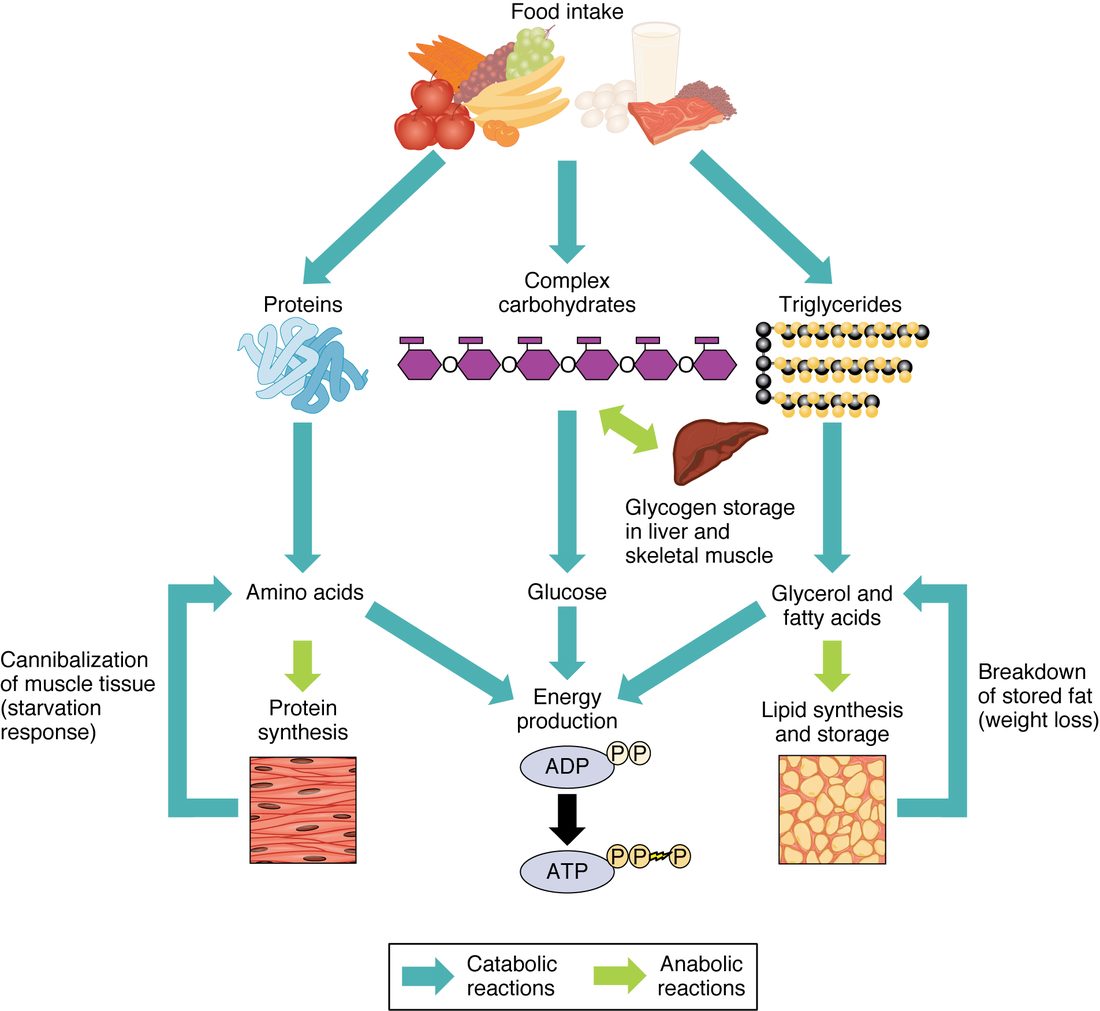
Food supplies six classes of nutrients. The macronutrients (carbohydrates, lipids, proteins and water) are needed in grams; the first three supply energy: about 4 kcal per gram for carbohydrate and protein and about 9 for fat. The micronutrients (vitamins and minerals) are needed in milligrams or micrograms and supply no energy. Essential nutrients must come from food because your body cannot make enough: nine essential amino acids, two essential fatty acids (linoleic and alpha-linolenic acid), and every vitamin and mineral. Vitamins are organic and work mostly as coenzymes or active molecules. The fat-soluble vitamins (A, D, E, K) are absorbed with fat and stored, so they can build up to toxic levels; the water-soluble vitamins (the B vitamins and C) are stored little and need a steady supply, except B12. Minerals are inorganic elements: major minerals such as calcium and sodium are needed at more than 100 mg a day, trace minerals such as iron, zinc and iodine at less.