Everything your body builds and every ATP it makes starts as something you ate. This page sorts food into its six classes of nutrients, explains which ones are essential and why, shows how to work out the energy in a meal from its grams of carbohydrate, fat and protein, and gives the vitamins and minerals functions list you need: what each one does in your cells, where it comes from, and what happens when you get too little or too much.
Six classes of nutrients
Look at a bowl of oatmeal made with milk and topped with a banana. It holds starch and sugars, a little fat, some protein, several vitamins, calcium and potassium, and a lot of water. Every food you eat is a mixture of the same few kinds of substance.
A nutrient (nutri- = nourish) is a substance from food that your body uses for energy, for building and repairing tissue, or for running its chemical reactions. Nutrients fall into six classes:
- Carbohydrates: sugars and starches, your main quick fuel.
- Lipids: mostly triglycerides, your densest fuel, plus phospholipids and cholesterol for membranes and hormones.
- Proteins: a supply of amino acids for building your own proteins, and a fuel when needed.
- Vitamins: small organic molecules needed in tiny amounts.
- Minerals: inorganic elements such as calcium, iron and iodine.
- Water: about 60% of an adult's body mass, the medium in which every reaction happens.
The classes split into two groups by how much you need:
- Macronutrients (macro- = large) are needed in grams a day: carbohydrates, lipids, proteins and water. The first three supply energy.
- Micronutrients (micro- = small) are needed in milligrams or micrograms a day: vitamins and minerals. They supply no energy. They let your enzymes and other proteins work.
Dietary fiber is carbohydrate your own enzymes cannot digest, such as cellulose. It adds bulk to the contents of your colon, and colon bacteria ferment some of it into short fatty acids that the colon cells use as fuel.
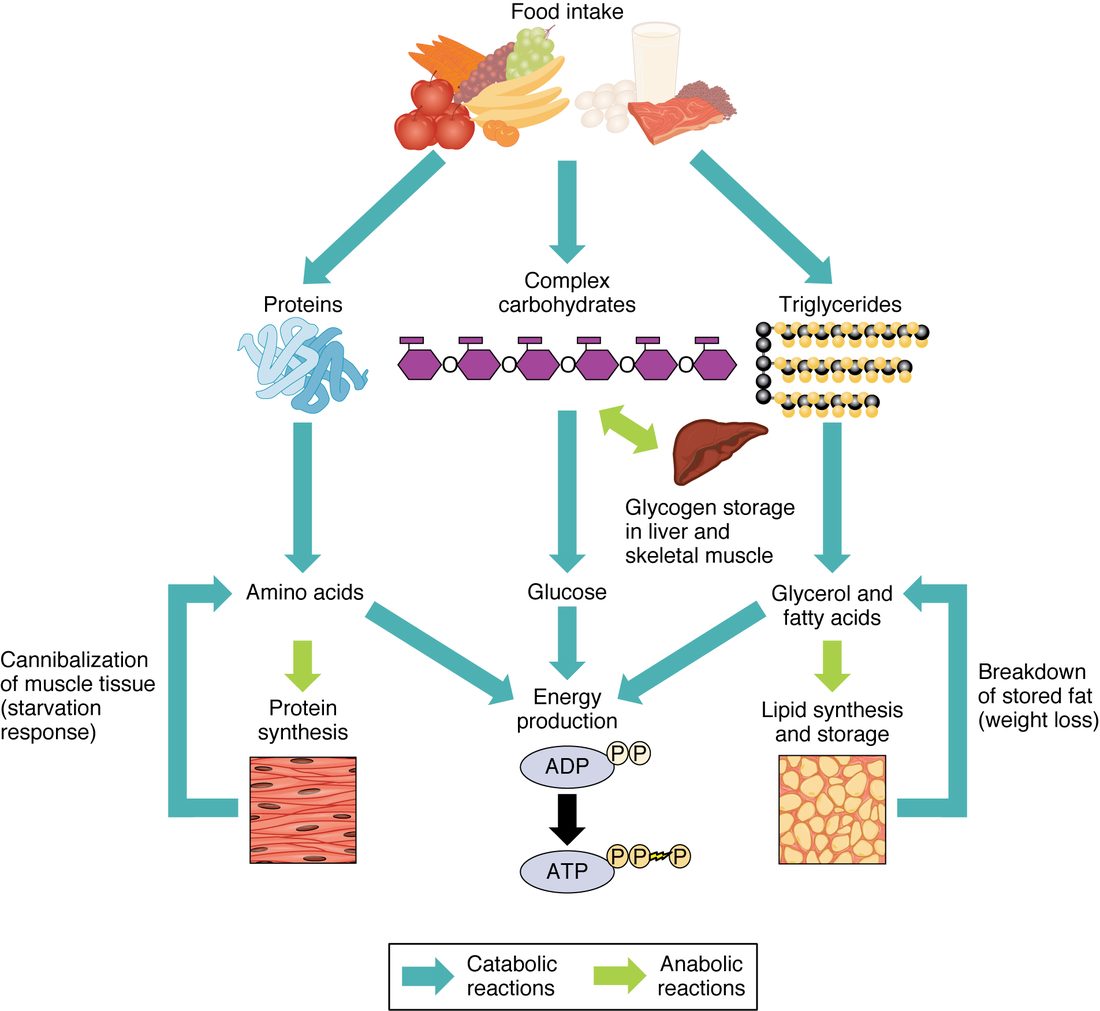
Figure 1 follows the three energy-supplying macronutrients from your plate. Digestion breaks each into its building blocks: amino acids, glucose, and glycerol with fatty acids. Your cells then either break those down further to make ATP (catabolism) or build them into your own proteins, glycogen and stored fat (anabolism).
Essential nutrients
Your liver can make glucose from amino acids, so you would survive a diet with no carbohydrate at all. You would not survive a diet with no lysine, an amino acid, however much else you ate. The difference is whether your cells can make the substance themselves.
An essential nutrient is one your body cannot make, or cannot make fast enough, so it must come from food. Every vitamin and mineral is essential by this definition. So are some amino acids and some fatty acids.
Essential amino acids
Your proteins use 20 kinds of amino acid. Your cells can build 11 of them from other molecules. The other 9 are essential amino acids: histidine, isoleucine, leucine, lysine, methionine, phenylalanine, threonine, tryptophan and valine. A cell building a protein needs every amino acid in that protein's sequence at the moment it adds it. If one essential amino acid is missing, ribosomes stall at that spot, and the protein is not finished. The other amino acids are then broken down for fuel rather than stored.
- A complete protein supplies all 9 in useful amounts. Eggs, milk, meat, fish and soy are complete.
- Most other plant proteins are low in one or two. Grains are low in lysine; beans and lentils are low in methionine. Eaten over the same day, the two cover each other's gaps. These are called complementary proteins.
Some amino acids are conditionally essential: normally made in enough amounts, but not always. Tyrosine is made from phenylalanine, so a person who cannot convert phenylalanine must get tyrosine from food.
Essential fatty acids
Your cells can make most fatty acids and can put double bonds into the chain near its carboxyl end. They cannot put a double bond near the far, tail end of the chain. Two fatty acids with such bonds are therefore essential fatty acids:
- Linoleic acid, an omega-6 fatty acid (its last double bond sits 6 carbons from the tail end), found in vegetable oils, nuts and seeds.
- Alpha-linolenic acid, an omega-3 fatty acid (3 carbons from the tail end), found in flaxseed, walnuts, canola and soy oils. Oily fish supply longer omega-3 fatty acids, which your cells can also make, slowly, from alpha-linolenic acid.
Your cells lengthen these two into the fatty acids of cell membranes, including the membranes of the brain and retina, and into short-lived signaling lipids that act on nearby cells. A lack is rare in adults on ordinary diets; it causes dry, scaly skin and poor wound healing.
The energy content of food
A bag of peanuts says 170 Calories per serving. That number is heat: the energy released when the food is broken down fully.
A calorie (calor- = heat) is the heat needed to raise the temperature of 1 gram of water by 1 °C. It is tiny, so food energy is given in kilocalories (kilo- = thousand): 1 kilocalorie (kcal) = 1,000 calories, the heat that raises 1 kg of water by 1 °C. On food labels in the United States, "Calorie" with a capital C means kilocalorie. Most other countries label food in kilojoules as well: 1 kcal = 4.184 kJ.
The energy content of food depends on which macronutrients it holds:
| Carbohydrate | Protein | Fat | Alcohol | |
|---|---|---|---|---|
| Energy your body gets (kcal per gram) | About 4 | About 4 | About 9 | About 7 |
| Why | Already partly oxidized: many oxygen atoms per carbon | Similar to carbohydrate; its nitrogen leaves in a waste product that still holds some energy | Mostly carbon–hydrogen bonds with few oxygen atoms, so each carbon can release more energy when it is oxidized | Between carbohydrate and fat |
| Is it a nutrient? | Yes | Yes | Yes | No: it supplies energy but nothing the body needs |
Vitamins, minerals, water and fiber your enzymes cannot digest supply no energy, or almost none.
Worked example 1: the energy in a meal
Problem. A turkey sandwich contains 40 g of carbohydrate, 25 g of protein and 12 g of fat. How many kilocalories does it supply?
- Carbohydrate. 40 g × 4 kcal/g = 160 kcal.
- Protein. 25 g × 4 kcal/g = 100 kcal.
- Fat. 12 g × 9 kcal/g = 108 kcal.
- Add. 160 + 100 + 108 = 368 kcal.
Answer. About 370 kcal. Notice that 12 g of fat supplies more energy than 25 g of protein.
Worked example 2: what share of the energy comes from fat?
Problem. For the same sandwich, what percentage of its energy comes from fat?
- Energy from fat. 108 kcal (from step 3 above).
- Total energy. 368 kcal.
- Divide and convert. 108 ÷ 368 = 0.29, or 29%.
Answer. About 29% of the energy comes from fat, even though fat is only 12 of the sandwich's 77 grams of macronutrient (16% by weight). Always compare energy, not grams.
Worked example 3: working backward from a label
Problem. A sports drink bottle supplies 140 kcal, all from sugar. How many grams of sugar does it hold?
- Write the relation. kcal = grams × 4 for carbohydrate.
- Rearrange. grams = kcal ÷ 4.
- Calculate. 140 ÷ 4 = 35 g.
Answer. 35 g of sugar, about 9 teaspoons.
Vitamins: what they are
In the 1700s, sailors on long voyages bled from their gums, bruised at a touch and saw old wounds reopen. Lemons and limes cured them within days. The cure was one molecule, now called vitamin C.
A vitamin (vita- = life; first thought to be "vital amines", although most are not amines) is an organic molecule that your body needs in small amounts, cannot make in enough amounts, and does not use as fuel or building material. Most vitamins work in one of two ways:
- As coenzymes, the organic helpers you met with enzymes. Without its coenzyme, the enzyme cannot catalyze its reaction. Most B vitamins work this way.
- As other active molecules: a hormone precursor (vitamin D), a light-absorbing pigment (vitamin A), or an antioxidant, a molecule that neutralizes free radicals before they damage lipids, proteins and DNA (vitamins C and E).
Vitamins supply no energy. A vitamin B tablet contains 0 kcal. The B vitamins do help your cells release energy from carbohydrate, fat and protein, but only in the way a key helps you start a car: it does not add fuel.
Fat-soluble and water-soluble vitamins
You met the two groups in digestion: some vitamins dissolve in fat and some in water, and that decides how they are absorbed. It also decides how they are stored and whether they can build up to harmful levels.
- The fat-soluble vitamins are A, D, E and K.
- The water-soluble vitamins are the eight B vitamins and vitamin C.
| Fat-soluble vitamins | Water-soluble vitamins | |
|---|---|---|
| Which ones | A, D, E, K | The B vitamins and C |
| Absorption | With dietary fat: in micelles, then chylomicrons into the lymph; needs bile and pancreatic lipase | By carriers across the intestinal lining, straight into the blood (B12 needs intrinsic factor) |
| Carried in blood | On carrier proteins or in lipid particles | Mostly dissolved in plasma |
| Storage | Stored in the liver and fat tissue, mostly for months (vitamin K stores last only days to weeks) | Little stored; the extra leaves in urine (B12 is the exception: the liver holds years' worth) |
| How often you need them | Stores cover gaps in intake | Need a steady supply |
| Risk of toxicity from too much | Higher, because they build up (especially A and D) | Lower, though high doses of some cause harm |
| Deficiency when fat is poorly absorbed | Yes: blocked bile duct, pancreatic failure, fat-blocking drugs | Not from fat malabsorption itself |
A mnemonic: the fat-soluble vitamins spell "ADEK", and they travel with fat everywhere: into the body, in the blood and in storage.
The fat-soluble vitamins
| Vitamin | Main jobs | Good sources | Too little | Too much |
|---|---|---|---|---|
| A (retinol) | Retinal, the light-absorbing part of rhodopsin in rods and of the cone pigments; keeps epithelia such as the cornea and airway lining moist and healthy; immune function | Liver, dairy, eggs; beta-carotene in orange and dark green vegetables, which your gut converts to vitamin A | Night blindness first, then a dry, damaged cornea; the leading preventable cause of childhood blindness worldwide; more severe infections | Liver damage, headache, bone loss; birth defects if taken in high doses in early pregnancy |
| D (calciferol) | Converted to calcitriol, which raises calcium and phosphate absorption in the gut | Made in skin exposed to sunlight; oily fish, fortified milk | Rickets in children, osteomalacia in adults | Hypercalcemia: weakness, calcium deposits in soft tissues |
| E (tocopherol) | Antioxidant that protects membrane lipids | Vegetable oils, nuts, seeds | Rare; damage to nerves and fragile red blood cells, mostly in fat malabsorption | May interfere with clotting at high doses |
| K | Lets the liver finish clotting factors II, VII, IX and X; also activates some bone proteins | Leafy green vegetables; some made by gut bacteria | Bleeding; newborns are given a vitamin K injection at birth | Little harm from food forms |
Vitamin A shows how a vitamin's chemistry sets its job. Retinal is the part of rhodopsin that changes shape when it absorbs light. Every time a rod responds to light, some retinal is lost from the recycling loop and has to be replaced from the blood. With too little vitamin A, rods run short of rhodopsin first, so the earliest sign is poor vision in dim light.
Vitamin K shows how a vitamin works as a coenzyme. The liver makes clotting factors II, VII, IX and X in an unfinished form. An enzyme that needs vitamin K adds a carboxyl group to several of their glutamate amino acids, which lets them bind calcium and gather on platelet surfaces. The drug warfarin blocks the recycling of vitamin K, so these factors stay unfinished and clotting slows.
The water-soluble vitamins
Most B vitamins are parts of coenzymes in the reactions that release energy from food. Two of them, folate and B12, are needed to make DNA, so a lack of either shows first in cells that divide fast, such as those in the bone marrow.
| Vitamin | Coenzyme role or main job | Good sources | Too little |
|---|---|---|---|
| B1 (thiamine) | Coenzyme for the enzyme that removes CO2 from pyruvate as it enters the mitochondrion, and for a similar step in the citric acid cycle | Whole and enriched grains, pork, legumes | Beriberi (nerve damage, heart failure); in alcohol use disorder, Wernicke encephalopathy: confusion, unsteady gait and eye movement problems |
| B2 (riboflavin) | Part of FAD, an electron carrier | Milk, eggs, meat, enriched grains | Cracks at the corners of the mouth, sore tongue |
| B3 (niacin) | Part of NAD+, the main electron carrier of glucose breakdown | Meat, fish, peanuts, enriched grains; made in small amounts from tryptophan | Pellagra: dermatitis, diarrhea, dementia |
| B5 (pantothenic acid) | Part of the carrier that holds two-carbon acetyl groups in fuel breakdown and fat synthesis | Almost all foods | Very rare |
| B6 (pyridoxine) | Coenzyme for moving amino groups between molecules in amino acid reactions; making several neurotransmitters | Meat, fish, potatoes, bananas | Anemia, dermatitis, nerve problems |
| B7 (biotin) | Coenzyme for adding CO2 to molecules, in making glucose and fatty acids | Eggs, nuts; made by gut bacteria | Rare; hair loss, rash |
| B9 (folate) | Carries one-carbon groups needed to make DNA bases | Leafy greens, legumes, fortified grains | Anemia with large red blood cells; in early pregnancy, neural tube defects in the embryo |
| B12 (cobalamin) | Works with folate in DNA synthesis; keeps myelin healthy | Animal foods (meat, fish, eggs, dairy) and fortified foods | Anemia with large red blood cells, and nerve damage (numbness, poor balance, memory loss) |
| C (ascorbic acid) | Keeps iron in the enzymes that strengthen collagen in its active form; antioxidant; improves iron absorption from plants | Citrus fruit, peppers, tomatoes, broccoli, potatoes | Scurvy: bleeding gums, easy bruising, poor wound healing, loose teeth |
Folate matters before most people know they are pregnant. The neural tube closes about four weeks after a pregnancy begins. So anyone who could become pregnant is advised to take 400 µg of folic acid (the supplement form) daily, and many countries add folic acid to flour, which has cut neural tube defects sharply.
Because water-soluble vitamins are stored so little, symptoms of a lack can start within weeks: about one to three months for scurvy. The exception is B12. You met its escorted route through the stomach, duodenum and ileum; the liver holds a store that lasts three to five years, so B12 deficiency appears years after absorption fails or after a person stops eating animal foods.
Water-soluble does not mean harmless. High doses of B6 taken for months damage sensory nerves, and high doses of niacin flush the skin and can injure the liver.
Minerals
Burn a piece of food completely and a little ash is left. That ash holds its minerals. A mineral, in nutrition, is an inorganic element your body needs from food. Minerals are not destroyed by cooking or by digestion, but some are lost in cooking water and some are absorbed poorly.
They are grouped by how much you need:
- Major minerals, needed at more than 100 mg a day: calcium, phosphorus, potassium, sodium, chloride, magnesium and sulfur.
- Trace minerals, needed at less than 100 mg a day: iron, zinc, copper, iodine, selenium, fluoride, manganese and molybdenum.
| Mineral | Main jobs | Good sources | Too little |
|---|---|---|---|
| Calcium | Bone and teeth; muscle contraction, neurotransmitter release, clotting, signaling inside cells | Dairy, fortified plant milks, leafy greens | Low bone mass, osteoporosis |
| Phosphorus | Bone; part of ATP, DNA, phospholipids; a buffer | Meat, dairy, grains | Rare; weakness |
| Sodium and chloride | Main ions of the extracellular fluid; hold its volume; nerve and muscle signals | Table salt, processed foods | Rare from diet; lost in heavy sweating or diarrhea |
| Potassium | Main ion inside cells; sets the resting membrane potential | Fruits, vegetables, legumes | Weakness, heart rhythm problems |
| Magnesium | Binds ATP in almost every ATP-using reaction; cofactor for hundreds of enzymes | Nuts, seeds, whole grains, greens | Cramps, tremor, heart rhythm problems |
| Iron (trace) | Hemoglobin and myoglobin carry oxygen; proteins of the electron transport chain | Red meat, fish (easily absorbed heme iron); legumes, greens (less easily absorbed) | Iron-deficiency anemia, fatigue |
| Iodine (trace) | Part of thyroid hormones | Iodized salt, seafood, dairy | Goiter; hypothyroidism; in pregnancy, impaired brain development of the child |
| Zinc (trace) | Cofactor for more than 300 enzymes; gene regulation; immune cells; wound healing; taste | Meat, shellfish, legumes, seeds | Slow growth, poor wound healing, loss of taste, frequent infections |
| Fluoride (trace) | Makes tooth enamel resist acid | Fluoridated water, tea | More tooth decay |
| Selenium (trace) | Part of antioxidant enzymes and of the enzymes that activate thyroid hormone | Seafood, Brazil nuts, grains | Rare; a heart muscle disease in low-selenium regions |
Iodine shows a mineral's job most clearly. Your thyroid gland needs about 150 µg a day to make its hormones. With too little, thyroid hormone output falls, less hormone reaches the pituitary to hold back TSH, TSH rises, and TSH makes the thyroid grow: a goiter. Adding iodine to table salt, started in the 1920s, made this common condition rare in many countries.
Iron shows how absorption can matter as much as intake. Heme iron from meat is absorbed well. Iron from plants is absorbed poorly, but vitamin C eaten at the same meal keeps it in the form the intestine takes up best. That is why iron-deficiency anemia is more common in people who eat no meat and is helped by eating fruit or vegetables rich in vitamin C with iron-rich plant foods.
Putting it together: a lack of vitamin C
A single missing micronutrient can undo tissues all over the body. Follow what happens in scurvy:
- Intake of vitamin C stops, for example in someone living on tea, toast and canned food. The small body store runs down over one to three months.
- The enzymes that add hydroxyl groups to proline and lysine in new collagen hold an iron atom that must stay in its reduced form. Vitamin C keeps it that way. Without it, the enzymes stop working.
- New collagen strands cannot twist together into stable triple helices or cross-link, so the collagen made is weak and is broken down.
- Collagen is always being replaced. Tissues that depend on it weaken: small vessel walls, gums, skin and healing wounds.
- Small vessels break, causing bruises and bleeding gums; teeth loosen; old wounds reopen and new ones do not heal.
Vitamin C by mouth reverses the bleeding within days, because the enzymes start working again as soon as the vitamin returns.