Energy balance and body temperature
1Why this matters
On a humid 33 °C August afternoon, a 17-year-old lineman collapses on the second day of preseason football practice. He is confused and combative, his skin is hot and still wet with sweat, and a rectal thermometer reads 41.6 °C. His trainer does not wait for the ambulance: she lowers him into a tub of ice water. Within 15 minutes his temperature is under 39 °C and he is answering questions. The minutes his core spent above 40 °C are what decide how well he recovers.
2What this builds on
3Quick check before you start
1. Which fibers make the sweat glands secrete?
- Parasympathetic fibers releasing acetylcholine
- Sympathetic cholinergic fibers releasing acetylcholine
- Sympathetic fibers releasing norepinephrine
Show the answer
Sweat glands receive sympathetic fibers that release acetylcholine onto muscarinic receptor proteins: the sympathetic cholinergic exception.
- Parasympathetic fibers releasing acetylcholine:
- Correct: Sympathetic cholinergic fibers releasing acetylcholine:
- Sympathetic fibers releasing norepinephrine:
2. What does leptin tell the hypothalamus?
- That the stomach is empty
- That blood glucose is falling
- How large the body's fat stores are
Show the answer
Fat cells release leptin roughly in proportion to how much fat they hold, so leptin signals the size of energy stores.
- That the stomach is empty:
- That blood glucose is falling:
- Correct: How large the body's fat stores are:
3. How much energy does 10 g of fat supply?
- About 40 kcal
- About 90 kcal
- About 10 kcal
Show the answer
Fat supplies about 9 kcal per gram, so 10 g supplies about 90 kcal.
- About 40 kcal:
- Correct: About 90 kcal:
- About 10 kcal:
4Anatomy
With labels hidden, select a box to reveal its label.
5How it works, step by step
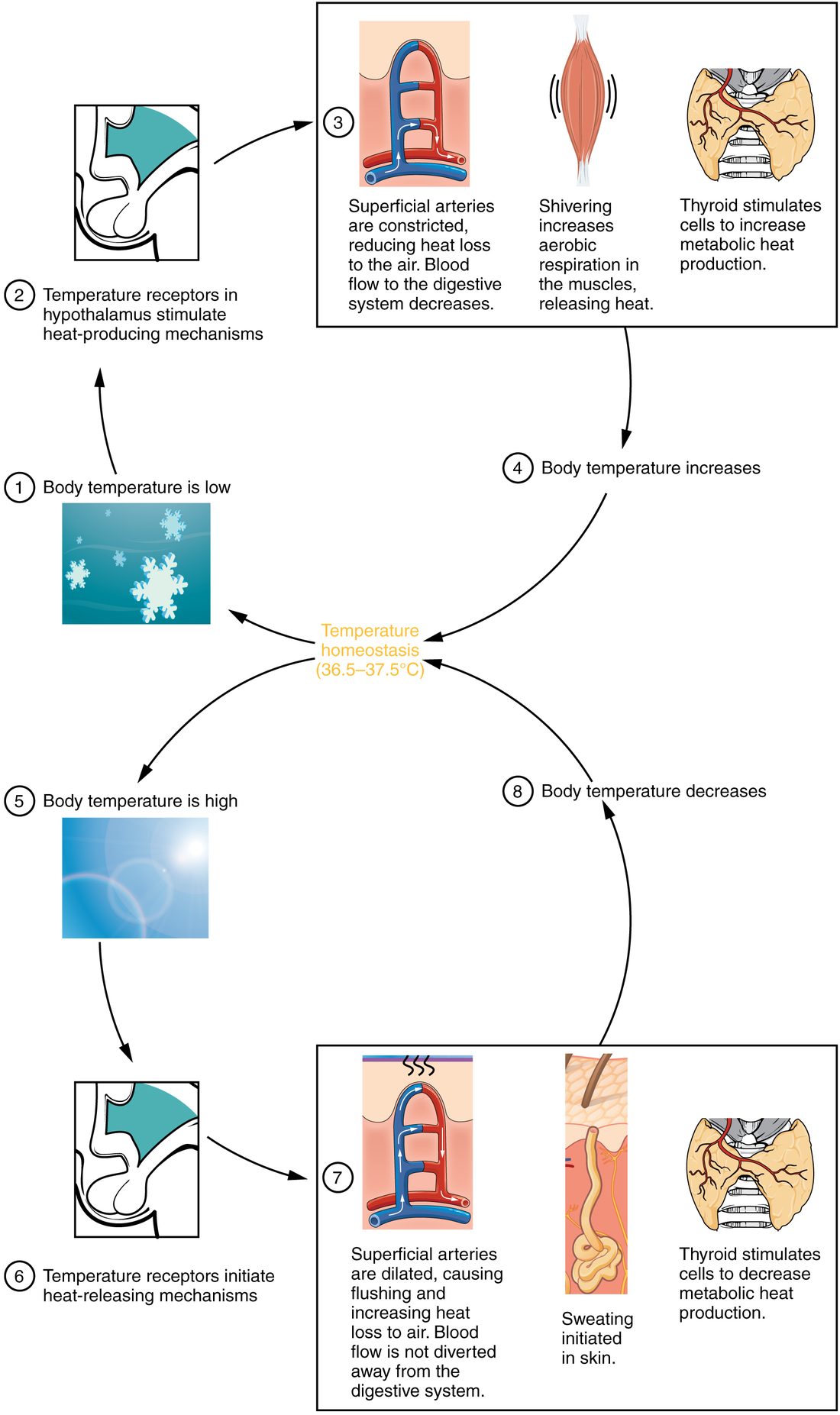
- Hard exercise raises heat production, and core and skin temperature begin to rise.Warm thermoreceptors in the skin and temperature-sensitive neurons in the hypothalamus increase their signals to the preoptic area.
- The preoptic area compares the input with its set point and finds the temperature too high.It drives sympathetic cholinergic nerves to the skin, which activate the sweat glands and actively widen skin blood vessels.
- More warm blood reaches the skin and sweat spreads over it.Heat is lost by radiation, convection and, above all, evaporation of sweat.
- Heat loss rises to match heat production.Core temperature levels off at a slightly raised value: negative feedback. If humid air stops sweat evaporating, heat loss falls short and core temperature keeps climbing toward heat stroke.
6Core concepts
7A common mistake
The wrong idea: Sweating cools you.
What actually happens: Sweat cools you only when it evaporates. Turning each liter of sweat into vapor takes about 580 kcal from your skin; sweat that drips off removes almost no heat. In humid air, evaporation slows, so you can sweat heavily, lose a lot of water, and still overheat. That is why a hot, humid day is far more dangerous for exercise than a hot, dry one.
8Check yourself
Anything you miss goes into your review queue.
1. A resting woman uses 200 mL of oxygen per minute. Each liter of oxygen consumed goes with about 4.8 kcal of energy released. What is her metabolic rate in kcal per day?
- About 1,380 kcal/day
- About 960 kcal/day
- About 1,730 kcal/day
- About 13,800 kcal/day
Show the answer
Oxygen per day: 200 mL/min × 1,440 min/day = 288,000 mL = 288 L. Energy: 288 L × 4.8 kcal/L = 1,382 kcal/day.
- Correct: About 1,380 kcal/day: Correct. 288 L × 4.8 kcal/L ≈ 1,380 kcal/day.
- About 960 kcal/day: 960 is 200 × 4.8, the kcal for 200 liters, not for a day's oxygen use.
- About 1,730 kcal/day: 1,730 kcal/day is the answer for 250 mL/min, not 200.
- About 13,800 kcal/day: This is ten times too large: 288,000 mL is 288 L, not 2,880 L.
2. A runner does the same 60-minute run on a hot, humid day (32 °C, 85% humidity) that she usually does on a cool, dry day. Predict each variable at the end of the hot run, compared with the end of the cool run.
| Variable | Change |
|---|---|
| Skin blood flow | — |
| Sweat rate | — |
| Share of her sweat that evaporates | — |
| Core temperature | — |
| Stroke volume | — |
| Heart rate | — |
Show the answer
Across the nervous, integumentary and cardiovascular systems: the heat load raises skin blood flow and sweating, but humidity blocks evaporation, so core temperature climbs. Sweat losses and blood held in the skin cut venous return and stroke volume, and heart rate rises to compensate. This is the setting for heat exhaustion and heat stroke.
- Skin blood flow: up. The hypothalamus drives more active vasodilation through sympathetic cholinergic nerves as core and skin temperature rise.
- Sweat rate: up. The same nerves drive the sweat glands harder in response to the greater heat load.
- Share of her sweat that evaporates: down. Humid air is close to saturated, so evaporation slows and much of the sweat drips off.
- Core temperature: up. Air near skin temperature blocks radiation and convection, and humid air limits evaporation, so heat loss falls short of heat production.
- Stroke volume: down. Sweat losses shrink plasma volume and more blood sits in the widened skin vessels, so less returns to fill the heart.
- Heart rate: up. With a smaller stroke volume, heart rate rises to keep cardiac output up for both muscles and skin.
3. A 17-year-old collapses at football practice on a humid day. He is confused, his skin is hot and sweaty, and his rectal temperature is 41.6 °C. What should be done first?
- Give a fever-reducing drug by mouth
- Wrap him in a blanket until the ambulance arrives
- Give salty fluids and let him rest seated
- Cool him rapidly, ideally by cold-water immersion
Show the answer
A core temperature above 40 °C with confusion is heat stroke. Damage depends on how long the core stays that hot, so the priority is rapid cooling, best by immersing him in cold water, before transport if that can be done safely.
- Give a fever-reducing drug by mouth: His set point is normal; heat gain has outrun heat loss. Fever-reducing drugs lower a raised set point, so they do not help, and he cannot swallow safely while confused.
- Wrap him in a blanket until the ambulance arrives: A blanket would trap heat and let his temperature keep rising.
- Give salty fluids and let him rest seated: Fluids and rest suit heat exhaustion, where the brain works normally. His confusion marks heat stroke, and he should not drink while confused.
- Correct: Cool him rapidly, ideally by cold-water immersion: Correct. Rapid cooling is the treatment for heat stroke.
4. Six months after losing 12 kg on a diet, a man says he is hungrier than before he started. Which change in his hormones best explains it?
- Lower leptin and higher ghrelin
- Higher leptin and lower ghrelin
- Higher insulin and higher leptin
- Lower ghrelin and lower insulin
Show the answer
With less fat, fat cells release less leptin, so the hypothalamus drives hunger and saves energy. Ghrelin from the stomach also tends to rise after weight loss. Both push toward regaining the lost weight.
- Correct: Lower leptin and higher ghrelin: Correct. Falling leptin and rising ghrelin both raise hunger.
- Higher leptin and lower ghrelin: High leptin and low ghrelin would both reduce hunger.
- Higher insulin and higher leptin: Higher insulin and leptin would signal plenty and reduce hunger.
- Lower ghrelin and lower insulin: Lower ghrelin would reduce hunger, not raise it.
5. A student traced the body's response to stepping out into freezing wind. One step is wrong. Which one?
- Cold thermoreceptors in the skin increase their firing
- Sensory signals reach the preoptic area of the hypothalamus
- Sympathetic nerves widen the arterioles of the skin
- Skeletal muscles begin to shiver
- Heat loss falls and heat production rises
Show the answer
In the cold, sympathetic nerves release norepinephrine onto skin arterioles, narrowing them. Less warm blood reaches the surface, so the shell insulates the core.
- Cold thermoreceptors in the skin increase their firing: This step is right. Skin sensors report the cold first, before the core cools.
- Sensory signals reach the preoptic area of the hypothalamus: This step is right. The preoptic area is the temperature control center.
- Correct: Sympathetic nerves widen the arterioles of the skin: This is the error. Skin arterioles narrow in the cold; they widen in the heat.
- Skeletal muscles begin to shiver: This step is right. Shivering raises heat production.
- Heat loss falls and heat production rises: This step is right. Both effects oppose the fall in temperature: negative feedback.
6. A man is pulled from icy water after 40 minutes. His core temperature is 29 °C. He has stopped shivering, is drowsy, and his heart rate is 40. Why must rescuers move him gently?
- Moving him would restart shivering and exhaust him
- Movement makes his skin vessels constrict further
- His cold heart can fibrillate if handled roughly
- His bones are brittle from the cold
Show the answer
At a core temperature near or below 30 °C, the heart muscle is cold and electrically unstable. Jostling can trigger ventricular fibrillation. Rescuers keep him horizontal, handle him gently and rewarm him.
- Moving him would restart shivering and exhaust him: Shivering stops in moderate hypothermia because heat production fails, and it would help rather than harm.
- Movement makes his skin vessels constrict further: Skin vessel tone is not the danger here.
- Correct: His cold heart can fibrillate if handled roughly: Correct. A cold heart is prone to fatal rhythms.
- His bones are brittle from the cold: Cold does not make bones brittle at these temperatures.
7. A woman with untreated hyperthyroidism eats more than usual yet is losing weight, and she feels hot. What best explains both?
- Her raised BMR makes her spend more energy, released as heat
- Her appetite hormones have stopped working properly
- She is absorbing much less of her food from the gut
- Her brown fat has been replaced by ordinary white fat
Show the answer
Thyroid hormones raise the number of sodium–potassium pumps and mitochondria in cells, so they use more ATP and oxygen. Her BMR rises, she spends more energy than she eats, and the extra energy is released as heat.
- Correct: Her raised BMR makes her spend more energy, released as heat: Correct. A raised BMR explains both weight loss and feeling hot.
- Her appetite hormones have stopped working properly: Her hunger is rising in response to greater spending, which shows appetite regulation is working.
- She is absorbing much less of her food from the gut: The weight loss comes from greater spending, not poor absorption.
- Her brown fat has been replaced by ordinary white fat: Hyperthyroidism raises heat production; losing brown fat would lower it.
9Summary
Metabolic rate is the rate of energy use, and so of heat production. The basal metabolic rate, measured at rest after a 12-hour fast in a warm room, is about 60 to 70% of the total metabolic rate and depends mostly on lean mass, thyroid hormones and sympathetic activity. Energy balance compares intake with spending; a surplus is stored as fat, but spending adjusts as weight changes. BMI (kg/m²) screens weight: 18.5 to 24.9 is the healthy range. The hypothalamus regulates appetite: ghrelin from the empty stomach raises hunger; stomach stretch and gut hormones bring satiety; leptin reports fat stores. Core temperature is held near 36.6 to 37 °C while the shell varies. Heat is lost by radiation, conduction, convection and evaporation; in hot air, only evaporation works. The preoptic area of the hypothalamus drives skin vasodilation and sweating when warm, and skin vasoconstriction, shivering and nonshivering thermogenesis in brown fat when cold. Heat exhaustion is water and salt loss with a normal brain; heat stroke is a core above about 40 °C with brain dysfunction and needs rapid cooling. Hypothermia is a core below 35 °C; frostbite is frozen tissue.