Thyroid and parathyroid glands
1Why this matters
Ms. Duarte, 38, has lost 6 kg in two months while eating more than ever. She feels hot, her hands shake and her heart races at rest. Her thyroid gland is overactive, and it is removed. The next evening her lips tingle and her hand cramps into a claw when her blood pressure is taken. Her thyroid hormone problem is fixed, but her blood calcium has crashed, because four tiny glands on the back of her thyroid gland were bruised in the operation.
2What this builds on
3Quick check before you start
1. How do lipid-soluble hormones change a target cell's activity?
- They bind a membrane receptor protein and raise cAMP
- They bind an intracellular receptor protein and change gene transcription
- They open ion channels in the plasma membrane
Show the answer
Lipid-soluble hormones cross the membrane and bind receptor proteins inside the cell. The hormone–receptor complex binds a hormone response element and changes transcription.
- They bind a membrane receptor protein and raise cAMP:
- Correct: They bind an intracellular receptor protein and change gene transcription:
- They open ion channels in the plasma membrane:
2. What happens to TSH if the thyroid gland's output falls?
- TSH falls with it
- TSH rises, because long-loop negative feedback is removed
- TSH stays the same
Show the answer
The thyroid gland's hormones normally hold TSH down by negative feedback. When they fall, the brake comes off and TSH rises.
- TSH falls with it:
- Correct: TSH rises, because long-loop negative feedback is removed:
- TSH stays the same:
3. Which bone cells break bone matrix down and release calcium into the blood?
- Osteoblasts
- Osteocytes
- Osteoclasts
Show the answer
Osteoclasts dissolve bone matrix, releasing calcium and phosphate. Osteoblasts build new matrix, and osteocytes maintain it.
- Osteoblasts:
- Osteocytes:
- Correct: Osteoclasts:
4Anatomy
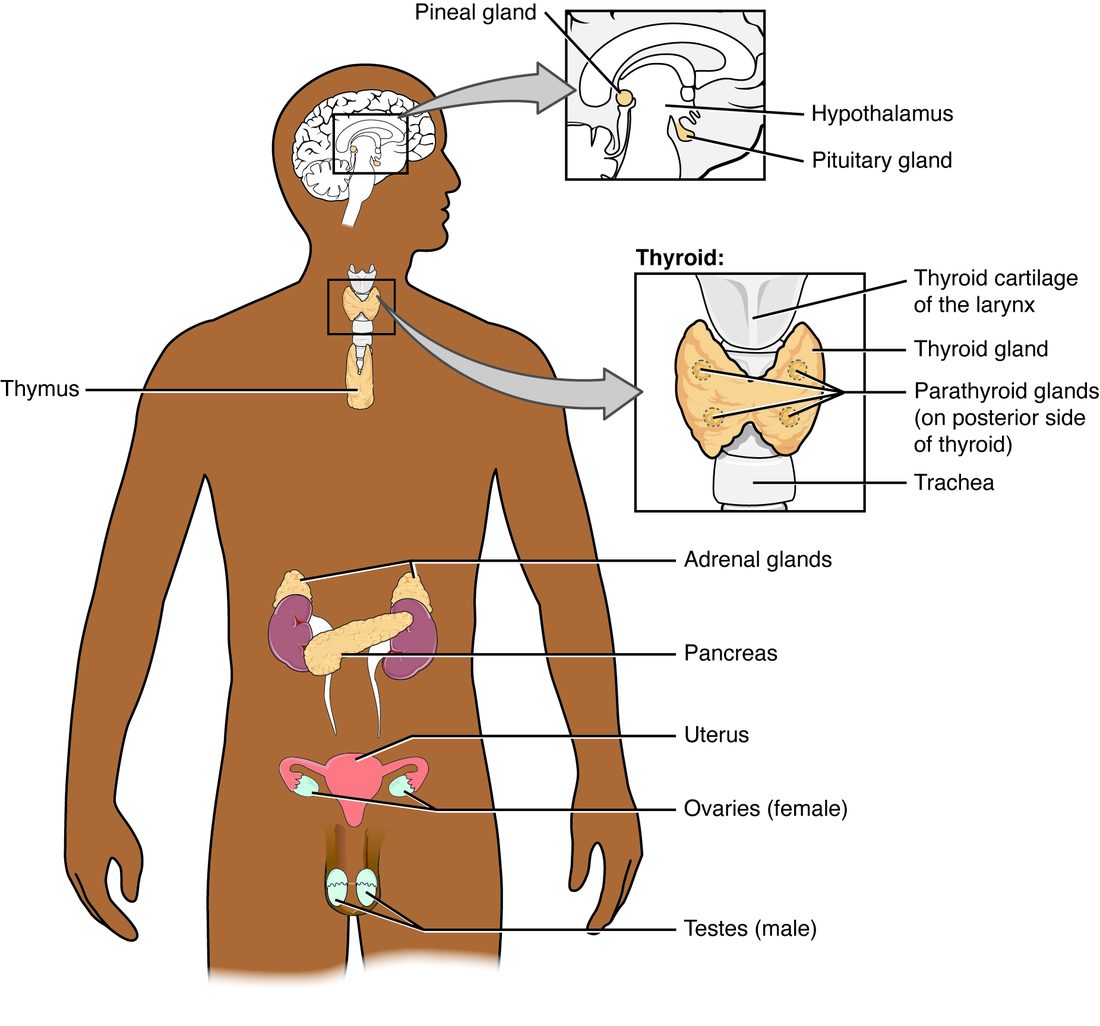
With labels hidden, select a box to reveal its label.
5How it works, step by step
- Blood calcium falls below its set point.Fewer calcium ions bind the calcium-sensing receptor proteins on parathyroid chief cells, and the cells release more PTH.
- PTH binds receptor proteins on osteoblasts.The osteoblasts signal osteoclasts to form and work harder, and dissolved bone releases calcium and phosphate into the blood.
- PTH also acts on the kidneys.The kidney's tubules keep more calcium, lose more phosphate, and switch on the enzyme that makes calcitriol.
- Calcitriol reaches the intestine and changes transcription in its lining cells.The intestine absorbs more calcium and phosphate from food.
- Calcium from bone, kidneys and intestine brings blood calcium back to its set point.The chief cells release less PTH: negative feedback.
6Core concepts
7A common mistake
The wrong idea: Calcitonin and PTH are equal partners: calcitonin lowers blood calcium just as strongly as PTH raises it.
What actually happens: PTH and calcitriol are the main regulators of blood calcium. Calcitonin does lower calcium by inhibiting osteoclasts, but in adults its effect is small: people with no thyroid gland, and so no calcitonin, keep normal calcium, and so do people with tumors making huge amounts of it. When calcium rises, the main correction is that PTH release falls. Exams still expect calcitonin as the hormone that lowers blood calcium.
8Check yourself
Anything you miss goes into your review queue.
1. A patient's whole thyroid gland is removed, but her parathyroid glands are left intact and working, and she is not yet taking any replacement hormone. Predict the change in each variable over the next few weeks.
| Variable | Change |
|---|---|
| T4 and T3 in the blood | — |
| TSH | — |
| Heat production by body cells | — |
| Calcitonin | — |
| Blood calcium | — |
Show the answer
Removing the thyroid gland removes T4, T3 and calcitonin. The thyroid axis responds with a high TSH, and every tissue slows. Blood calcium stays normal because the parathyroid glands and calcitriol, not calcitonin, control it in adults.
- T4 and T3 in the blood: down. The follicular cells that made them are gone; what remains is slowly cleared, and T4 has a half-life of about a week.
- TSH: up. Without T4 and T3, long-loop negative feedback on the anterior pituitary is lost, so TSH rises high.
- Heat production by body cells: down. Less thyroid hormone means fewer sodium–potassium pumps and mitochondria, so cells use less oxygen and make less heat.
- Calcitonin: down. The parafollicular (C) cells that make calcitonin were removed with the gland.
- Blood calcium: no change. PTH and calcitriol, the main regulators, still work, so calcium stays normal despite losing calcitonin.
2. A person's diet has contained almost no iodine for many months. Predict the change in each variable.
| Variable | Change |
|---|---|
| T4 and T3 made by the thyroid gland | — |
| TSH | — |
| Size of the thyroid gland | — |
| Heart rate | — |
Show the answer
Without iodine, the gland cannot make its hormones. Feedback is lost, TSH rises, and TSH makes the gland grow into a goiter while the person shows the slowed signs of hypothyroidism.
- T4 and T3 made by the thyroid gland: down. Iodine is part of both hormones; without it the follicular cells cannot finish making them.
- TSH: up. Low T4 and T3 remove long-loop negative feedback, so the anterior pituitary releases more TSH.
- Size of the thyroid gland: up. High TSH keeps driving the follicular cells to grow and make thyroglobulin: a goiter.
- Heart rate: down. With less thyroid hormone, heart cells have fewer beta-1 receptor proteins and less drive, so the resting heart rate falls.
3. A 52-year-old woman is tired, always cold and has slow bowels, has gained a little weight and has dry skin and a slow pulse. Her free T4 is low and her TSH is high. What is the most likely explanation?
- Her anterior pituitary is failing to make TSH
- Her hypothalamus is making too little TRH
- Her parathyroid glands are overactive
- Her thyroid gland itself is failing
Show the answer
Low thyroid hormone with high TSH points to the thyroid gland itself. Her symptoms are the slowed state of hypothyroidism. With the gland failing, long-loop negative feedback is lost and the anterior pituitary pushes TSH up. In iodized-salt countries, the usual cause is Hashimoto thyroiditis.
- Her anterior pituitary is failing to make TSH: A failing anterior pituitary would give a low TSH, not a high one.
- Her hypothalamus is making too little TRH: Too little TRH would lower TSH, not raise it.
- Her parathyroid glands are overactive: Overactive parathyroid glands raise blood calcium; they do not lower T4 or raise TSH.
- Correct: Her thyroid gland itself is failing: Correct. Primary hypothyroidism: the target gland fails and TSH rises.
4. A patient has low free T4 and a low TSH. Where is the fault most likely to be?
- The thyroid gland
- The parathyroid glands
- The anterior pituitary or hypothalamus
- The parafollicular cells
Show the answer
If the thyroid gland had failed, TSH would be high. A low TSH with low T4 means the thyroid gland is not being driven: the anterior pituitary is making too little TSH, or the hypothalamus too little TRH.
- The thyroid gland: A failing thyroid gland removes feedback and makes TSH rise, not fall.
- The parathyroid glands: The parathyroid glands control calcium, not T4 or TSH.
- Correct: The anterior pituitary or hypothalamus: Correct. Too little drive from above lowers both TSH and T4.
- The parafollicular cells: Parafollicular cells make calcitonin, not T4, and do not control TSH.
5. Select every effect of parathyroid hormone.
- More osteoclast activity, releasing calcium from bone
- More calcium kept by the kidneys
- More phosphate kept by the kidneys
- More calcitriol made by the kidneys
- Osteoclasts switched off
Show the answer
PTH raises blood calcium: it drives bone breakdown by osteoclasts (acting through osteoblasts), makes the kidneys keep calcium and lose phosphate, and switches on calcitriol production.
- Correct: More osteoclast activity, releasing calcium from bone: Correct. PTH drives osteoclast activity.
- Correct: More calcium kept by the kidneys: Correct. PTH makes the kidneys pull calcium back from the urine.
- More phosphate kept by the kidneys: PTH does the opposite: it makes the kidneys lose phosphate in the urine.
- Correct: More calcitriol made by the kidneys: Correct. PTH switches on the kidney enzyme that makes calcitriol.
- Osteoclasts switched off: Switching osteoclasts off is calcitonin's action, not PTH's.
6. The day after thyroid surgery, a patient has tingling lips and fingers, and her hand cramps into a claw when a blood pressure cuff is inflated. What best explains this?
- Loss of calcitonin has made her calcium rise
- Loss of T4 has slowed her nerves
- Low PTH from damaged parathyroid glands
- TSH has risen and is stimulating her muscles
Show the answer
The parathyroid glands sit on the back of the thyroid gland and are easily injured in thyroid surgery. Without PTH, blood calcium falls. Low extracellular calcium makes voltage-gated sodium channels open more easily, so nerves and muscles fire on their own: tingling, cramps and tetany.
- Loss of calcitonin has made her calcium rise: Losing calcitonin would, if anything, let calcium rise, and high calcium makes nerves less excitable, not more.
- Loss of T4 has slowed her nerves: T4 has a half-life of about a week, so it cannot have fallen enough in one day, and lack of it slows reflexes rather than causing cramps.
- Correct: Low PTH from damaged parathyroid glands: Correct. Hypoparathyroidism after surgery causes hypocalcemia and tetany.
- TSH has risen and is stimulating her muscles: TSH acts on the thyroid gland, not on muscles, and it would not cause tetany.
7. Twenty years after her thyroid gland was removed, a woman takes T4 tablets and has no calcitonin at all. Her parathyroid glands are healthy. What is her blood calcium most likely to be?
- Normal, because PTH and calcitriol control it
- Very high, because nothing lowers it
- Very low, because calcitonin is needed to keep calcium in bone
- Unpredictable from day to day
Show the answer
In adults, PTH and calcitriol are the main regulators of blood calcium. When calcium rises, PTH release falls, so less calcium comes from bone, the kidneys and the gut. People with no thyroid gland keep normal calcium as long as their parathyroid glands work.
- Correct: Normal, because PTH and calcitriol control it: Correct. Calcitonin's role in adults is small.
- Very high, because nothing lowers it: Calcium does not climb without calcitonin: falling PTH is the main brake when calcium rises.
- Very low, because calcitonin is needed to keep calcium in bone: Calcitonin lowers calcium; losing it could not make calcium very low.
- Unpredictable from day to day: The PTH loop keeps calcium steady from day to day without calcitonin.
8. A person gets almost no sunlight and little vitamin D in food for a year. Predict the change in each variable.
| Variable | Change |
|---|---|
| Calcitriol | — |
| Calcium absorbed by the intestine | — |
| PTH | — |
| Phosphate lost in the urine | — |
Show the answer
Low vitamin D means low calcitriol and poor calcium absorption. PTH rises to defend blood calcium, taking calcium from bone and dumping phosphate. Too little calcium phosphate reaches new bone matrix, causing rickets or osteomalacia.
- Calcitriol: down. Less vitamin D reaches the liver and kidneys to be activated.
- Calcium absorbed by the intestine: down. Without calcitriol, the intestinal cells make fewer of the proteins that absorb calcium.
- PTH: up. The small dip in blood calcium makes the chief cells release more PTH.
- Phosphate lost in the urine: up. The higher PTH makes the kidneys keep less phosphate.
9Summary
The thyroid gland's follicles store thyroglobulin in colloid. Follicular cells trap iodide, attach iodine to tyrosines on thyroglobulin, and release thyroxine (T4) and triiodothyronine (T3) when TSH drives them; tissues convert T4 to the more active T3. These lipid-soluble hormones change transcription in almost every cell, raising oxygen use and heat, sensitizing the heart to the sympathetic system, and enabling growth and brain development. TRH and TSH drive the gland, and T4 and T3 feed back to hold them down. Too little hormone (hypothyroidism) slows everything; too much (hyperthyroidism, usually Graves disease) speeds everything; high TSH or a stimulating immune protein causes a goiter; newborns are screened for congenital hypothyroidism. The parathyroid glands release PTH when calcium falls: it frees calcium from bone through osteoblasts and osteoclasts, makes the kidneys keep calcium and lose phosphate, and switches on calcitriol, which raises calcium absorption in the intestine. Too little vitamin D causes rickets or osteomalacia. Calcitonin from the C cells inhibits osteoclasts, but in adults its effect is minor.