Functions of the skin
1Why this matters
Marcus, 17, collapses during football practice on a muggy August afternoon. His shirt is soaked and sweat is pouring off him, yet his temperature is 40 °C. The trainer moves him into the shade, strips off his gear and sprays him with water in front of a fan while a tub of ice water is filled, then lowers him into it. To see why he overheated while sweating so hard, and why water and moving air cool him, you need to know how your skin trades heat with the air.
2What this builds on
3Quick check before you start
1. In a negative feedback loop, what does the response do to the stimulus?
- Makes it larger
- Opposes it, returning the variable toward the set point
- Leaves it unchanged
Show the answer
In negative feedback, the response pushes the regulated variable back toward the set point, so the stimulus shrinks and the loop switches itself off.
- Makes it larger:
- Correct: Opposes it, returning the variable toward the set point:
- Leaves it unchanged:
2. What happens to blood flow into a tissue when the smooth muscle in the walls of its small arteries relaxes?
- Vasodilation increases flow
- Vasoconstriction decreases flow
- Nothing changes
Show the answer
Relaxed smooth muscle lets the vessel widen (vasodilation). A wider vessel has less resistance, so more blood flows through.
- Correct: Vasodilation increases flow:
- Vasoconstriction decreases flow:
- Nothing changes:
3. Which layer of the epidermis is made of flat, dead, keratin-filled cells sealed by lipid sheets?
- Stratum basale
- Stratum spinosum
- Stratum corneum
Show the answer
The stratum corneum is the surface layer of dead, keratin-filled cells in lipid sheets, and it is the core of the skin's barrier.
- Stratum basale:
- Stratum spinosum:
- Correct: Stratum corneum:
4Anatomy
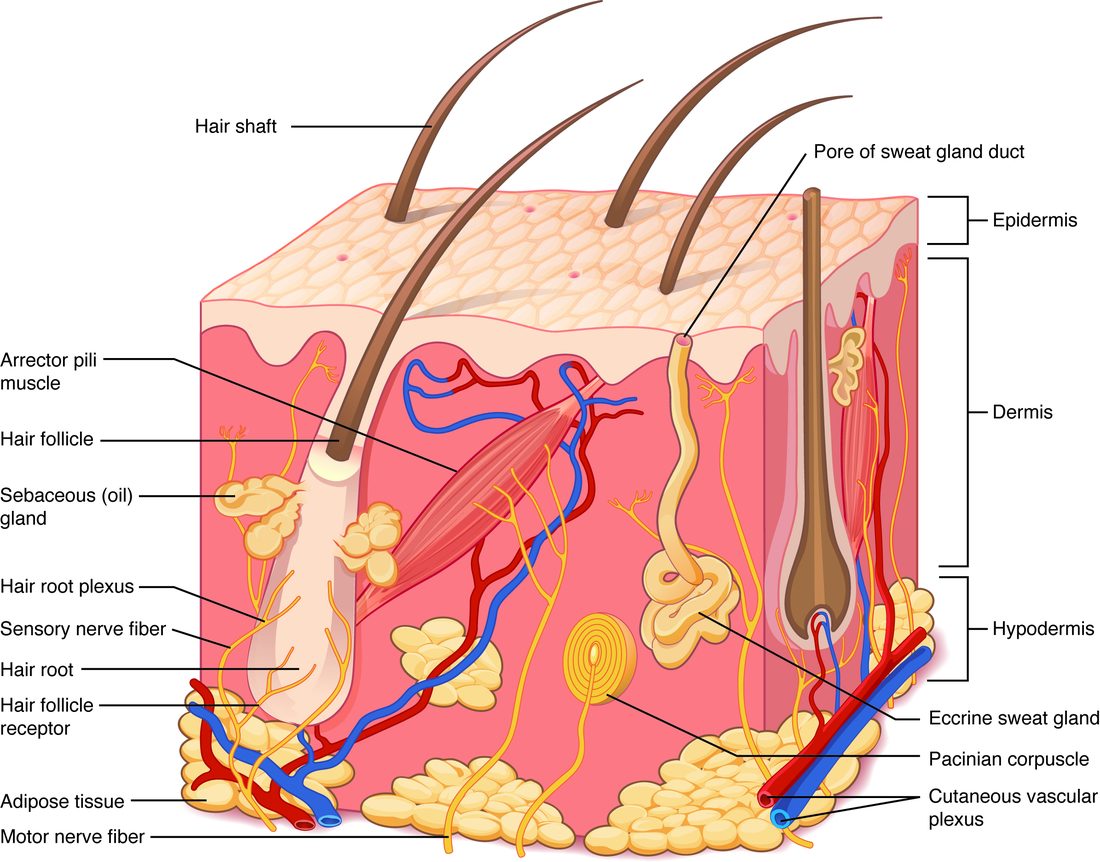
With labels hidden, select a box to reveal its label.
5How it works, step by step
- Exercise raises heat production, and body temperature starts to rise.Warm-sensitive nerve endings in the skin and temperature-sensitive neurons in the brain signal the brain's temperature control center.
- The control center detects a temperature above its set point.It sends nerve signals that widen the vessels of the dermis and make the eccrine sweat glands secrete.
- Dermal blood flow rises and sweat spreads over the skin.The skin surface warms and stays wet, so more heat is lost by radiation, convection and, above all, evaporation.
- Heat loss now matches heat production.Body temperature falls back toward the set point, the stimulus shrinks, and the responses ease off: negative feedback.
6Core concepts
7A common mistake
The wrong idea: The more you sweat, the more you cool down.
What actually happens: Sweat cools you only when it evaporates: each liter that turns to vapor on your skin removes about 580 kcal, while sweat that drips off removes almost none. In humid air, sweat evaporates slowly, so a person can be dripping with sweat and still overheating. Fanning and misting help because moving air and a thin film of water speed evaporation.
8Check yourself
Anything you miss goes into your review queue.
1. A student jogs for 40 minutes on a hot, dry afternoon. Predict the change in each variable during the jog, compared with resting indoors.
| Variable | Change |
|---|---|
| Heat produced by her muscles | — |
| Dermal blood flow | — |
| Skin surface temperature | — |
| Eccrine sweat output | — |
| Heat lost by evaporation | — |
Show the answer
Exercise raises heat production. The temperature loop responds with vasodilation in the dermis, which warms the skin surface, and with eccrine sweating. In dry air the sweat evaporates, so heat loss by evaporation rises and body temperature is held near its set point.
- Heat produced by her muscles: up. Working skeletal muscle breaks down far more fuel, and most of that energy is released as heat.
- Dermal blood flow: up. Warm-sensitive endings signal the brain's temperature control center, which sends signals that widen the vessels of the dermis.
- Skin surface temperature: up. More warm blood flowing through the dermis carries heat to the skin surface.
- Eccrine sweat output: up. The control center signals the eccrine sweat glands to secrete.
- Heat lost by evaporation: up. More sweat is on the skin, and dry air lets it evaporate quickly, each liter removing about 580 kcal.
2. A worker does the same hard job on two days with the same air temperature of 36 °C. On the second day the air is very humid. Predict the change in each variable on the humid day, compared with the dry day.
| Variable | Change |
|---|---|
| Rate at which sweat evaporates | — |
| Sweat dripping off unevaporated | — |
| Heat lost by evaporation | — |
| Internal body temperature | — |
Show the answer
When the air is hotter than the skin, radiation and convection add heat, and evaporation is the only way to lose it. Humidity slows evaporation, so more sweat drips off uselessly, less heat is lost, and body temperature climbs even though the worker is sweating hard.
- Rate at which sweat evaporates: down. Humid air already holds a lot of water vapor, so water on the skin turns to vapor more slowly.
- Sweat dripping off unevaporated: up. Sweat that cannot evaporate builds up on the skin and runs off.
- Heat lost by evaporation: down. Only sweat that evaporates removes heat; dripping sweat removes almost none.
- Internal body temperature: up. At 36 °C the air is hotter than the skin, so evaporation is the only route of heat loss; with it reduced, heat builds up.
3. A roofer makes 696 kcal of heat per hour on a day when the air is hotter than his skin. How much sweat must evaporate each hour just to remove that heat? (Each liter evaporated removes about 580 kcal.)
- About 0.8 L
- About 1.2 L
- About 4.0 L
- About 1.0 L
Show the answer
Evaporation is the only route when the air is hotter than the skin. Volume = heat ÷ 580 kcal/L = 696 ÷ 580 = 1.2 L per hour, and more if some drips off.
- About 0.8 L: 0.8 comes from dividing 580 by 696, the wrong way round.
- Correct: About 1.2 L: Correct. 696 ÷ 580 = 1.2 L.
- About 4.0 L: 4.0 L would remove about 2,300 kcal, more than three times the heat he makes.
- About 1.0 L: 1.0 L removes only 580 kcal, less than the 696 kcal he makes.
4. Put the steps of vitamin D production and activation in order, starting in the skin.
- UVB light strikes 7-dehydrocholesterol in keratinocytes
- Previtamin D3 forms
- Body warmth converts it to vitamin D3 (cholecalciferol)
- The liver adds a hydroxyl group, making 25-hydroxyvitamin D
- The kidneys add a second hydroxyl group, making the active hormone
- The intestine absorbs more calcium and phosphate
Show the answer
UVB opens a ring of 7-dehydrocholesterol, making previtamin D3, which body warmth turns into vitamin D3. The liver then makes 25-hydroxyvitamin D, the main form in the blood, and the kidneys make the active hormone, which raises calcium and phosphate absorption in the intestine.
- Correct order: 1. UVB light strikes 7-dehydrocholesterol in keratinocytes 2. Previtamin D3 forms 3. Body warmth converts it to vitamin D3 (cholecalciferol) 4. The liver adds a hydroxyl group, making 25-hydroxyvitamin D 5. The kidneys add a second hydroxyl group, making the active hormone 6. The intestine absorbs more calcium and phosphate
5. A patient with long-standing, severe kidney failure spends plenty of time outdoors and eats a varied diet. Her 25-hydroxyvitamin D level is normal, but she absorbs calcium poorly. Which step has failed?
- UVB conversion of 7-dehydrocholesterol in the skin
- Conversion of previtamin D3 to vitamin D3
- The liver's addition of the first hydroxyl group
- The kidneys' addition of the second hydroxyl group
Show the answer
A normal 25-hydroxyvitamin D level shows the skin and liver steps are working. The final step, adding the second hydroxyl group to make the active hormone, happens in the kidneys, so failing kidneys make too little of it and calcium absorption falls. She needs the active hormone itself as a drug.
- UVB conversion of 7-dehydrocholesterol in the skin: If the skin step had failed, and she ate little vitamin D, her 25-hydroxyvitamin D would be low, not normal.
- Conversion of previtamin D3 to vitamin D3: This conversion also happens in the skin, before the liver step; a normal 25-hydroxyvitamin D level shows it is working.
- The liver's addition of the first hydroxyl group: The liver's product is 25-hydroxyvitamin D, and its level is normal.
- Correct: The kidneys' addition of the second hydroxyl group: Correct. The kidneys make the active hormone, and hers are failing.
6. A doctor holds a buzzing tuning fork against a patient's ankle bone to test deep vibration sense. Which sensory receptors in the skin mainly detect it?
- Lamellated (Pacinian) corpuscles
- Free nerve endings
- Tactile (Merkel) cells
- Endings wrapped around hair follicles
Show the answer
Lamellated corpuscles sit deep in the dermis and hypodermis. Their many layers pass on fast changes in pressure and filter out steady pressure, so they respond best to deep pressure and fast vibration.
- Correct: Lamellated (Pacinian) corpuscles: Correct. Deep, fast vibration is the lamellated corpuscle's specialty.
- Free nerve endings: Free nerve endings mainly sense pain, temperature and itch.
- Tactile (Merkel) cells: Tactile cells sense steady light pressure and texture near the surface, not fast vibration.
- Endings wrapped around hair follicles: Hair follicle endings sense a hair bending; the fork presses on skin and bone.
7. A skin patch delivers a drug steadily through intact skin. Another drug, which dissolves only in water, barely gets through the same skin. What explains the difference?
- The patch drug is carried by sweat into the dermis
- Water-soluble drugs are destroyed by the acidic pH
- The patch drug dissolves through the lipid sheets
- Only the patch drug is small enough to cross
Show the answer
The barrier of the stratum corneum is made of lipid sheets between dead cells. Lipid-soluble (hydrophobic) molecules dissolve into that lipid and slowly pass through; water-soluble molecules cannot cross it easily. Skin-patch drugs are chosen to be lipid soluble.
- The patch drug is carried by sweat into the dermis: Sweat flows outward, from the glands to the surface, so it cannot carry drugs inward.
- Water-soluble drugs are destroyed by the acidic pH: The skin's pH of about 5 is only mildly acidic and does not destroy most drugs.
- Correct: The patch drug dissolves through the lipid sheets: Correct. Lipid solubility lets a drug cross the lipid barrier.
- Only the patch drug is small enough to cross: Size matters less than whether the molecule can dissolve in the lipid sheets that fill the spaces between the cells.
8. A student described the response to cold. One step is wrong. Which one?
- Cold air cools the skin
- Cold-sensitive nerve endings signal the brain
- The brain's temperature control center compares the input with the set point
- The vessels of the dermis widen, bringing warm blood to the surface
- Skeletal muscles begin to shiver
Show the answer
In cold, the dermal vessels narrow (vasoconstriction). That keeps warm blood deeper in the body, cools the skin surface and shrinks the gradient that drives heat loss. Widening them would lose heat faster.
- Cold air cools the skin: This step is right. The skin is the first to cool.
- Cold-sensitive nerve endings signal the brain: This step is right. Cold-sensitive endings are the sensors.
- The brain's temperature control center compares the input with the set point: This step is right. The control center compares input with the set point and sends out commands.
- Correct: The vessels of the dermis widen, bringing warm blood to the surface: This is the error. Dermal vessels narrow in the cold; they widen in heat.
- Skeletal muscles begin to shiver: This step is right. Shivering makes heat.
9Summary
The skin is a barrier: dead, keratin-filled cells joined tightly and sealed by lipid sheets, on a dry, shed, slightly acidic surface, keep water in and microbes out, while lipid-soluble substances can slowly pass. Its touch receptors include free nerve endings (pain, temperature, itch), tactile cells, tactile corpuscles in the dermal papillae (light touch) and lamellated corpuscles deep in the dermis (pressure, vibration). Heat leaves by radiation, conduction, convection and evaporation, each down a gradient; when the air is hotter than the skin, only evaporation works, at about 580 kcal per liter. In the body temperature loop, the brain's temperature control center raises dermal blood flow and sweating when you are warm, and lowers dermal blood flow and starts shivering when you are cold. UVB turns 7-dehydrocholesterol in keratinocytes into vitamin D3 (cholecalciferol); the liver and then the kidneys activate it, and too little causes rickets in children.