Carbohydrate metabolism in detail
1Why this matters
A firefighter carries Ms. Brandt, 52, out of a burning apartment. She is confused and breathing fast, and her pulse oximeter reads 99%. A blood sample from her vein is almost as bright red as arterial blood, and her lactate is five times normal. Her blood is full of oxygen, yet her cells are behaving as if they had none. Smoke from burning plastics carries cyanide, and cyanide jams the last step of the machinery on this page.
2What this builds on
3Quick check before you start
1. What is the net ATP gain from glycolysis of one glucose?
- 2 ATP
- 4 ATP
- About 30 ATP
Show the answer
Glycolysis makes 4 ATP but spends 2 in its early steps, for a net gain of 2 per glucose, plus 2 NADH.
- Correct: 2 ATP:
- 4 ATP:
- About 30 ATP:
2. When a molecule is oxidized, what happens to it?
- It gains electrons
- It loses electrons
- It gains a phosphate group
Show the answer
Oxidation is loss of electrons; reduction is gain. When glucose is oxidized, its electrons are passed to carriers such as NAD+, which is reduced to NADH.
- It gains electrons:
- Correct: It loses electrons:
- It gains a phosphate group:
3. What is glycogenolysis?
- Making new glucose from amino acids
- Building glycogen from glucose
- Breaking glycogen down into glucose
Show the answer
Glycogenolysis (glycogen + -lysis = breaking apart) releases glucose units from stored glycogen.
- Making new glucose from amino acids:
- Building glycogen from glucose:
- Correct: Breaking glycogen down into glucose:
4Anatomy
With labels hidden, select a box to reveal its label.
5How it works, step by step
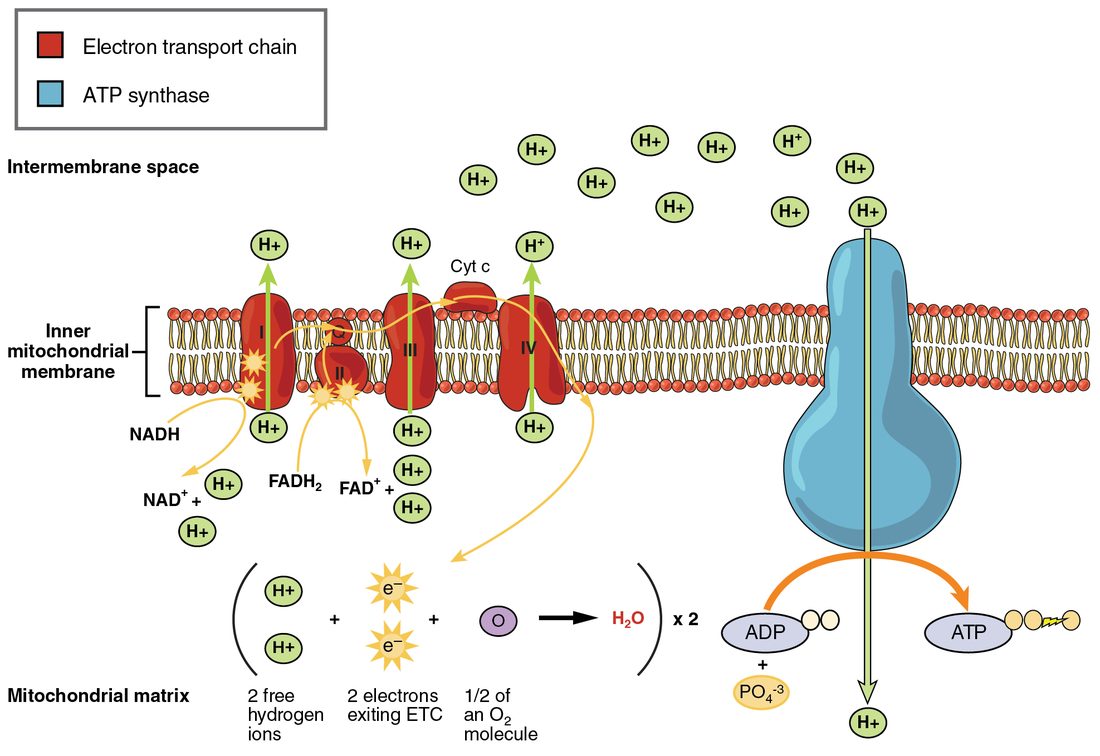
- NADH from glycolysis, pyruvate breakdown and the citric acid cycle gives its electrons to complex I.The electrons pass from carrier to carrier toward oxygen, each carrier holding them more tightly, so each transfer releases energy.
- Complexes I, III and IV use that released energy.They pump H+ from the matrix into the intermembrane space, building an H+ gradient across the inner membrane.
- Oxygen at complex IV accepts the electrons and H+, forming water.Electrons keep moving down the chain, so pumping continues and the gradient is maintained.
- H+ can return to the matrix only through ATP synthase.Its flow turns the enzyme's rotor, and each turn joins ADP and phosphate into ATP: chemiosmosis.
- Most ATP in the cell is made this way.One glucose yields about 30–32 ATP, about 26–28 of them from oxidative phosphorylation.
6Core concepts
7A common mistake
The wrong idea: The citric acid cycle makes most of your ATP.
What actually happens: The citric acid cycle makes only 2 ATP per glucose directly. Its real output is loaded electron carriers: 6 NADH and 2 FADH2 per glucose, plus CO2. The ATP from those carriers is made later, by the electron transport chain and ATP synthase. That is also why the cycle stops without oxygen even though it never uses oxygen itself: without the chain, NAD+ and FAD are not regenerated.
8Check yourself
Anything you miss goes into your review queue.
1. Hexokinase turns glucose into glucose-6-phosphate as soon as it enters a cell. Which consequence of this step keeps glucose moving into the cell?
- It keeps free glucose inside low, so glucose keeps flowing in
- It raises the cell's ATP level, which then powers glucose pumps
- It opens more glucose carriers in the membrane
- It makes glucose soluble in the lipid bilayer
Show the answer
Glucose enters most cells by facilitated diffusion, down its concentration gradient. Hexokinase converts it at once to charged glucose-6-phosphate, which the carriers do not carry out. Free glucose inside stays low, so the gradient into the cell is kept.
- Correct: It keeps free glucose inside low, so glucose keeps flowing in: Correct. Trapping glucose as glucose-6-phosphate keeps the inward gradient.
- It raises the cell's ATP level, which then powers glucose pumps: This step spends ATP rather than making it, and entry through glucose carriers is facilitated diffusion, not pumping.
- It opens more glucose carriers in the membrane: Hexokinase acts inside the cell; it does not change the number of carriers. Insulin does that in muscle and fat.
- It makes glucose soluble in the lipid bilayer: Adding a charged phosphate makes the molecule less able to cross lipid, not more.
2. How many CO2 molecules does the citric acid cycle itself release from one glucose, and how many does the whole of aerobic respiration release?
- 2 from the cycle; 6 in all
- 4 from the cycle; 4 in all
- 6 from the cycle; 6 in all
- 4 from the cycle; 6 in all
Show the answer
Each turn of the cycle releases 2 CO2, and one glucose gives two acetyl CoA, so the cycle releases 4. The other 2 are released as each pyruvate becomes acetyl CoA. All 6 carbons of glucose leave as CO2.
- 2 from the cycle; 6 in all: 2 is the release per turn. One glucose drives two turns.
- 4 from the cycle; 4 in all: This misses the 2 CO2 released when the two pyruvate become acetyl CoA, before the cycle.
- 6 from the cycle; 6 in all: The cycle releases 4; the other 2 come from the pyruvate step, outside the cycle.
- Correct: 4 from the cycle; 6 in all: Correct. 4 from two turns of the cycle, plus 2 from pyruvate breakdown.
3. Cyanide blocks complex IV of the electron transport chain in a person's cells. Predict the change in each variable within minutes.
| Variable | Change |
|---|---|
| Oxygen used by the cells | — |
| H+ gradient across the inner mitochondrial membrane | — |
| ATP made by ATP synthase | — |
| Lactate released into the blood | — |
| Oxygen left in venous blood | — |
Show the answer
Blocking complex IV stops electron flow and oxygen use. No H+ is pumped, the gradient collapses and oxidative phosphorylation stops. Cells fall back on glycolysis and lactate production, and unused oxygen stays in venous blood.
- Oxygen used by the cells: down. Complex IV is where oxygen accepts electrons; with it blocked, oxygen is no longer taken up.
- H+ gradient across the inner mitochondrial membrane: down. Electrons stop flowing, so the complexes stop pumping H+, and the gradient runs down through ATP synthase and small leaks.
- ATP made by ATP synthase: down. With no gradient to drive it, ATP synthase stops making ATP.
- Lactate released into the blood: up. Falling ATP speeds glycolysis, and pyruvate is turned into lactate to regenerate NAD+.
- Oxygen left in venous blood: up. Oxygen is still delivered but the tissues cannot use it, so more of it stays in the blood returning to the heart.
4. One turn of the citric acid cycle makes 3 NADH, 1 FADH2 and 1 ATP. Using current values (2.5 ATP per NADH, 1.5 per FADH2), how much ATP does one turn yield in all?
- 5 ATP
- 9 ATP
- 10 ATP
- 12 ATP
Show the answer
3 NADH × 2.5 = 7.5; 1 FADH2 × 1.5 = 1.5; plus 1 ATP made directly. 7.5 + 1.5 + 1 = 10 ATP per turn, or 20 per glucose.
- 5 ATP: 5 counts only the carriers (3 + 1 + 1) as if each were worth one ATP.
- 9 ATP: 9 leaves out the ATP made directly in the cycle.
- Correct: 10 ATP: Correct. 7.5 + 1.5 + 1 = 10.
- 12 ATP: 12 uses the older whole-number values (3 × 3 + 2 + 1). Current values are 2.5 and 1.5.
5. Why does one FADH2 yield less ATP than one NADH?
- FADH2 carries only one electron
- It is made in the cytosol and shuttled in
- Its electrons skip the H+ pump in complex I
- Its electrons bypass complexes III and IV
Show the answer
NADH gives its electrons to complex I, which pumps H+. FADH2 gives its electrons to complex II, which pumps none, so they pass through only complexes III and IV. They pump about 6 H+ instead of about 10, which makes about 1.5 ATP instead of 2.5.
- FADH2 carries only one electron: FADH2 carries two electrons, like NADH.
- It is made in the cytosol and shuttled in: The FADH2 of the citric acid cycle is made by an enzyme in the inner membrane itself, not in the cytosol.
- Correct: Its electrons skip the H+ pump in complex I: Correct. Entering after complex I means fewer H+ are pumped.
- Its electrons bypass complexes III and IV: Its electrons do pass through complexes III and IV; they skip only complex I.
6. Skeletal muscle stores about four times as much glycogen as the liver. Why can't a person's muscle glycogen keep the glucose in their blood up between meals?
- Muscle glycogen is broken down only during sleep
- Muscle cells lack glycogen phosphorylase
- Insulin blocks glucose from leaving muscle cells between meals
- Muscle has no glucose-6-phosphatase to free glucose
Show the answer
Glycogen breakdown gives glucose-1-phosphate, which becomes glucose-6-phosphate. Only liver and kidney cells have glucose-6-phosphatase to remove the phosphate. In muscle, glucose-6-phosphate stays trapped and goes into glycolysis in that muscle.
- Muscle glycogen is broken down only during sleep: Muscle breaks glycogen down whenever it works, day or night; the question is where the glucose goes.
- Muscle cells lack glycogen phosphorylase: Muscle has plenty of glycogen phosphorylase; that is how it uses its own glycogen during exercise.
- Insulin blocks glucose from leaving muscle cells between meals: Between meals insulin is low, and the block is an enzyme that muscle lacks, not a hormone.
- Correct: Muscle has no glucose-6-phosphatase to free glucose: Correct. Without glucose-6-phosphatase, muscle keeps its glucose for itself.
7. Select every molecule the liver can use as raw material for gluconeogenesis.
- Lactate
- Alanine
- Glycerol
- Fatty acids
- Acetyl CoA
Show the answer
Lactate and alanine become pyruvate, and glycerol enters as a three-carbon sugar phosphate; all three can be built into glucose. Fatty acids are broken down to acetyl CoA, and the step from pyruvate to acetyl CoA cannot run backward, so neither can become glucose.
- Correct: Lactate: Correct. Lactate is turned back into pyruvate.
- Correct: Alanine: Correct. Alanine, from muscle protein, becomes pyruvate once its nitrogen is removed.
- Correct: Glycerol: Correct. Glycerol from stored fat enters as a three-carbon sugar phosphate.
- Fatty acids: Fatty acids are broken down to acetyl CoA, which cannot become pyruvate.
- Acetyl CoA: The step that makes acetyl CoA from pyruvate is one way only, so acetyl CoA cannot become glucose.
8. A 1-year-old has an enlarged liver and becomes shaky and drowsy three to four hours after each feed. Her blood lactate is high. Her liver can build glycogen and break it down to glucose-6-phosphate. Which enzyme is she most likely missing?
- Glycogen synthase
- Hexokinase
- Glycogen phosphorylase
- Glucose-6-phosphatase
Show the answer
Without glucose-6-phosphatase, the liver cannot release free glucose from either glycogen or gluconeogenesis. Blood glucose falls a few hours after each feed, glycogen piles up and enlarges the liver, and the trapped glucose-6-phosphate is pushed down glycolysis into lactate. This is glycogen storage disease type I.
- Glycogen synthase: Without glycogen synthase, glycogen could not be built, and the liver would not enlarge with stored glycogen.
- Hexokinase: The question says she makes glucose-6-phosphate normally, and the liver has its own form of hexokinase for glucose uptake.
- Glycogen phosphorylase: She can break glycogen down to glucose-6-phosphate, so phosphorylase works.
- Correct: Glucose-6-phosphatase: Correct. The final step of glucose release is missing.
9Summary
Glycolysis in the cytosol spends 2 ATP in its energy-consuming phase (hexokinase traps glucose as glucose-6-phosphate; phosphofructokinase commits it) and makes 4 ATP and 2 NADH in its energy-yielding phase, leaving 2 pyruvate. In the mitochondrial matrix, each pyruvate loses a carbon as CO2 and becomes acetyl CoA, a step that cannot be reversed. The citric acid cycle (Krebs or TCA cycle) joins acetyl CoA to oxaloacetate and, per turn, releases 2 CO2 and makes 3 NADH, 1 FADH2 and 1 ATP. In the inner membrane, the electron transport chain passes electrons to oxygen, the terminal electron acceptor, and pumps H+ into the intermembrane space; H+ flowing back through ATP synthase makes ATP (chemiosmosis). The total is about 30–32 ATP per glucose. The liver stores glucose as glycogen, releases it by phosphorolysis and glucose-6-phosphatase, and makes new glucose from lactate, amino acids and glycerol by gluconeogenesis, which bypasses glycolysis's three one-way steps.