Carbon dioxide transport
1Why this matters
Ms. Petrov, 44, is on a ventilator after surgery, and the machine's breathing rate has been set too low. Within twenty minutes, a blood sample from her artery shows her carbon dioxide has climbed and her blood has turned more acidic. Nothing is wrong with her kidneys or her metabolism. The change comes from how your blood carries carbon dioxide: mostly as bicarbonate, made by an enzyme in red blood cells, in a reaction that releases acid.
2What this builds on
3Quick check before you start
1. Carbon dioxide reacts with water. What does the carbonic acid it forms split into?
- A hydrogen ion and a bicarbonate ion
- Oxygen and glucose
- A hydroxide ion and carbon monoxide
Show the answer
CO2 + H2O ⇌ H2CO3 ⇌ H+ + HCO3−. Carbonic acid is a weak acid that splits into a hydrogen ion and a bicarbonate ion; this is the carbonic acid–bicarbonate buffer.
- Correct: A hydrogen ion and a bicarbonate ion:
- Oxygen and glucose:
- A hydroxide ion and carbon monoxide:
2. A carrier protein lets an ion cross a membrane down its concentration gradient without using ATP. What is this called?
- Primary active transport
- Facilitated diffusion
- Endocytosis
Show the answer
Facilitated diffusion uses a channel or carrier protein, moves a substance down its gradient, and needs no ATP.
- Primary active transport:
- Correct: Facilitated diffusion:
- Endocytosis:
3. In an active tissue, more carbon dioxide and a lower pH make hemoglobin do what?
- Bind oxygen more tightly
- Release oxygen more readily
- Stop carrying oxygen at all
Show the answer
This is the Bohr effect: carbon dioxide and hydrogen ions lower hemoglobin's affinity for oxygen, shifting the dissociation curve right, so more oxygen unloads where it is being used.
- Bind oxygen more tightly:
- Correct: Release oxygen more readily:
- Stop carrying oxygen at all:
4Anatomy
With labels hidden, select a box to reveal its label.
5How it works, step by step
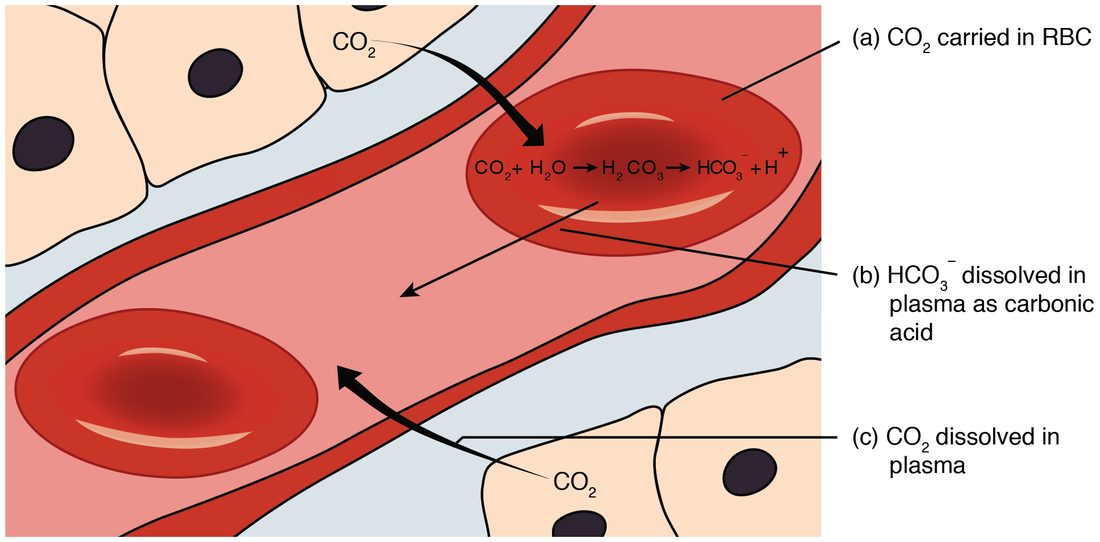
- A working tissue cell makes carbon dioxide, so the PCO2 inside it is higher than in the capillary blood.Carbon dioxide diffuses out of the cell, into the capillary and on into a red blood cell.
- Inside the red blood cell, carbonic anhydrase speeds the reaction of carbon dioxide with water.Carbonic acid forms and splits at once into a hydrogen ion and a bicarbonate ion.
- Hemoglobin is unloading oxygen at the same time, and deoxyhemoglobin binds hydrogen ions readily.The hydrogen ions are buffered, the reaction keeps running toward bicarbonate, and more carbon dioxide can be taken up (the Haldane effect).
- Bicarbonate builds up inside the red blood cell.Band 3 swaps it for chloride from the plasma (the chloride shift), and the bicarbonate is carried in the plasma to the lungs.
- In the lungs, alveolar PCO2 is low and oxygen binds hemoglobin, which releases its hydrogen ions.Every step reverses: bicarbonate re-enters the red blood cell, becomes carbon dioxide again, and diffuses into the alveoli to be breathed out.
6Core concepts
7A common mistake
The wrong idea: Carbon dioxide travels mainly on hemoglobin, bound to the same site as oxygen.
What actually happens: Only about a fifth of the carbon dioxide in blood rides on hemoglobin, as carbaminohemoglobin, and it binds to the amino groups at the ends of the globin chains, not to the iron where oxygen binds. About 70% travels as bicarbonate ions in the plasma, made inside red blood cells by carbonic anhydrase. Carbon monoxide is the gas that competes with oxygen for the iron.
8Check yourself
Anything you miss goes into your review queue.
1. In venous blood, which form carries the largest share of the carbon dioxide?
- Carbaminohemoglobin
- Bicarbonate ions in the plasma
- Carbon dioxide dissolved in plasma
- Carbonic acid
Show the answer
About 70% of the carbon dioxide in blood travels as bicarbonate. It is made inside red blood cells by carbonic anhydrase and carried mostly in the plasma after the chloride shift.
- Carbaminohemoglobin: Carbaminohemoglobin carries about 20–23%, a real but smaller share.
- Correct: Bicarbonate ions in the plasma: Correct. Bicarbonate carries about 70%.
- Carbon dioxide dissolved in plasma: Dissolved carbon dioxide is only about 7–10%, even though carbon dioxide is far more soluble than oxygen.
- Carbonic acid: Carbonic acid exists only for an instant before it splits into a hydrogen ion and bicarbonate, so almost none is present at any moment.
2. The figure shows three routes for carbon dioxide leaving the tissue cells. Which route carries the largest share?
- Dissolving in the plasma and staying there
- Staying inside the tissue cell until exhaled
- Conversion inside the red blood cell to bicarbonate
- Binding to hemoglobin as carbaminohemoglobin inside the red blood cell
Show the answer
Inside the red blood cell, carbonic anhydrase converts carbon dioxide to carbonic acid, which splits into a hydrogen ion and bicarbonate. The bicarbonate then moves into the plasma. This route carries about 70% of the carbon dioxide.
- Dissolving in the plasma and staying there: Dissolved carbon dioxide is the smallest share, about 7–10%.
- Staying inside the tissue cell until exhaled: Carbon dioxide cannot stay in the tissue cell: it diffuses out down its partial pressure gradient and must reach the lungs in the blood.
- Correct: Conversion inside the red blood cell to bicarbonate: Correct. Conversion to bicarbonate carries about 70%.
- Binding to hemoglobin as carbaminohemoglobin inside the red blood cell: Binding to hemoglobin as carbaminohemoglobin carries about 20–23%, the middle share.
3. Put the steps in order to trace carbon dioxide from a tissue cell to the air.
- Carbon dioxide diffuses out of the tissue cell and into a red blood cell
- Carbonic anhydrase converts it to carbonic acid, which splits; hemoglobin binds the hydrogen ion
- Bicarbonate leaves the red blood cell in exchange for chloride
- Bicarbonate travels in the plasma to a pulmonary capillary
- Bicarbonate re-enters the red blood cell and is converted back to carbon dioxide
- Carbon dioxide diffuses into the alveoli and is breathed out
Show the answer
In the tissues, carbon dioxide enters the blood, is converted to bicarbonate in red blood cells, and the bicarbonate moves into the plasma by the chloride shift. In the lungs every step reverses: bicarbonate re-enters the red blood cell, is converted back to carbon dioxide, and the carbon dioxide diffuses into the alveoli.
- Correct order: 1. Carbon dioxide diffuses out of the tissue cell and into a red blood cell 2. Carbonic anhydrase converts it to carbonic acid, which splits; hemoglobin binds the hydrogen ion 3. Bicarbonate leaves the red blood cell in exchange for chloride 4. Bicarbonate travels in the plasma to a pulmonary capillary 5. Bicarbonate re-enters the red blood cell and is converted back to carbon dioxide 6. Carbon dioxide diffuses into the alveoli and is breathed out
4. As blood passes through the lungs and hemoglobin binds oxygen, how does that help carbon dioxide leave the blood?
- Oxygen reacts with bicarbonate to form carbon dioxide
- Oxyhemoglobin releases H+, which turns bicarbonate back into CO2
- Oxygen activates carbonic anhydrase, which otherwise stays switched off
- Oxygen pushes chloride out of the red blood cell, dragging carbon dioxide with it
Show the answer
This is the Haldane effect in the lungs. Oxyhemoglobin holds hydrogen ions less well than deoxyhemoglobin, so it releases them. They combine with bicarbonate to form carbonic acid, which carbonic anhydrase converts to carbon dioxide and water. Oxyhemoglobin also releases the carbon dioxide it held as carbaminohemoglobin.
- Oxygen reacts with bicarbonate to form carbon dioxide: Oxygen does not react with bicarbonate. The link runs through hemoglobin and the hydrogen ions it releases.
- Correct: Oxyhemoglobin releases H+, which turns bicarbonate back into CO2: Correct. Released hydrogen ions drive the reaction back toward carbon dioxide.
- Oxygen activates carbonic anhydrase, which otherwise stays switched off: Carbonic anhydrase is always active. It speeds the reaction in whichever direction the concentrations push it; oxygen does not switch it on.
- Oxygen pushes chloride out of the red blood cell, dragging carbon dioxide with it: Chloride does leave the red blood cell in the lungs, but only in exchange for bicarbonate coming in. It does not carry carbon dioxide.
5. Two samples of blood are exposed to the same PCO2 of 45 mm Hg. Sample 1 is fully oxygenated; sample 2 has been stripped of oxygen. Which holds more carbon dioxide?
- They hold the same amount, because PCO2 is the same
- Sample 1, because oxyhemoglobin binds more carbon dioxide
- Sample 2, because deoxyhemoglobin binds more H+ and more CO2
- Neither holds any carbon dioxide until carbonic anhydrase is added
Show the answer
This is the Haldane effect. At the same PCO2, deoxygenated blood carries more carbon dioxide, because deoxyhemoglobin binds hydrogen ions more readily (pulling more carbon dioxide into bicarbonate) and forms carbaminohemoglobin more readily.
- They hold the same amount, because PCO2 is the same: PCO2 sets only the dissolved carbon dioxide. The total the blood holds also depends on how much is converted to bicarbonate and bound to hemoglobin, which depends on oxygenation.
- Sample 1, because oxyhemoglobin binds more carbon dioxide: This reverses the Haldane effect: oxyhemoglobin binds less carbon dioxide and fewer hydrogen ions.
- Correct: Sample 2, because deoxyhemoglobin binds more H+ and more CO2: Correct. Less oxygen on hemoglobin means more carbon dioxide carried at the same PCO2.
- Neither holds any carbon dioxide until carbonic anhydrase is added: Red blood cells already contain carbonic anhydrase, and dissolved carbon dioxide needs no enzyme at all.
6. A student breathes fast and deep on purpose for one minute. Predict the change in each variable in his arterial blood by the end of the minute.
| Variable | Change |
|---|---|
| PCO2 | — |
| Hydrogen ion concentration | — |
| pH | — |
Show the answer
Breathing more than the body's carbon dioxide production requires lowers PCO2. The carbonic acid reaction runs to the left, hydrogen ions are consumed, and pH rises.
- PCO2: down. He is breathing out carbon dioxide faster than his cells make it, so the carbon dioxide in his alveoli and arterial blood falls.
- Hydrogen ion concentration: down. Less carbon dioxide pulls CO2 + H2O ⇌ H2CO3 ⇌ H+ + HCO3− to the left, which uses up hydrogen ions.
- pH: up. pH rises when free hydrogen ions fall.
7. Blood passing a working muscle gains a large amount of carbon dioxide, which forms carbonic acid. Yet its pH falls only from about 7.40 to 7.36. What mainly prevents a bigger fall?
- Deoxyhemoglobin binds most of the hydrogen ions as it gives up oxygen
- The chloride shift carries the hydrogen ions out of the red blood cell into plasma
- Carbonic anhydrase destroys the hydrogen ions
- The hydrogen ions are exhaled from the muscle
Show the answer
Hemoglobin is unloading oxygen in the same capillary where hydrogen ions are being made, and deoxyhemoglobin binds hydrogen ions more readily than oxyhemoglobin. It buffers most of them, so the free hydrogen ion concentration rises only a little.
- Correct: Deoxyhemoglobin binds most of the hydrogen ions as it gives up oxygen: Correct. Buffering by deoxyhemoglobin keeps venous pH close to arterial pH.
- The chloride shift carries the hydrogen ions out of the red blood cell into plasma: The chloride shift moves bicarbonate out, not hydrogen ions. Chloride enters in exchange for bicarbonate.
- Carbonic anhydrase destroys the hydrogen ions: Carbonic anhydrase speeds the reaction that makes hydrogen ions; it does not remove them.
- The hydrogen ions are exhaled from the muscle: Hydrogen ions are not a gas and cannot be exhaled. Only carbon dioxide leaves through the lungs.
9Summary
Blood carries carbon dioxide in three forms: about 7–10% dissolved, about 20–23% as carbaminohemoglobin (bound to the amino groups of globin) and about 70% as bicarbonate. Carbonic anhydrase in red blood cells speeds CO2 + H2O ⇌ H2CO3 ⇌ H+ + HCO3− in whichever direction the concentrations push it: toward bicarbonate in the tissues and back to carbon dioxide in the lungs. Bicarbonate leaves the red blood cell in exchange for chloride through band 3 (the chloride shift), a passive exchange that reverses in the lungs. Deoxyhemoglobin buffers the hydrogen ions and binds more carbon dioxide, so blood that has unloaded oxygen can carry more carbon dioxide (the Haldane effect); in the lungs, oxygen binding drives carbon dioxide out. Because carbon dioxide forms carbonic acid, a higher PCO2 lowers blood pH and a lower PCO2 raises it, so breathing changes blood pH within minutes.