Regulating acid–base balance
1Why this matters
Mr. Reyes, 70, has kidney failure and gets dialysis three times a week. His lungs are healthy and he breathes normally, yet between sessions his blood bicarbonate drifts lower every day, and his blood pH with it. Breathing can get rid of carbon dioxide, but not the sulfuric acid made from the protein he eats. To see why each organ can clear only its own kind of acid, you need the three defenses that hold your pH steady: buffers, lungs and kidneys.
2What this builds on
3Quick check before you start
1. A patient's blood pH falls from 7.40 to 7.10. What happens to the hydrogen ion concentration?
- It falls by a third
- It doubles
- It rises by 0.3 nmol/L
Show the answer
The pH scale is logarithmic. A fall of 0.3 units doubles [H+], from 40 to 80 nmol/L.
- It falls by a third:
- Correct: It doubles:
- It rises by 0.3 nmol/L:
2. What does carbonic anhydrase do?
- Speeds the reaction between carbon dioxide and water, in whichever direction concentrations push it
- Pumps bicarbonate out of red blood cells in exchange for chloride
- Binds carbon dioxide to the amino groups of hemoglobin
Show the answer
Carbonic anhydrase speeds CO2 + H2O ⇌ H2CO3 in either direction. Band 3 does the bicarbonate–chloride swap, and carbaminohemoglobin forms without the enzyme.
- Correct: Speeds the reaction between carbon dioxide and water, in whichever direction concentrations push it:
- Pumps bicarbonate out of red blood cells in exchange for chloride:
- Binds carbon dioxide to the amino groups of hemoglobin:
3. Which cells of the collecting duct secrete acid or bicarbonate depending on blood pH?
- Principal cells
- Intercalated cells
- Podocytes
Show the answer
Intercalated cells, scattered among the principal cells, secrete H+ or bicarbonate. Principal cells handle sodium, potassium and water.
- Principal cells:
- Correct: Intercalated cells:
- Podocytes:
4Anatomy
With labels hidden, select a box to reveal its label.
5How it works, step by step
- A fixed acid, such as sulfuric acid from a protein-rich meal, adds hydrogen ions to the blood.Bicarbonate takes up the hydrogen ions within seconds, so bicarbonate falls and the bicarbonate to carbon dioxide ratio falls below 20.
- The lower ratio lowers blood pH slightly.The carotid bodies sense the fall in arterial pH and signal the respiratory centers.
- The respiratory centers drive the diaphragm and intercostal muscles harder.Ventilation rises, more carbon dioxide is breathed out, and PCO2 falls, which brings the ratio back toward 20 and pH toward normal.
- Bicarbonate is still low, and more acid reaches the tubule cells.Type A intercalated cells secrete more hydrogen ions, which leave in the urine as titratable acid and ammonium.
- Each hydrogen ion excreted leaves a bicarbonate ion behind in the tubule cell.New bicarbonate enters the blood, bicarbonate returns to about 24 mmol/L, and breathing returns to its usual level.
6Core concepts
7A common mistake
The wrong idea: Breathing faster can get rid of any excess acid in the body.
What actually happens: The lungs remove only carbon dioxide, the volatile acid. Fixed acids, such as the sulfuric and phosphoric acids made from your diet, cannot become a gas. Faster breathing lowers PCO2 and so restores the bicarbonate to carbon dioxide ratio, but the bicarbonate that the fixed acid used up stays low. Only the kidneys excrete fixed acid and make the new bicarbonate that replaces it.
8Check yourself
Anything you miss goes into your review queue.
1. A fixed acid uses up half of a man's bicarbonate, leaving 12 mmol/L. Before his breathing changes, his arterial PCO2 is still 40 mm Hg. What is his blood pH?
- 7.30
- 7.10
- 7.40
- 7.20
Show the answer
0.03 × 40 = 1.2 mmol/L dissolved carbon dioxide. The ratio is 12 ÷ 1.2 = 10, and log 10 = 1.0, so pH = 6.1 + 1.0 = 7.1. Halving the ratio lowers pH by 0.3.
- 7.30: 7.30 would need a ratio of 16. That is what the ratio becomes if the lungs later lower PCO2 to 25 mm Hg, not before breathing changes.
- Correct: 7.10: Correct. Half the bicarbonate at the same PCO2 halves the ratio, from 20 to 10, and pH falls from 7.40 to 7.10.
- 7.40: pH stays 7.40 only if the ratio stays 20. Bicarbonate has halved while carbon dioxide has not changed, so the ratio has halved.
- 7.20: 7.20 is the pH for a ratio of 12.5. Halving 20 gives 10, not 12.5.
2. Patient A has a bicarbonate of 12 mmol/L and an arterial PCO2 of 20 mm Hg. Patient B has a bicarbonate of 24 mmol/L and an arterial PCO2 of 40 mm Hg. How do their blood pH values compare?
- Patient A's pH is lower than Patient B's
- Both are about 7.40
- Patient A's pH is higher than Patient B's
- They cannot be compared without measuring hydrogen ions
Show the answer
pH depends on the ratio, not the amounts. Patient A: 12 ÷ (0.03 × 20) = 12 ÷ 0.6 = 20. Patient B: 24 ÷ 1.2 = 20. The same ratio gives the same pH, 7.40.
- Patient A's pH is lower than Patient B's: Patient A has half the bicarbonate, but also half the carbon dioxide, so the ratio is unchanged and so is the pH.
- Correct: Both are about 7.40: Correct. Both ratios are 20 to 1, so both pH values are 7.40, even though Patient A's values are both abnormal.
- Patient A's pH is higher than Patient B's: A's carbon dioxide is low, which on its own would raise pH, but his bicarbonate is low by the same proportion, which cancels it.
- They cannot be compared without measuring hydrogen ions: The Henderson–Hasselbalch equation gives pH from bicarbonate and PCO2 alone. That is how blood gas analyzers relate the three values.
3. Select every acid that must be excreted by the kidneys rather than breathed out or burned as fuel.
- Sulfuric acid from breaking down dietary protein
- Carbonic acid formed from carbon dioxide
- Phosphoric acid from breaking down phospholipids
- Ketone bodies made during an overnight fast
- Hydrogen ions released into the blood during a 30-second sprint
Show the answer
Fixed acids that the body cannot burn, such as sulfuric and phosphoric acid, can leave only through the kidneys. Carbonic acid leaves as carbon dioxide, ketone bodies from a fast are burned as fuel, and the acid of a sprint is reversed as liver and muscle burn the lactate.
- Correct: Sulfuric acid from breaking down dietary protein: Correct. Sulfur-containing amino acids yield sulfuric acid, which cannot be breathed out or burned. It is the largest share of the daily fixed acid load.
- Carbonic acid formed from carbon dioxide: Carbonic acid is the volatile acid. It turns into carbon dioxide, which the lungs breathe out within minutes.
- Correct: Phosphoric acid from breaking down phospholipids: Correct. Phosphoric acid is a fixed acid; the kidneys must excrete it.
- Ketone bodies made during an overnight fast: Ketone bodies made in a fast are burned by heart, muscle and kidney about as fast as the liver makes them. Blood pH stays close to normal, and they add no lasting acid load for the kidneys to excrete.
- Hydrogen ions released into the blood during a 30-second sprint: The sprint's acid is buffered by bicarbonate and the carbon dioxide is breathed out. Over the next hour or so, the liver and muscles use the lactate as fuel, which takes the hydrogen ions back up. The kidneys hardly need to act.
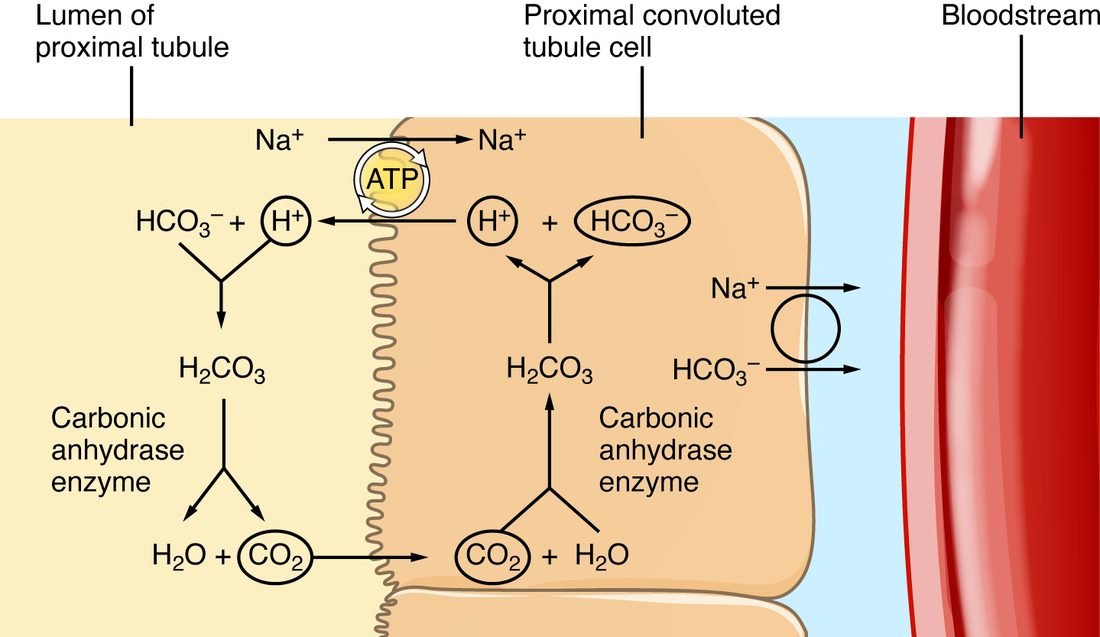
4. A student wrote out how the proximal tubule reclaims filtered bicarbonate. One step is wrong. Which one?
- Carbonic anhydrase inside the tubule cell forms H+ and HCO3− from carbon dioxide and water
- The H+ enters the lumen in exchange for Na+
- In the lumen, H+ joins filtered HCO3−, and the carbonic acid leaves in the urine
- Carbon dioxide diffuses from the lumen into the tubule cell
- The HCO3− made inside the cell crosses the basolateral membrane with Na+ and enters the peritubular capillaries
Show the answer
Carbonic acid in the lumen does not leave in the urine. Carbonic anhydrase on the brush border splits it into carbon dioxide and water, and the carbon dioxide diffuses into the cell to be used again. The secreted H+ ends up in water, so no acid is excreted in this process.
- Carbonic anhydrase inside the tubule cell forms H+ and HCO3− from carbon dioxide and water: This step is right. Carbonic anhydrase inside the cell makes the H+ and HCO3− that start the cycle.
- The H+ enters the lumen in exchange for Na+: This step is right. The sodium–hydrogen exchanger swaps H+ out for Na+ in, powered by the sodium gradient.
- Correct: In the lumen, H+ joins filtered HCO3−, and the carbonic acid leaves in the urine: This is the error. The carbonic acid is split into carbon dioxide and water in the lumen; it is not excreted.
- Carbon dioxide diffuses from the lumen into the tubule cell: This step is right. The carbon dioxide formed in the lumen crosses into the cell and feeds carbonic anhydrase again.
- The HCO3− made inside the cell crosses the basolateral membrane with Na+ and enters the peritubular capillaries: This step is right. A basolateral carrier moves HCO3− out with Na+, so bicarbonate reaches the blood.
5. Mr. Reyes, 70, has kidney failure and gets dialysis three times a week. His lungs are healthy, yet between sessions his plasma bicarbonate falls every day. Why can't his breathing stop the fall?
- His lungs remove carbon dioxide but not fixed acids
- Kidney failure stops his carotid bodies from sensing pH
- His lungs lose bicarbonate into the air he breathes out
- High urea stops carbon dioxide from crossing his alveolar walls
Show the answer
Breathing removes only the volatile acid, carbon dioxide. The fixed acids from protein and phosphate compounds can leave only through the kidneys, which also make the new bicarbonate that replaces what those acids use up. Without working kidneys, bicarbonate falls day by day.
- Correct: His lungs remove carbon dioxide but not fixed acids: Correct. Extra breathing can lower PCO2 to keep the ratio closer to normal, but it cannot excrete fixed acid or replace bicarbonate.
- Kidney failure stops his carotid bodies from sensing pH: The carotid bodies sense arterial pH directly, and kidney failure does not stop them. His breathing does rise a little as his pH falls.
- His lungs lose bicarbonate into the air he breathes out: Bicarbonate is an ion dissolved in plasma. It does not leave through the lungs; it is turned into carbon dioxide, which does.
- High urea stops carbon dioxide from crossing his alveolar walls: Urea does not block gas exchange. His carbon dioxide leaves normally; the problem is the acid that cannot become a gas.
6. Ana has been climbing at 4,300 m for four days. She breathes harder than at sea level, and her arterial PCO2 is low. Which change in her kidneys moves her blood pH back toward normal?
- Type A intercalated cells secrete more hydrogen ions
- Type B intercalated cells secrete more bicarbonate into the urine
- The proximal tubule breaks down more glutamine and excretes more ammonium
- The tubules reclaim more of the filtered bicarbonate
Show the answer
Low PCO2 makes her blood alkaline. Low PCO2 also means less H+ forms inside tubule cells, so less bicarbonate is reclaimed, and type B intercalated cells secrete bicarbonate. Losing bicarbonate lowers the top of the ratio to match the lower PCO2, and pH moves back toward normal.
- Type A intercalated cells secrete more hydrogen ions: More H+ secretion would add new bicarbonate to her blood and make it more alkaline.
- Correct: Type B intercalated cells secrete more bicarbonate into the urine: Correct. Excreting bicarbonate brings the ratio back toward 20 to 1.
- The proximal tubule breaks down more glutamine and excretes more ammonium: More ammonium excretion adds new bicarbonate to the blood. That is the response to acid, not to alkalinity.
- The tubules reclaim more of the filtered bicarbonate: Reclaiming more bicarbonate would keep it in her blood. Her kidneys need to let more go.
7. A type A intercalated cell secretes one hydrogen ion, which leaves the body in the urine as part of an ammonium ion. What does this add to the blood?
- One chloride ion
- One hydrogen ion
- One molecule of carbon dioxide
- One new bicarbonate ion
Show the answer
Carbonic anhydrase made that H+ together with an HCO3− inside the cell. The H+ left in the urine, and the HCO3− crossed into the blood. It replaces a bicarbonate ion that a fixed acid used up.
- One chloride ion: Chloride moves the other way: from the blood into the cell, in exchange for the bicarbonate that leaves.
- One hydrogen ion: The hydrogen ion went into the urine. Sending hydrogen ions to the blood is what type B cells do.
- One molecule of carbon dioxide: Carbon dioxide was used up inside the cell to make the H+ and HCO3−, not added to the blood.
- Correct: One new bicarbonate ion: Correct. Every H+ excreted on ammonia or phosphate adds one new bicarbonate to the blood.
8. Mr. Osei has had an ongoing fixed acid load for a week. His kidneys are healthy. Which change in his urine best shows that they have stepped up acid excretion?
- Several times more ammonium than normal
- Several times more titratable acid than normal
- Several times more free hydrogen ions than normal
- More bicarbonate than normal
Show the answer
Ammonium is the adjustable route. Over 3 to 5 days, the proximal tubule breaks down more glutamine, and ammonium excretion can rise five- to tenfold, adding an equal amount of new bicarbonate to the blood.
- Correct: Several times more ammonium than normal: Correct. Rising ammonium production is the kidneys' main long-term response to an acid load.
- Several times more titratable acid than normal: Titratable acid is limited by how much phosphate is filtered, so it rises only modestly.
- Several times more free hydrogen ions than normal: Urine pH cannot fall much below 4.5, where each liter holds only about 0.03 mmol of free H+. Free hydrogen ions carry a tiny share of acid at any pH.
- More bicarbonate than normal: Losing bicarbonate would make his acid load worse. In an acid load the kidneys reclaim essentially all of it.
9Summary
Your body makes about 13,000 mmol of volatile acid (carbon dioxide) a day, removed by the lungs, and 50 to 100 mmol of fixed acid, mainly sulfuric and phosphoric acid from your diet, which only the kidneys can excrete. Chemical buffers (bicarbonate in extracellular fluid, phosphate in cells and urine, and proteins such as hemoglobin) act in seconds but remove no acid. Blood pH follows the ratio of bicarbonate to dissolved carbon dioxide, normally 20 to 1: pH = 6.1 + log(HCO3− ÷ (0.03 × PCO2)). The lungs set the bottom of the ratio within minutes through the chemoreceptor feedback loop. The kidneys set the top over hours to days: the proximal tubule reclaims nearly all filtered bicarbonate, and type A intercalated cells secrete hydrogen ions that leave as titratable acid and ammonium, each one adding a new bicarbonate to the blood. Type B intercalated cells excrete bicarbonate when the blood is too alkaline.