Carbon dioxide transport is how your blood carries the carbon dioxide your cells make from the tissues to the lungs. Very little of it travels as a dissolved gas. Most of it is turned into bicarbonate inside red blood cells, and some rides on hemoglobin. This page follows one molecule of carbon dioxide from a working cell to the air you breathe out: the three forms it travels in, the enzyme carbonic anhydrase, the chloride shift, the Haldane effect, and why carbon dioxide in your blood sets your blood pH.
How much carbon dioxide your blood carries
Every minute at rest, your cells make about 200 mL of carbon dioxide as a waste product of cellular respiration. All of it has to reach your lungs in the blood, because that is the only route out.
Your blood never empties of carbon dioxide. Arterial blood leaving the lungs still holds about 48 mL of carbon dioxide in every 100 mL. As it passes through the systemic capillaries, it picks up about 4 mL more per 100 mL, so venous blood returning to the heart holds about 52 mL per 100 mL. That small difference, multiplied by your whole cardiac output, carries everything your cells make.
Worked example 1: carbon dioxide delivered to the lungs each minute
Problem. A resting adult has a cardiac output of 5 L/min. His venous blood holds 52 mL of carbon dioxide per 100 mL, and his arterial blood holds 48 mL per 100 mL. How much carbon dioxide does his blood unload in his lungs each minute?
- Find the difference per 100 mL. 52 − 48 = 4 mL of carbon dioxide unloaded from each 100 mL of blood.
- Convert cardiac output to the same unit. 5 L/min = 5,000 mL/min, which is 50 lots of 100 mL each minute.
- Multiply. 50 × 4 mL = 200 mL of carbon dioxide per minute.
- Check against production. His cells make about 200 mL per minute at rest, so the blood removes it as fast as it is made.
Answer. About 200 mL/min. During hard exercise, carbon dioxide production can rise tenfold, and both cardiac output and the venous–arterial difference rise to carry it.
The three forms carbon dioxide travels in
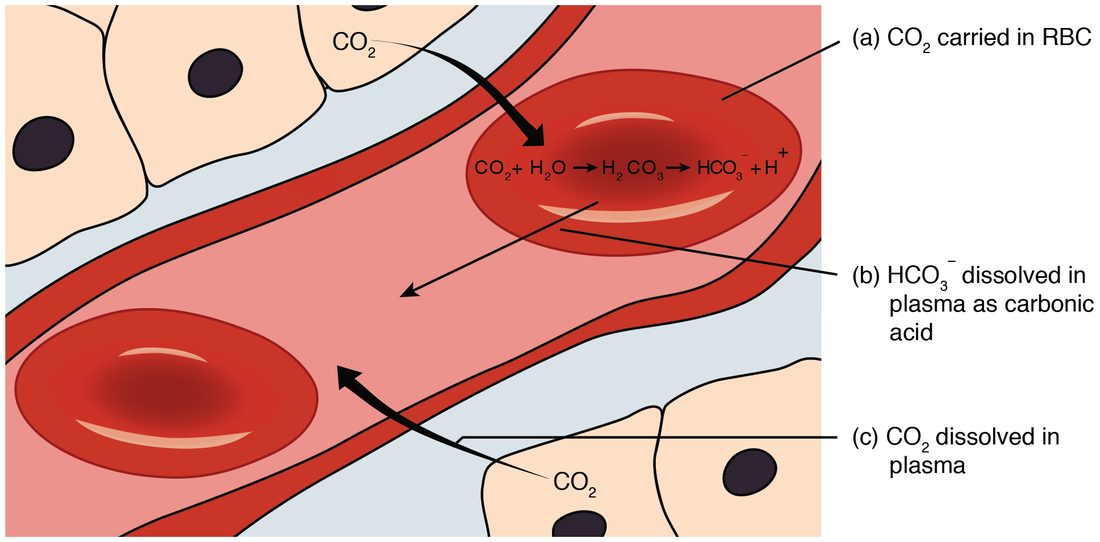
Carbon dioxide dissolves in water far better than oxygen does: at the same partial pressure, about 20 times more of it goes into solution (Henry's law). Even so, the dissolved gas is only a small part of what blood carries. In venous blood, the carbon dioxide is split roughly like this:
- Dissolved carbon dioxide: about 7–10%. Molecules of CO2 dissolved in the plasma and in the cytosol of red blood cells. This is the only form that sets the PCO2 of the blood, and the only form that can diffuse across membranes.
- Carbaminohemoglobin: about 20–23%. Carbaminohemoglobin (carb- = carbon, amino = amino group, hemo- = blood, globin = the protein) is hemoglobin with carbon dioxide bound to it. Carbon dioxide attaches to the free amino groups at the ends of the globin chains, not to the iron of the heme groups. So it does not compete with oxygen for the same site. A small amount also binds to plasma proteins in the same way; together these are called carbamino compounds.
- Bicarbonate ions (HCO3−): about 70%. Most carbon dioxide is converted into bicarbonate inside red blood cells and then carried in the plasma.
Figure 1 shows the three routes. Carbon dioxide leaves a tissue cell, crosses into a capillary, and either stays dissolved in the plasma, enters a red blood cell and binds hemoglobin, or is converted into bicarbonate inside the red blood cell.
Carbonic anhydrase
You met the carbonic acid–bicarbonate buffer with the chemistry of pH. Carbon dioxide reacts with water to form carbonic acid, and carbonic acid splits into a hydrogen ion and a bicarbonate ion:
CO2 + H2O ⇌ H2CO3 ⇌ H+ + HCO3−
Both steps are reversible. The second happens almost instantly. The first, left to itself, is slow: it takes many seconds, and blood spends only about a second in a capillary. In the plasma, which has almost none of the enzyme that speeds it, very little bicarbonate forms.
Inside red blood cells, the first step is sped up by carbonic anhydrase (carbon-ic = of carbon, an- = without, hydr- = water, -ase = enzyme: the enzyme that adds or removes water from carbonic acid). It is one of the fastest enzymes known. It speeds the reaction by thousands of times, so it reaches equilibrium well within the time blood spends in a capillary. Like any enzyme, it speeds the reaction in whichever direction the concentrations push it:
- In the tissues, PCO2 is high, so the reaction runs to the right: CO2 → carbonic acid → H+ + HCO3−.
- In the lungs, PCO2 is low, so it runs to the left: H+ + HCO3− → carbonic acid → CO2, which diffuses out into the alveoli.
Carbonic anhydrase does not decide which way the reaction goes. The concentrations do. The enzyme only makes the reaction fast enough to finish while the blood is still in the capillary.
The chloride shift
Each carbon dioxide molecule converted by carbonic anhydrase leaves one bicarbonate ion and one hydrogen ion inside the red blood cell. If the bicarbonate stayed there, it would build up, the reaction would slow, and the red blood cell could carry little more. Instead, most of it moves out into the plasma.
It leaves through a carrier protein in the red blood cell membrane called band 3 (also called the anion exchanger). Band 3 swaps one bicarbonate ion out for one chloride ion (Cl−) in. This one-for-one swap is the chloride shift. It is a form of facilitated diffusion: each ion moves down its own concentration gradient, and no ATP is used. Because one negative ion leaves as one enters, the charge across the membrane does not change.
Figure 2 puts the pieces together for a red blood cell in a systemic capillary.
Two side effects of the chloride shift are worth knowing:
- Venous red blood cells hold more chloride than arterial ones, and plasma chloride is slightly lower in venous blood.
- Venous red blood cells are slightly larger. The cell has gained ions (bicarbonate made inside, chloride brought in, while the hydrogen ions are bound to hemoglobin and do not count as free particles), so water follows by osmosis. Venous hematocrit is a few percent higher than arterial hematocrit for this reason.
Where the hydrogen ions go
Converting carbon dioxide to bicarbonate makes one hydrogen ion for every bicarbonate ion. If those hydrogen ions stayed free, venous blood would be strongly acidic. Instead, almost all of them bind to hemoglobin, which acts as a buffer inside the red blood cell.
Timing makes this work. In a systemic capillary, hemoglobin is giving up oxygen at the same moment carbon dioxide arrives. Deoxyhemoglobin binds hydrogen ions more readily than oxyhemoglobin does. So as hemoglobin unloads oxygen, it becomes a better buffer, just when more hydrogen ions are being made. As a result, venous blood is only slightly more acidic than arterial blood: its pH is about 7.36, against about 7.40 in arterial blood.
You met the other side of this coin in oxygen transport: the Bohr effect. Hydrogen ions and carbon dioxide binding to hemoglobin lower its affinity for oxygen, which helps oxygen unload in active tissues.
The Haldane effect
Here is a puzzle. Blood with the same PCO2 can hold different amounts of carbon dioxide, depending on how much oxygen its hemoglobin carries. At a PCO2 of 45 mm Hg, fully deoxygenated blood holds several mL more carbon dioxide per 100 mL than fully oxygenated blood.
This is the Haldane effect, named after the physiologist John Scott Haldane: the less oxygen hemoglobin carries, the more carbon dioxide the blood can carry. It has two causes, both inside the red blood cell:
- Buffering. Deoxyhemoglobin binds hydrogen ions more readily. By mopping up hydrogen ions, it pulls the reaction CO2 + H2O → H+ + HCO3− further to the right, so more carbon dioxide is converted to bicarbonate.
- Carbamino binding. Deoxyhemoglobin forms carbaminohemoglobin more readily than oxyhemoglobin does.
The Haldane effect works in both places:
- In the tissues, hemoglobin unloads oxygen, so it can take up more carbon dioxide.
- In the lungs, oxygen binds hemoglobin. Oxyhemoglobin releases its hydrogen ions and its carbamino carbon dioxide, and the released hydrogen ions combine with bicarbonate to form carbon dioxide. More carbon dioxide diffuses out into the alveoli.
| Bohr effect | Haldane effect | |
|---|---|---|
| What changes | Hemoglobin's affinity for oxygen | How much carbon dioxide the blood can carry |
| Caused by | More carbon dioxide and hydrogen ions (lower pH) | Less oxygen bound to hemoglobin |
| Effect in the tissues | Hemoglobin releases more oxygen | Blood takes up more carbon dioxide |
| Effect in the lungs | Hemoglobin binds oxygen more readily as carbon dioxide leaves | Blood releases more carbon dioxide as oxygen binds |
| On a graph | The oxygen–hemoglobin dissociation curve shifts right | The carbon dioxide content curve of deoxygenated blood sits above that of oxygenated blood |
| In one sentence | Carbon dioxide pushes oxygen off hemoglobin | Oxygen pushes carbon dioxide out of the blood |
The two effects are the same chemistry seen from opposite sides: binding hydrogen ions and carbon dioxide at some sites on hemoglobin lowers its hold on oxygen at others, and binding oxygen lowers its hold on hydrogen ions and carbon dioxide. The Haldane effect returns in the next two topics, because it helps explain why giving a lot of oxygen can raise PCO2 in some people with long-term lung disease.
Carbon dioxide from a tissue cell to the air
Put together, one molecule's journey runs like this:
- A cell makes carbon dioxide in its mitochondria during cellular respiration.
- The carbon dioxide diffuses down its partial pressure gradient out of the cell, through the interstitial fluid and into a systemic capillary (internal respiration).
- Most of it diffuses on into a red blood cell.
- Carbonic anhydrase converts it to carbonic acid, which splits into a hydrogen ion and a bicarbonate ion.
- The hydrogen ion binds deoxyhemoglobin; the bicarbonate leaves the red blood cell through band 3 in exchange for chloride (the chloride shift).
- The bicarbonate travels in the plasma through the veins and the right side of the heart to a pulmonary capillary.
- In the lungs, PCO2 in the alveoli is lower. Bicarbonate re-enters the red blood cell in exchange for chloride (the chloride shift in reverse).
- Oxygen binds hemoglobin, which releases its hydrogen ions (the Haldane effect). The hydrogen ions combine with bicarbonate to form carbonic acid, and carbonic anhydrase converts it to carbon dioxide and water.
- The carbon dioxide diffuses out of the red blood cell, across the respiratory membrane and into the alveoli (external respiration).
- You breathe it out.
The small amounts carried dissolved and as carbaminohemoglobin follow the same logic: dissolved carbon dioxide simply diffuses out, and carbaminohemoglobin releases its carbon dioxide as oxygen binds.
Carbon dioxide and blood pH
Hold your breath for 30 seconds. Carbon dioxide keeps arriving at your lungs, but none leaves, so the PCO2 of your blood climbs. Through CO2 + H2O ⇌ H2CO3 ⇌ H+ + HCO3−, more carbon dioxide means more hydrogen ions, and your blood pH falls a little. Breathe fast and deep for a minute, and the opposite happens: you blow off carbon dioxide faster than you make it, PCO2 falls, the reaction runs to the left, hydrogen ions are used up, and your pH rises.
The general rule is the law of mass action applied to one reversible reaction:
- PCO2 up → more hydrogen ions → pH down. If the pH falls below 7.35, the result is acidosis.
- PCO2 down → fewer hydrogen ions → pH up. If the pH rises above 7.45, the result is alkalosis.
Normal arterial PCO2 is about 40 mm Hg (35–45 mm Hg), and normal arterial pH is 7.35–7.45. Because carbon dioxide leaves only through the lungs, the lungs can change the amount of acid in your blood within minutes, simply by changing how much air moves in and out. The kidneys handle the other acids your metabolism makes, far more slowly.
Worked example 2: which way does the pH go?
Problem. A swimmer holds her breath for 40 seconds underwater. What happens to her arterial PCO2, her hydrogen ion concentration and her blood pH, and why?
- Carbon dioxide balance. Her cells keep making carbon dioxide, but no air moves in or out of her lungs, so none is removed. Arterial PCO2 rises.
- The reaction. More CO2 pushes CO2 + H2O ⇌ H2CO3 ⇌ H+ + HCO3− to the right, speeded by carbonic anhydrase in her red blood cells.
- Hydrogen ions. More carbonic acid splits, so the hydrogen ion concentration rises. Hemoglobin and other buffers bind most of the new hydrogen ions, but not all.
- pH. pH is a measure of free hydrogen ions: more of them means a lower pH.
Answer. PCO2 up, hydrogen ions up, pH down. When she surfaces and breathes, the extra carbon dioxide is exhaled and all three return to normal within a minute or so.
This link between carbon dioxide and pH is why breathing and acid–base balance can never be separated. The next topic shows how your brainstem senses these changes and adjusts your breathing to hold PCO2, and so pH, steady.