Spermatogenesis and male hormones
1Why this matters
Marcus, 31, and his partner have been trying to conceive for a year. His semen analysis shows almost no sperm, yet he looks muscular and fit. Asked about medications, he admits to injecting testosterone for the last 18 months to help his training. His doctor explains that the injections are the likely cause, and that sperm production may take a year or more to recover after he stops. The explanation lies in how the brain and the testes control each other.
2What this builds on
3Quick check before you start
1. Which hormone from the hypothalamus makes the anterior pituitary release LH and FSH?
- GnRH
- TRH
- CRH
Show the answer
Gonadotropin-releasing hormone (GnRH) travels through the hypophyseal portal vessels to the anterior pituitary and drives release of the gonadotropins, LH and FSH.
- Correct: GnRH:
- TRH:
- CRH:
2. In meiosis I, what separates?
- Sister chromatids
- Homologous chromosomes
- The two strands of each DNA molecule
Show the answer
Meiosis I separates the homologous chromosomes of each pair, so each new cell is haploid; sister chromatids separate in meiosis II.
- Sister chromatids:
- Correct: Homologous chromosomes:
- The two strands of each DNA molecule:
3. Which cells of the testis make testosterone?
- Cells of the epididymis
- Interstitial (Leydig) cells between the seminiferous tubules
- Smooth muscle cells of the ductus deferens
Show the answer
Interstitial (Leydig) cells lie between the seminiferous tubules and make testosterone under the control of LH.
- Cells of the epididymis:
- Correct: Interstitial (Leydig) cells between the seminiferous tubules:
- Smooth muscle cells of the ductus deferens:
4Anatomy
With labels hidden, select a box to reveal its label.
5How it works, step by step
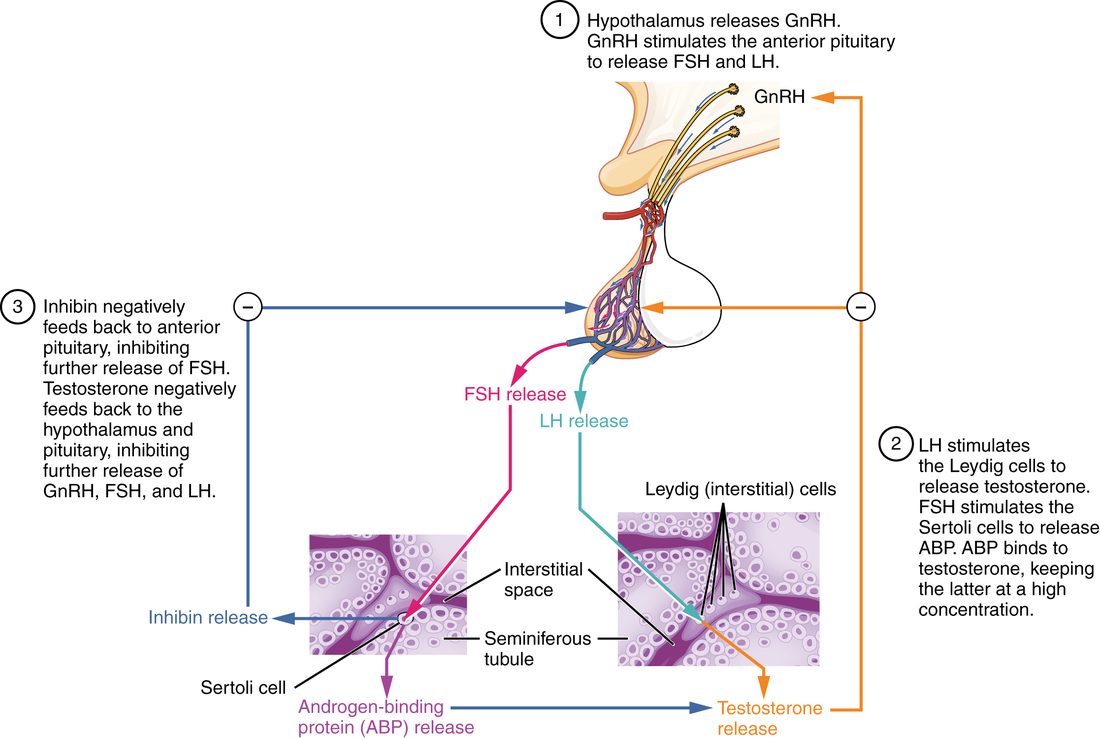
- Neurons in the hypothalamus release GnRH in pulses into the portal vessels.The anterior pituitary releases LH and FSH into the blood.
- LH binds receptor proteins on the Leydig cells.The Leydig cells make testosterone, which enters the blood and reaches a very high level inside the nearby tubules.
- FSH and the high local testosterone act on the Sertoli cells.The Sertoli cells support spermatogonia through meiosis and spermiogenesis, and they release inhibin.
- Blood testosterone and inhibin rise.Testosterone slows GnRH and LH release, and inhibin slows FSH release: negative feedback holds both products steady.
- An outside androgen, such as injected testosterone, keeps the brake on hard.LH and FSH fall, the Leydig cells stop making testosterone, the tubules lose their high local level, and sperm production drops.
6Core concepts
7A common mistake
The wrong idea: Taking extra testosterone boosts a man's sperm production and fertility.
What actually happens: Spermatogenesis needs testosterone at a concentration inside the tubules many times higher than in the blood, and only the man's own Leydig cells, driven by LH, can supply it there. Injected testosterone raises blood levels but brakes the hypothalamus and pituitary through negative feedback, so LH and FSH fall, the Leydig cells go quiet, the tubules lose their local testosterone, and sperm production falls, often to nearly zero.
8Check yourself
Anything you miss goes into your review queue.
1. A cell in the wall of a seminiferous tubule holds 23 chromosomes, and each is made of two chromatids. What is the cell?
- Spermatogonium
- Primary spermatocyte
- Secondary spermatocyte
- Spermatid
Show the answer
Meiosis I halves the chromosome number but leaves the sister chromatids joined, so a secondary spermatocyte has 23 double chromosomes.
- Spermatogonium: Spermatogonia are diploid stem cells with 46 chromosomes.
- Primary spermatocyte: A primary spermatocyte is diploid: 46 chromosomes, 92 chromatids.
- Correct: Secondary spermatocyte: Correct. Haploid with double chromosomes: the stage between meiosis I and meiosis II.
- Spermatid: A spermatid has finished meiosis II, so its 23 chromosomes are single.
2. Fifty primary spermatocytes complete meiosis and spermiogenesis normally. How many sperm result?
- 50
- 100
- 200
- 400
Show the answer
Each primary spermatocyte gives two secondary spermatocytes, each of which gives two spermatids: 4 per primary spermatocyte. Spermiogenesis reshapes without dividing. 50 × 4 = 200 sperm.
- 50: Spermiogenesis does not divide cells, but meiosis does, twice.
- 100: 100 counts only one division. Meiosis has two.
- Correct: 200: Correct. Four sperm from each primary spermatocyte.
- 400: 400 would need a third division. Spermiogenesis only reshapes.
3. Why are the spermatocytes and spermatids kept behind the blood-testis barrier, while the spermatogonia sit outside it?
- Spermatogonia need no nutrients from the blood, while the later cells need a great many of them
- The later cells carry new proteins made after the immune system learned self-tolerance
- Spermatogonia are haploid and cannot be harmed by toxins
- The barrier stops sperm from leaving the tubule too early
Show the answer
Self-tolerance was established in childhood, before meiosis began. Spermatocytes and spermatids make new surface proteins that white blood cells have never been taught to ignore, so they would be attacked as foreign. The Sertoli tight junctions keep antibodies and lymphocytes away from them.
- Spermatogonia need no nutrients from the blood, while the later cells need a great many of them: Spermatogonia need nutrients too; they get them directly from the blood side of the barrier.
- Correct: The later cells carry new proteins made after the immune system learned self-tolerance: Correct. The barrier shields cells whose proteins look foreign to the immune system.
- Spermatogonia are haploid and cannot be harmed by toxins: Spermatogonia are diploid, not haploid.
- The barrier stops sperm from leaving the tubule too early: Sperm are released into the lumen on the far side of the barrier; the barrier does not hold them back.
4. A man's testes are badly damaged by an infection, and both his Leydig and Sertoli cells stop working. Predict the change in each variable weeks later, compared with before.
| Variable | Change |
|---|---|
| Blood testosterone | — |
| Inhibin | — |
| GnRH pulses from the hypothalamus | — |
| LH | — |
| FSH | — |
| Sperm count | — |
Show the answer
When the gonad fails, its products fall and the feedback brakes lift. The hypothalamus and pituitary push harder, so GnRH, LH and FSH rise, but the damaged testis cannot respond. Low testosterone with high LH and FSH is the pattern of testicular (primary) failure.
- Blood testosterone: down. The Leydig cells that make testosterone no longer work, so blood testosterone falls.
- Inhibin: down. Inhibin comes from the Sertoli cells, which have stopped working.
- GnRH pulses from the hypothalamus: up. With little testosterone, the brake on the hypothalamus is lifted, so it releases more GnRH.
- LH: up. Less testosterone braking the pituitary, and more GnRH driving it, raise LH.
- FSH: up. Both brakes on FSH, testosterone and inhibin, are gone, so FSH rises, usually even more than LH.
- Sperm count: down. Without working Sertoli cells and a high local testosterone level, spermatogenesis stops.
5. A 29-year-old bodybuilder has taken testosterone injections for a year. His blood androgen level is high, yet a fertility test finds almost no sperm. What explains this?
- Very high blood testosterone poisons the finished sperm directly while they are stored in the ducts
- Negative feedback suppressed his LH and FSH, so the tubules lost their local testosterone and FSH
- The injections block the ductus deferens
- His Sertoli cells were converted into Leydig cells
Show the answer
The injected androgen brakes the hypothalamus and pituitary, so GnRH, LH and FSH fall. Without LH, his Leydig cells stop making testosterone, and the very high local level inside the tubules is lost, along with FSH support. Spermatogenesis needs that local level, which blood testosterone from injections cannot reach. His testes also shrink. You can follow the same chain in the endocrine chapter's anabolic steroid scenario.
- Very high blood testosterone poisons the finished sperm directly while they are stored in the ducts: Testosterone is needed for spermatogenesis; it does not kill sperm.
- Correct: Negative feedback suppressed his LH and FSH, so the tubules lost their local testosterone and FSH: Correct. Suppressed LH and FSH remove the local drive to sperm production.
- The injections block the ductus deferens: Hormone injections do not block a duct; the problem is that few sperm are made.
- His Sertoli cells were converted into Leydig cells: Cells do not convert from one type to the other; both types simply lose their pituitary drive.
6. Two years after chemotherapy for lymphoma, a man has normal testosterone and LH but a high FSH level and very few sperm. What is the best explanation?
- His pituitary is making too much GnRH
- His Leydig cells were destroyed, so they no longer make enough testosterone
- His testosterone receptor proteins no longer work
- His germ cells were destroyed, so his Sertoli cells release less inhibin
Show the answer
Chemotherapy kills rapidly dividing germ cells but usually spares the Leydig cells, so testosterone and LH stay normal. Sertoli cells supporting few germ cells release less inhibin, so the brake on FSH weakens and FSH rises on its own.
- His pituitary is making too much GnRH: GnRH comes from the hypothalamus, not the pituitary, and more GnRH would raise LH as well as FSH.
- His Leydig cells were destroyed, so they no longer make enough testosterone: If Leydig cells were destroyed, testosterone would be low and LH high.
- His testosterone receptor proteins no longer work: Broken receptor proteins would raise both testosterone and LH, because feedback would fail too.
- Correct: His germ cells were destroyed, so his Sertoli cells release less inhibin: Correct. Low inhibin selectively raises FSH.
7. A student described the male HPG axis. One step is wrong. Which one?
- The hypothalamus releases GnRH in pulses
- GnRH makes the anterior pituitary release LH and FSH
- LH drives the Leydig cells to make testosterone
- FSH and testosterone act on the Sertoli cells
- Inhibin from the Leydig cells lowers FSH release
Show the answer
Inhibin comes from the Sertoli cells, not the Leydig cells. It acts on the anterior pituitary to lower FSH release.
- The hypothalamus releases GnRH in pulses: This step is right. GnRH is released in bursts every 1 to 3 hours.
- GnRH makes the anterior pituitary release LH and FSH: This step is right. GnRH is the releasing hormone for both gonadotropins.
- LH drives the Leydig cells to make testosterone: This step is right. LH targets the Leydig cells.
- FSH and testosterone act on the Sertoli cells: This step is right. The Sertoli cells respond to both.
- Correct: Inhibin from the Leydig cells lowers FSH release: This is the error. Sertoli cells, not Leydig cells, make inhibin.
8. Select every change at puberty that testosterone (directly or as DHT) produces in a boy.
- Deeper voice from a larger larynx
- Increased skeletal muscle mass
- Start of spermatogenesis
- Growth of facial hair
- Closure of the epiphyseal plates without any conversion
Show the answer
Testosterone enlarges the larynx, builds muscle, starts spermatogenesis and, through DHT in hair follicles, grows facial hair. Plate closure depends on estradiol made from testosterone by aromatase, so testosterone does not close the plates by itself.
- Correct: Deeper voice from a larger larynx: Correct. Testosterone enlarges the larynx and lengthens the vocal cords.
- Correct: Increased skeletal muscle mass: Correct. Testosterone speeds protein synthesis in skeletal muscle.
- Correct: Start of spermatogenesis: Correct. Spermatogenesis needs a high local testosterone level.
- Correct: Growth of facial hair: Correct. DHT acting on hair follicles drives male-pattern hair growth.
- Closure of the epiphyseal plates without any conversion: The plates close under estrogen. Men who cannot make or respond to estrogen keep growing into adulthood.
9Summary
Spermatogenesis runs from puberty on, in the wall of every seminiferous tubule, and takes about 64 to 74 days. Spermatogonia renew themselves by mitosis; a primary spermatocyte completes meiosis I to give two secondary spermatocytes, meiosis II gives four haploid spermatids, and spermiogenesis reshapes each into a sperm with a head (compact nucleus and enzyme-filled acrosome), a midpiece of mitochondria and a flagellum. Sustentacular (Sertoli) cells wrap the developing cells, join by tight junctions into the blood-testis barrier, make androgen-binding protein and release inhibin. In the HPG axis, pulsed GnRH drives LH and FSH; LH drives the Leydig cells to make testosterone; FSH and testosterone drive the Sertoli cells; testosterone brakes GnRH and LH, and inhibin brakes FSH. Testosterone, partly as DHT and estradiol, shapes the male tract before birth, produces the secondary sex characteristics at puberty and maintains sperm production, muscle, bone and red cell production.