The menstrual cycle hormones graph looks like a tangle of four curves, but it follows from a few rules, and this page explains it step by step. You will see how GnRH, FSH and LH from the brain and the estradiol, progesterone and inhibin from the ovary control each other; why estradiol that normally holds LH down suddenly drives a huge LH surge; how the lining of the uterus is built up and shed in step with the ovary; and how the same system switches on at puberty, winds down at menopause, and is switched off on purpose by hormonal contraception.
Two cycles run on one clock
Every month, two things repeat in step. In the ovary, a follicle grows, releases its oocyte and turns into a corpus luteum. In the uterus, the endometrium thickens and is then shed. The ovary's hormones drive the uterus, so the two cycles always stay in step.
- The ovarian cycle has two phases around ovulation. In the follicular phase, follicles grow and one becomes dominant. After ovulation comes the luteal phase, when the corpus luteum is active.
- The uterine cycle (also called the menstrual cycle) has three phases: the menstrual phase (the period, or menses), the proliferative phase and the secretory phase.
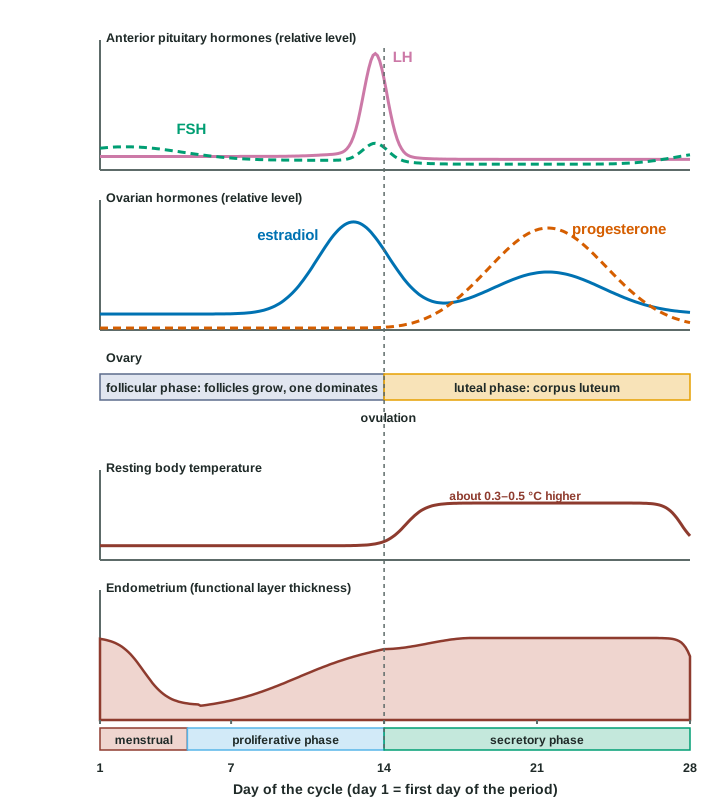
By convention, day 1 is the first day of bleeding. Textbooks draw a 28-day model cycle, with ovulation on day 14. Real adult cycles run from about 24 to 38 days and still count as normal. Most of that variation is in the follicular phase: the luteal phase is steadier, usually 12 to 14 days, because it is set by the corpus luteum's lifespan. So ovulation happens about two weeks before the next period starts, whatever the cycle length. Figure 1 puts all of it on one time line; the rest of this page explains it from left to right.
Worked example: when does ovulation happen in a longer cycle?
Problem. Maya's cycles are regular and 32 days long. On about which day of her cycle does she ovulate?
- Use the steady phase. The luteal phase, from ovulation to the next period, lasts about 14 days in most cycles.
- Turn that into a rule. Ovulation day ≈ cycle length − 14. Check it on the model cycle: 28 − 14 = day 14.
- Apply it. 32 − 14 = day 18.
- Check which phase absorbed the difference. Her follicular phase is about 18 days instead of 14. The extra 4 days are all before ovulation.
Answer. Around day 18, not day 14. Real luteal phases vary from about 11 to 17 days, so this is an estimate, not a date.
The control system: GnRH, FSH, LH and the ovary
You met the gonadal axis in the endocrine chapter, and the male version earlier in this chapter, in spermatogenesis and male hormones. The same three levels run the female cycle:
- Hypothalamus. GnRH neurons release GnRH in pulses, roughly one an hour in the follicular phase, into the hypophyseal portal system.
- Anterior pituitary. Each GnRH pulse releases a pulse of the two gonadotropins, FSH and LH. Pulse speed matters: fast pulses favor LH, and slower pulses favor FSH.
- Ovary. FSH and LH act on the follicle and the corpus luteum, which release estradiol, progesterone and inhibin. Those hormones feed back on the hypothalamus and pituitary.
The two gonadotropins do parallel jobs in the two sexes:
| FSH | LH | |
|---|---|---|
| Target cells in the testis | Sustentacular (Sertoli) cells | Interstitial (Leydig) cells |
| Main effect in males | Supports spermatogenesis; inhibin release | Testosterone release |
| Target cells in the ovary | Granulosa cells | Theca cells, and later the granulosa cells too |
| Main effect in females | Follicle growth; aromatase turns androgens into estradiol | Androgens for estradiol; the surge triggers ovulation; forms and sustains the corpus luteum |
| Held back selectively by | Inhibin (and estradiol) | Testosterone in males; progesterone and estradiol in females |
| Favored by GnRH pulses that are | Slower | Faster |
The follicular phase: negative feedback picks one follicle
Start at the end of the previous cycle, when the old corpus luteum dies.
- FSH rises. The corpus luteum's estradiol, progesterone and inhibin had been holding FSH down. When they fall, negative feedback lifts, and FSH climbs in the last days of one cycle and the first days of the next. That is the small FSH bump at the start of Figure 1.
- A group of follicles is rescued. The tertiary follicles that happen to be ready need FSH to keep growing. The rise in FSH saves a group of them from atresia.
- Estradiol and inhibin rise. As those follicles grow, their granulosa cells turn theca androgens into estradiol and also release inhibin.
- FSH falls again. Estradiol and inhibin act on the hypothalamus and pituitary. This is ordinary negative feedback, and inhibin acts on FSH selectively.
- One follicle wins. As FSH falls, only the follicle most sensitive to it keeps growing. It has the most FSH receptor proteins and the best blood supply, and its granulosa cells now also carry LH receptor proteins, so it can run on LH. The rest undergo atresia. This dominant follicle now makes most of the ovary's estradiol, and its output climbs steeply.
Meanwhile, the rising estradiol rebuilds the uterine lining, which you will follow below.
The LH surge: estradiol switches to positive feedback
Look at the middle of Figure 1. Estradiol climbs to a peak. As it peaks, LH starts to shoot up, reaching many times its usual level about a day later, with a smaller rise in FSH. This is the LH surge, and it is the trigger for ovulation.
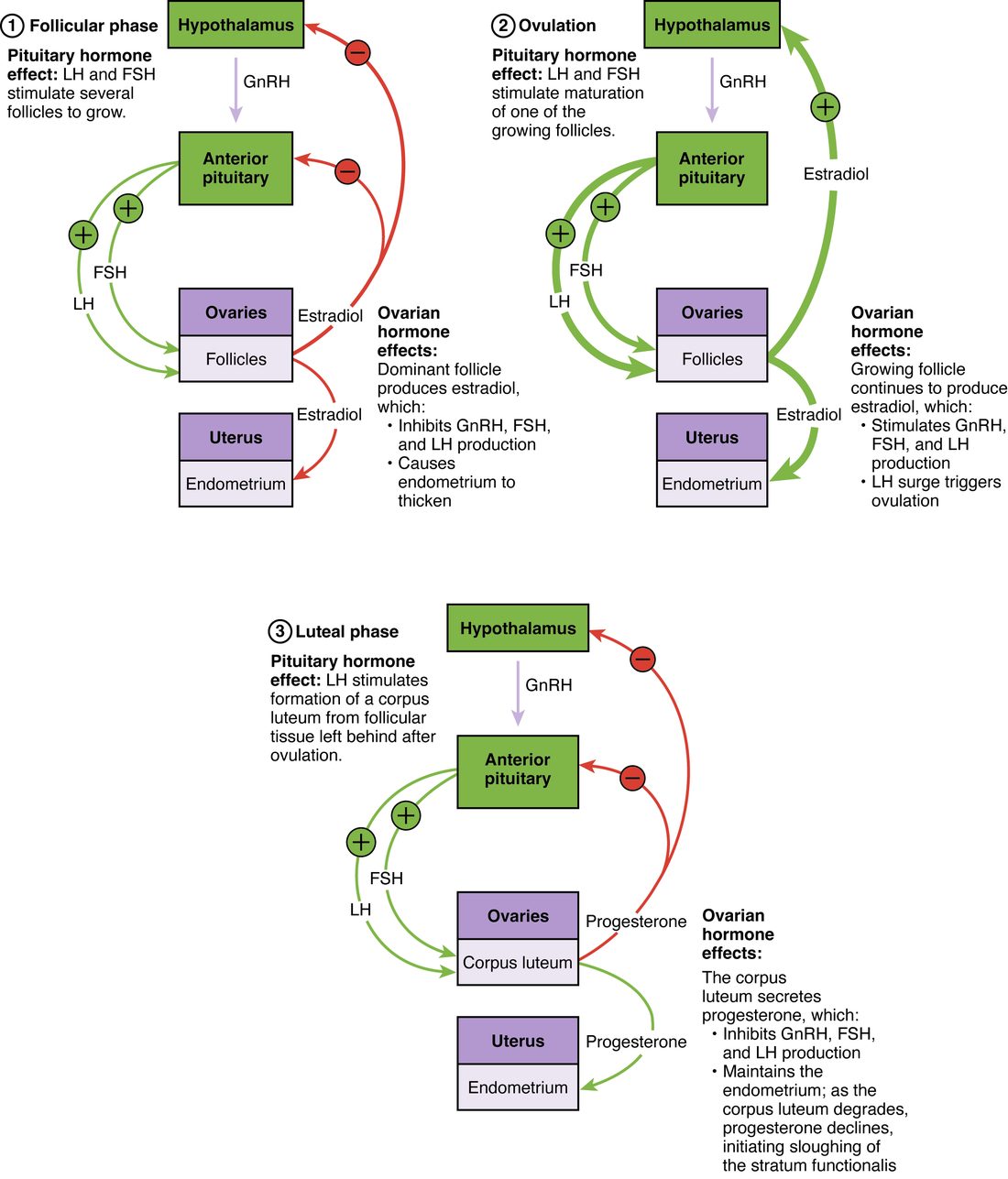
The puzzle is that estradiol has been suppressing the gonadotropins all through the follicular phase. What changes is the dose and the time. Once estradiol from the dominant follicle stays high, above roughly 200 pg/mL for about two days, its effect reverses:
- In the hypothalamus, high sustained estradiol now excites, instead of holding down, the estrogen-sensitive neurons that drive the GnRH neurons (they release a signaling peptide called kisspeptin). In rodents, a separate group of these neurons carries this positive signal; in humans the exact site is still debated. GnRH output rises.
- In the anterior pituitary, high estradiol adds GnRH receptor proteins to the gonadotropin-making cells, so each GnRH pulse releases far more LH.
Before the surge, rising LH and FSH make the dominant follicle grow and release still more estradiol, which pushes GnRH and LH higher again. That is positive feedback, like the childbirth loop in Foundations. Once the surge starts, estradiol actually falls, because the LH is already turning the follicle's cells toward making progesterone. Figure 2 contrasts the negative-feedback arrangement of the follicular phase with the positive-feedback arrangement at ovulation.
The surge as a feedback loop
| Slot | The LH surge |
|---|---|
| Stimulus | Estradiol from the dominant follicle stays high for about two days |
| Receptor (sensor) | Estrogen receptor proteins in hypothalamic neurons and pituitary cells |
| Afferent pathway | Estradiol carried in the blood |
| Control center | Hypothalamus (GnRH neurons and the neurons that drive them) |
| Efferent pathway | GnRH through the hypophyseal portal system |
| Effector | Gonadotropin-making cells of the anterior pituitary |
| Response | LH surge; before it, the rising gonadotropins had driven estradiol still higher: positive feedback |
A positive feedback loop needs something to end it. Here the surge sets up its own ending, through its effect on the follicle. The surge lasts about two days. Ovulation follows about 34 to 36 hours after it begins, and the LH that triggered it also turns the follicle's cells into a corpus luteum. Those cells switch from making mostly estradiol to making mostly progesterone, so estradiol falls, the stimulus disappears, and progesterone begins to hold GnRH down.
| Estradiol's negative feedback | Estradiol's positive feedback | |
|---|---|---|
| When | Most of the cycle | About two days before ovulation |
| Estradiol level | Low to moderate | High (roughly 200 pg/mL or more) and sustained |
| Effect on GnRH and LH | Holds them down | Drives a surge |
| Pituitary response to GnRH | Ordinary | Greatly increased |
| Result | FSH falls and one follicle is selected | Ovulation |
| How it ends | Runs until the corpus luteum takes over | Ovulation and the switch to progesterone remove the stimulus |
The luteal phase: progesterone holds everything down
After ovulation, the corpus luteum releases large amounts of progesterone plus estradiol and inhibin. Together they give the strongest negative feedback of the cycle. Progesterone slows the GnRH pulse generator, and FSH and LH fall to their lowest levels. No follicle can go on to ovulate while the corpus luteum is working.
Without a pregnancy, the corpus luteum dies after 12 to 14 days. How it is timed is not fully understood, but LH at luteal levels cannot keep it alive past that point. As its hormones fall, negative feedback lifts, FSH starts to rise, and the next cycle begins. If an embryo is present, a hormone it makes, which acts like LH, keeps the corpus luteum going; that is taught with early development.
What estrogen and progesterone do
The two ovarian steroids often act on the same tissues in opposite or complementary ways. Estrogen builds; progesterone prepares, and it can act only on tissues that estrogen has first primed with progesterone receptor proteins.
| Estrogen (mainly estradiol) | Progesterone | |
|---|---|---|
| Main source (nonpregnant) | Granulosa cells of growing follicles; also the corpus luteum | Corpus luteum |
| Endometrium | Makes the functional layer grow; adds progesterone receptor proteins | Turns the thick layer secretory: glands coil and secrete, arteries coil |
| Cervical mucus | Thin, watery, stretchy; sperm pass easily | Thick and sticky; forms a plug |
| Myometrium | More excitable | Quieter; fewer contractions |
| Breasts | Duct growth and fat at puberty | Growth of alveoli |
| Body temperature | Little effect | Raises resting temperature by about 0.3 to 0.5 °C |
| Feedback on GnRH, FSH and LH | Negative at low to moderate levels; positive when high and sustained | Negative (slows GnRH pulses) |
| Other tissues | Female secondary sex characteristics; keeps bone mass by limiting osteoclasts; closes growth plates; keeps the vaginal lining thick and glycogen-rich; raises HDL; raises clotting factors from the liver | Increases breathing slightly; helps keep a pregnancy going |
The temperature row is why a woman's resting temperature runs a little higher in the two weeks before each period: that is the luteal phase, when progesterone is high. A rise in morning temperature shows that ovulation has already happened; it cannot predict it in advance.
The uterine cycle
Now follow the bottom panel of Figure 1. Each phase is driven by the ovarian hormones above it.
Menstrual phase (about days 1 to 5)
When the corpus luteum dies, progesterone falls, and the functional layer loses its support:
- The endometrial cells release prostaglandins and signals that draw in white blood cells.
- Enzymes from those cells and from the endometrium itself digest the tissue that holds the functional layer together.
- The coiled arteries of the functional layer constrict in spasms, starving it of blood.
- The functional layer breaks away and is shed with blood through the cervix and vagina. The prostaglandins also make the myometrium contract, which squeezes the tissue out and causes cramps.
Menstruation (mens- = month) usually lasts 3 to 7 days, with an average blood loss of about 30 to 40 mL; more than about 80 mL is heavy. The basal layer, with its own short arteries, survives.
Proliferative phase (about days 6 to 14)
Rising estradiol from the growing follicles makes the basal layer's cells divide and rebuild the functional layer. Glands and coiled arteries regrow, and the lining thickens several-fold by ovulation. Estradiol also adds progesterone receptor proteins, readying the lining for the next phase, and makes the cervical mucus thin and stretchy around ovulation.
Secretory phase (about days 15 to 28)
Progesterone from the corpus luteum changes the thick lining without adding much more thickness. The glands become coiled and secrete a glycogen-rich fluid, the stroma becomes swollen with fluid, and the coiled arteries grow longer and more tightly coiled. For a few days in the middle of this phase, the lining is ready for an embryo to attach. The cervical mucus turns thick. If no embryo arrives, the corpus luteum dies, progesterone falls, and the menstrual phase begins again.
Puberty
Puberty is the transition to a body able to reproduce, driven by the gonadal axis switching on. In childhood, GnRH pulses are very small. Between about 8 and 13 years in girls, the GnRH pulse generator reawakens: pulses grow, first at night and then through the day. Kisspeptin-releasing neurons are central to that reawakening, and a minimum of body fat, signaled partly by leptin, is needed for it to proceed.
In girls the usual order is:
- Breast budding, the first visible sign, at about 10 years on average.
- Pubic and underarm hair, driven partly by adrenal androgens.
- The growth spurt, which in girls comes early in puberty; estrogen then closes the growth plates.
- Menarche (men- = month, arche = beginning), the first period, at about 12 to 13 years, usually two to three years after breast budding.
The first cycles are often irregular and many release no oocyte, because the positive-feedback LH surge takes a year or more to mature. In boys, puberty starts with testicular enlargement at about 9 to 14 years, and testosterone drives the male secondary sex characteristics you met in spermatogenesis and male hormones, earlier in this chapter.
Menopause
Menopause (pausis = stopping) is the permanent end of periods, diagnosed after 12 months with none. The average age is about 51, and most women reach it between 45 and 55.
It happens because the ovary runs out of follicles. By menopause, only about a thousand remain; the rest were lost to atresia. Fewer growing follicles means:
- Less inhibin and less estradiol.
- Less negative feedback, so FSH rises first and most (it has lost both inhibin and estradiol), then LH. A high FSH is the laboratory sign of menopause.
- Cycles become irregular in the years before, the perimenopause, as ovulation fails more often.
- Finally, no follicle responds, and estradiol stays low.
Low estrogen explains the common changes: hot flashes and night sweats, from disturbed temperature control in the hypothalamus; a thinner, drier, less acidic vaginal lining; faster bone loss, raising the risk of osteoporosis; and an LDL level that climbs. Hormone therapy relieves hot flashes and slows bone loss. For healthy women under 60, or within 10 years of menopause, with troublesome symptoms, current guidelines judge that its benefits usually outweigh its risks; a woman with a uterus needs a progestin along with the estrogen, because estrogen alone overstimulates the endometrium.
Hormonal contraception
Contraception (contra- = against) is any method of preventing pregnancy. Hormonal contraception uses synthetic versions of the ovarian hormones to turn the cycle's own negative feedback against it.
The combined pill
The combined oral contraceptive (the birth control pill) contains a synthetic estrogen and a progestin, a synthetic hormone that acts like progesterone. Taken daily:
- Steady estrogen and progestin keep negative feedback on the hypothalamus and pituitary switched on all month.
- GnRH pulses stay slow and FSH and LH stay low.
- No follicle is selected to dominate, so estradiol never rises high enough for long enough to trigger positive feedback. There is no LH surge and no ovulation.
- The progestin also keeps the cervical mucus thick and the endometrium thin, as backups.
Most packs include a few hormone-free days. The drop in hormones sheds the thin lining, and that withdrawal bleed is not a true period, since no ovulation came before it. With perfect use, fewer than 1 in 100 women become pregnant in a year; with typical use, including missed pills, about 7 in 100.
Other hormonal methods
- Progestin-only methods (the progestin-only pill, the implant, the injection and the hormonal intrauterine device) thicken cervical mucus and thin the endometrium. The implant and injection also block ovulation reliably. The implant and the hormonal intrauterine device are among the most effective methods, with fewer than 1 pregnancy per 100 women a year even with typical use.
- Emergency contraception pills taken after unprotected sex work mainly by delaying or preventing ovulation. They do not end a pregnancy that is already established. Levonorgestrel pills work poorly once the LH surge has begun; ulipristal pills can still delay ovulation early in the surge, but not once LH has peaked.
Summary
The ovarian cycle has a follicular phase and a luteal phase around ovulation; the uterine cycle has menstrual, proliferative and secretory phases, and ovulation comes about 14 days before the next period. Early in the cycle, FSH rises as the old corpus luteum's hormones fall, and a group of follicles grows. Their estradiol and inhibin lower FSH by negative feedback, and one dominant follicle survives. Its high, sustained estradiol switches the hypothalamus and pituitary to positive feedback and causes the LH surge, which triggers ovulation and forms the corpus luteum. The corpus luteum's progesterone, estradiol and inhibin hold FSH and LH down for 12 to 14 days; when it dies, progesterone falls, the functional layer is shed, and FSH rises again. Estrogen builds the endometrium and thins the cervical mucus; progesterone makes the lining secretory, thickens the mucus and raises body temperature. Puberty begins when the GnRH pulse generator reawakens, menopause follows when the follicles run out and FSH rises, and hormonal contraception uses steady negative feedback to prevent the LH surge and ovulation.