Male reproductive anatomy
1Why this matters
Jordan, 15, wakes at 5 a.m. with sudden, severe pain in his left testis and vomits twice. The testis sits high and lies crosswise in the scrotum. The emergency physician calls the surgeon at once: the testis has twisted on its cord, cutting off its own blood supply, and it can usually be saved only if it is untwisted within about six hours. To see why the twist is so dangerous, you need to know what hangs on that cord and how the testis connects to the rest of the male reproductive system.
2What this builds on
3Quick check before you start
1. How long is the adult male urethra?
- About 3 to 4 cm
- About 18 to 20 cm
- About 45 cm
Show the answer
The male urethra runs about 18 to 20 cm, from the bladder through a gland just below it, through the pelvic floor and along the penis. The female urethra is only 3 to 4 cm.
- About 3 to 4 cm:
- Correct: About 18 to 20 cm:
- About 45 cm:
2. What makes a gland exocrine rather than endocrine?
- It releases its product through a duct onto a surface or into a cavity
- It releases hormones into the blood
- It has no epithelial cells
Show the answer
Exocrine glands empty through ducts; endocrine glands are ductless and release hormones into the blood.
- Correct: It releases its product through a duct onto a surface or into a cavity:
- It releases hormones into the blood:
- It has no epithelial cells:
3. Which division of the autonomic nervous system uses norepinephrine at most of its target organs?
- Parasympathetic
- Sympathetic
- Neither; both use acetylcholine
Show the answer
Most sympathetic postganglionic neurons release norepinephrine onto adrenergic receptor proteins. Parasympathetic postganglionic neurons release acetylcholine.
- Parasympathetic:
- Correct: Sympathetic:
- Neither; both use acetylcholine:
4Anatomy
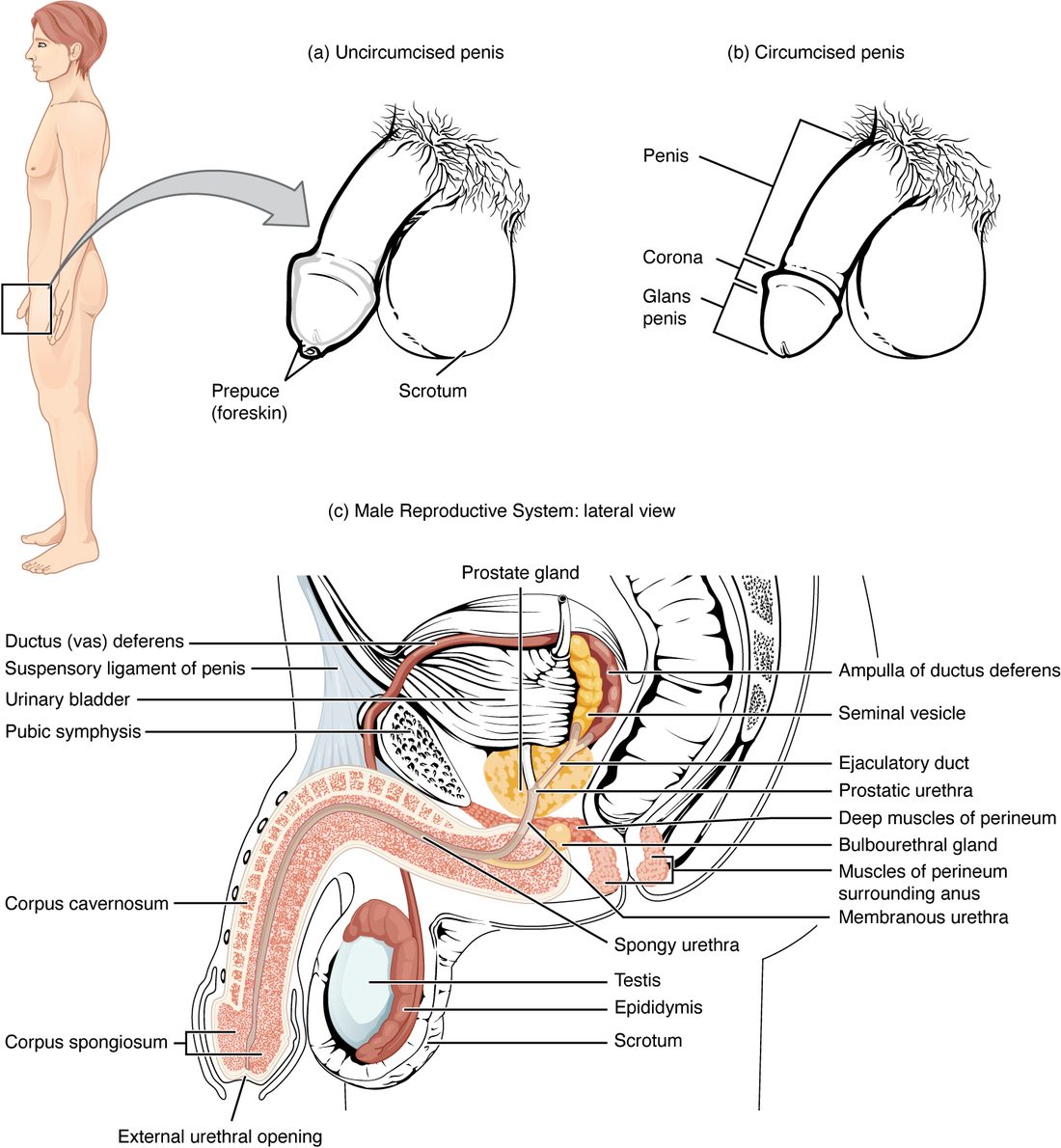
With labels hidden, select a box to reveal its label.
5How it works, step by step
- Sperm made in the seminiferous tubules pass through the rete testis into the epididymis.Over several days in the epididymis they gain the ability to swim, and they are stored in its tail.
- Sexual stimulation fires sacral parasympathetic neurons, which release nitric oxide in the penis.Smooth muscle relaxes, blood fills the corpora cavernosa and squeezes their veins shut: an erection.
- At the peak of stimulation, sympathetic neurons release norepinephrine onto the ducts and glands.The ductus deferens, seminal vesicles and prostate contract and move sperm and fluid into the prostatic urethra while the bladder neck closes (emission).
- Semen in the urethra triggers a spinal reflex through the pudendal nerve.The bulbospongiosus and pelvic floor muscles contract rhythmically and expel the semen (expulsion).
- Sympathetic activity continues after ejaculation.Smooth muscle in the erectile tissue contracts, blood drains out, and the erection subsides.
6Core concepts
7A common mistake
The wrong idea: Semen is mostly sperm, made by the testes.
What actually happens: Sperm are only a few percent of semen volume. About 60 to 70% comes from the seminal vesicles and 20 to 30% from the prostate, with a little mucus from the bulbourethral glands. That is why a vasectomy, which blocks only the sperm, leaves the volume of semen almost unchanged.
8Check yourself
Anything you miss goes into your review queue.
1. Put the structures in the order sperm pass through them, from where they are made to where they leave the body.
- Seminiferous tubule
- Epididymis
- Ductus deferens
- Ejaculatory duct
- Prostatic urethra
- Spongy urethra
Show the answer
Sperm are made in the seminiferous tubules, mature and are stored in the epididymis, travel the ductus deferens up through the inguinal canal and behind the bladder, enter the ejaculatory duct inside the prostate, and pass through the prostatic, membranous and spongy parts of the urethra to the outside.
- Correct order: 1. Seminiferous tubule 2. Epididymis 3. Ductus deferens 4. Ejaculatory duct 5. Prostatic urethra 6. Spongy urethra
2. On a cold day, a man's scrotum looks tight and wrinkled, and his testes sit close to his body. Which muscles produce these two changes?
- The dartos wrinkles the skin; the cremaster lifts the testes
- The cremaster wrinkles the skin; the dartos lifts the testes
- The bulbospongiosus does both
- The detrusor wrinkles the skin; the external urethral sphincter lifts the testes
Show the answer
The dartos is smooth muscle under the scrotal skin; it contracts in cold and wrinkles the skin, reducing heat loss. The cremaster is skeletal muscle around each testis and its cord; it contracts and pulls the testes toward the warm body.
- Correct: The dartos wrinkles the skin; the cremaster lifts the testes: Correct. Dartos: wrinkling. Cremaster: lifting.
- The cremaster wrinkles the skin; the dartos lifts the testes: This reverses the two muscles.
- The bulbospongiosus does both: The bulbospongiosus is at the root of the penis and drives expulsion of semen. It does not act on the scrotum.
- The detrusor wrinkles the skin; the external urethral sphincter lifts the testes: The detrusor is the bladder wall muscle and the external urethral sphincter surrounds the urethra; neither acts on the scrotum.
3. A man has a vasectomy: each ductus deferens is cut and sealed. What happens to his semen and hormones afterward?
- Semen volume falls by about 90% and testosterone falls
- Semen stops altogether and testosterone rises
- Semen still contains sperm, but it loses its fructose and most of its fluid volume
- Semen contains no sperm, its volume barely changes, and testosterone is unchanged
Show the answer
The cut ducts stop sperm from reaching the urethra. Most of the semen comes from the seminal vesicles and prostate, downstream of the cut, so volume barely changes. Testosterone leaves the testis in the blood, not through the ducts, so it is unaffected.
- Semen volume falls by about 90% and testosterone falls: Sperm are only a few percent of semen volume, and testosterone travels in the blood, not the ductus deferens.
- Semen stops altogether and testosterone rises: The accessory glands still make and release their fluids, and nothing in the operation raises testosterone.
- Semen still contains sperm, but it loses its fructose and most of its fluid volume: The seminal vesicles, which supply the fructose and most of the volume, still empty into the ejaculatory ducts. It is the sperm that are missing.
- Correct: Semen contains no sperm, its volume barely changes, and testosterone is unchanged: Correct. Sperm are blocked; gland fluid and blood-borne testosterone are not.
4. A 68-year-old man has a weak urine stream, trouble starting, and gets up three times a night to pass urine. Enlargement of which structure best explains this?
- Seminal vesicles
- Bulbourethral glands
- Epididymis
- Prostate
Show the answer
The prostate wraps around the first part of the urethra just below the bladder. As it enlarges with age (benign prostatic hyperplasia), it squeezes the prostatic urethra and slows the outflow of urine.
- Seminal vesicles: The seminal vesicles lie behind the bladder and do not surround the urethra.
- Bulbourethral glands: The bulbourethral glands are pea-sized glands in the pelvic floor; their enlargement is rare and not the cause of this common pattern.
- Epididymis: The epididymis is on the back of the testis, far from the urinary outflow.
- Correct: Prostate: Correct. An enlarged prostate narrows the urethra it surrounds.
5. During an erection, why does the corpus spongiosum stay softer than the corpora cavernosa?
- It has no arteries of its own and fills only by blood leaking from its neighbors
- Its thin capsule does not trap blood as tightly, so the urethra stays open
- It is made of skeletal muscle instead of erectile tissue
- Sympathetic nerves keep it contracted during an erection
Show the answer
The corpora cavernosa have a thick tunica albuginea that squeezes their draining veins shut, so pressure inside rises close to arterial pressure. The corpus spongiosum's capsule is thin, so its pressure stays lower. Its softness keeps the urethra inside it open for semen to pass.
- It has no arteries of its own and fills only by blood leaking from its neighbors: The corpus spongiosum fills with blood too; it has its own arteries.
- Correct: Its thin capsule does not trap blood as tightly, so the urethra stays open: Correct. A thin capsule traps less blood, so the tissue stays compressible and the urethra stays open.
- It is made of skeletal muscle instead of erectile tissue: The corpus spongiosum is erectile tissue with smooth muscle, like the other two columns.
- Sympathetic nerves keep it contracted during an erection: Sympathetic activity ends an erection in all three columns; it does not keep one soft during it.
6. Which division of the nervous system drives emission, the movement of semen into the urethra?
- Parasympathetic
- Somatic motor
- Enteric
- Sympathetic
Show the answer
Emission is driven by sympathetic neurons from about T10–L2. Norepinephrine on alpha-1 receptor proteins contracts the smooth muscle of the ductus deferens, seminal vesicles and prostate, and closes the bladder neck.
- Parasympathetic: Parasympathetic nerves produce erection, not emission.
- Somatic motor: Somatic motor neurons in the pudendal nerve drive expulsion, the next phase, through skeletal muscle.
- Enteric: The gut's own nerve network does not control the reproductive ducts.
- Correct: Sympathetic: Correct. Sympathetic nerves contract the smooth muscle of the ducts and glands.
7. A man starts a drug that blocks alpha-1 receptor proteins to ease urine flow past his enlarged prostate. He notices that little or no semen comes out when he ejaculates. A urine sample taken just afterward is cloudy and full of sperm. What explains this?
- The drug stops his testes from making sperm
- The bladder neck does not close, so semen goes back into the bladder
- The drug blocks the pudendal nerve, so the pelvic floor muscles cannot expel semen
- His seminal vesicles have stopped making fluid
Show the answer
During emission, norepinephrine on alpha-1 receptor proteins contracts the internal urethral sphincter at the bladder neck. With those receptor proteins blocked, the neck stays open, and when the pelvic muscles contract, semen takes the easier path back into the bladder: retrograde ejaculation. It leaves with the next urine, which is cloudy and holds sperm. (These drugs can also weaken emission itself, so less semen is made to move; then the urine holds no extra sperm.)
- The drug stops his testes from making sperm: Sperm production depends on hormones, not on alpha-1 receptor proteins in the bladder neck, and the sperm in his urine show they are still being made.
- Correct: The bladder neck does not close, so semen goes back into the bladder: Correct. An open bladder neck lets semen flow backward into the bladder.
- The drug blocks the pudendal nerve, so the pelvic floor muscles cannot expel semen: The pudendal nerve is somatic and uses acetylcholine at skeletal muscle; an alpha-1 blocker does not block it.
- His seminal vesicles have stopped making fluid: The sperm-filled urine shows semen was produced and moved, but went the wrong way.
8. Name the pinned structure.
- Seminal vesicle
- Prostate gland
- Bulbourethral gland
- Epididymis
Show the answer
The coiled, pouch-like gland on the back of the bladder is a seminal vesicle.
- Correct: Seminal vesicle: Correct. The seminal vesicle sits behind the bladder, above the prostate.
- Prostate gland: The prostate lies below the bladder, around the urethra.
- Bulbourethral gland: The bulbourethral gland is a small round gland below the prostate.
- Epididymis: The epididymis lies on the back of the testis, in the scrotum.
9Summary
The testes hang in the scrotum, 2 to 3 °C below core temperature, kept cool by the dartos and cremaster muscles and the pampiniform plexus. Inside each testis, seminiferous tubules make sperm and interstitial (Leydig) cells between them make testosterone. Sperm pass through the rete testis into the epididymis, where they mature and are stored, then along the ductus deferens, which runs in the spermatic cord through the inguinal canal, into the ejaculatory duct and the urethra. Semen is mostly fluid from the seminal vesicles (alkaline, with fructose) and the prostate (with PSA), plus mucus from the bulbourethral glands. The penis has two corpora cavernosa and one corpus spongiosum, which holds the urethra and forms the glans. Erection is parasympathetic, through nitric oxide; emission is sympathetic; expulsion is a somatic reflex through the pudendal nerve.