Sine and cosine are the coordinates of a point on the unit circle. The third function you met in Topic 3.2, tangent, is their quotient. It behaves very differently: it has no maximum, its graph breaks into separate branches, and it repeats twice as often. This page builds the graph of tangent from sine and cosine, then reads its period, zeros and asymptotes, and transforms it.
Tangent as a slope and as a height
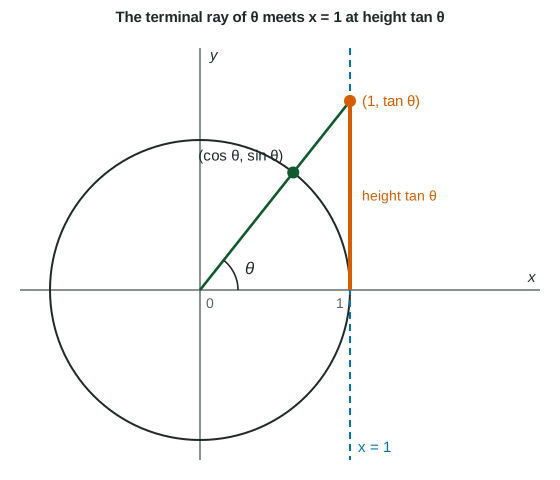
Put an angle in standard position. Its terminal ray meets the unit circle at . The slope of that ray is rise over run:
Extend the ray until it hits the vertical line . Because the ray goes through the origin with slope , it reaches that line at height (Figure 1). As grows toward , the ray gets steeper and the height shoots up. At the ray is vertical, parallel to the line, and never meets it. That is a vertical asymptote.
Zeros, asymptotes and period
A quotient is where its top is and is undefined where its bottom is . So:
- Zeros: where , at for every integer .
- Vertical asymptotes: where , at . Near each one the outputs grow without bound. Write both sides in limit notation:
and . - Period : adding to the angle points the ray in the opposite direction. Both and change sign, so their quotient does not change: .
- Range: every real number, .
On each branch, such as , tangent increases. Left of the zero the graph is concave down, and right of it the graph is concave up: on the rate of change of is increasing, so equal steps in give bigger and bigger rises.
| Function | Period | Range | Zeros | Vertical asymptotes |
|---|---|---|---|---|
| none | ||||
| none | ||||
Transforming tangent
The same four changes you used for sinusoids work here. In
- stretches the graph vertically (and reflects it if ). There is no amplitude, because tangent has no maximum.
- changes the period to . Notice the , not .
- shifts the graph right units, so every zero and asymptote moves right .
- shifts the graph up units. The "center" points of the branches move to height .
Worked example. Find the period, the vertical asymptotes and one zero of .
Period. , so the period is .
Asymptotes. Set the input of tangent equal to : . Divide by : . Add : . The asymptotes are apart, one period, as they should be.
A zero. Set the input equal to : gives . Check: .
Rates of change on a branch
Average rates of change on tangent behave like those of any concave-up or concave-down graph. Take on with two equal intervals.
Worked example. The average rate of change of on is
Tangent is not proportional to its input. Doubling the angle from to triples the output, from to . Always compute the values instead of scaling them.
Common slips
- Using for the period. That is the sine rule; tangent uses .
- Putting asymptotes where . Those are the zeros; asymptotes come from .
- Writing only one side of an asymptote. Give both one-sided limits, each with its sign.