A function rarely changes at one steady speed. Medicine builds up quickly in the blood at first, then slowly. To talk about "how fast" for such functions, precalculus uses one tool over and over: the average rate of change. This page defines it, reads it from tables, graphs and formulas, and uses it to compare how fast a function changes at two different points.
The average rate of change
The average rate of change of a function on an interval is the change in output divided by the change in input:
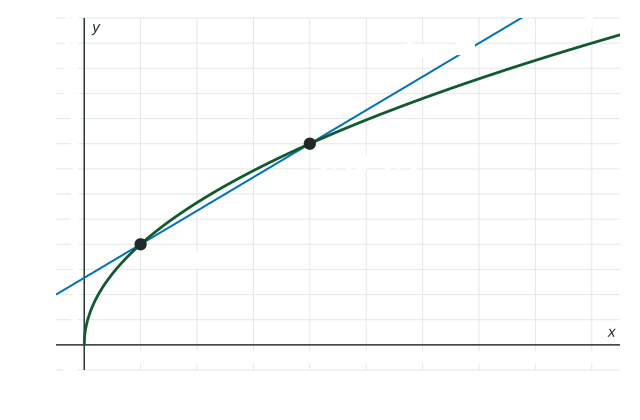
It is the slope of the line through the two points and on the graph of . If were a line, its slope would be the same on every interval; for other functions, the answer depends on the interval, so always name it.
The units are output units per input unit. If is miles and is hours, the average rate of change is in miles per hour.
From a table
Worked example 1. A hiker has walked miles after hours: , , , , . Find the average rate of change of on and say what it means.
Meaning: between hour and hour , the hiker covered distance at an average of miles per hour.
The table's times are not evenly spaced, so the biggest change in distance is not the biggest rate. On the hiker gained miles over hours; on , miles over hour, a faster miles per hour. Always divide before you compare.
What the sign tells you
A positive average rate of change means the output ended higher than it started: input and output moved the same way overall. A negative rate means the output ended lower. A rate of means the outputs at the two ends are equal. It does not mean was constant: it may have gone up and come back down.
The definition can be rearranged to find an output: if the average rate of change of on is , then .
How fast at a single point
An average over a long interval blurs fast and slow parts together. To estimate how fast changes at one input , use the average rate of change over a short interval containing . The shorter the interval, the better the estimate.
Worked example 2. The concentration of a medicine is milligrams per liter after hours. Is it rising faster at or at ? (Calculator.)
Near : and (store it).
Near : and .
Same interval length, so the comparison is fair: the concentration is rising faster at .
Keep the full calculator values until the end. Rounding to before dividing gives , which is not accurate to three decimal places, and the exam takes the point.
Writing it for a grader
Name the function, the interval and the units, and show the quotient: "The average rate of change of on is