A line changes at a steady rate: the same step in always gives the same change in . That makes lines the measuring stick for every other function in this course. To see how fast a curve changes between two of its points, you draw the line through them and read its slope.
Slope
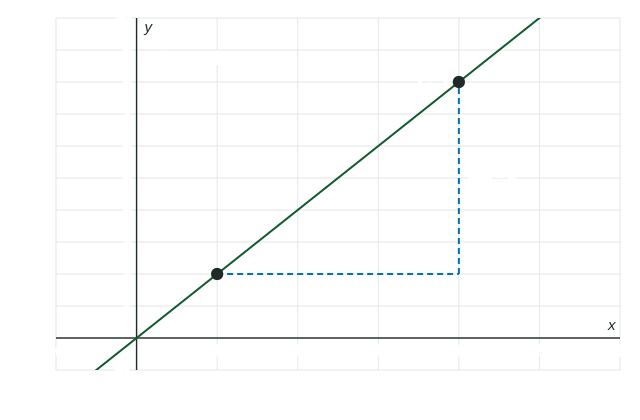
The slope of a line is its rise over its run, the change in divided by the change in , between any two of its points:
Subtract in the same order on top and bottom. For and :
| Slope | The line | Example |
|---|---|---|
| positive | rises left to right | |
| negative | falls left to right | |
| horizontal | ||
| undefined | vertical (run ) |
Equations of a line
Point-slope form uses one point and the slope : . It says that from the known point, changes by times the change in . Solved for , it is , the form you will use to estimate values.
Slope-intercept form has slope and -intercept .
Worked example 1. Find the line through and , and its value at .
Slope:
Point-slope form from : , so .
At : . In slope-intercept form the line is .
When you rewrite point-slope form, distribute the slope to both terms: becomes , so .
A line through two points of a curve
The two points do not have to come from a line. For , the points and are on a curve, and the line through them has slope . The next topic gives this slope its own name and uses it to measure how fast changes; the algebra is the same as here.
Slope in context
When and are quantities, the slope has units of output per input. For a phone plan dollars for minutes, the slope is dollars per minute: each extra minute adds $0.10. The intercept, $15, is the cost at .