
Unit 3 builds sine and cosine as functions of any angle. They start life as something smaller: ratios of the sides of a right triangle. This page is the algebra you need for that first step.
Naming the sides
In a right triangle the side across from the right angle is the hypotenuse; it is always the longest side. The other two sides, the legs, get their names from the acute angle you are working with, called here:
- the opposite side is the leg across from ;
- the adjacent side is the leg that touches (the hypotenuse touches it too, but it already has a name).
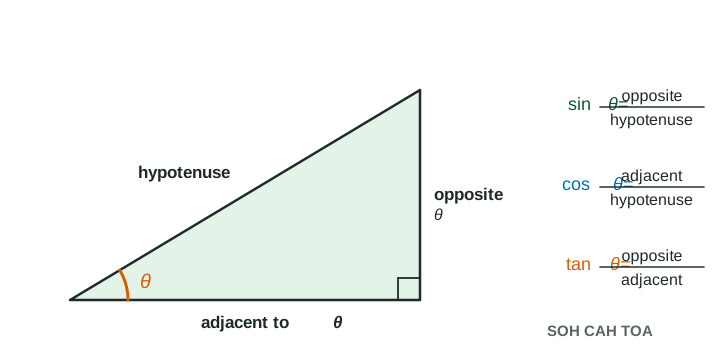
Move to the other acute angle and the two legs swap names. Always ask "opposite to which angle?"
Three ratios that depend only on the angle
Any two right triangles with the same acute angle are similar: one is a scaled copy of the other. Scaling multiplies every side by the same number, so the ratio of any two sides does not change. Each ratio is therefore a property of the angle alone, and each has a name. These are the trigonometric ratios:
| Ratio | Definition | Memory aid |
|---|---|---|
| SOH | ||
| CAH | ||
| TOA |
Because the hypotenuse is the longest side, and are between and for an acute angle. can be any positive number. When the adjacent side lies flat, is the rise over the run of the hypotenuse: its slope.
Worked example 1. A right triangle has legs and . The angle is across from the side . Find , and .
First the hypotenuse: .
From : opposite , adjacent , hypotenuse . So , , .
Finding a missing side
Know one angle and one side? Choose the ratio that uses the side you know and the side you want, write an equation, and solve it.
Worked example 2. A ramp's sloped surface is 20 feet long and makes a angle with the ground. Use to find how high the ramp rises.
The rise is opposite the angle and the 20 feet is the hypotenuse, so use sine: .
Multiply both sides by 20:
If the unknown side is on the bottom of the ratio, you divide instead: with , multiply by to get , then .
The same idea gives formulas. If a hypotenuse has length , then the opposite side is and the adjacent side is . These two expressions come back in the next topics, where they become the coordinates of a point on a circle.