Right-Triangle Trigonometry
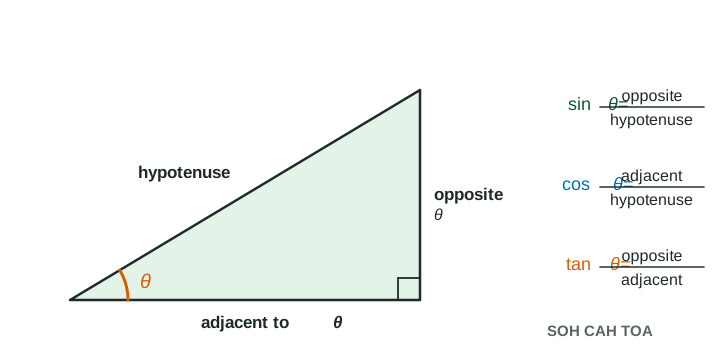
In a right triangle, name the legs from the angle θ : opposite and adjacent.
Part 1 · Hook
Why this matters
Part 2 · Prerequisite check
Quick check before you start
1. A line rises 6 units while it runs 8 units to the right. What is its slope?
Show the answer
Slope is rise over run: .
- Correct: :
- :
- :
- :
2. Solve for .
Show the answer
, so .
- Correct: :
- :
- :
- :
Part 3 · See it
See it first
Part 4 · Step by step
How it works, step by step
- Stand at an acute angle of a right trianglethe leg across from is the opposite side, the leg touching is the adjacent side, and the side across from the right angle is the hypotenuse
- Right triangles with the same angle are similarthe ratios of their sides are the same, whatever the triangle's size, so each ratio depends only on
- Name the three ratios
, , (SOH CAH TOA) - You know one side and the anglepick the ratio that links the known side to the unknown one, write the equation, and solve it
Part 5 · Key ideas
Key ideas
- The hypotenuse is the longest side, so and are between and for an acute angle.
is rise over run: the slope of the hypotenuse when the adjacent side lies flat. - To find a side: write the ratio, put in the known values, then multiply (unknown on top) or divide (unknown on the bottom).
Part 6 · Misconception
A common mistake
The wrong idea: The opposite side is always the vertical side and the adjacent side is always the horizontal one.
What actually happens: Opposite and adjacent are named from the angle you use. Switch to the other acute angle and the two legs swap names; only the hypotenuse stays the same.
Part 7 · Check yourself
Check yourself
Exam-style questions. Anything you miss goes into your review queue.
1. A right triangle has legs of length and and hypotenuse . The angle is across from the leg of length . What is ?
Show the answer
Sine is opposite over hypotenuse. From the opposite side is , so .
- Correct: : Opposite over hypotenuse .
- : is adjacent over hypotenuse, which is .
- : is opposite over adjacent, which is .
- : This is the ratio upside down; the hypotenuse goes on the bottom.
2. In the same triangle (legs and , hypotenuse ), the other acute angle is , across from the leg of length . What is ?
No calculator. Type the exact value (a fraction, π, e or a root is fine).
Show the answer
From : opposite , adjacent , so .
- Answer: ≈ 1.875
3. A kite string 40 meters long makes an angle of with the level ground. Use to find the kite's height above the hand holding the string, in meters.
No calculator. Type the exact value (a fraction, π, e or a root is fine), in meters.
Show the answer
, so meters.
- Answer: 32.768 meters
4. A right triangle has hypotenuse and an acute angle . Write the length of the side adjacent to in terms of .
Type an expression for .
Show the answer
, so adjacent .
- Answer:
5. A wheelchair ramp rises 2 feet over a horizontal distance of 24 feet. Let be the angle the ramp makes with the ground. What is ?
No calculator. Type the exact value (a fraction, π, e or a root is fine).
Show the answer
The rise is opposite and the horizontal run is adjacent: , the slope of the ramp.
- Answer: ≈ 0.083
Part 8 · Summary
Summary
Part 9 · Up next
What comes next
Part 10 · Connections