
Rational expressions are fractions with polynomials on top and bottom. Topic 1.7 builds functions out of them, and their behavior depends on details of the algebra: which factors cancel and which inputs are excluded. This page is that algebra.
What a rational expression is
A rational expression is a quotient of two polynomials, such as or . It is undefined wherever the denominator is . Find those inputs by factoring the denominator:
Simplifying
Factor the numerator and denominator completely, then cancel factors they share.
Worked example 1. Simplify .
Factor: .
Cancel : , with and .
The excluded input does not come back when the factor cancels. The original expression has no value at , so the simplified one is equal to it only for . On a graph, that shows up as a single missing point.
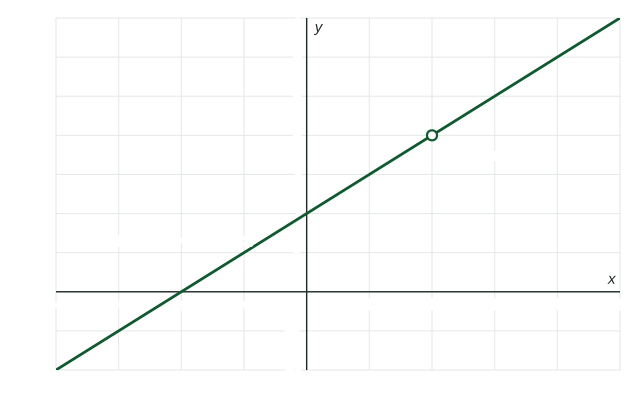
Cancel factors, never terms. In the 's are terms of sums; nothing cancels. In
Adding and subtracting
Use a common denominator, the product of the different factors.
Worked example 2. Write as one fraction.
Common denominator . Multiply each numerator by the factor its denominator lacks:
Multiplying and dividing
Multiply numerators and denominators straight across, cancelling common factors. To divide, multiply by the reciprocal of the second fraction:
A fraction inside a fraction simplifies the same way: multiply its top and bottom by the small denominators.
Splitting a fraction
The reverse of adding: when the numerator is a sum, divide each term by the denominator. . When the denominator has two terms, first write the numerator in terms of it:
Topic 1.7 uses this form: for large , the small fraction is close to , so the expression behaves like .