Skills
Rational Expressions
A rational expression is a quotient of polynomials, undefined where its denominator is 0 .
Practice 1: Procedural and Symbolic Fluency
Part 1 · Hook
Why this matters
If
friends split a $120 bill and a $30 tip, each pays
dollars. Expressions with the variable in a denominator show up whenever something is shared or divided. Topic 1.7 studies
functions built from them, so first the algebra: simplify, combine, split, and keep track of the inputs that are not allowed.
Part 2 · Before you start
What this builds on
Part 3 · Prerequisite check
Quick check before you start
1. Which is factored?
Show the answer
Product , sum : and .
- Correct: :
- :
- :
- :
2. Which inputs are not in the domain of ?
Show the answer
The denominator is at .
- Correct: :
- :
- :
- :
Part 5 · Step by step
How it works, step by step
- A denominator has a factor that is at → is excluded from the domain, before and after any simplifying
- The numerator and denominator share a factor→it cancels, but the excluded input stays excluded
- Two fractions are added or subtracted→rewrite both over a common denominator, then combine the numerators
- A numerator is a sum→each term can be divided by the denominator separately:
Part 6 · Key ideas
Key ideas
- A rational expression is a quotient of two polynomials, like . It is undefined where its denominator is .
- Factor first, then cancel common factors, never terms. Keep the excluded inputs of the original.
- Add with a common denominator; multiply straight across; divide by multiplying by the reciprocal.
Part 7 · Misconception
A common mistake
The wrong idea: , cancelling the 's and .
What actually happens: Only factors of the whole top and bottom cancel. At , . does not simplify.
Part 8 · Check yourself
Check yourself
Exam-style questions. Anything you miss goes into your review queue.
1. Simplify , and state the inputs that must be left out.
- , with
- , with and
- , with
- , with
Show the answer
for and . The original expression is undefined at both, so both stay excluded.
- , with : The canceled factor still counts: makes the original denominator .
- Correct: , with and : Right: both zeros of the original denominator stay excluded.
- , with : Only factors cancel, never terms: cannot be canceled from a sum.
- , with : ; the factor that cancels is , leaving .
2. Write as a single fraction.
Type an expression.
Show the answer
Common denominator : .
- Answer:
3. Which inputs make undefined?
- and
- and
Show the answer
A fraction is undefined where its denominator is : at and . The numerator's zeros do not matter for the domain.
- Correct: and : Right: is at both.
- : At the numerator is , which is allowed: the value is .
- : also makes zero.
- and : These solve ; the denominator is .
4. and have the same value at every input except one. Which?
Show the answer
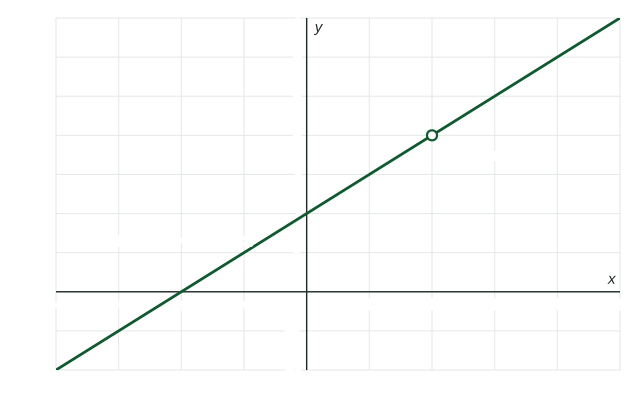
only when . At the fraction has no value; its graph is the line with that one point missing.
- : Both are at : and .
- : At both give .
- : At both give .
- Correct: : Right: is undefined at , while there.
5. Which simplification is correct?
- , for
- , for
Show the answer
Cancel only common factors of the whole numerator and denominator: . Terms of a sum cannot be canceled.
- : and are terms of a sum, not factors; check : .
- : Divide both terms by : .
- Correct: , for : Right: is a factor of the top, , so it cancels.
- , for : Check : , not .
6. Which is equal to for ?
Show the answer
Write the top around the denominator: . Then .
- : Check : on the left but here.
- Correct: : Right: , so divide each part by .
- : Check : , but at the left is and this is .
- : , so the leftover is , not .
Part 9 · Summary
Summary
A rational expression is a quotient of polynomials, undefined where its denominator is
. Factor, then cancel common factors only, keeping the original exclusions. Add with a common denominator, multiply across, divide by the reciprocal, and split a sum in the numerator term by term.
Part 10 · Up next
What comes next
Part 11 · Connections
Connections