Unit 1 studies functions built from powers of : their zeros, their turning points, how fast they change. The zeros come from factors, so this page collects the algebra: multiplying polynomials and factoring them.
Polynomials
A polynomial is a sum of terms of the form , where is a whole number: , , . No variables in denominators, no square roots of . Writing the terms from the highest power to the lowest makes them easy to compare.
Multiplying
Multiply each term of one factor by each term of the other, then combine like terms.
Worked example 1. Multiply .
.
.
Add: .
Squares of sums have a middle term: , never . When subtracting a product, put it in parentheses so the minus sign reaches every term.
Factoring: the order to try
Factoring undoes multiplying. Work through these in order:
Common factor. .
Patterns. Check each factor against the table below.
Grouping for four terms: pair them so each pair shares a binomial.
Quadratic-style trinomials, including ones in , like .
Pattern
Factored
Example
difference of squares
difference of cubes
sum of cubes
A sum of squares, like , does not factor with real numbers.
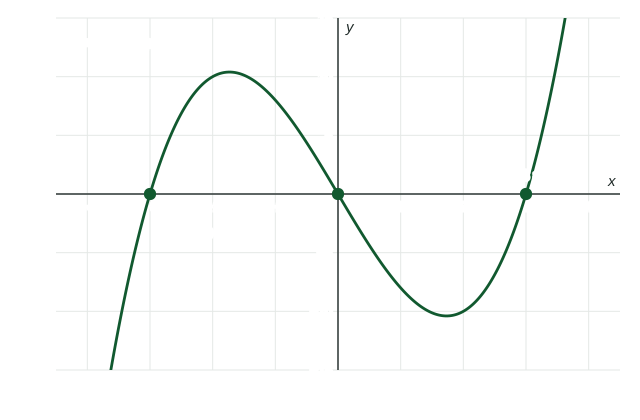
If a product is , one of its factors is . So the solutions of are , and . The connection also runs backward: if , then is a factor of . For , , so is a factor, and .
Figure 1. Each factor of gives one -intercept. LevlPrep original diagram.
Do not divide an equation by to simplify it. Dividing assumes and silently drops the solution .