Skills

Polynomial Arithmetic and Factoring

Multiply polynomials by distributing every term and combining like terms.

Practice 1: Procedural and Symbolic Fluency

Part 1 · Hook

Why this matters

An engineer who knows the outputs of a curve's formula still needs its zeros: where a beam's bending is zero, where a profit breaks even. For the curves in this unit, the zeros come from writing the formula as a product. That is factoring, and it is the algebra Topic 1.4 builds on.

Part 2 · Before you start

What this builds on

Part 3 · Prerequisite check

Quick check before you start

1. Solve x2−5x+6=0x^2 - 5x + 6 = 0.

  1. x=2x = 2 or x=3x = 3
  2. x=−2x = -2 or x=−3x = -3
  3. x=5x = 5 or x=6x = 6
  4. x=1x = 1 or x=6x = 6
Show the answer

(x−2)(x−3)=0(x - 2)(x - 3) = 0.

  • Correct: x=2x = 2 or x=3x = 3:
  • x=−2x = -2 or x=−3x = -3:
  • x=5x = 5 or x=6x = 6:
  • x=1x = 1 or x=6x = 6:

2. What is (x+3)2(x + 3)^2 multiplied out?

  1. x2+6x+9x^2 + 6x + 9
  2. x2+9x^2 + 9
  3. x2+3x+9x^2 + 3x + 9
  4. x2+6x+6x^2 + 6x + 6
Show the answer

(x+3)(x+3)(x + 3)(x + 3)=x2+3x+3x+9= x^2 + 3x + 3x + 9.

  • Correct: x2+6x+9x^2 + 6x + 9:
  • x2+9x^2 + 9:
  • x2+3x+9x^2 + 3x + 9:
  • x2+6x+6x^2 + 6x + 6:

Part 4 · See it

See it first

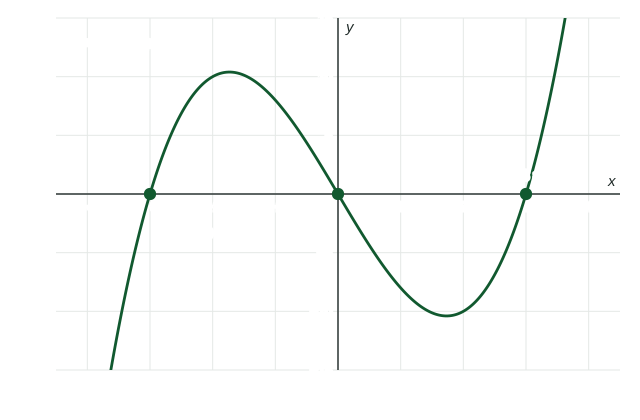
The graph of y = x³ − 9x = x(x − 3)(x + 3). It crosses the x-axis at x = −3, 0 and 3, one crossing for each factor: x + 3 = 0, x = 0 and x − 3 = 0.
yy=x3−9x= x^3 - 9x=x(x−3)(x+3)= x(x - 3)(x + 3) crosses the xx-axis once for each factor: at x=−3x = -3, 00 and 33. LevlPrep original diagram.

Part 5 · Step by step

How it works, step by step

  1. Every term shares a factortake it out first: x3−9x=x(x2−9)x^3 - 9x = x(x^2 - 9)
  2. A factor matches a pattern (a2−b2a^2 - b^2, a3−b3a^3 - b^3, a3+b3a^3 + b^3)use the pattern: x2−9=(x−3)(x+3)x^2 - 9 = (x - 3)(x + 3)
  3. Four terms pair up with a shared binomialfactor by grouping: x2(x+2)−4(x+2)x^2(x + 2) - 4(x + 2)=(x2−4)(x+2)= (x^2 - 4)(x + 2)
  4. A polynomial is written as a product equal to 00each factor equal to 00 gives a solution, and p(a)=0p(a) = 0 means x−ax - a is a factor

Part 6 · Key ideas

Key ideas

  • A polynomial is a sum of terms axnax^n with whole-number powers, like x3+x2−7x+2x^3 + x^2 - 7x + 2.
  • Multiply by distributing every term of one factor over every term of the other, then combine like terms.
  • Factor in order: common factor, then patterns (difference of squares, sum or difference of cubes), then grouping.

Part 7 · Misconception

A common mistake

The wrong idea: To solve x3=9xx^3 = 9x, divide both sides by xx to get x2=9x^2 = 9.

What actually happens: Dividing by xx assumes x≠0x \ne 0 and loses the solution x=0x = 0. Move everything to one side and factor: x(x−3)(x+3)=0x(x - 3)(x + 3) = 0.

Part 8 · Check yourself

Check yourself

Exam-style questions. Anything you miss goes into your review queue.

1. Multiply out (x−2)(x2+3x−1)(x - 2)(x^2 + 3x - 1) and combine like terms.

Type an expression.

Show the answer

x(x2+3x−1)−2(x2+3x−1)x(x^2 + 3x - 1) - 2(x^2 + 3x - 1)=x3= x^3+3x2−x−2x2−6x+ 3x^2 - x - 2x^2 - 6x+2+ 2=x3= x^3+x2−7x+ x^2 - 7x+2+ 2.

  • Answer: x3+x2−7x+2x^{3} + x^{2} - 7x + 2

2. Which is x3−9xx^3 - 9x factored completely?

  1. x(x2−9)x(x^2 - 9)
  2. x(x−3)(x+3)x(x - 3)(x + 3)
  3. (x−3)(x+3)(x - 3)(x + 3)
  4. x(x−3)(x−3)x(x - 3)(x - 3)
Show the answer

Common factor first: x3−9x=x(x2−9)x^3 - 9x = x(x^2 - 9). Then x2−9=(x−3)(x+3)x^2 - 9 = (x - 3)(x + 3). So x3−9xx^3 - 9x=x(x−3)(x+3)= x(x - 3)(x + 3).

  • x(x2−9)x(x^2 - 9): x2−9x^2 - 9 is a difference of squares and still splits: (x−3)(x+3)(x - 3)(x + 3).
  • Correct: x(x−3)(x+3)x(x - 3)(x + 3): Right: take out the common xx, then factor x2−9x^2 - 9 as a difference of squares.
  • (x−3)(x+3)(x - 3)(x + 3): This multiplies to x2−9x^2 - 9; the common factor xx was dropped.
  • x(x−3)(x−3)x(x - 3)(x - 3): (x−3)(x−3)(x - 3)(x - 3)=x2−6x+9= x^2 - 6x + 9, not x2−9x^2 - 9.

3. Factor x3+2x2−4x−8x^3 + 2x^2 - 4x - 8 by grouping.

  1. (x+2)(x2+4)(x + 2)(x^2 + 4)
  2. (x−2)(x+2)(x - 2)(x + 2)
  3. (x+2)2(x+2)(x + 2)^2(x + 2)
  4. (x−2)(x+2)2(x - 2)(x + 2)^2
Show the answer

Group: x2(x+2)−4(x+2)x^2(x + 2) - 4(x + 2). Factor out (x+2)(x + 2): (x2−4)(x+2)(x^2 - 4)(x + 2). Then x2−4=(x−2)(x+2)x^2 - 4 = (x - 2)(x + 2), so the result is (x−2)(x+2)2(x - 2)(x + 2)^2.

  • (x+2)(x2+4)(x + 2)(x^2 + 4): The second group is −4(x+2)-4(x + 2), so the other factor is x2−4x^2 - 4, not x2+4x^2 + 4.
  • (x−2)(x+2)(x - 2)(x + 2): This has only two linear factors; it multiplies to x2−4x^2 - 4, not a cubic.
  • (x+2)2(x+2)(x + 2)^2(x + 2): That is (x+2)3(x + 2)^3; check: its constant term is 88, not −8-8.
  • Correct: (x−2)(x+2)2(x - 2)(x + 2)^2: Right: x2(x+2)−4(x+2)x^2(x + 2) - 4(x + 2)=(x2−4)(x+2)= (x^2 - 4)(x + 2)=(x−2)(x+2)(x+2)= (x - 2)(x + 2)(x + 2).

4. For p(x)=x3−4x2+x+6p(x) = x^3 - 4x^2 + x + 6, p(2)=0p(2) = 0. Which must be a factor of p(x)p(x)?

  1. x+2x + 2
  2. x−6x - 6
  3. x−2x - 2
  4. xx
Show the answer

If p(a)=0p(a) = 0, then x−ax - a is a factor. Here p(2)p(2)=8−16+2+6= 8 - 16 + 2 + 6=0= 0, so x−2x - 2 is a factor; in fact p(x)p(x)=(x−2)(x−3)(x+1)= (x - 2)(x - 3)(x + 1).

  • x+2x + 2: x+2x + 2 is 00 at x=−2x = -2; the factor for the zero x=2x = 2 is x−2x - 2.
  • x−6x - 6: 66 is the constant term; p(6)=84≠0p(6) = 84 \ne 0.
  • Correct: x−2x - 2: Right: an input aa with p(a)=0p(a) = 0 gives the factor x−ax - a.
  • xx: p(0)=6≠0p(0) = 6 \ne 0, so xx is not a factor.

5. Which is x4−5x2+4x^4 - 5x^2 + 4 factored completely?

  1. (x2−1)(x2−4)(x^2 - 1)(x^2 - 4)
  2. (x−1)(x+1)(x−2)(x+2)(x - 1)(x + 1)(x - 2)(x + 2)
  3. (x−1)2(x−2)2(x - 1)^2(x - 2)^2
  4. (x2+1)(x2+4)(x^2 + 1)(x^2 + 4)
Show the answer

Let u=x2u = x^2: u2−5u+4u^2 - 5u + 4=(u−1)(u−4)= (u - 1)(u - 4). So x4−5x2x^4 - 5x^2+4+ 4=(x2−1)(x2−4)= (x^2 - 1)(x^2 - 4)=(x−1)(x+1)(x−2)(x+2)= (x - 1)(x + 1)(x - 2)(x + 2).

  • (x2−1)(x2−4)(x^2 - 1)(x^2 - 4): Correct as a first step, but each factor is a difference of squares and splits again.
  • Correct: (x−1)(x+1)(x−2)(x+2)(x - 1)(x + 1)(x - 2)(x + 2): Right: treat it as a quadratic in x2x^2, then split each difference of squares.
  • (x−1)2(x−2)2(x - 1)^2(x - 2)^2: This has x3x^3 and xx terms when multiplied out; x4−5x2+4x^4 - 5x^2 + 4 has none.
  • (x2+1)(x2+4)(x^2 + 1)(x^2 + 4): This multiplies to x4+5x2+4x^4 + 5x^2 + 4: the sign of the middle term is wrong.

6. What are the solutions of x3−9x=0x^3 - 9x = 0?

  1. x=3x = 3 and x=−3x = -3
  2. x=9x = 9
  3. x=0x = 0, x=3x = 3 and x=−3x = -3
  4. x=0x = 0, x=9x = 9 and x=−9x = -9
Show the answer

Factor: x(x−3)(x+3)=0x(x - 3)(x + 3) = 0. A product is 00 when a factor is 00: x=0x = 0, 33 or −3-3. Never divide by xx; it hides x=0x = 0.

  • x=3x = 3 and x=−3x = -3: Dividing both sides by xx loses the solution x=0x = 0. Factor instead.
  • x=9x = 9: x3=9xx^3 = 9x does not mean x=9x = 9; 93−81≠09^3 - 81 \ne 0.
  • Correct: x=0x = 0, x=3x = 3 and x=−3x = -3: Right: x(x−3)(x+3)=0x(x - 3)(x + 3) = 0, and each factor gives a solution.
  • x=0x = 0, x=9x = 9 and x=−9x = -9: x2=9x^2 = 9 gives x=±3x = \pm 3, not ±9\pm 9.

Part 9 · Summary

Summary

Multiply polynomials by distributing every term and combining like terms. Factor by taking out a common factor first, then using a difference of squares a2−b2=(a−b)(a+b)a^2 - b^2 = (a - b)(a + b), a sum or difference of cubes, or grouping. A product equals 00 when a factor does, and p(a)=0p(a) = 0 means x−ax - a is a factor.

Part 10 · Up next

What comes next

Part 11 · Connections

Connections